
Agate vs jasper: the collector's identification guide
Agate is translucent; jasper is opaque. That single difference in diaphaneity separates the two most commonly confused chalcedony varieties. Hold a thin edge of the specimen toward a bright light source: if light passes through, even faintly, it is likely agate. No light transmission at all points to jasper.
- For collectors: translucency affects display value, slice appeal, and how light interacts with banding patterns.
- For jewellery and metaphysical uses: the distinction shapes how a stone is cut, polished, and described in listings.
Key takeaways
Agate and jasper are both chalcedony varieties (SiO₂), separated by one reliable field test: hold a thin edge to light. Agate transmits it; jasper does not.
| Point | Details |
|---|---|
| Core difference | Agate is translucent; jasper is opaque due to higher impurity content. |
| Light test | Hold the thinnest edge to a bright LED; light transmission confirms agate. |
| Mohs hardness | Both rate 6.5–7, making them durable for jewellery and tumbling. |
| Ambiguous specimens | Label mixed-transparency pieces “jasper-agate” or “jaspagate” rather than forcing one category. |
| Legacy Crystals and Minerals | Offers verified jasper and quartz specimens with provenance details for collectors who want authenticated pieces. |
Table of Contents
- What is chalcedony, and where do agate and jasper fit?
- What does agate look like, and where does it form?
- What does jasper look like, and how does it form?
- How do agate and jasper form differently?
- How to tell agate from jasper at home or when shopping
- Common varieties and what to look for in the field or shop
- Trade names, misnomers, and when to use “chalcedony” instead
- Common uses, value drivers, and care
- Collector buying checklist and authentication steps
- Verified specimens at Legacy Crystals and Minerals
- Sources
- FAQ
What is chalcedony, and where do agate and jasper fit?
Both agate and jasper are chalcedony varieties, meaning they share the same base chemistry: microcrystalline (cryptocrystalline) quartz with the chemical formula SiO₂. Chalcedony is not a mineral species in the strict sense; it is a textural and compositional form of quartz in which individual crystals are too small to see without a microscope.
The name “chalcedony” functions as both a catch-all group label and a specific trade name for plain, waxy, blue-grey material. Gem-A and the USGS both use it as the umbrella term covering agate, jasper, carnelian, bloodstone, chrysoprase, and onyx, among others. When a dealer labels something simply “chalcedony,” they are often being deliberately conservative about which sub-variety it is.
What does agate look like, and where does it form?
Agate is defined by its rhythmic, concentric banding. Thin edges are typically translucent to semitransparent, and the bands often follow the contours of the cavity in which the stone grew. Formation happens inside nodules, geodes, or vesicles in volcanic rock, where silica-rich groundwater deposits successive layers inward over long periods.
Common named agate types and their key visual cues:
- Moss agate: green or black dendritic inclusions resembling plant growth; no true banding.
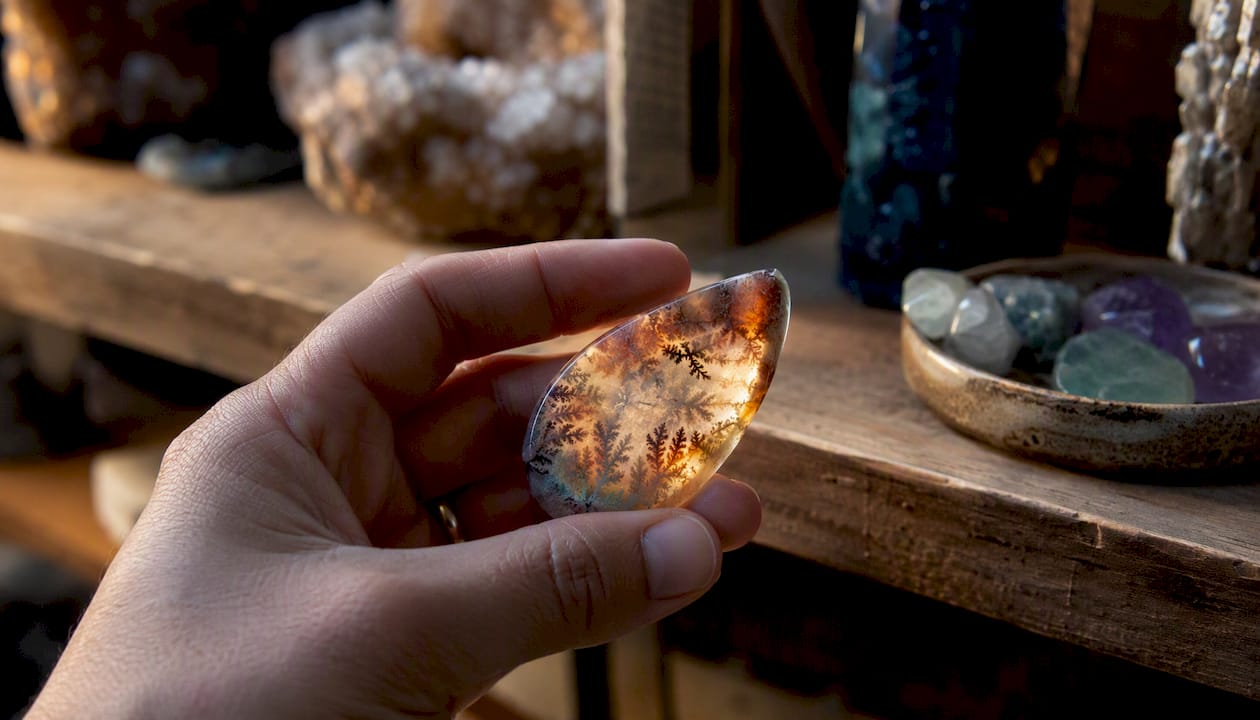
- Dendritic agate: similar to moss but with finer, tree-like manganese oxide patterns on a clear or white base.
- Plume agate: feathery, three-dimensional inclusions visible through translucent silica; often red, orange, or white.
- Fire agate: iridescent, layered botryoidal structure producing play-of-colour; found mainly in the southwestern United States and Mexico.
- Banded agate: the classic type, with clearly defined parallel or concentric colour bands.
What does jasper look like, and how does it form?
Jasper is opaque. Patterns tend to be mottled, brecciated, scenic, or orbicular rather than banded. The opacity comes from a higher concentration of impurities, including iron oxides, clay minerals, and organic matter, which block light transmission. Jasper typically forms through widespread silica cementation of sediments or volcanic ash, or through silica replacement of pre-existing rock, rather than cavity filling.
Common jasper types:
- Picture jasper: tan, brown, and cream tones arranged in landscape-like scenes; from massive sedimentary deposits.
- Red jasper: uniform to mottled deep red from iron oxide content; one of the most widely available jasper types.
- Ocean jasper: orbicular green, white, and pink patterns; found in Madagascar along coastal outcrops.
- Bloodstone: dark green with red spots of iron oxide; technically a jasper, though often sold under its own name.
The red jasper beaded bracelet and ocean jasper bracelet at Legacy Crystals and Minerals show how these opaque patterns translate into finished jewellery.
How do agate and jasper form differently?
The geological pathways explain the visual differences directly.
-
Agate pathway: A gas bubble or cavity forms in cooling volcanic rock. Silica-rich groundwater percolates in. Successive thin layers of chalcedony deposit on the cavity walls, growing inward. Each layer reflects slight changes in silica concentration or trace elements, producing the concentric banding. The result is a nodule with a hollow or quartz-crystal centre and translucent walls.
-
Jasper pathway: Silica-rich fluids permeate a sedimentary or volcaniclastic deposit (fine ash, clay, or organic-rich sediment). Silica cements the particles together or replaces the original material wholesale. Because the silica is intimately mixed with iron oxides, clays, and other impurities throughout the mass, light cannot pass through. The result is a dense, opaque rock with colour and pattern determined by the original sediment composition.
-
The role of impurities: Minerals notes that jasper’s colour comes primarily from iron oxides and clay minerals. These same impurities are what make jasper opaque. Agate forms in cleaner silica solutions, so impurities are lower and translucency is preserved.
-
Moganite and microstructure: Mindat reports that chalcedony often contains minor amounts of moganite, a silica polymorph, commonly between about 1% and 20%. Moganite slowly converts to quartz over geologic time and contributes to the fibrous microstructure that produces agate banding. True agate banding is structural, tied to fibrous chalcedony growth, not staining or fracture-fill patterns.
-
Transitional specimens: Local deposit conditions can produce material with both translucent and opaque zones. These hybrids are real and common; the trade labels them “jasper-agate” or “jaspagate.”
How to tell agate from jasper at home or when shopping
Step-by-step light test
- Find the thinnest edge of the specimen or slice.
- Hold it directly against a bright LED flashlight or phone torch in a dim room.
- Observe: agate transmits light, showing a warm glow or visible banding through the stone. Jasper transmits nothing.
- For online purchases, request a “lit-edge photo”: seller holds the stone edge-on to a light source and photographs it.
Comparison of observable properties
| Property | Agate | Jasper |
|---|---|---|
| Diaphaneity | Translucent to semitransparent | Opaque |
| Typical pattern | Concentric or parallel bands | Mottled, scenic, orbicular, brecciated |
| Typical colours | White, grey, blue, red, orange, brown | Red, yellow, green, brown, black |
| Formation context | Volcanic cavities, nodules | Sediment cementation, replacement |
| Mohs hardness | 6.5–7 | 6.5–7 |
| Surface lustre | Waxy to vitreous | Waxy to dull |
Secondary checks
- Wet the surface: water temporarily reveals banding that dry surfaces obscure.
- Loupe or magnification: look for fibrous microstructure in agate; jasper shows a granular or massive texture.
- Streak and hardness: both scratch glass (Mohs 6.5–7 per Gem-A), so hardness alone does not separate them.
- Saw-cut or slice photo: for cavity agates, a cross-section shows the banding geometry clearly.
Pro Tip: When a specimen has both translucent and opaque zones, label it “jasper-agate” or “jaspagate” rather than forcing it into one category. Request a slice or saw-cut photo from the seller before buying any cavity agate online.
Common varieties and what to look for in the field or shop
Moss agate looks like it contains plant material but contains no organic matter. The inclusions are manganese or iron oxide dendrites. Viewing a backlit slice makes the three-dimensional depth of the inclusions visible in a way no surface photo captures.
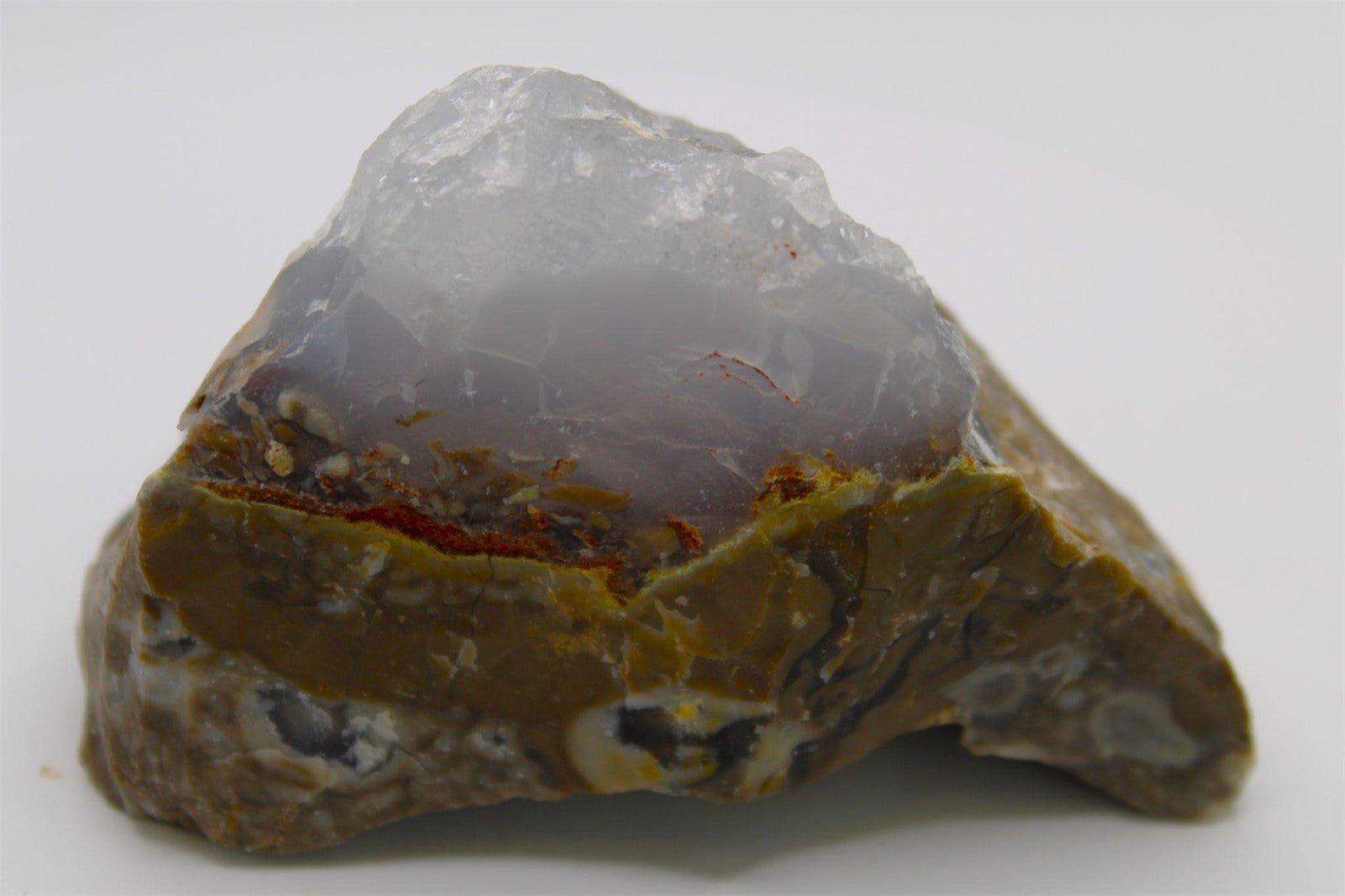
Plume agate rewards examination from multiple angles. The feathery plumes sit inside translucent silica, so rotating the specimen under a light source reveals depth and colour shifts that a flat photo misses entirely.
Banded agate is the most straightforward to identify: parallel or concentric colour bands, translucent at the edge. Oregon thunderegg agates are a well-known North American example, noted by the USGS among classic collecting localities.
Picture jasper is best evaluated on a polished face. The landscape patterns are a product of the original sediment layering, so a flat, polished surface shows them most clearly. Backlit edges will remain dark.
Ocean jasper is distinctive for its orbicular (spherical) patterns. The orbs form during silica replacement and are unique to specific Madagascar localities. Colour range is wide: green, pink, white, yellow, and combinations.
Bloodstone is a jasper, despite its historical name suggesting something else. The red spots are iron oxide inclusions in a dark green base. Colour alone is not a reliable identifier across the chalcedony group; a red stone could be carnelian (translucent), red jasper (opaque), or even dyed material.
Trade names, misnomers, and when to use “chalcedony” instead
The trade uses “chalcedony” as a safe, conservative label when a specimen’s translucency is ambiguous or when it shows no clear banding or opaque character. The practical rule: if you cannot confirm translucency or banding, call it chalcedony.
Common misnomers and problem materials:
- “Jasper” applied to non-quartz rocks: some limestones, rhyolites, and fine-grained siltstones are sold as jasper because they look similar. A hardness test (jasper scratches glass; limestone does not) separates them quickly.
- “Agate” applied to stained or dyed material: dyed quartzite or reconstructed stone is sometimes sold as agate. Dye tends to concentrate along fractures rather than following natural banding. The guide to spotting fake crystals at Legacy Crystals and Minerals covers this in detail.
- “Bloodstone” as a standalone name: bloodstone is a jasper variety; the name is a historical trade term, not a separate mineral.
- Hybrid specimens: when a piece has clearly opaque zones and clearly translucent zones, “jasper-agate” or “jaspagate” is the honest label. RockTumbler and field guides both accept these hybrid terms.
Common uses, value drivers, and care
Common uses:
- Cabochons and beads for jewellery
- Tumbled stones for collections or metaphysical use
- Carvings and decorative objects
- Display slices (especially banded agate)
- Metaphysical items: agate is associated with balance and grounding; jasper with stability and nurturing energy
Value drivers:
- Rarity of pattern (plume agates and scenic picture jaspers command premiums)
- Translucency and clarity in agate slices
- Size of fine banded slices with intact centres
- Confirmed locality provenance
- Condition and quality of polish or natural surface
Care tips:
- Clean with mild soap and a soft brush; rinse thoroughly.
- Avoid prolonged acid exposure (vinegar, citrus cleaners) and harsh solvents.
- Store separately from harder stones to prevent surface scratching.
- Mohs hardness of 6.5–7 means both materials are durable for everyday jewellery but can be scratched by quartz sand or harder minerals.
- Keep away from prolonged direct sunlight if colour saturation is a concern, particularly for dyed specimens.
Collector buying checklist and authentication steps
Before purchasing agate or jasper online or in person, request or confirm the following:
- Lit-edge photo: stone held edge-on to a light source; confirms translucency or opacity.
- Full-face polish photo: shows the complete pattern under neutral lighting.
- Loupe or macro close-up: reveals surface texture, fibrous structure, or granular jasper matrix.
- Provenance or locality information: Oregon, Texas, Madagascar, and other named localities add verifiable context.
- Slice or saw-cut image: for cavity agates, a cross-section confirms banding geometry and centre condition.
- Condition and polish notes: any chips, repairs, or stabilisation treatments should be disclosed.
Photo-request template (copy and send to sellers):
Authentication tips:
- For high-value pieces, request a gemological certificate or lab report.
- Ask specifically whether the stone has been dyed, stabilised, or resin-filled. Treatments are not inherently problematic, but they must be disclosed.
- Prefer sellers who show saw-cut backs or full-slice photos for agates; this is standard practice among reputable dealers.
Canadian buyer note: Canadian consumer protection rules under provincial sale-of-goods legislation generally require that goods match their description. If a stone is sold as “natural agate” and arrives dyed or reconstructed, buyers have recourse through the seller or their credit card provider. Keep all listing descriptions and photos before purchase.
Verified specimens at Legacy Crystals and Minerals
Legacy Crystals and Minerals carries a curated selection of jasper and quartz-family pieces, each listed with provenance details and high-resolution photography. The White Sea Urchin Quartz Bracelet (12mm, AAA Grade) is one example of the store’s premium jewellery range, where material quality and finish are documented before listing. For collectors who want to apply the identification steps above to real specimens, the shop’s product pages include the kind of detailed photography that supports confident buying decisions. Browse the full collection at Legacycrystalsandminerals to find authenticated pieces with clear material descriptions.
Sources
- Gem-A — Different types of chalcedony
- USGS — Chalcedony (gemstone information archive)
- Mindat — Chalcedony (min-960)
- Minerals
FAQ
Is jasper in the agate family?
Yes. Both agate and jasper are varieties of chalcedony, which is a form of microcrystalline quartz (SiO₂). They share the same mineral group but differ in diaphaneity: agate is translucent, jasper is opaque.
Is agate or jasper more valuable?
Neither is categorically more valuable. Rare patterned agates (plume, fire) and scenic picture jaspers both command high prices; value depends on pattern rarity, clarity, size, and provenance rather than which category the stone falls into.
Is agate a cheap stone?
Common banded agate is widely available and inexpensive, but fine specimens with rare inclusions, large translucent slices, or confirmed locality provenance can sell for significant amounts. Quality and rarity drive price across the full chalcedony group.
Can jasper turn into agate?
No. The two form through different geological processes and the resulting microstructure is fixed. A specimen can contain both jasper and agate zones (a “jaspagate”), but one does not convert into the other after formation.


