
3 Apatite Species That Explain Its Colours, Care, and Meaning
Apatite is a phosphate mineral with the formula Ca5(PO4)3(F,Cl,OH), grouped scientifically alongside fluorapatite and chlorapatite. In metaphysical circles it carries a simpler reputation: a stone linked to manifestation, mental clarity, and follow-through on goals. The sections below cover the mineral’s hardness, colour range, where it forms, how to care for it, and how people actually use it day to day.
TL;DR:
- Nearly all apatite sold for jewelry is untreated, but some may be dye-treated, especially in porous or lower-grade specimens; always check for signs of surface dyeing.
- Blue apatite, especially from Madagascar, is highly sought after for its vivid saturation, commanding a price premium, and is best suited for collectors or daily wear in bracelet form.
- Its Mohs hardness of 5 makes apatite vulnerable to scratching and fracturing, so it requires gentle cleaning, careful setting, and protective storage, especially in active environments.
- Provenance significantly influences apatite value, with locality details affecting price, colour expectations, and suitability for display, collection, or metaphysical use.
- The mineral’s biological role as the primary component of bone and teeth is why some practitioners associate apatite with physical embodiment and support its use in manifestation practices.
Table of Contents
- What is apatite made of, and what are its key properties?
- Where does apatite form, and why does it matter beyond jewellery?
- What do apatite’s different colours mean?
- What does apatite mean spiritually, and how is it used?
- How do you care for apatite, and can you wear it every day?
- How can you actually use apatite day to day?
- Why does provenance matter when buying apatite?
- How do you tell apatite apart from similar-looking minerals?
- What is apatite used for beyond decoration and metaphysics?
- Are treated or enhanced apatite stones common?
- Shop apatite matched to how you’ll actually use it
- Sources
- FAQ
What is apatite made of, and what are its key properties?
The name covers a group of calcium phosphate minerals rather than a single fixed compound. The general formula, Ca5(PO4)3(F,Cl,OH), reflects three related species: fluorapatite, chlorapatite, and hydroxylapatite, distinguished by which anion (fluorine, chlorine, or hydroxyl) fills that final slot. Fluorapatite is by far the most common member found in nature, according to the Handbook of Mineralogy.
Apatite crystallizes in the hexagonal system, often forming elongated, six-sided prismatic crystals, though it also turns up as granular masses and rounded nodules with no obvious crystal faces at all. On the Mohs scale it sits at about 5, the same rough hardness as tooth enamel. That places it well below quartz (7) and miles below sapphire (9), which matters more than it sounds once you start thinking about jewellery.
Quick facts for identification:
- Chemical formula: Ca5(PO4)3(F,Cl,OH)
- Crystal system: hexagonal
- Mohs hardness: approximately 5
- Common colours: blue, green, yellow, violet, pink, and colourless
- Lustre: vitreous to slightly greasy
- Fracture: conchoidal to uneven, with moderate brittleness
The name itself has a slightly ironic backstory. It comes from the Greek word for “to deceive,” a label the German geologist Abraham Gottlob Werner gave it in 1786 because apatite crystals were routinely mistaken for other gemstones like beryl or olivine. That confusion, in a sense, is still apatite’s calling card.
Where does apatite form, and why does it matter beyond jewellery?
Apatite is not rare. It forms across nearly every rock category, which is part of why it plays such a large role in industry and biology alike.
- Igneous rocks: especially syenites and carbonatites, where phosphorus-rich melts crystallize it directly
- Pegmatites: slow-cooling veins that allow apatite crystals to grow large and gem-quality
- Metamorphic settings: marbles and skarns, where mineral-rich fluids recrystallize existing rock
- Sedimentary deposits: phosphorite beds, formed largely from ancient marine organic material
These occurrence settings, including syenites, carbonatites, pegmatites, marbles, and skarns, are well documented in the Handbook of Mineralogy. Gem-quality material with the saturated colour collectors want comes from a shorter list of localities: Madagascar, Brazil, Mexico, and parts of Myanmar produce most of what reaches jewellery markets, and locality often predicts the shade you’ll get.
Apatite’s reach goes well past decoration. It is the world’s major commercial source of phosphorus, the element behind most agricultural fertilizer. And in a quieter but stranger way, apatite lives inside you. Hydroxylapatite is the actual mineral that makes up the bulk of bone and tooth enamel in every vertebrate, humans included. Metaphysical writers sometimes point to this biological fact when framing apatite as a stone connected to physical embodiment, not just abstract intention.
What do apatite’s different colours mean?
Colour in apatite comes down to trace elements riding along in that crystal lattice, mostly manganese, iron, or rare earth elements substituting into the structure. The result is one of the more varied colour ranges in the mineral world.
- Blue apatite: the most sought-after variety, ranging from soft powder blue to the vivid neon blue-green tied to Madagascar; that saturation is part of what drives collector demand for Madagascar material.
- Green apatite: often called asparagus stone historically, ranges from olive to a clear grassy green.
- Yellow and gold apatite: sometimes marketed as “yellow apatite” or informally confused with other yellow stones.
- Violet and pink apatite: less common, prized by collectors for rarity more than size.
- Colourless apatite: rarer in the trade, valued mainly by mineral collectors and gemologists rather than jewellery buyers.
Some apatite specimens fluoresce under ultraviolet light, a trait that adds to their appeal for display pieces rather than wearable jewellery. Deep, evenly saturated colour with minimal fracturing suits both cutting and collecting; paler or heavily included material usually ends up as tumbled stones or carving rough instead.
What does apatite mean spiritually, and how is it used?
Ask someone in the crystal world what apatite is for, and manifestation comes up almost immediately. It’s commonly described as a stone that supports clarity of thought, ambition, and honest communication, the kind of energy people reach for when they’re trying to turn a vague goal into an actual plan.
Colour tends to steer which chakra practitioners associate with a given piece:
- Blue apatite: throat chakra, tied to communication and speaking your intentions out loud
- Blue and indigo apatite: third eye, associated with mental clarity and insight
- Green apatite: heart chakra, linked to emotional balance
- Gold or yellow apatite: solar plexus, associated with confidence and personal will
Because hydroxylapatite literally makes up human bone, some practitioners frame the stone as a bridge between physical presence and forward intention, less an abstract idea and more something rooted in the body. Whether or not that connection persuades you, the practical framing is worth taking seriously: most experienced users describe apatite’s role in manifestation as supporting follow-through and mental focus rather than acting as some kind of shortcut. The stone doesn’t do the work. It’s meant to support the person doing the work.
In practice, people tend to use apatite in a few consistent ways:
- Setting a written intention while holding the stone, naming a specific goal rather than a vague wish.
- Journalling alongside the stone, tracking small actions taken toward that goal over days or weeks.
- Placing it during meditation, often at the throat or forehead, paired with slow breathing to support focus.
Readers exploring this further may find manifestation ritual techniques useful for structuring a consistent practice rather than a one-off session.
Pro Tip: Write your intention as something measurable, not aspirational. “I will send three portfolio emails this week” gives apatite something concrete to anchor to. “I will succeed” gives it nothing to work with.
How do you care for apatite, and can you wear it every day?
That Mohs hardness of 5 is the single most important fact for anyone buying apatite jewellery. It’s soft enough to scratch with everyday grit, and its conchoidal fracture means a sharp knock can chip a facet edge or crack a bead outright.
- Avoid ultrasonic and steam cleaners; both can stress fractures already present in the stone.
- Skip prolonged water immersion, since repeated soaking can dull polish over time.
- Clean with mild soap, warm water, and a soft brush, then dry immediately.
- Keep apatite away from direct sunlight and heat sources, since prolonged exposure can fade colour saturation.
- Store separately from harder gems like quartz or sapphire, which can scratch apatite in a shared pouch or drawer.
Setting matters as much as care routine. Pendants, earrings, and protected bezel settings shield apatite from daily impact far better than a ring worn on an active hand. Bead bracelets are popular and generally fine for regular wear, provided you take them off before workouts, yard work, or anything involving a lot of hand-to-surface contact.
Pro Tip: If you love the look but worry about durability, a bracelet is a safer daily-wear format than a ring. Beads distribute impact across many small surfaces instead of concentrating it on one exposed stone.
How can you actually use apatite day to day?
Most people who work with apatite regularly keep the routine simple. Overcomplicating it tends to work against the whole point, which is consistency.
- State one clear intention. Hold the stone, name a specific outcome you’re working toward, and say it out loud or write it down.
- Note one action step. Before setting the stone down, decide on a single concrete thing you’ll do that day connected to that intention.
- Check back weekly. Revisit the same stone and intention seven days later, and adjust the action step based on what actually happened.
For meditation, blue and indigo varieties work well held near the throat or forehead, paired with slow four-count breathing. Some practitioners reference formal meditation postures and hand positions, including mudra symbolism, as a way to add structure to the sitting itself.
Wearing apatite daily as a bracelet or pendant is the simplest low-effort approach, especially for people who find dedicated ritual time hard to fit in. Some pair it with smoky quartz for grounding, on the logic that clarity and ambition work better when there’s a stabilizing counterweight. If you’re new to this, keep expectations modest for the first few weeks. Track small, observable changes in follow-through rather than expecting a dramatic shift, and treat the stone as a reminder more than a mechanism.
Why does provenance matter when buying apatite?
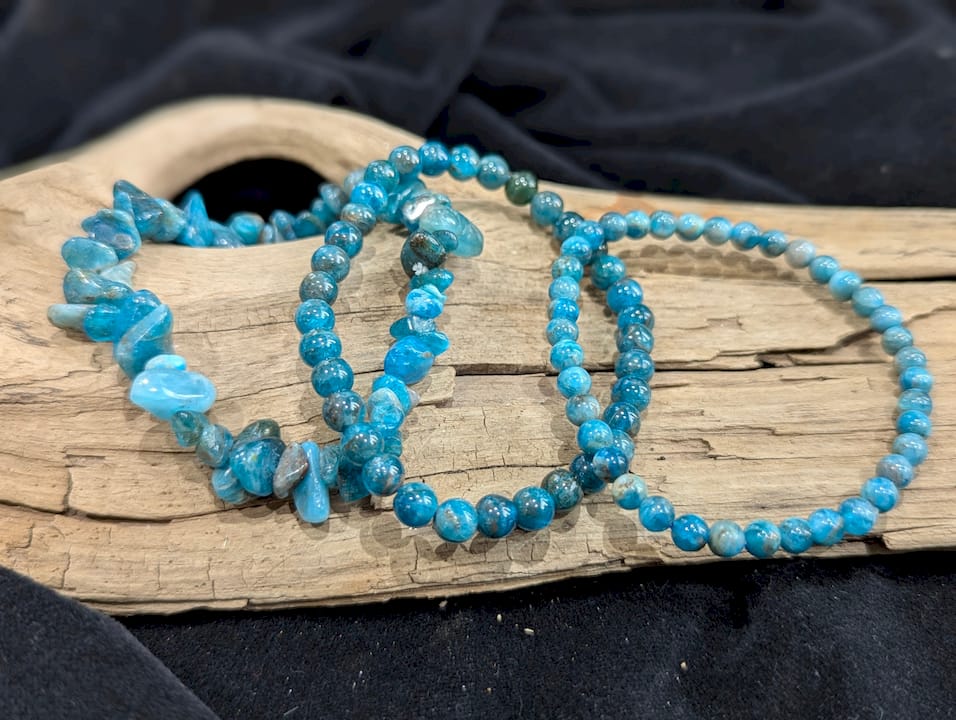
Legacy Crystals and Minerals sources apatite specimens with documented locality information, the kind of detail that separates a museum-grade piece from an anonymous tumbled stone at a gift shop. Author Simon, who covers mineral provenance and buying guidance for the brand, notes that locality data changes how a piece should be evaluated, priced, and used.
When shopping for apatite, whether for meditation, daily wear, or a display shelf, look for listings that state the mining locality, show high-resolution photos under consistent lighting, and list weight or dimensions plainly. A collector’s guide to specimen value explains why these details matter more for apatite than for common quartz varieties, given how much colour and value shift between deposits. Neon Madagascar blue, in particular, tends to command a price premium tied directly to that saturation and origin.
How do you tell apatite apart from similar-looking minerals?
Apatite gets mistaken for a handful of other stones, a mix-up that’s been happening since the name was coined. Blue apatite is frequently confused with aquamarine or blue topaz at first glance, but a hardness test settles it quickly: apatite sits at roughly 5, while aquamarine runs 7.5 to 8 and topaz around 8. A steel file that leaves a mark on the stone rules out both of those harder gems.
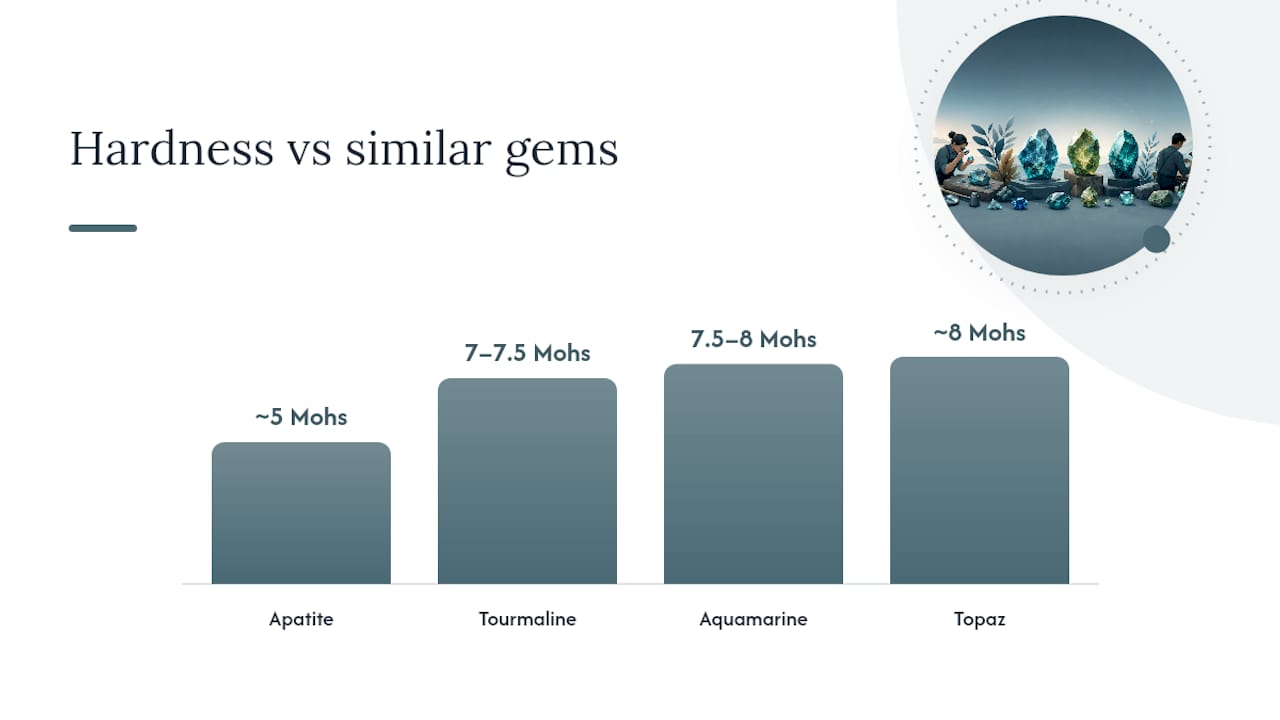
Green apatite gets swapped with peridot or tourmaline in casual identification, though peridot’s stronger double refraction and tourmaline’s greater hardness (around 7 to 7.5) separate them under closer inspection. Yellow apatite occasionally gets sold, deliberately or by mistake, under names associated with citrine, despite citrine’s considerably greater hardness and different crystal habit.
The most reliable field checks are hardness and specific gravity rather than colour alone, since colour varies so widely within apatite itself. A jeweller’s loupe can also reveal apatite’s tendency toward internal fractures and slightly greasy lustre, both less common in the harder gem species it gets confused with. For serious purchases, a refractometer reading or a gemological lab report removes any doubt, but for everyday buying, sourcing from a seller who states the species outright, rather than a vague “blue gemstone” label, avoids the problem before it starts.
What is apatite used for beyond decoration and metaphysics?
Apatite’s biggest industrial role has nothing to do with beauty at all. As the world’s major commercial source of phosphorus, it underpins global fertilizer production, meaning a mineral you might wear as a bracelet is also, in a completely different form, feeding crops on an industrial scale.
Phosphorus extracted from apatite deposits also finds its way into detergents, some food additives, and certain metal treatment processes. Geologists additionally use apatite as a tool for dating rocks and understanding thermal history, since the mineral’s crystal structure records temperature changes over geological time in ways that help reconstruct how mountain ranges or sedimentary basins formed.
On the biological side, hydroxylapatite’s role as the structural mineral in bone and tooth enamel has made it relevant to medicine and materials science well beyond geology. Synthetic hydroxylapatite is used in some bone graft materials and dental treatments, precisely because its composition mirrors what the human body already produces naturally. That overlap between a gem-shop tumbled stone and a biomedical material is one of the stranger facts in mineralogy, and it’s part of why apatite gets more scientific attention than its jewellery presence alone would suggest.
Are treated or enhanced apatite stones common?
Most apatite sold as tumbled stones, beads, or cabochons is untreated, largely because the natural colour range is already wide enough that dyeing rarely adds value. That said, enhancement does happen in the trade, and buyers should know what to watch for.
Heat treatment occasionally lightens or shifts colour in some apatite material, similar to practices used on other coloured gemstones, though it’s less commonly reported for apatite than for stones like topaz or tourmaline. Dyeing shows up more often in lower-grade or porous material, where a pale or unevenly coloured stone gets treated to produce a more uniform, marketable blue or green. Dye tends to concentrate in surface fractures and pits rather than distributing evenly through the stone, which is the main visual tell.
A simple acetone-on-cotton-swab test in an inconspicuous spot can reveal dye transfer, though this should only be attempted on a stone you’re not worried about damaging. Sellers who disclose treatment status directly are the safer bet, and the same identification principles used for treated agate apply reasonably well here: check colour distribution under magnification, ask about locality, and be skeptical of unusually saturated, unusually cheap material sold with no provenance information at all.
Shop apatite matched to how you’ll actually use it
Legacy Crystals and Minerals stocks apatite across a few different formats, each suited to a different way of working with the stone rather than a one-size-fits-all approach. If you’re just starting out and want something to hold during meditation or carry in a pocket, the Blue Apatite Tumbled Stone — A Grade is a straightforward, low-cost entry point with none of the fragility concerns that come with facets or sharp edges.
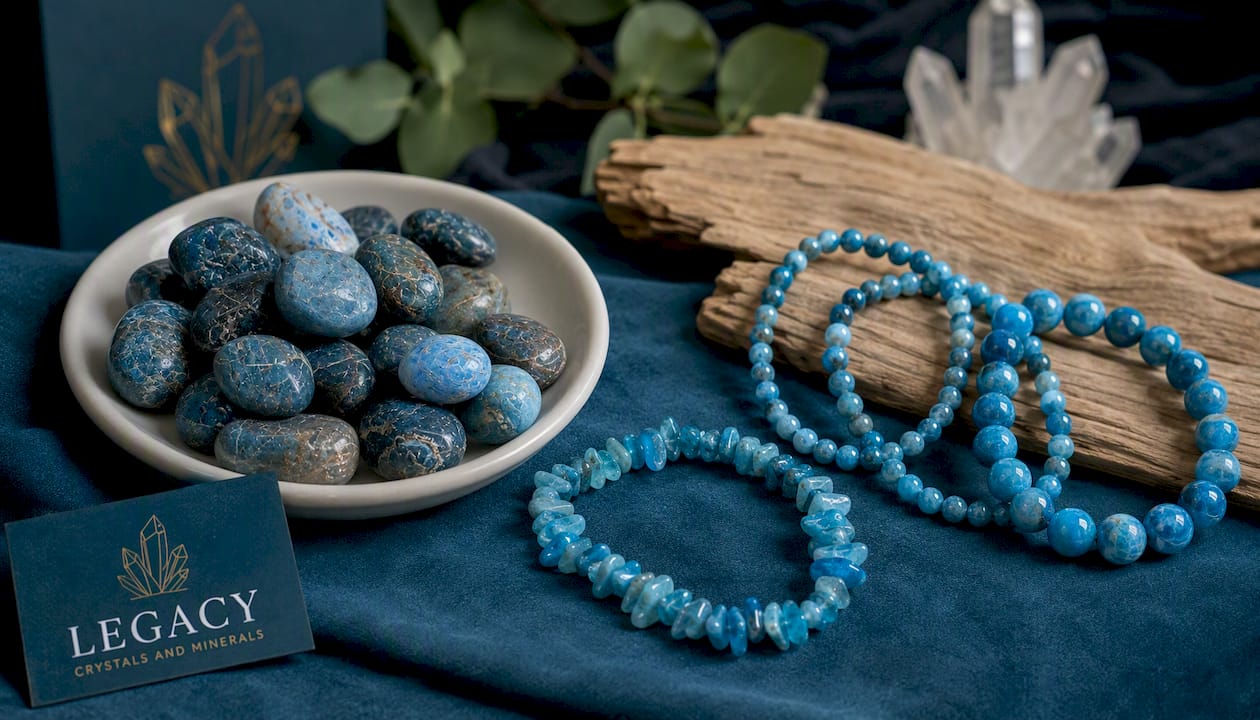
For daily wear, the Blue Apatite Bracelets, available from 3mm to 10mm beads, give you a wearable option that distributes impact across many small surfaces rather than concentrating stress on one exposed stone, a real advantage over a ring or pendant if you’re active. Collectors chasing the vivid neon saturation covered earlier should look at the HQ Blue Apatite Bracelet in 6mm, 8mm, or 10mm round beads, sourced from Madagascar and priced for the colour depth that locality is known for.
Every listing states bead size, sourcing notes, and weight up front, so you know exactly what you’re buying before checkout. Shipping and return details are listed on each product page. If you’re ready to start a daily practice or add a specimen to a collection, browse the current apatite selection and pick the format that matches how you actually intend to use the stone.
Sources
FAQ
What is the spiritual meaning of apatite?
Apatite is commonly regarded as a stone of manifestation, associated with mental clarity, ambition, and honest communication, with colour determining which chakra a practitioner focuses on.
What is apatite in the body?
Hydroxylapatite is the actual mineral form that makes up most of human bone and tooth enamel, which is part of why some metaphysical traditions connect the stone to physical embodiment.
What is blue apatite good for?
Blue apatite is associated with throat chakra work and communication, and practitioners often use it to support clarity when setting and speaking intentions out loud, whether as a tumbled stone for meditation or a bracelet for daily wear.
What is apatite used for?
Beyond jewellery and metaphysical practice, apatite is the world’s major commercial source of phosphorus, used in fertilizer production, and its hydroxylapatite form is used in some bone graft and dental materials.


