

Bracelet sizing guide: measure, convert and order right
Measure your wrist, add the right allowance for your bracelet type, then match the total to the conversion table below. That single rule covers most sizing decisions. For elastic and beaded crystal bracelets, add a small allowance to your wrist measurement. For bangles, measure inner diameter.
For chain bracelets with a clasp, add a moderate allowance. When in doubt, choose adjustable. Legacy Crystals and Minerals applies these same bracelet sizing guides to every beaded and gemstone piece in its catalogue, so the rules here map directly to ordering from the site.
Three quick methods to measure: soft measuring tape wrapped snugly around the wrist; string plus a ruler (mark where the string meets, then measure flat); or a printable measuring strip scaled to 100% and cut out. All three give the same result when used correctly.
Unit conversion hint: wrist circumference in mm ÷ 10 = cm; cm × 0.394 = inches.
Table of Contents
- How do you measure your wrist accurately?
- How does bracelet type change the sizing rules?
- Standard bracelet size chart for Canada
- How do bead size and construction affect fit for crystal bracelets?
- How do you measure a bracelet you already own?
- Practical tips for ordering, gifting and adjusting fit
- Fit and comfort considerations for gemstone and crystal bracelets
- Why trust this guide?
- Key takeaways
- Legacy Crystals and Minerals: custom sizing and made-to-order bracelets
- FAQ
How do you measure your wrist accurately?
All three methods below give reliable results. Pick whichever tools are on hand.
1. Soft measuring tape Wrap a flexible tape around the wrist bone, just below the wrist joint. Keep it snug but not tight. Note the measurement in mm.
2. String plus ruler Wrap a piece of string or a strip of paper around the wrist. Mark where the end meets the string. Lay it flat against a ruler and read the measurement.
3. Printable measuring strip Print the strip at 100% scale (no “fit to page” scaling). Cut it out, wrap it around the wrist, and read the marked measurement.
| Method | Accuracy | Tools needed | Best for |
|---|---|---|---|
| Soft measuring tape | High | Tape measure | Most people |
| String + ruler | High | String, ruler | No tape on hand |
| Printable strip | Medium–high | Printer, scissors | Quick reference |
Pro Tip: Measure at the end of the day, when the wrist is at its largest. Measure the hand you wear the bracelet on, and measure over any watch or cuff you normally wear at the same time.
How does bracelet type change the sizing rules?
Each construction type needs a different allowance. The allowance accounts for clasp length, bead diameter, stretch factor, and how the piece sits on the wrist.
Elastic and beaded bracelets: Add a small allowance to wrist circumference. Elastic stretches to go on, so a snug fit is comfortable.
Classic bead strands with a clasp:
Standard finished lengths run within a typical range for adults. Add a moderate allowance to wrist measurement for a comfortable drape.
Rigid bangles: Measure inner diameter, not circumference. The bangle must pass over the knuckles. Measure the widest part of the hand (across the knuckles) and match to inner diameter. Typical adult bangles have inner diameters suited to hand widths.
Cuffs: Cuffs open at the back and adjust. Measure wrist circumference and choose a cuff whose inner arc is 10–15 mm larger. Most cuffs fit a range of wrist sizes spanning small to large adult wrists.
Chain bracelets with a clasp: Add a moderate allowance for a standard fit, and a larger allowance for a loose, layered look. Just as hybrid approaches in material selection balance durability with flexibility, mixing clasp styles with extender chains gives the most versatile fit.
Standard bracelet size chart for Canada
Wrist measurements and recommended finished bracelet lengths below. All measurements in mm; cm and inch equivalents follow.
| Wrist size | Wrist (mm) | Wrist (cm) | Wrist (in) | Elastic/beaded | Chain with clasp | Bangle inner dia. |
|---|---|---|---|---|---|---|
| Child (3–8 yrs) | small wrist sizes for children | corresponding approximate sizes | typical elastic/beaded and chain bracelet lengths | bangle inner diameter ranges | ||
| Child | medium wrist sizes for children | corresponding approximate sizes | typical elastic/beaded and chain bracelet lengths | bangle inner diameter ranges | ||
| Small adult | small adult wrist sizes | corresponding approximate sizes | typical elastic/beaded and chain bracelet lengths | bangle inner diameter ranges | ||
| Medium adult | medium adult wrist sizes | corresponding approximate sizes | typical elastic/beaded and chain bracelet lengths | bangle inner diameter ranges | ||
| Large adult | large adult wrist sizes | corresponding approximate sizes | typical elastic/beaded and chain bracelet lengths | bangle inner diameter ranges |
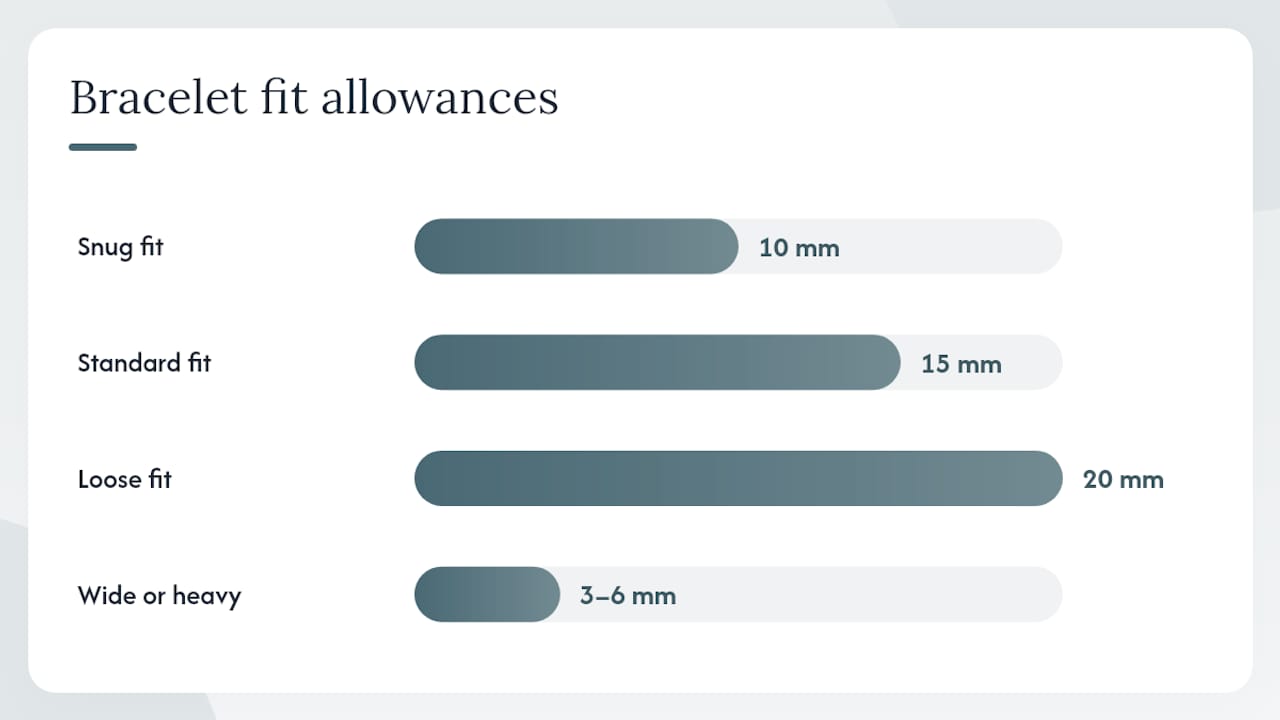
Snug vs. loose allowance: For a snug fit, add 10 mm to wrist circumference. For a standard fit, add 15 mm. For a loose or layered look, add 20 mm.
Wide or heavy bracelets: Add an extra 3–6 mm beyond the standard allowance. A wide cuff or a heavy stone strand sits lower and tighter than a thin chain at the same nominal length.
How do bead size and construction affect fit for crystal bracelets?
Large beads and thick knots make a bracelet sit noticeably larger than its strung length suggests. A strand of 8 mm beads on a 160 mm wrist needs roughly 170–175 mm of finished length, but the beads themselves add visual and physical bulk that changes how the piece moves.
Bead diameter directly affects circumference. Larger beads curve less tightly around the wrist, so a strand of 12 mm beads sits slightly looser than the same length in 6 mm beads. Spacer beads add length without adding weight, which is useful for adjusting fit without restringing. Knot thickness between beads (common in hand-knotted strands) adds 1–2 mm per knot across a full strand.
Just as practitioners in material science favour mixes of sizes to balance surface area and stability, mixing bead diameters or adding spacers in a bracelet improves both comfort and visual balance.
Pro Tip: For heavy or inflexible gemstone beads, add an extra 3–6 mm to the standard allowance. Example: 160 mm wrist + 15 mm standard allowance + 5 mm for heavy stone = 180 mm finished length. The 8 mm black rutile quartz bracelet is a practical reference for this calculation.
How do you measure a bracelet you already own?
Measuring an existing piece is the most reliable way to replicate a fit when ordering or making a gift.
- Lay the bracelet flat on a ruler or measuring tape.
- For a chain or beaded strand, measure end to end (including the clasp).
- For a bangle, measure the inner diameter across the widest point.
- Convert inner diameter to circumference if needed: circumference = π × diameter (approximately 3.14 × diameter in mm).
- Subtract the allowance you prefer to get back to the wrist measurement, or add allowance to match a new piece.
For elastic bracelets, measure at rest. Pull the bracelet gently to check stretch, but record the relaxed length. The relaxed length is what determines fit on the wrist.
Practical tips for ordering, gifting and adjusting fit
When ordering online, choose adjustable or slightly larger when unsure. Wrists swell in warm weather and after physical activity, and a bracelet that fits in July may feel tight in a heated room in January.
Gift checklist:
- Measure a bracelet the recipient already wears (lay it flat, measure end to end).
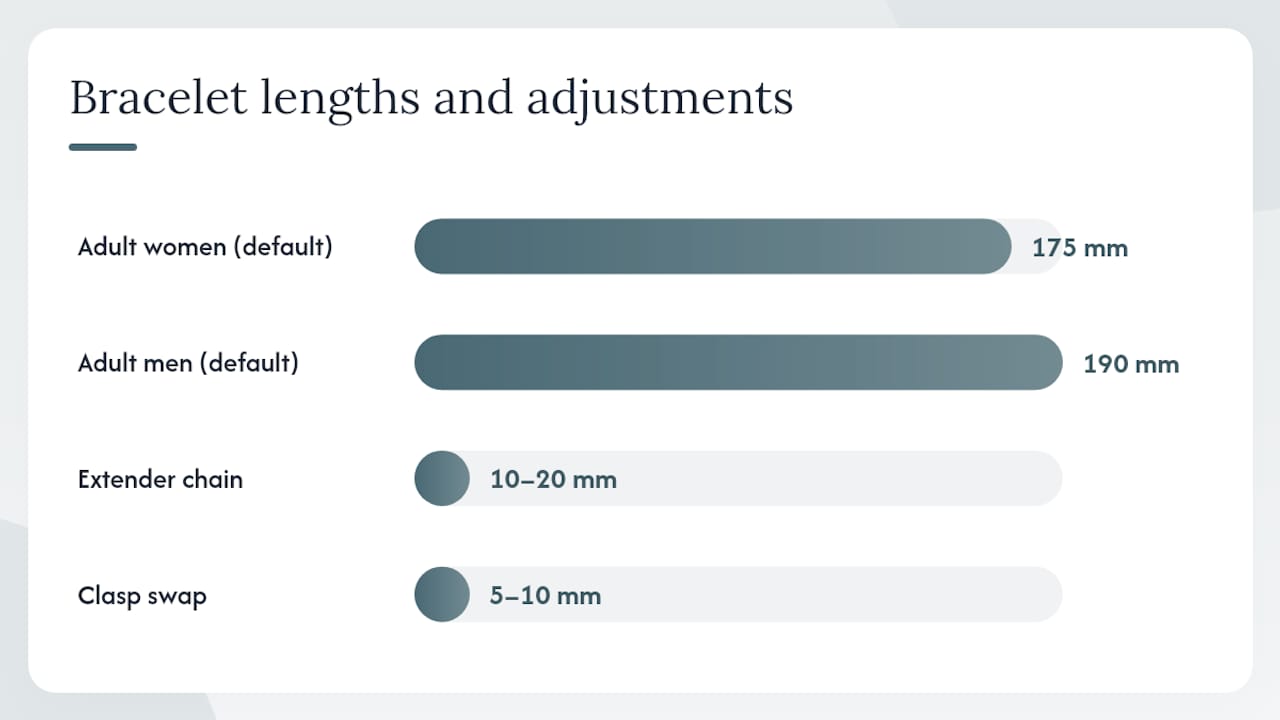
- If no bracelet is available, 175 mm is a safe default for most adult women; 190 mm for most adult men.
- Prefer adjustable clasps, extender chains, or elastic construction for unknown sizes.
- For children, choose elastic or adjustable. Children’s wrists grow quickly.
Resizing options:
- Extender chains: Add 10–20 mm of length. Simple, reversible, no damage to the original piece.
- Bead removal: Shortens a strand by removing beads from each end. Works well on elastic strands; requires restringing on knotted pieces.
- Restringing: Full restring allows any length adjustment. Recommended for fragile or high-value stones. Avoid repeated restringing on porous or soft stones — abrasion risk increases each time.
- Clasp swap: Replacing a lobster clasp with a toggle or magnetic clasp can add 5–10 mm of effective length.
Durability trade-offs matter here. As noted in material durability research, harder materials last longer but offer less flexibility. The same applies to dense gemstone beads: they are durable but less forgiving of a poor fit than softer or elastic constructions.
Fit and comfort considerations for gemstone and crystal bracelets
Stone weight, bead shape, and surface polish all affect how a bracelet moves and how it feels at a given length. A strand of dense stones like malachite chip or red jasper pulls downward more than a glass bead strand of the same length, which means it sits lower and can feel tighter during hand use.
Cold weather causes wrists to contract slightly; heat and activity cause swelling. For daily wear through a Canadian winter, a standard 15 mm allowance is usually comfortable. For summer or active wear, 20 mm gives more room.
Bracelets that are too loose on heavy stone strands risk abrasion against the back of the hand. Too tight, and the beads press into the skin during flexion. The ideal fit for a heavy gemstone bracelet allows one finger to slide underneath comfortably.
After restringing or repair, check that knots are seated correctly and that the finished length matches the original. Responsible sourcing of mineral materials also matters here: porous or reclaimed stones may behave differently under repeated tension than dense, polished beads. The Royal Horticultural Society’s guidance on reclaimed mineral materials reinforces that material origin affects long-term durability, a principle that applies equally to gemstone beads.
Why trust this guide?
Legacy Crystals and Minerals combines direct product-fitting experience with educational resources to advise on fit for museum-grade and gemstone bracelets. Every sizing rule in this guide reflects the construction details of actual pieces in the catalogue, from 8 mm polished jade beads to chip-style irregular strands.
Responsible mineral sourcing and accurate fit guidance go together. Just as professionals in aquatic science distinguish between inert decorative rock and responsibly sourced live media — as documented by MarcoRocks — Legacy Crystals and Minerals applies the same standard to bead provenance: knowing the origin and density of a stone informs both its ethical sourcing and its fit behaviour on the wrist.
Readers can request personalised sizing help or a printable measuring strip directly through the contact page at Legacy Crystals and Minerals. Product pages list actual bead diameters and construction details so buyers can apply the calculations above before ordering. The
provides additional context on how stone density and surface finish affect long-term wear.
Key takeaways
Measure your wrist accurately, add the correct type-specific allowance, and choose adjustable construction whenever the recipient’s size is unknown.
| Point | Details |
|---|---|
| Measure at day’s end | Wrist circumference is largest at the end of the day; measure the hand the bracelet will be worn on. |
| Add type-specific allowance | Elastic/beaded: add 10–15 mm; chain with clasp: add 15 mm; bangle: match inner diameter to knuckle width. |
| Heavy beads need extra room | Dense or inflexible gemstone beads require an additional 3–6 mm beyond the standard allowance. |
| Default gift size | 175 mm suits most adult women; 190 mm suits most adult men when no measurement is available. |
| Legacy Crystals and Minerals | Offers custom-sized crystal bracelets with bead diameter and construction details listed on every product page. |
Legacy Crystals and Minerals: custom sizing and made-to-order bracelets
Getting the right fit on a gemstone bracelet is straightforward when the product page tells you exactly what you are working with. Legacy Crystals and Minerals lists bead diameter, construction method, and finished length on every bracelet listing, so the calculations in this guide apply directly at checkout.
For buyers who need a non-standard length, Legacy offers custom-sized crystal bracelets. Submit your wrist measurement and preferred allowance through the contact page, and the team will confirm length, bead count, and turnaround before stringing. The Coral Jade Bracelet in 8 mm polished beads and the Milk Jade Bracelet in 8 mm are two popular starting points for custom length requests. Extender chains and restringing services are also available. Contact Legacy Crystals and Minerals directly to request a custom size or attach a photo of your existing bracelet with your measurement.
FAQ
What is the standard bracelet length for adult women in Canada?
Most adult women’s bracelets have finished lengths covering typical adult wrist sizes, with a standard allowance for comfort.
How much allowance should you add for an elastic beaded bracelet?
Add 10–15 mm to your wrist circumference. Elastic construction stretches to go on, so a snug fit is comfortable and secure.
How do you measure a bangle size?
Measure the widest part of your hand across the knuckles, then match that to the bangle’s inner diameter. Typical adult bangles have inner diameters suited to hand widths.
Does bead size affect bracelet fit?
Yes. Larger beads add bulk and sit slightly looser at the same strung length. For heavy gemstone beads, add an extra 3–6 mm to the standard allowance.
Can Legacy Crystals and Minerals make a bracelet in a custom length?
Yes. Submit your wrist measurement and preferred fit style through the contact page, and Legacy Crystals and Minerals will confirm the finished length and bead count before completing the order.


