

What crystal bracelets actually cost, by price tier
Budget bracelets run $5 to $25. Mid-range pieces sit at $25 to $75. Premium and collector-grade bracelets start around $75 and climb past $200 for large beads, rare mineral sources, or exceptional clarity. Most first-time buyers get the best value starting in the $15 to $40 range, since a genuinely good starter piece does not require top-tier pricing to look and feel right. The word “crystal” on a label tells you almost nothing about value on its own. What matters is the form, size, grade and rarity of the actual stone.
- Budget ($5–$25): small tumbled beads, mixed chip strands, mass-market stretch bracelets
- Mid-range ($25–$75): consistent 6–8mm round beads, better polish, single-origin stones
- Premium ($75–$200+): large or high-clarity beads, rare provenance, metal findings and custom stringing
Key Takeaways
Crystal bracelet prices are set by size, form, grade, and rarity, not by brand names or metaphysical claims, and most beginners should start shopping in the $15 to $40 range.
| Point | Details |
|---|---|
| Price bands | Budget runs $5 to $25, mid-range $25 to $75, premium starts around $75 and rises past $200. |
| Four core price drivers | Size, form, grade, and rarity set the baseline price before brand or design enters the picture. |
| Authenticity checks matter most at low prices | Cold-touch tests, weight checks, and bead-hole photos catch dye and synthetic material before you buy. |
| Brand pricing differs from mineral pricing | Designer bracelets price on metal finish and design labour, not stone rarity. |
| Legacy Crystals and Minerals as a benchmark | Catalogue examples from budget chip bracelets to AAA-grade 12mm strands show these price factors applied to real, provenance-documented pieces. |
Table of Contents
- What you get at budget, mid-range and premium crystal bracelet prices
- Concrete factors that raise a bracelet’s price
- How to spot fakes and price-related red flags
- How much to spend depending on your goal and style
- Real catalogue examples that show these price factors at work
- A checklist to use before you buy any bracelet listing
- Regional price variations and market trends in 2026
- Does brand or designer reputation change the price?
- Do sales and seasonal promotions actually lower prices?
- Natural crystal bracelets vs synthetic: how the prices compare
- Where to check crystal bracelet prices and provenance further
- Find a bracelet that matches your budget and your reasons for buying
- Sources
- FAQ
What you get at budget, mid-range and premium crystal bracelet prices
Price bands in a crystal bracelet price guide aren’t arbitrary. Each tier reflects a real, visible difference in what you’re holding.
-
Budget tier ($5–$25). This is where you’ll find small chip-style beads, mixed “chakra” strands, and stretch bracelets made from common stones like rose quartz or howlite. Bead sizes tend to run 4mm to 6mm, and polish is often uneven. This is also the tier where marketplace volume is highest. Large retailers list thousands of options under $25, which tells you a lot about supply: at this price, you’re paying for a common material and simple production, not scarcity.
-
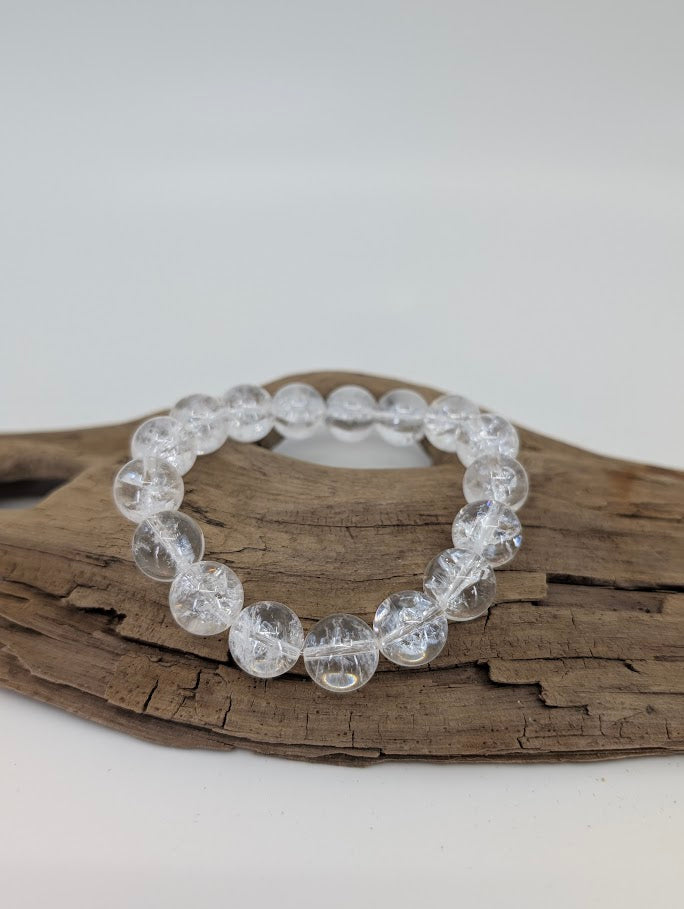
Mid-range tier ($25–$75). Here the beads get more consistent, usually 6mm to 8mm, with better polish and fewer visible flaws. Retail pricing patterns back this up directly. A clear crystal beaded bracelet with 6mm beads commonly lists around $45, while the same style in larger diameters climbs toward $100 or more. A bracelet like Legacy Crystals and Minerals’ Clear Crackle Quartz Bracelet in 6mm or 8mm sits comfortably in this bracket, offering a visible step up in clarity without collector-grade pricing.
-
Premium tier ($75–$200+). This is where bead diameter, mineral rarity, and craftsmanship start compounding. A 12mm or 14mm bead strand in a scarce material, finished with sterling silver findings or custom knotting, easily clears $150. This tier is also where provenance starts mattering: a bracelet cut from a single documented mine site carries a different value than a generic “quartz” strand with no origin listed.
If a listing prices well above its tier without a size, grade, or provenance explanation, treat that as a question to ask, not a reason to walk away.
Concrete factors that raise a bracelet’s price
A fair price in any crystal jewellery price guide comes down to a short list of measurable factors, not a store’s reputation or a vague sense of “quality.”
- Size and form. A tumble is cheaper than a faceted bead. A 6mm bead is cheaper than a 12mm bead of the same stone, often by a wide margin.
- Grade, clarity and colour. Cloudy, included, or pale stones cost less than clear, saturated, evenly coloured ones. Grade and clarity are two of the four core price drivers in any credible pricing framework.
- Rarity and mine provenance. A stone tied to a specific, named locality (a particular mine in a particular province) commands more than an unlabelled “mixed origin” stone.
- Workmanship and findings. Hand-knotting, sterling silver clasps, and custom stringing add labour cost on top of the raw material.
- Treatment history. Dyed, heat-treated, or synthetic material should cost less than untreated natural stone, and a seller should disclose which applies.
It’s worth separating mineral-driven pricing from design-driven pricing too. A branded fashion bracelet with cut crystal accents can be priced around €79 based on metal finish and design rather than the rarity of the stone itself. That’s a completely different pricing logic than a natural mineral bracelet, and it explains why two bracelets that look similar can sit far apart in price.
Pro Tip: Ask any seller which of these five factors is driving their price. A vague answer is itself useful information.
How to spot fakes and price-related red flags
Fake or mislabelled crystal bracelets are common enough that a few quick checks belong in every purchase, especially online.
- Look at the bead holes. Dyed stones often pool colour right at the drilled hole, a sign the colour isn’t natural to the mineral.
- Try a cold-touch test. Genuine stone stays cool to the touch longer than glass or plastic when first picked up.
- Check the weight. Natural stone beads tend to feel heavier than resin or glass beads of the same size.
- Ask for close-up photos. Close-up shots of bead holes and internal inclusions reveal dye and confirm natural formation features that a staged product photo won’t show.
- Treat a price far below market as a flag, not a bargain. If a bracelet is priced well under what its stated size and material would normally cost, ask why before you ask “where do I click to buy.”
With thousands of bracelets listed under $25 across major marketplaces, low pricing alone isn’t proof of a scam. But it is exactly the price band where mislabelling and mixed-origin stones show up most often, so the checks above matter more here than anywhere else.
How much to spend depending on your goal and style
Your budget should follow your reason for buying, not the other way around.
- Everyday fashion accessory ($15–$40). Bead size and colour consistency matter more here than provenance. A mixed chip-style piece, like Legacy Crystals and Minerals’ Mixed Crystal Chip Bracelet, delivers visual variety at low cost.
- Personal or metaphysical use ($25–$75). Buyers in this bracket usually prioritize a specific stone type over bead size. Consistent 6mm to 8mm beads in a single mineral give a clean, intentional look without premium pricing.
- Collector or gift-grade piece ($75+). Here, prioritize provenance and clarity over everything else. Custom stringing and sterling silver findings can add $20 to $50 on top of the base material cost, and that’s a reasonable trade if the piece is meant to last or be handed down.
Real catalogue examples that show these price factors at work
Seeing these price drivers applied to actual products makes the pattern click faster than any general rule.
- Budget to mid tier: the Dragon Bloodstone Beaded Bracelet (4mm), made from natural epidote jasper, sits low because of its small bead size, even though the material itself has good colour depth.
- Mid tier: the Garden Quartz Bracelet (6mm) reflects standard mid-range bead sizing with the added interest of visible internal inclusions, a grade factor that adds character without pushing it into premium pricing.
- Mid to premium tier: the Mystery Crystal Bead Bracelet is priced as a blind grab, meaning the value proposition is discovery and specimen variety rather than a guaranteed single stone type.
- Premium tier: the White Sea Urchin Quartz Bracelet, with 12mm polished beads and an AAA grade rating, shows how size and grade compound to justify a higher price point.
- Collector-adjacent premium: the High Clarity Double-Terminated Quartz Bracelet earns its price through clarity grading alone, at a bead size that would otherwise sit mid-range.
Photos and provenance notes on each product page fill in the details a price alone can’t.
| Product | Tier | Why |
|---|---|---|
| Dragon Bloodstone Beaded Bracelet (4mm) | Budget to mid | Small bead size keeps cost down despite rich colour |
| Garden Quartz Bracelet (6mm) | Mid | Standard bead size, visible inclusions add character |
| White Sea Urchin Quartz Bracelet (12mm) | Premium | Large beads plus AAA grade drive the price up |
A checklist to use before you buy any bracelet listing
Run through this before checkout, especially on marketplace listings where seller information is thin.
- Ask the seller for the stone’s origin or mine location, not just the mineral name.
- Ask directly whether the beads are dyed, heat-treated, or synthetic.
- Confirm the exact bead diameter in millimetres, not a vague size description.
- Ask what metal the clasp and any findings are made from.
- Insist on close-up photos of bead holes and any inclusions, not just a styled overview shot.
- Check the return policy before paying, particularly for anything over $75.
- Avoid unusual payment requests outside the platform’s standard checkout.
Once it arrives, keep it away from harsh sunlight and household chemicals, since both can dull polish and fade colour over time, which matters if you ever plan to resell or pass the piece along.
Pro Tip: Save the seller’s provenance answers and photos in one place. If a clasp ever needs repair, that record helps a jeweller or appraiser confirm what you actually own.
Regional price variations and market trends in 2026
Crystal bracelet pricing isn’t uniform across markets. Regions closer to mining sources, such as parts of Asia for jade and quartz varieties, often see lower base prices for those specific stones, since transport and import markup get stripped out. North American retail prices typically carry the added cost of shipping, customs, and currency conversion on top of the raw material price, which is one reason the same stone type can cost noticeably more once it reaches a US storefront.
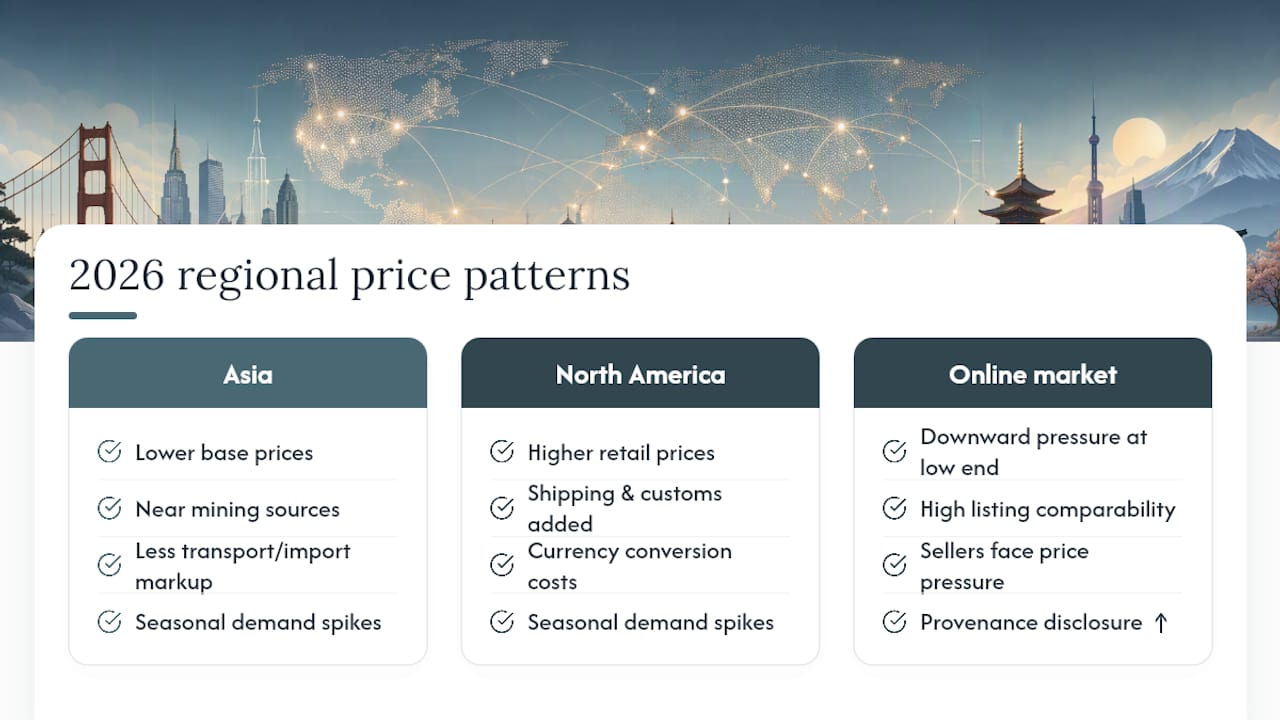
Online marketplaces have also pushed prices downward at the low end. With so many inexpensive listings available globally, buyers now have more room to compare before committing, and sellers face more pressure to justify anything priced above the volume-market norm. That pressure tends to push honest sellers toward clearer provenance disclosure, since a buyer who can compare fifty listings in five minutes will ask why one costs triple the rest.
Seasonal demand shifts matter too. Interest in specific stones tends to spike around New Year’s resolutions and gift-giving periods, which can nudge popular varieties up slightly during those windows. None of this changes the underlying price drivers. Size, grade, and rarity still set the baseline. Regional and seasonal factors just shift where on that baseline a given listing lands.
Does brand or designer reputation change the price?
Yes, but not for the reason many buyers assume. A named brand or designer bracelet often costs more because of design work, metal finish, and production quality, not because the mineral inside is rarer.
The Bric Bracelet Crystal Gold from Daniel Wellington makes this clear: it’s priced around €79 largely on the strength of its gold finish and design detailing, even where the crystal element itself is small or simulated. That’s a completely different pricing logic than a natural mineral bracelet priced on stone rarity. Jewellery pricing strategy in the fashion segment factors in brand positioning, design labour, and marketing cost, none of which reflect what the stone would cost on its own.
For a natural crystal bracelet, provenance and craftsmanship reputation matter more than a logo. A seller or publisher known for accurate stone identification and clear sourcing information carries real value, because it reduces the risk of buying a mislabelled or treated stone at a natural-stone price. That’s a different kind of reputation than a fashion label’s, but it affects price just as much, particularly in the premium tier.
Do sales and seasonal promotions actually lower prices?
Seasonal promotions do bring real discounts, most heavily around major gift-giving periods and end-of-season clearance windows. Retailers often discount slower-moving stock, chip-style bracelets and common stones especially, to clear inventory ahead of new arrivals.
Premium and collector-grade pieces discount less aggressively, and for good reason: a bracelet’s price there is tied to a specific, often one-of-a-kind stone, so there’s less incentive to mark it down to move volume. If you’re shopping in the premium tier, a small discount on a well-documented piece is worth more than a large discount on an unclear one.
Natural crystal bracelets vs synthetic: how the prices compare
Natural and synthetic crystal bracelets can look nearly identical, which is exactly why the price gap between them causes so much confusion. Natural stone pricing follows the size, grade, and rarity factors already covered, and even common natural stones like rose quartz or amethyst carry a price floor tied to mining and processing cost.
Synthetic or lab-created material, along with dyed glass and resin sold as “crystal,” can undercut natural stone significantly because there’s no mining, no rarity, and often no meaningful grading involved. That’s not automatically a bad purchase. A synthetic piece can be a legitimate budget-tier fashion accessory. The problem is when synthetic material gets priced and marketed as if it were natural, which is precisely the scenario the cold-touch and weight checks covered earlier are designed to catch.
As a rule of thumb, if a bracelet’s price sits well below the typical range for its stated stone and bead size, ask directly whether the material is natural, treated, or synthetic before buying. A straight answer costs the seller nothing and protects you either way.
Where to check crystal bracelet prices and provenance further
- Crystal Price Guide: What Every Stone Actually Costs, for tiered pricing benchmarks across hundreds of stones.
- Legacy Crystals and Minerals’ crystal price factors guide, for a deeper breakdown of how these factors apply to specific stone types.
- Product pages cited above for the Dragon Bloodstone, Garden Quartz, and White Sea Urchin Quartz bracelets.
Find a bracelet that matches your budget and your reasons for buying
Once you know what drives a fair price, the harder part is finding a seller willing to actually show you the provenance behind it. That’s the gap Legacy Crystals and Minerals is built to close: every bracelet and specimen in the catalogue comes with documented sourcing, so you’re never guessing whether a listed grade or origin is real.
If you’re starting your first collection, the White Sea Urchin Quartz Bracelet shows exactly what a properly graded 12mm premium piece looks like, while budget-conscious shoppers can compare bead-size options directly on the Mystery Crystal Bead Bracelet listing before deciding. Browse either page now, check the provenance notes and photos for yourself, and add the piece that matches the budget you’ve just worked out.
Sources
- Crystal Price Guide: What Every Stone Actually Costs | Crystal Almanac
- Simple Natural Clear Crystal Beaded Bracelet – GTHIC
- Amazon search results for Crystal Bracelets
FAQ
How much should a beginner spend on a crystal bracelet?
Most beginners get good value starting between $15 and $40, which covers consistent bead sizing and a clearly identified stone without paying for rarity you don’t yet need.
Why do two bracelets made of the same stone have different prices?
Bead size, clarity grade, and mine provenance usually explain the gap, along with whether the piece includes custom stringing or metal findings.
Is a cheap crystal bracelet automatically fake?
No, but listings under $25 warrant extra checks, since that price band contains both legitimate low-grade natural stone and mislabelled synthetic material.
Does a designer or brand name mean better stone quality?
Not necessarily. Designer bracelets often price for metal finish and design work rather than mineral rarity, which is a different pricing logic than natural stone jewellery.
What’s the fastest way to check if a bracelet is natural stone?
A cold-touch test, a weight check, and close-up photos of the bead holes for dye pooling catch most common fakes without any special equipment.
Recommended
- How crystal bracelets work energetically: a clear guide – Legacy Crystals and Minerals
- Mixed Crystal Chip Bracelet — Chakra Spectrum - Legacy Crystals and Minerals – Legacy Crystals and Minerals
- Clear Crackle Quartz Bracelet — 6mm & 8mm Beads - Legacy Crystals and Minerals – Legacy Crystals and Minerals
- Terahertz Bracelet – 8MM, 10MM, 12MM, 14MM Polished Round Beads – Legacy Crystals and Minerals


