

Mineral specimen grading: a collector's practical guide
Mineral specimen grading is the process of evaluating a natural specimen against a set of aesthetic, physical, and documentary criteria to determine its collector value. There is no single universal numeric standard for this process. Grades are descriptive, not absolute. The criteria collectors and dealers apply consistently are:
- Crystal integrity: terminations, edges, chips, fractures, cleavage damage
- Aesthetic composition: balance, contrast, matrix relationship, displayability
- Colour, lustre, and clarity: hue, saturation, tone, transparency, surface reflectance
- Size and completeness: dimensions, weight, proportionality relative to matrix
- Rarity and locality/provenance: documented origin, species scarcity, historical significance
- Condition and treatments: repairs, stabilisations, adhesives, and mandatory disclosure
- Documentation: labels, invoices, lab reports, and photographic records
When buying or cataloguing a specimen, ask for: the exact locality (mine, region, country), any treatments or repairs, dimensions and weight, and photos from multiple angles with a scale reference included.
Key takeaways
Mineral specimen grading relies on seven criteria applied consistently: crystal integrity, aesthetic composition, colour and lustre, size and scale, rarity and locality, condition and treatments, and documentation.
| Point | Details |
|---|---|
| Inspect terminations first | Chips or breaks on primary terminations are the single most common cause of grade reduction. |
| Verify locality with Mindat.org | Documented locality raises grade and value; cross-check all locality claims against authoritative records. |
| Disclose all treatments | Repairs and stabilisations must be stated explicitly; undisclosed treatments are disqualifying for serious collectors. |
| Photograph with a metric scale | Every grade claim requires multi-angle photos with a ruler or scale bar under daylight-balanced light. |
| Use verbal grades, not just numbers | No universal numeric standard exists for raw specimens; descriptive grades (Fine, Extra Fine, Exhibition) are the market norm. |
Table of Contents
- What does “collector grade” actually mean?
- The grading checklist: what to inspect criterion by criterion
- How to grade a specimen step by step
- Common grading scales and how to read them
- How to spot treatments, stabilisations, and fakes
- Standards for photos, measurements, and provenance records
- How handling, storage, and environment affect grade over time
- How grade translates to price for Canadian collectors
- How a reputable seller documents and communicates grade
- Sources
- FAQ
What does “collector grade” actually mean?
“Collector grade” describes a specimen assessed primarily on aesthetics and rarity rather than on industrial utility. It is not an assay result. A piece of pyrite with sharp, mirror-bright cubic crystals on a contrasting matrix is collector grade because of how it looks and where it came from, not because of its iron content. Industrial mineral quality assessment focuses on assays, modal mineralogy, and processing behaviour — criteria that have little bearing on whether a collector wants to display a specimen.
The diamond 4 Cs (cut, colour, clarity, carat) are the most widely recognised grading framework in the gem world, but they were designed for faceted diamonds and do not translate cleanly to raw mineral specimens or most coloured stones. There is currently no universal industry standard for grading coloured stones or mineral specimens; professionals rely on descriptive assessments of colour, clarity, and form, with provenance and disclosure providing transparency.
In practice, dealers use verbal tiers. “Commercial” describes a specimen suitable for general retail with minor flaws. “Fine” implies above-average crystal development and condition. “Extra Fine” or “Premium” signals near-perfect crystals, strong aesthetics, and clean condition. “Exhibition” or “Museum Quality” is reserved for pieces that would hold their own in a major institutional display. These labels are not legally defined, which means a seller can apply them however they choose.
Numeric scores do appear occasionally. Proprietary systems like the Gübelin Gemstone Rating condense quality, rarity, and visual salience into a single point score for high-end faceted coloured gemstones. These are intended as guidance tools, not absolute standards, and they apply almost exclusively to transparent, faceted material rather than raw mineral specimens.
Pro Tip: When a seller uses a proprietary numeric score or a label like “AAA,” ask what specific criteria that score covers and whether it was assigned by the seller or an independent lab. Seller-created ratings are common and not inherently dishonest, but they need a clear explanation to be meaningful.
The grading checklist: what to inspect criterion by criterion
Crystal integrity and perfection
Terminations are the first thing serious collectors examine. A sharp, undamaged termination on a quartz point or a complete octahedral fluorite crystal signals that the specimen survived extraction and handling intact. Chips on termination tips, broken edges, or cleavage steps reduce grade significantly. Collectors use terms like “sharp terminations,” “pristine edges,” and “no contact” to describe top-condition crystals. “Contact” means a crystal face touched another surface during growth and is slightly flattened or etched. Minor contacts are acceptable on otherwise exceptional pieces; multiple contacts on primary crystals drop a specimen to Fine or below.
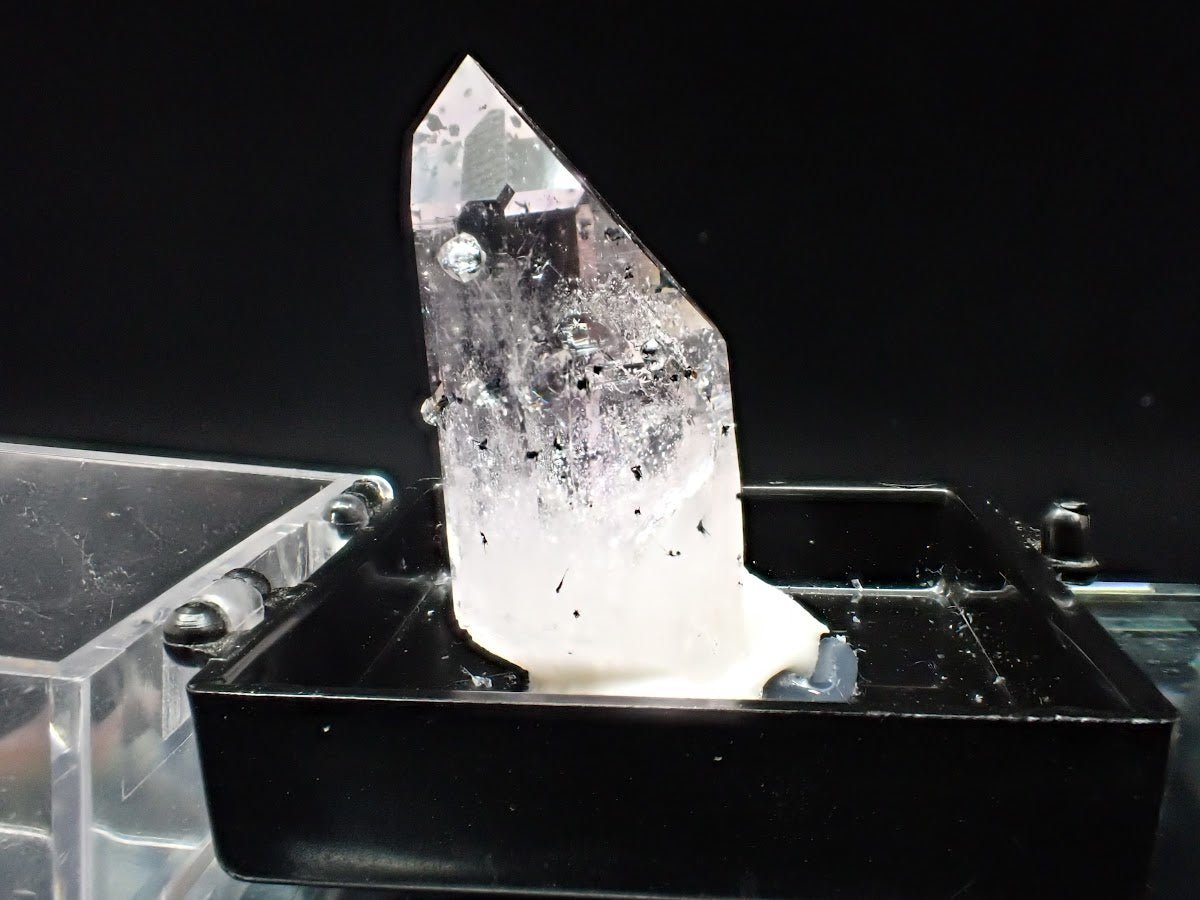
Fractures inside a crystal body are distinct from surface chips. Internal fractures scatter light and reduce transparency, which matters more for species prized for clarity (aquamarine, topaz, calcite) than for opaque minerals. Cleavage damage, where a crystal has split along a natural plane, is usually more visually disruptive than a small surface chip and is harder to repair convincingly.
Aesthetic composition
A specimen’s display orientation determines how it reads to a viewer. The best face should present a natural focal point, with supporting crystals or matrix framing it rather than competing with it. “Perfectly floored cluster” describes a flat, stable base that lets a specimen stand without a mount. “Self-standing” is a practical premium. Contrast between crystal colour and matrix colour adds visual impact: deep purple amethyst on white calcite matrix reads more strongly than the same crystals on grey quartz matrix.
Habit matters too. Bladed, prismatic, acicular, and tabular crystals each carry different aesthetic expectations. A botryoidal malachite specimen is judged on the smoothness and richness of its surface, not on termination sharpness. Knowing the expected habit for a species is part of applying the right criteria. For a broader look at what makes specimens desirable to collectors, the Legacy Crystals and Minerals guide on collectible minerals covers rarity and displayability in detail.
Colour quality and lustre
Colour is assessed across three dimensions: hue (the base colour), tone (light to dark), and saturation (intensity or chroma). A medium-toned, highly saturated colour is generally most desirable. Pale, washed-out tone or very dark tone both reduce visual appeal. Colour zoning, where a crystal shows bands of different saturation or hue, can be a positive feature (as in bicolour tourmaline) or a detractor (as in uneven amethyst).
Reliable colour evaluation requires standardised viewing conditions. The Munsell and World of Colour systems provide a standard framework for hue, value, and chroma notation under calibrated lighting. In practice, most collectors use a daylight-balanced light source (5,000–6,500K) and view specimens against a neutral grey background to minimise colour casts. Lustre descriptors include vitreous, resinous, adamantine, silky, pearly, and metallic. “Velvety lustre” on a malachite or “adamantine lustre” on a cerussite are positive grade signals.
Clarity, transparency, and inclusions
For transparent or translucent species, inclusions reduce collector value when they obscure the crystal interior or create a cloudy appearance. Rutile needles in quartz are an exception: they are often a positive feature. The key distinction from gem grading is that raw specimens are not faceted, so inclusions are evaluated in the context of the whole crystal form rather than light performance. A slightly included aquamarine crystal with perfect terminations and strong colour may still grade higher than a cleaner crystal with damaged tips.
Size, completeness, and scale
Larger specimens command higher prices at equivalent quality, but size alone does not determine grade. A 2 cm fluorite octahedron with perfect faces grades higher than a 10 cm cluster with broken crystals. Matrix scale affects perceived size: a small crystal on a large matrix can look proportionally insignificant, while the same crystal on a minimal matrix reads as bold and complete. Weight and dimensions should always be recorded in metric units (grams and centimetres) for consistency.
Rarity, locality, and provenance
Locality is one of the most powerful grade multipliers. A rhodochrosite from the Sweet Home Mine in Colorado, a tourmaline from Paprok in Afghanistan, or a gold specimen from the Hollinger Mine in Timmins, Ontario carries a premium that an identical-looking specimen from an unknown source does not. Mindat is the primary reference database collectors and dealers use to verify locality records and species identification. Documented locality raises grade because it is verifiable, historically significant, and often tied to a finite supply of material.
Provenance documents that carry weight include original field labels written at the time of collection, dealer invoices with locality stated, auction records, and institutional deaccession paperwork. A handwritten label from a known 19th-century collection can add substantial value. Anonymous “origin unknown” claims should be treated cautiously. For a detailed look at how locality affects value, the Legacy Crystals and Minerals locality guide covers the topic thoroughly.
Condition, repairs, and stabilisations
Repairs and stabilisations are common in the mineral trade and are not automatically disqualifying, but they must be disclosed. Accepted practices include the use of clear adhesives (Hxtal NYL-1 or similar) to reattach broken crystals, backing fragile specimens with epoxy or resin to prevent further damage, and applying consolidants to friable matrix. What matters is disclosure. A repaired specimen with full disclosure grades lower than an unrepaired equivalent but higher than an undisclosed repair discovered later.
Stabilisation coatings on porous or soft minerals (turquoise, malachite, chrysocolla) are standard in the trade. Dyeing is less accepted for display specimens and must always be disclosed. Reterming, where a broken crystal tip is recut or reshaped to simulate an intact termination, is considered deceptive if undisclosed.
Pro Tip: Under UV light (longwave or shortwave), adhesives and resin fills often fluoresce differently from the surrounding mineral. A UV torch is one of the most useful tools a collector can carry to a show or use when inspecting a new acquisition.
How to grade a specimen step by step
Use this workflow whether you are inspecting a piece in person or evaluating an online listing.
- Verify identification. Confirm the species name against IMA-approved nomenclature and cross-check locality data on Mindat.org. Misidentified specimens are mispriced specimens.
- Inspect integrity from top to base. Start at the primary terminations, work down the crystal faces, check the matrix edges, and examine the underside. Use a 10x loupe for surface chips and fractures. Note every defect, even minor ones.
- Evaluate aesthetics and display orientation. Rotate the specimen to find the best face. Test it under different light sources (incandescent, daylight, LED). Note colour shift, lustre quality, and how the matrix frames the crystals.
- Check for treatment signs and repairs. Look for colour that is unnaturally uniform or concentrated in fractures (possible dyeing). Check for glue lines, backing material, or recut surfaces. Use UV light where possible.
- Measure and photograph with a scale. Record length, width, height in centimetres and weight in grams. Photograph from at least three angles: best face, side profile, and underside. Include a ruler or coin for scale in every shot.
- Compile documentation and assign a descriptive grade. Gather locality label, dealer invoice, any lab reports, and previous ownership records. Assign a verbal grade (Commercial, Fine, Extra Fine, Exhibition) based on the criteria above and note the specific reasons for any deductions.
For remote grading from photos, request images taken under daylight-balanced light with no heavy post-processing. Close-up shots of terminations and any damage areas are non-negotiable. A photo that hides the underside of a specimen is a red flag. The Legacy Crystals and Minerals guide on reading premium listings explains what to look for in a trustworthy online listing.
Common grading scales and how to read them
Most mineral dealers use descriptive verbal grades rather than a single numeric standard, partly because no universal system exists and partly because the criteria that matter vary by species and specimen type.
The most widely used verbal scale runs roughly as follows:
| Grade label | Typical meaning for collectors |
|---|---|
| Commercial | Recognisable species, visible flaws, suitable for general display or study |
| Good | Above average condition, minor chips or contacts acceptable |
| Fine | Well-formed crystals, good colour, no major damage, display-worthy |
| Extra Fine | Near-perfect crystals, strong aesthetics, clean condition, minor flaws only |
| Exhibition / Museum | Exceptional in all criteria; suitable for institutional display |
For tumbled and polished stones, letter grades (AAA, AA, A, B) are common in retail. These refer to surface finish, colour uniformity, and absence of visible inclusions or cracks. The Legacy Crystals and Minerals tumbled stone grading scale explains exactly how these tiers map to buyer expectations for polished material.
Numeric proprietary systems do exist. The Gübelin Gemstone Rating assigns points across quality, rarity, and salience for high-end faceted coloured gemstones. Salience is included specifically because visual appeal is inherently subjective and objective criteria alone do not capture why one ruby commands a premium over another with similar measurements. These scores are guidance tools for the upper end of the faceted gem market and rarely apply to raw mineral specimens. Automated image-based classification models used in mining contexts define quality classes by iron content thresholds and processing behaviour, not by aesthetic criteria, so any “grade” produced by such a system is not comparable to collector-grade assessment.
How to spot treatments, stabilisations, and fakes
Common treatments and what to look for:
- Dyeing: Colour concentrated in fractures or surface pores rather than distributed evenly through the crystal. Chalcedony, howlite, and magnesite are frequently dyed to simulate turquoise or other species. Acetone on a cotton swab will lift some dyes.
- Resin stabilisation: Common in turquoise, malachite, and chrysocolla. The surface may feel slightly plastic or show a uniform sheen inconsistent with natural lustre. UV light often reveals resin fills as bright fluorescent patches.
- Backing: Thin slabs of fragile material (ammolite, opal, labradorite) are sometimes cemented to a backing material to add stability. Check the edge profile for a visible join line.
- Reterming: A recut termination tip looks geometrically perfect but may show polishing scratches under magnification that are absent on natural faces. The lustre on a recut face is often slightly different from adjacent natural faces.
- Composites: Two or more pieces assembled to create a more impressive specimen. Look for glue lines at the matrix join, colour or texture discontinuities, and any area where the crystal habit changes abruptly.
Red flags in online listings include photos taken only under warm incandescent light (which can mask dye colours), no underside photo, no scale reference, and locality described only as “Brazil” or “Africa” with no further detail.
When to request lab testing: for any specimen above a price threshold you consider significant, for gemstone-quality material where heat or chemical treatment is common (corundum, beryl, tourmaline), and for any piece where locality is central to the value claim. Useful tests include UV fluorescence, FTIR spectroscopy (detects resins and coatings), Raman spectroscopy (confirms species identity), and standard gemmological reports from accredited labs such as GIA or the Canadian Gemmological Association.
Pro Tip: For quality control and description standards in collectibles retail more broadly, the buyer-confidence principles outlined in this collectibles retail guide translate well to mineral listings: look for consistent, multi-angle documentation and explicit condition disclosures before committing to a purchase.
Standards for photos, measurements, and provenance records
Photography standards
Every grade claim is only as credible as the photos supporting it. Minimum requirements:
- Daylight-balanced light source (5,000–6,500K) to render colour accurately, consistent with standardised colour-grading protocols
- Neutral grey or white background
- At least three angles: primary display face, side profile, underside
- Close-up of primary terminations and any damage areas
- A metric scale bar or ruler in every shot
- No heavy saturation or contrast adjustments in post-processing
Minimum metadata fields
Record these for every specimen in your catalogue:
- Species name (IMA-approved)
- Locality: mine, district, province/state, country
- Dimensions: length × width × height in centimetres
- Weight in grams
- Date of acquisition and method (purchased, traded, collected)
- Previous ownership (if known)
- Treatment or repair disclosure
- Lab reports (if obtained)
Provenance documentation
Strong provenance includes original field labels (handwritten at the time of collection), dealer invoices with locality stated, auction house records, and institutional deaccession documents. Mineralogical Society of America resources provide practical protocols for sampling, documentation, and handling that support credible long-term provenance records. Cross-referencing locality claims against Mindat.org records is standard practice for verifying that a stated locality is geologically plausible for the species.
Label specimens physically with a small, acid-free tag tied or placed with the specimen, not written directly on the matrix. In digital catalogues, link the physical label ID to the full metadata record.
Pro Tip: Anonymous origin claims like “South American amethyst” with no mine or district specified are not provenance. They are a geographic category. Treat them as unverified and price or grade accordingly.
How handling, storage, and environment affect grade over time
Environmental risks
Several minerals are sensitive to specific environmental conditions:
- Humidity: Halite, sylvite, and other water-soluble minerals dissolve or effloresce in humid air. Pyrite and marcasite can oxidise and crumble (pyrite disease) in high humidity combined with pollutants. Store sensitive specimens in sealed cases with silica gel desiccant.
- Sunlight and UV: Amethyst, rose quartz, and many coloured minerals fade with prolonged UV exposure. Display cases with UV-filtering glass or acrylic protect colour over time.
- Temperature swings: Rapid temperature changes can stress crystals with inclusions or internal fractures, potentially propagating existing cracks.
- Atmospheric pollutants: Sulphur compounds in urban air can tarnish silver minerals and affect sulphide specimens.
Handling risks
Skin oils leave residue on crystal faces and can etch soft minerals over time. Handle specimens with clean cotton gloves or support them from the matrix rather than the crystals. Abrasion from other specimens during transport is a common source of grade loss. Wrap each piece individually in acid-free tissue or foam before moving.
Storage and display
Stable humidity (40–50% relative humidity for most minerals), padded mounts or foam-lined trays, and inert display cases are the baseline. Avoid household glass cleaners on specimens; many contain ammonia, which damages carbonate minerals and some sulphides. Ultrasonic cleaners are not appropriate for specimens with fractures, inclusions, or repairs. For minor dust, a soft natural-bristle brush or a gentle stream of compressed air is sufficient.
Pro Tip: Mineralogical Society of America protocols are a practical reference for long-term specimen care and documentation. Applying even a basic version of their handling and storage guidance preserves grade and supports provenance continuity.
How grade translates to price for Canadian collectors
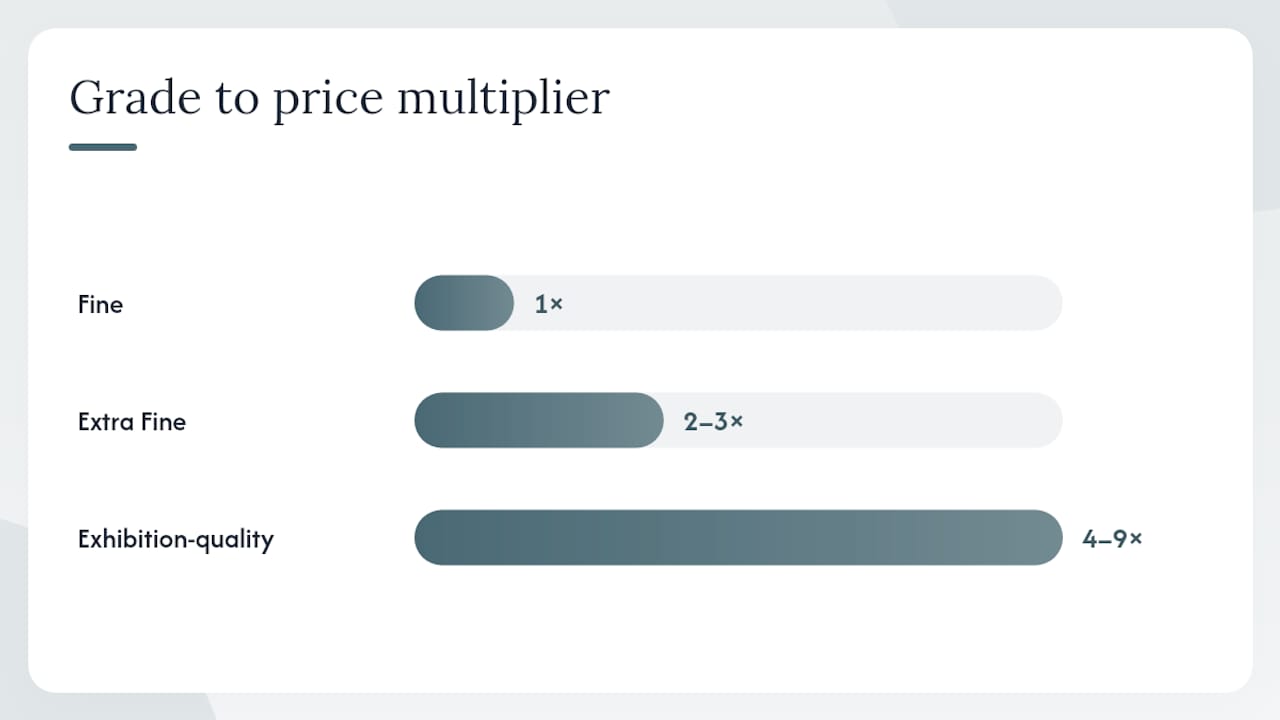
Grade affects price non-linearly. The difference between a Fine and an Extra Fine specimen of the same species and locality can double or triple the price. Exhibition-quality material from a historically significant locality can command multiples of that again. Intact terminations, documented locality, and clean condition are the three factors most consistently associated with price premiums across Canadian mineral show markets and online platforms.
Canadian collectors buy and sell through several channels, each with different grading expectations:
- Mineral club shows and gem fairs: The Gem and Mineral Club of Ottawa, the Vancouver Island Rock and Gem Club, and similar regional clubs hold annual shows where grading is informal and negotiated in person. Buyers can inspect specimens directly, which reduces the documentation burden.
- Online marketplaces: Platforms used by Canadian collectors include specialist dealer websites and general auction platforms. Online sales require more rigorous documentation because buyers cannot inspect in person. Multi-angle photos, stated dimensions, and explicit treatment disclosure are expected at any serious price point.
- Specialist dealers: Canadian dealers who focus on collector-grade material typically provide locality documentation and condition notes as standard. Pricing reflects the cost of sourcing, documentation, and curation.
For pricing guidance, compare active listings for the same species and locality on established platforms rather than relying on asking prices alone. Factor in shipping costs and, for international acquisitions, Canada Border Services Agency import requirements for certain organic minerals (coral, ammolite) and CITES-listed materials.
The Mineralogical Association of Canada is the primary national resource for locality data, species records, and connections to regional clubs and museum collections. Provincial museum collections (Royal Ontario Museum, Canadian Museum of Nature in Ottawa, Redpath Museum at McGill) provide reference specimens useful for comparing locality material and calibrating grade expectations.
- Use Mindat.org to verify locality plausibility and compare similar material from the same source
- Contact the Mineralogical Association of Canada for regional club connections and Canadian locality expertise
- Reference provincial museum collections for benchmark specimens from Canadian localities
- Factor import/export rules into valuations for internationally sourced material
How a reputable seller documents and communicates grade
A professional mineral listing should function as a verifiable grade record, not a marketing description. The standard listing checklist for a reputable seller includes:
- Species name (IMA-approved nomenclature)
- Locality: mine, district, province/state, country
- Dimensions in centimetres and weight in grams
- Primary display face description and display orientation
- Condition notes: any chips, contacts, fractures, or repairs stated explicitly
- Treatment disclosure: stabilisation, adhesives, coatings, or dyeing noted clearly
- Provenance documents available: field label, dealer invoice, lab report
- Multiple photos: primary face, side, underside, close-up of terminations and any damage, scale reference in every image
Legacy Crystals and Minerals applies these standards across its curated listings, pairing specimen descriptions with educational content so collectors understand exactly what they are buying and why a grade claim is supported. The collector grade guide on the Legacy Crystals and Minerals site explains the criteria used in listings and how they map to the descriptors collectors encounter in the broader market.
Transparency guidelines for sellers: photograph damage, not just the best face. State treatments in plain language in the listing body, not buried in fine print. If a lab report exists, reference it and make it available. If provenance is limited to “dealer-stated locality,” say so rather than presenting it as documented field provenance.
Pro Tip: Before purchasing from any online seller, request the underside photo and ask directly: “Has this specimen been repaired or treated in any way?” A seller who answers clearly and promptly, with supporting photos, is demonstrating the transparency that serious collectors expect. A vague or delayed answer is informative in its own way.
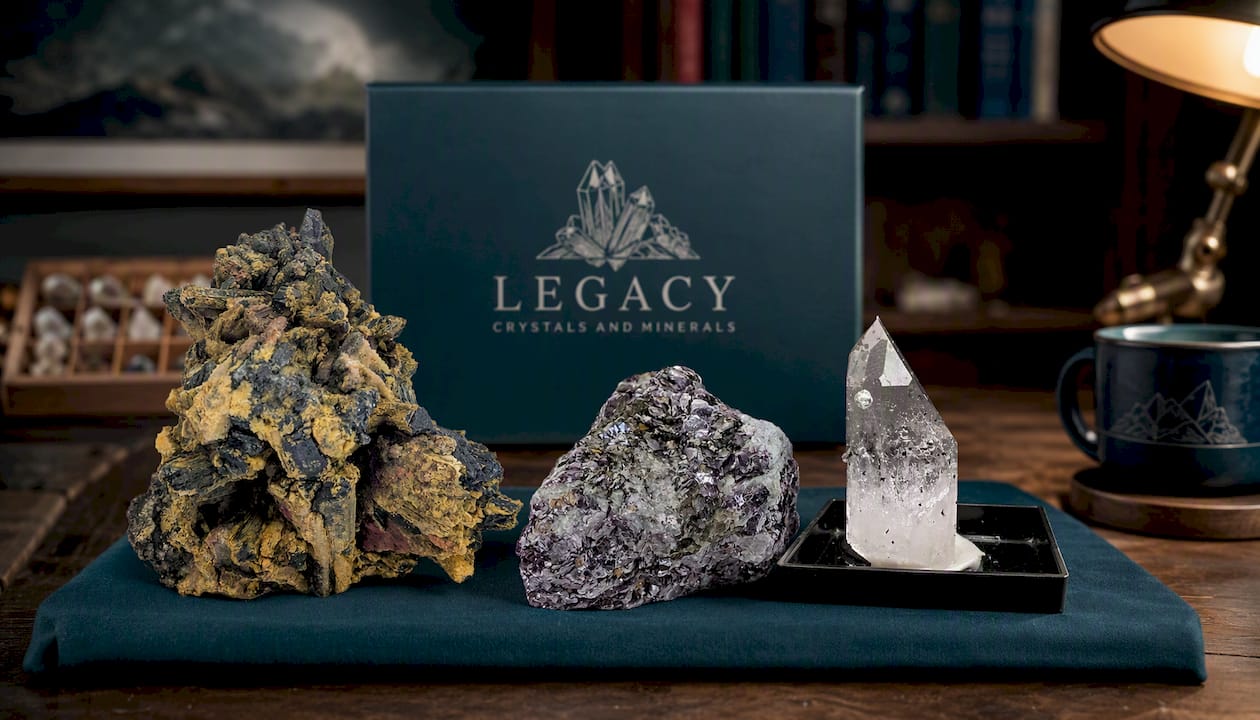
Legacy Crystals and Minerals curates museum-grade specimens and mineral-based jewellery with full locality documentation, condition disclosure, and treatment transparency. Each piece in the collection is selected against the grading criteria covered in this guide. Browse the Coral Jade Bracelet and Milk Jade Bracelet for examples of how grading and material disclosure apply to finished mineral jewellery, or explore the full collection at Legacycrystalsandminerals.
Sources
Core reference organisations and databases for mineral specimen grading and identification:
- An Introduction to Gemstone Grading - International Gem Society
- Gübelin Gemstone Rating - Overview
- Characterization of ore properties for geometallurgy - Elements Magazine
- An approach to color stone grading - Italian Gemological Review
- Applied study on hybrid models for mineral quality assessment - MDPI
FAQ
What is mineral specimen grading?
Mineral specimen grading is the evaluation of a natural specimen against criteria including crystal integrity, colour, lustre, size, locality, and condition to determine its collector value. No single universal numeric standard exists; grades are typically descriptive (Commercial, Fine, Extra Fine, Exhibition).
How do you identify a mineral specimen?
Confirm the species name against IMA-approved nomenclature and verify locality data on Mindat.org. Physical checks include hardness, cleavage, lustre, and streak; for definitive identification of complex or valuable material, Raman spectroscopy or FTIR testing provides confirmation.
What is the lowest grade for a mineral specimen?
“Commercial” is the lowest recognised collector grade, describing a specimen with visible flaws, minor damage, or average crystal development that is still suitable for general display or study. Below commercial, material is typically sold as bulk or study specimens without a collector-grade designation.
What are the main mineral classification groups?
The IMA recognises minerals classified into groups including silicates, oxides, sulphides, carbonates, phosphates, halides, sulphates, and native elements. These chemical classes are relevant to identification and species verification but are separate from the aesthetic criteria used in collector-grade assessment.
Does locality really affect a specimen’s grade and price?
Yes. A documented locality from a historically significant or geologically rare source raises both grade and market value. Collectors use Mindat.org to verify locality records, and provenance documents such as original field labels or dealer invoices with stated locality are among the strongest trust signals in the mineral trade.
Recommended
- What Makes a Mineral Specimen Collector Grade? – Legacy Crystals and Minerals
- Crystal specimens: a collector’s guide to types and value – Legacy Crystals and Minerals
- Legacy Tumbled Stone Grading Scale: AAA, AA, A & B Explained – Legacy Crystals and Minerals
- What Makes a Mineral Collectible? – Legacy Crystals and Minerals


