

Opal vs opalite: what every buyer needs to know
Natural opal is an earth-formed hydrated silica mineraloid that can display play-of-colour. Retail opalite is almost always man-made opalescent glass or resin. The difference matters for value, resale, and authenticity.
- Quick ID rule: Look for shifting, multi-hued colour flashes (play-of-colour) under light, check heft relative to size, and request a lab report or certificate of authenticity (COA) for any stone priced as precious opal.
- Quick value rule: Quality natural opal can hold significant collector value; opalite is a low-cost decorative glass with negligible resale potential.
The one-line verdict: If the listing says “opalite” and no lab report is offered, assume it is man-made glass until proven otherwise.
Table of Contents
- How opal and opalite look and feel side by side
- Hardness, specific gravity, and tests you can use
- How the market values opal versus opalite
- Buying opal or opalite in Canada: checklist and red flags
- How to care for opal and opalite
- Key takeaways
- Authoritative references and recommended labs
- Natural specimens with full disclosure at Legacy Crystals and Minerals
- FAQ
How opal and opalite look and feel side by side
The visual difference between the two is clear once you know what to look for. The challenge is that photographic lighting and phone filters can make opalite look far more dramatic than it appears in person.
| Feature | Natural opal | Opalite (glass/resin) |
|---|---|---|
| Origin | Earth-formed, hydrated silica | Man-made glass or resin |
| Optical effect | Play-of-colour (multi-hued flashes) | Uniform opalescent glow |
| Typical clarity | Opaque to translucent; natural matrix | Translucent to semi-transparent |
| Common inclusions | Matrix, potch, natural voids | Air bubbles, swirl lines |
| Typical retail finish | Cabochon, freeform, raw | Smooth, high-polish factory finish |
Key appearance differences:
- Natural precious opal shows colour that shifts and changes as the viewing angle changes. Opalite shows a consistent, uniform glow that does not shift in the same way.
- Opalite glass typically glows blue on dark backgrounds and shifts to a peach or orange tone on light backgrounds. Natural opal does not behave this way.
- Opalite has a factory-polished uniformity. Natural opal surfaces often show subtle irregularities, matrix patches, or potch (colourless opal base).
- Air bubbles trapped during glass manufacture are a reliable tell under a loupe. Natural opal does not contain air bubbles.
Photographic lighting is a genuine problem for online buyers. A phone flash held close to opalite can produce an image that looks like vivid play-of-colour. Request video under natural daylight before purchasing any stone claimed to be precious opal.
Hardness, specific gravity, and tests you can use
Natural opal and opalite glass differ measurably in physical properties. These differences are what gem labs rely on for definitive identification.
Physical property comparison:
- Plastic/resin opalite: A 1989 Gems & Gemology study documented plastic imitation opals with a specific gravity of approximately 1.20–1.21, far below natural opal
Home-friendly checks (non-destructive):
Lab tests professionals use:
- Microscopic structure — The Gems & Gemology paper documents honeycomb and columnar patterns in plastic simulants that are absent in natural opal
Warning: Avoid scratch tests and acid tests on any stone you value. A scratch test can permanently damage a natural opal’s surface. For any purchase above a few hundred dollars, a lab report from GIA or a Canadian gem lab is worth the cost.
How the market values opal versus opalite
The price gap between quality natural opal and retail opalite is substantial, and the resale dynamics are entirely different.
Value drivers for natural opal (GIA quality factors):
- Play-of-colour intensity and spectral range
- Body tone (black opal commands the highest premiums)
- Pattern (harlequin, rolling flash, pinfire)
- Brilliance and brightness of colour display
- Clarity and freedom from cracks or crazing
- Origin and provenance documentation
- Size and cut quality
Opalite price factors:
- Aesthetic quality of the glow (intensity, uniformity)
- Absence of visible bubbles or manufacturing defects
- Bead or cabochon size and finish consistency
- Brand or supplier reputation in the decorative market
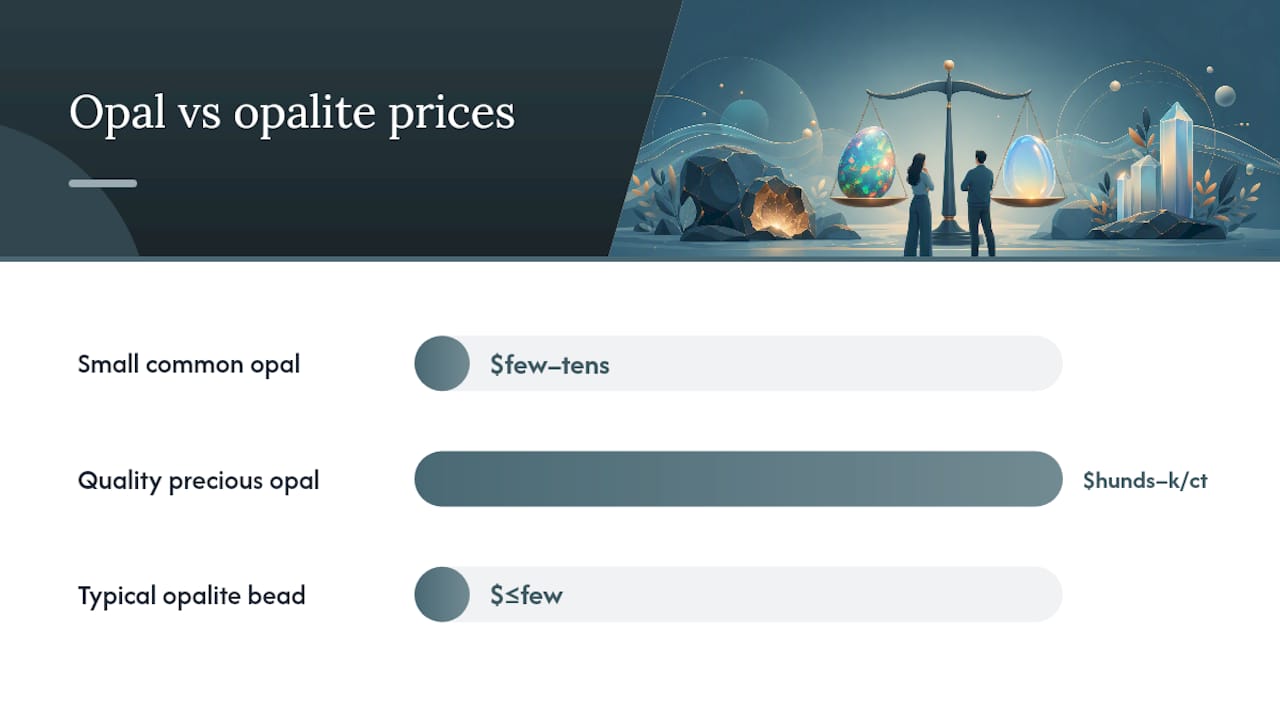
Illustrative price brackets:
- Small common opal (no play-of-colour): a few dollars to tens of dollars per piece
- Quality precious opal (documented play-of-colour, Australian origin): hundreds to thousands of dollars per carat
- Typical opalite bead or small cabochon: a few dollars or less per piece
Opal can hold or appreciate in collector value when it is rare, well-documented, and high quality. Opalite has negligible resale value beyond its decorative appeal. Knowing what makes a mineral collectible before purchasing helps set realistic expectations for either material.
Buying opal or opalite in Canada: checklist and red flags
Canadian buyers face the same misrepresentation risks as buyers anywhere, with the added consideration of import documentation when purchasing from overseas sellers.
Questions to ask every seller:
- Is this natural opal or man-made opalite? (Require a direct written answer.)
- What is the stone’s country of origin?
- Is a lab report or COA available? Who issued it?
- Is the opal solid, doublet, or triplet? (Doublets and triplets are legitimate but must be disclosed.)
- Are the photos of the exact item for sale, taken under natural light?
- What is the return policy for Canadian buyers, including shipping costs?
Red flags:
- “Black opal” priced at costume-jewellery levels
- No provenance offered for any stone claimed to be precious opal
- Seller refuses to provide a COA or lab report when asked
- Product photos appear heavily filtered or show only close-up macro shots with no scale reference
- Listing uses “opalite” and “opal” interchangeably without clarification
Canadian-specific guidance:
- Request import documentation (country of origin, declared value) when buying from overseas; this affects customs and any future resale or insurance appraisal.
- Confirm the seller’s refund and return shipping policy covers Canada explicitly.
- For significant purchases, request lab certificates from GIA or a Canadian gem lab recognised by the Canadian Gemmological Association.
When evaluating listing quality and finishing standards, compare how reputable sellers present products. The White Sea Urchin Quartz Bracelet – 12mm Polished Crystal | AAA Grade listing from Legacy Crystals and Minerals shows the level of product detail and material disclosure buyers should expect from any reputable seller. For broader guidance on spotting fake crystals online, Legacy Crystals and Minerals also maintains a practical reference guide.
How to care for opal and opalite
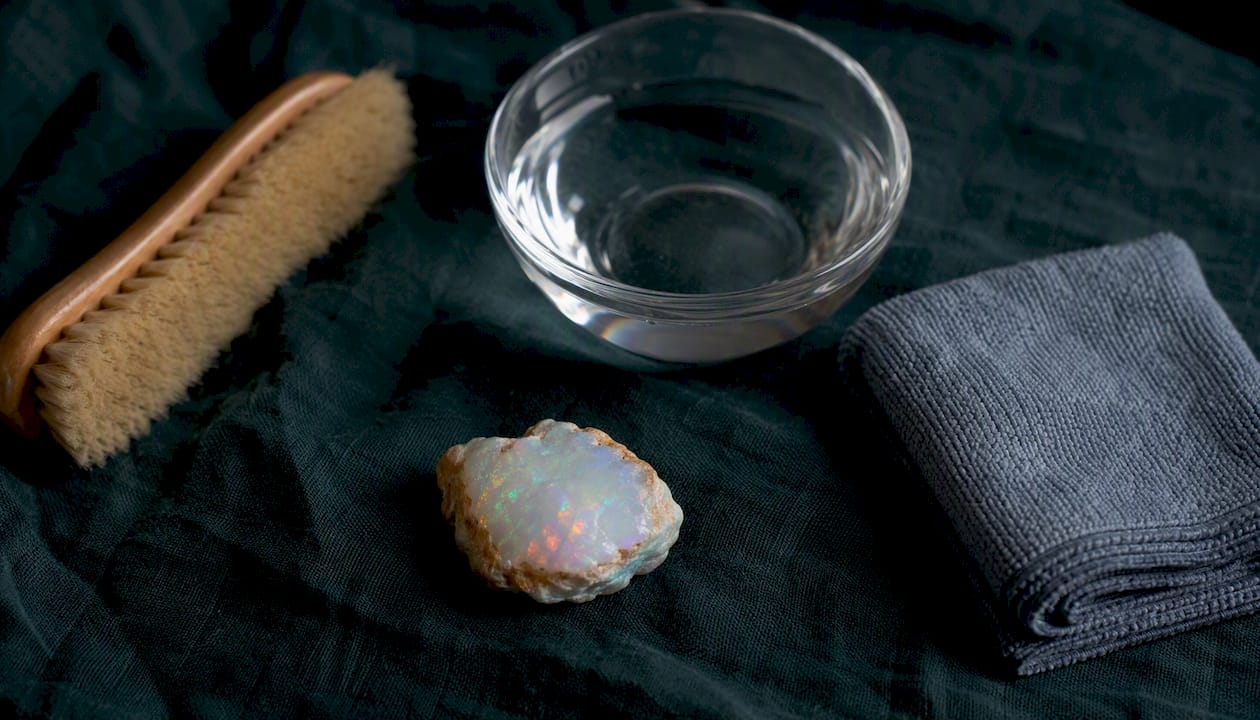
Care requirements differ significantly between the two materials.
| Care Factor | Natural opal | Opalite (glass) | Opalite (resin) |
|---|---|---|---|
| Recommended storage | Stable humidity, away from heat | Room temperature, standard storage | Avoid prolonged heat or direct sun |
| Cleaning method | Damp soft cloth only | Mild soap and soft cloth | Mild soap and soft cloth; no solvents |
| Heat sensitivity | High — avoid sudden temperature change | Moderate | High — resin can craze or discolour |
| Ultrasonic cleaner | Never | Not recommended | Never |
| Polish resilience | Moderate — surface can scratch at Mohs 5.5–6.5 | Good for glass | Lower — resin scratches more easily |
Natural opal dos and don’ts:
- Store away from direct sunlight and heat sources; opal contains water (up to 20% by weight) and can crack if it dries out
- Never use ultrasonic or steam cleaners
- Avoid sudden temperature changes (e.g., moving from a cold car to a heated room rapidly)
- Surface oiling is occasionally suggested for certain specimens, but only on professional advice
Opalite (glass or resin) dos and don’ts:
- Glass opalite is more tolerant of temperature variation than natural opal, but avoid thermal shock
- Resin-based opalite can craze or yellow with prolonged UV exposure
- Avoid acetone, alcohol, and other solvents on any resin piece
- Mild soap and a soft cloth are safe for both glass and resin opalite
Practical tip: Until a stone’s identity is confirmed, store and handle it as you would natural opal. This protects the piece regardless of what it turns out to be.
Key takeaways
Natural opal is an earth-formed mineraloid with potential play-of-colour and real collector value; retail opalite is almost always man-made glass or resin with negligible resale worth.
| Point | Details |
|---|---|
| Identity at a glance | Natural opal shows shifting multi-hued play-of-colour; opalite shows a uniform blue or peach glow. |
| Best home test | Check for air bubbles under a 10x loupe and observe the background colour shift (blue on dark, peach on light) — both indicate opalite glass. |
| Value gap | Quality precious opal can reach hundreds to thousands of dollars per carat; opalite beads retail for a few dollars or less per piece. |
| Lab test priority | Specific gravity (hydrostatic method) is the most reliable non-destructive test; plastic simulants measure approximately 1.20–1.21 versus natural opal at approximately 1.98–2.25. |
| Legacy Crystals and Minerals | Offers natural crystal and mineral specimens with clear material disclosure; browse the collection to compare listing transparency and finishing standards. |
Authoritative references and recommended labs
Primary references:
- GIA opal overview — formation, identification, and quality factors
- GIA opal quality factors — play-of-colour, body tone, pattern, and brilliance
- Gems & Gemology: plastic imitation opal study — specific gravity, IR, and microscopic markers
- geology.com: opalite vs opal — dual terminology explained
- Wikipedia: opalite — retail characteristics and lighting effects
- geologyscience.com: opalite — home-check heuristics
- allcrystal.com: opal vs opalite — optical and price comparison
- healing-sounds.com: natural opalite vs synthetic — buyer questions and seller guidance
For verification in Canada:
Legacy Crystals and Minerals is a starting point for purchasing natural crystal and mineral specimens with clear material disclosure. Browse the collection at legacycrystalsandminerals.com or contact the team to ask about specific pieces.
Natural specimens with full disclosure at Legacy Crystals and Minerals
Knowing the difference between natural opal and man-made opalite is only useful if the seller you buy from is transparent about what they are selling. Legacy Crystals and Minerals stocks natural crystal and mineral specimens, polished stones, and mineral-based jewellery, each listed with clear material identification and finishing details.
The White Sea Urchin Quartz Bracelet – 12mm Polished Crystal | AAA Grade is a practical example of how a reputable listing should read: material clearly named, grade stated, and photography showing the actual item. That standard of disclosure is what separates a trustworthy purchase from a gamble. For collectors adding specimens to a curated collection, Legacy Crystals and Minerals also carries museum-grade minerals with provenance documentation. Browse the full collection at legacycrystalsandminerals.com to find pieces that meet the same transparency standard this article recommends.
FAQ
Is opalite the same as opal?
No. Natural opal is an earth-formed hydrated silica mineraloid; retail opalite is almost always man-made opalescent glass or resin. The two share a visual similarity but differ in origin, composition, and value.
Is opalite a fake opal?
Opalite is a simulant, not a fake in the fraudulent sense, provided it is sold honestly as man-made glass. The problem arises when sellers use “opalite” and “opal” interchangeably without disclosing that the material is synthetic.
Which is more expensive, opal or opalite?
Natural opal is significantly more expensive. Quality precious opal can reach hundreds to thousands of dollars per carat; opalite beads and cabochons typically retail for a few dollars or less per piece.
Is opal better than opalite?
For collectors and buyers seeking a natural gemstone with resale value, natural opal is the superior choice. Opalite is a legitimate decorative material at its price point, but it holds no collector value and cannot substitute for natural opal in any gemological or investment context.
Recommended
- Pink Opal Bracelet — 8MM - Legacy Crystals and Minerals – Legacy Crystals and Minerals
- Vug vs. Geode — What’s the Difference? – Legacy Crystals and Minerals
- How to Identify Natural vs Synthetic Crystals – Legacy Crystals and Minerals
- Quartz Varieties — From Clear to Smoky to Strawberry – Legacy Crystals and Minerals


