
Raw crystal jewellery vs polished: how to choose for wear and energy
Raw crystal jewellery and polished crystal jewellery are equally authentic. Neither form is objectively better, so the right choice comes down to how you plan to use the piece.
Choose raw when you want dramatic texture, unfiltered visual presence, or a specimen meant for display, grids, or an altar. Choose polished when you want comfort against the skin, durability for daily wear, or a directed feel suited to meditation and bodywork. Here’s how that plays out in practice:
- Altar, grid, or display shelf → raw. Rough terminations and natural faces read as sculptural on their own.
- Pocket, pendant, or all-day bracelet → polished. Smooth surfaces don’t catch on fabric, skin, or pocket lining.
- Gift for a beginner or child → polished. No sharp edges, less risk of chips or scratches.
- Collector’s centrepiece or statement necklace → raw. The irregularity is the appeal.
If you only take one thing from this article: pick polished for anything that touches your body regularly, and raw for anything meant to be looked at rather than carried.
Table of Contents
- Raw crystal jewellery vs polished crystals: what the terms actually mean
- Physical and aesthetic differences: texture, colour, and how each form wears
- Do raw and polished crystals feel different energetically?
- Choosing raw or polished for jewellery: wearability and stone selection
- Caring for raw versus polished crystal jewellery
- Authenticity, treatments, and price: what finish tells you (and doesn’t)
- A quick checklist: which form should you actually buy?
- What sellers and setters recommend before you buy
- History and cultural significance of raw and polished crystal jewellery
- Does cutting or polishing reduce a crystal’s energetic effectiveness?
- Key takeaways: raw vs polished crystal jewellery in one glance
- Find your next piece with Legacy Crystals and Minerals
- Sources
- FAQ
Raw crystal jewellery vs polished crystals: what the terms actually mean
“Raw” and “polished” describe how much a specimen has been altered by human hands after it leaves the ground, not how genuine it is. Both are natural minerals. The difference lives entirely in the finishing process.
A raw crystal is largely untouched. It keeps its original growth formation, natural termination points, and the matrix or rough faces the mineral formed with underground. Quartz points, uncut amethyst clusters, and rough tourmaline all fall into this category. Some sellers lightly clean a raw piece to remove dirt, but they don’t cut, tumble, or shape it.
A polished crystal has been mechanically or manually altered to smooth its surface and reveal internal colour and clarity. That process might mean tumbling in a rotating drum for days, hand cutting into a cabochon, or shaping into beads for a bracelet. The difference between raw and polished crystals comes down to intervention level, not authenticity.
Plenty of pieces sit between these two extremes. A druzy slice keeps its natural crystalline crust on top while the base gets cut flat for setting. A cabochon is shaped and domed but not faceted like a gemstone. Tumbled beads sit at the fully polished end, worn smooth over hours of abrasive contact. Knowing where a piece falls on that spectrum helps you judge what you’re actually buying.
Physical and aesthetic differences: texture, colour, and how each form wears
The differences you can see and feel come down to four things: surface geometry, colour reveal, tactile feel, and how the piece photographs.
Raw crystals show their internal structure through natural facets and terminations. Light bounces off multiple uneven planes, creating a scattered, sometimes matte appearance. Colour often looks muted on the outer surface because the growth surface can carry mineral coatings or micro-fractures. Polished crystals eliminate that scatter. Cutting or tumbling exposes the crystal’s interior, so colour saturates and light travels through cleanly, which is why a polished amethyst tumble looks noticeably richer than a rough chunk of the same stone.
Texture is the most obvious difference on skin. Raw pieces can carry sharp termination points or jagged matrix edges. That’s part of their character, but it also means raw stone jewellery needs thoughtful design work to manage sharp edges and fragility, especially for anything worn close to the body. Polished stones are uniformly smooth, which is why they dominate bead bracelets and everyday rings.
| Feature | Raw crystal jewellery | Polished crystal jewellery |
|---|---|---|
| Surface texture | Irregular, natural faces and terminations | Smooth, consistent finish |
| Colour presentation | Often muted or matrix-covered | Saturated, light travels through cleanly |
| Photographs as | Sculptural, dramatic, high-contrast | Even, glossy, colour-forward |
| Comfort against skin | Can catch on clothing or skin | Comfortable for sustained contact |
| Typical setting | Wire wrap, cage, protective bezel | Prong, bezel, bead-strung |
Rough terminations also drive setting decisions. A jeweller working with a raw point has to decide whether to expose the natural tip (dramatic, but vulnerable) or cap it in metal (safer, less striking).
Pro Tip: Match the setting to the stone’s hardness, not just its looks. Bezel settings protect softer raw stones by enclosing the edges, while prong settings expose more of the stone and suit harder, more durable minerals like quartz or corundum.
Do raw and polished crystals feel different energetically?
The most common comparison in crystal work is the lamp versus the flashlight. Raw crystals, left in their natural formation, are described as radiating a more expansive, omnidirectional energy, like a lamp lighting an entire room. Polished crystals, smoothed and shaped, are described as delivering a more contained, directed energy, closer to a flashlight aimed at one spot.
That framing shows up consistently in how practitioners actually use each form:
- Room clearing or protection grids → raw specimens placed in corners or near entryways, chosen for their spread-out presence.
- Meditation or focused intention work → polished palm stones or points, held or placed where a single directed feel is useful.
- Pendulums → polished points almost exclusively, since balance and a smooth taper matter for movement.
- Body layouts and chakra work → polished stones, largely because their flat, smooth surfaces stay stable on the skin during sustained contact, where raw stones’ irregular shapes tend to shift or dig in.
Polishing a crystal changes its surface geometry and therefore its energy delivery pattern. It does not change the mineral’s underlying composition or its energetic signature.
That distinction, confirmed by practitioners who work with both forms, matters more than most buyers realize. A polished rose quartz and a raw rose quartz are the same mineral, chemically and energetically, at the molecular level. What differs is how that energy reaches you. Intention and use still do most of the work; the finish is a delivery mechanism, not a quality upgrade.
Choosing raw or polished for jewellery: wearability and stone selection
Jewellery adds a layer the display case doesn’t: the piece has to survive contact with your body, your clothes, and daily life.
Start with a basic wearability checklist before buying:
- Comfort: Will sharp edges or terminations dig into skin during normal movement?
- Stability: Does the setting hold the stone securely, or will an irregular raw shape work loose over time?
- Pocket-friendliness: Can it survive being dropped in a bag or pocket without chipping?
- Safety around kids and pets: Are there exposed points that could scratch or snag?
Setting choice answers most of these questions. Bezel settings wrap a metal rim around the stone’s edge, which protects softer raw stones and vulnerable girdles. Cage settings do something similar for larger, irregular raw pieces, holding them in a metal lattice without grinding down natural faces. Wire wrapping is the classic choice for raw points and clusters, since it can follow the stone’s natural shape rather than forcing it into a standard cut. Prong settings, by contrast, expose more of the stone and work best on harder, already-shaped material.
For raw pieces, look toward druzy slices, small geode sections, and terminated quartz points, all of which show off natural formation without excessive fragility. For everyday polished pieces, tumbled citrine, polished moonstone, and rounded rose quartz hold up to daily wear while still reading as clearly “crystal.” A polished bead bracelet like the Black & Red Copper Rutile Quartz Bracelet is a good example of how tumbling reveals internal rutile needles that would be nearly invisible on a rough surface.
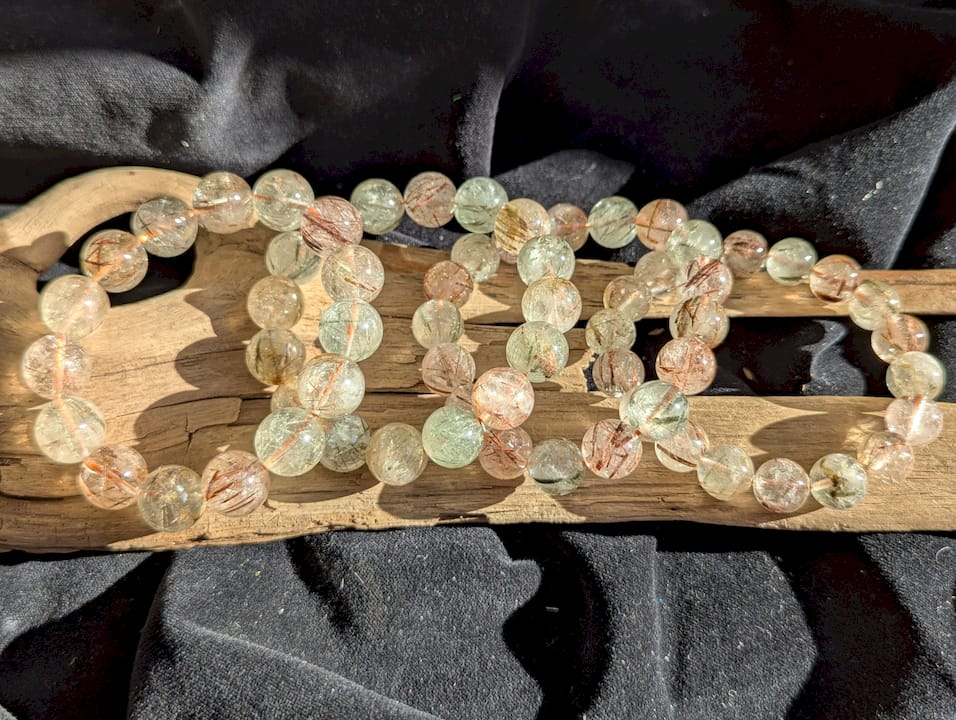
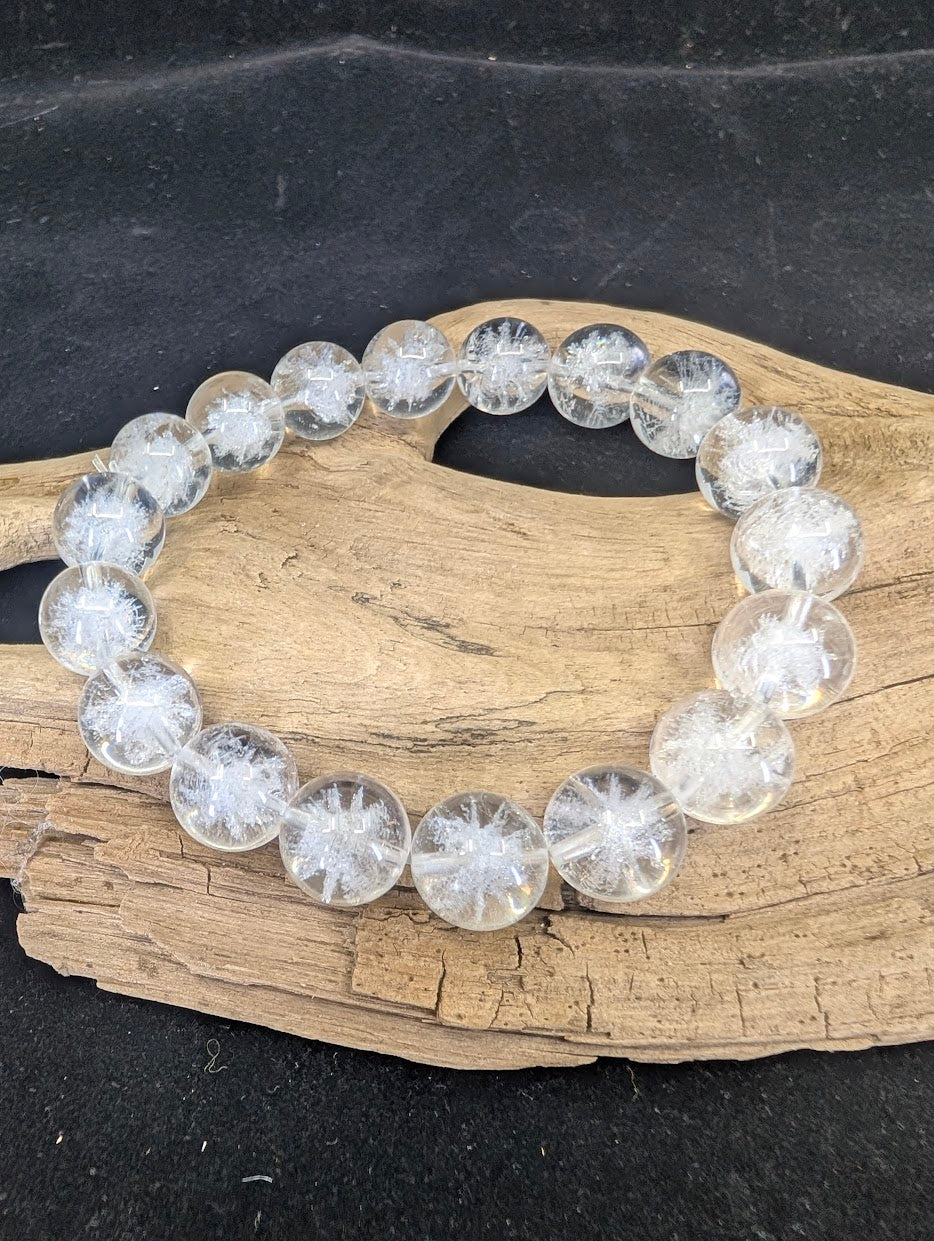
Some opaque, less fragile raw stones, like turquoise or lapis, can be set with minimal shaping when their natural edges aren’t sharp, giving you a raw look with fewer wearability trade offs. If you want the everyday comfort of polish with more texture visually, a bracelet like the White Sea Urchin Quartz Bracelet shows how a 12mm polished cut can still carry visual complexity through natural pattern and inclusions.
Caring for raw versus polished crystal jewellery
Cleaning method matters more here than with most jewellery, because the wrong approach can permanently damage a raw specimen’s natural surface or dull a polished piece’s shine.
For polished pieces:
- Wipe with a soft, lint-free cloth after each wear to remove oils and skin contact residue.
- Wash occasionally with mild soap and lukewarm water, then dry immediately.
- Avoid ultrasonic cleaners on softer or heat-sensitive stones like opal, turquoise, or moonstone, even though the smooth surface generally tolerates gentle handling better than raw specimens do.
- Store separately from harder gemstones to prevent surface scratching during storage.
For raw pieces:
- Use compressed air to remove loose dust from crevices and natural terminations, since a cloth can snag on sharp edges.
- For non-porous, non-soluble raw stones, a gentle soak in mild soap and water with soft brushing works, but always test a small area first.
- Never use steam or sonic cleaning on druzy specimens or heat-sensitive minerals. Vibration and heat can fracture natural crystal formations that a polished surface would tolerate.
- Store raw pieces separately, ideally in a padded compartment, since their irregular shape makes them prone to chipping against other jewellery.
A few minerals need extra caution regardless of finish. Calcite, selenite, and some turquoise are water-soluble or highly porous, and soaking them, raw or polished, can dull the surface or cause structural damage. Halite and certain soft carbonates are similarly vulnerable. When in doubt about a specific stone’s water tolerance, dry cleaning methods are the safer default.
Authenticity, treatments, and price: what finish tells you (and doesn’t)
Finish influences price far more than it influences authenticity. Both raw and polished specimens are genuine natural minerals; the real distinction is level of human intervention, not whether the stone is “real.”
Price patterns follow predictable logic:
- Large raw museum-grade specimens can command high prices, driven by rarity, size, and display value rather than processing.
- Tumbled and polished sets tend to be far more accessible, since machine tumbling processes large batches efficiently and fits standard jewellery formats.
- Rare polished cuts (fine cabochons, precision-faceted stones) can still be expensive when the raw material itself is scarce, showing that finish and rarity are separate value drivers.
Before buying, run through a short authenticity checklist:
- Weight: Natural minerals typically feel denser than glass or resin imitations of similar size.
- Matrix and inclusions: Genuine specimens usually show natural inclusions, colour zoning, or matrix attachment points that manufactured lookalikes rarely replicate convincingly.
- Seller provenance: A seller who can name the mine or region and disclose any treatment is a stronger signal than one who can’t.
- Testing for rarer stones: For high-value purchases, ask whether lab verification or gemmological testing is available.
Pro Tip: Before buying a rare or expensive specimen, ask the seller directly whether the stone has been dyed, stabilized, or heat-treated, and where it was mined. A seller with nothing to hide will answer specifically, not vaguely.
A quick checklist: which form should you actually buy?
Run through these questions before checkout, whether you’re shopping online or standing in front of a display case:
- Where will it live? A shelf or altar favours raw; a jewellery box you open daily favours polished.
- How will you use it? Grids, room energy, and collector display lean raw. Bodywork, meditation holding, and pendulum work lean polished.
- Do you need comfort or display? If the piece touches skin for hours, polished wins. If it’s meant to be seen, not worn constantly, raw holds its own.
- Are kids or pets nearby? Polished, smoother edges are safer around curious hands and paws.
If you’re still unsure, pick polished for portability and everyday contact, and raw for display, grids, and collector interest. You don’t have to commit to one or the other across your whole collection, either. Pairing a raw bracelet with polished studs or a pendant adds textural contrast to an outfit without sacrificing wearability where it counts.
What sellers and setters recommend before you buy
Provenance matters more with raw specimens because there’s less processing to hide flaws or misidentification. Ask any seller whether a stone has been stabilized, dyed, or otherwise treated, and request the region or mine of origin along with clear photos of natural, unaltered surfaces. That combination tells you more about what you’re actually paying for than a generic product description ever will.
Setting rules of thumb hold up across most stone types: bezel settings for softer raw roughs, since the enclosed edge protects both the stone and the wearer; prong settings for harder, already-shaped terminated crystals, since exposed edges aren’t a durability risk on quartz-hardness material or higher. For porous or softer raw stones like turquoise, avoid prolonged water exposure entirely and favour a bezel or cage over an open prong setting.
Legacy Crystals and Minerals documents provenance and specimen grading standards as part of its educational resources, giving buyers a reference point for what “collector grade” actually means before they compare listings elsewhere.
History and cultural significance of raw and polished crystal jewellery
Raw crystal use predates polishing technology by thousands of years. Early cultures wore or carried unmodified stones, valued for their natural form as much as any believed property, long before lapidary tools existed to shape them. Polishing itself is ancient too. Roman and Egyptian artisans ground and shaped gemstones using abrasive sand and water by hand, a slow process that made polished stones a mark of status because of the labour involved.
Mechanized tumbling changed the economics entirely in the twentieth century, turning polished stones from a luxury good into an everyday product. That shift is part of why polished crystal jewellery now dominates mainstream retail, while raw specimens have retained a niche tied more closely to collectors, mineralogists, and specific spiritual practices that value the stone’s untouched form as symbolically significant.
Does cutting or polishing reduce a crystal’s energetic effectiveness?
No credible source suggests cutting or polishing weakens a crystal’s underlying properties. What changes is the surface, not the mineral. A quartz point ground into a sphere is still quartz, chemically and structurally identical to its rough form, with the same trace elements and crystal lattice.
What practitioners describe changing is delivery, not strength. A rough point channels energy along its natural termination in one commonly cited framework; a sphere radiates evenly in all directions because it has no single directional point left. That’s a shape effect, not a potency loss. The strongest variable in any reported effect remains the person’s intention and consistency of use, not whether a lapidary wheel ever touched the stone.
Key takeaways: raw vs polished crystal jewellery in one glance
Neither raw nor polished crystal jewellery is objectively better. The right choice depends entirely on whether the piece needs to survive daily wear or simply needs to be seen.
| Point | Details |
|---|---|
| Match form to use | Polished for daily wear and bodywork; raw for display, grids, and collector pieces. |
| Setting protects the stone | Bezel settings suit softer raw stones; prong settings suit harder, already-shaped minerals. |
| Authenticity isn’t about finish | Both raw and polished specimens are genuine minerals; only intervention level differs. |
| Care routines differ by form | Raw pieces need compressed air and dry methods; polished pieces tolerate soap and water. |
| Legacy Crystals and Minerals offers both forms | Its catalogue includes polished bracelets and raw specimens, each described with provenance detail so buyers can match finish to purpose. |
Find your next piece with Legacy Crystals and Minerals
Legacy Crystals and Minerals carries both ends of this comparison under one roof, so you’re not choosing between a specialist raw dealer and a mass-market jewellery seller. Every listing includes provenance notes and grading detail, which means you can compare a rough specimen against a polished bracelet using the same standard of information rather than guessing at quality across different sellers.
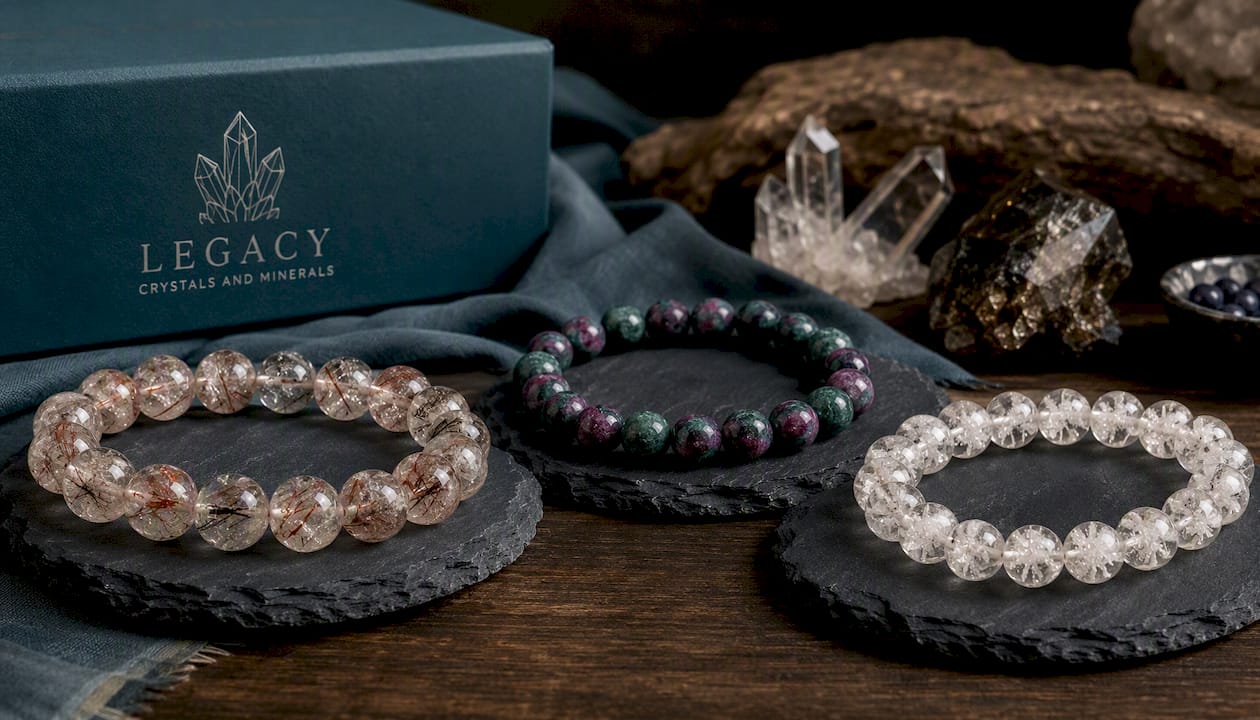
If daily wear and comfort are the priority, the Ruby in Blue Kyanite Bead Bracelet shows how natural corundum reads once tumbled and strung, with the kind of colour saturation that only shows up after polishing. Collectors leaning toward display pieces or grid work will find raw specimens catalogued with the same provenance rigour. Whichever direction fits your use case, browse the current collection and check the specimen notes on each listing before you buy, so the piece you choose actually matches how you plan to use it.
Sources
For readers who want to go deeper on any single piece of this comparison, a few resources cover the ground well. The International Gem Society’s guide on raw stone jewellery design and care is the most detailed independent resource on handling fragile raw specimens safely. Timothy Roe’s guide to stone setting styles breaks down bezel, prong, and cage settings in practical, jeweller-level detail.
- Raw vs Polished Crystals: Which Should You Buy? | Crystals Alchemy
- Raw stone jewelry design and care - International Gem Society
- An expert guide to stone setting styles - Timothy Roe
FAQ
Are raw crystals better than polished crystals?
Neither is objectively better. Raw crystals suit display, grids, and collector interest, while polished crystals suit daily wear, comfort, and directed practices like meditation or bodywork.
How can you tell if a raw crystal is real?
Check the weight (natural minerals usually feel denser than glass or resin), look for natural inclusions or matrix attachment, and ask the seller for provenance details like mine or region of origin.
Is a raw crystal worth anything?
Yes. Large or rare raw specimens can command high prices for their rarity and display value, sometimes exceeding comparable polished pieces, though smaller raw stones are often more affordable than finished jewellery.
Do raw crystals really work?
That depends on your framework for “work.” Practitioners describe raw crystals as delivering a more expansive, omnidirectional energy compared to the more directed feel of polished stones, but the underlying mineral composition is identical either way.
Should I choose raw or polished for everyday jewellery?
Polished. Smooth surfaces are more comfortable against skin, more durable for daily contact, and easier to set securely in rings, bracelets, and pendants worn regularly.


