

How to tell real jade from fake: a practical guide
The fastest reliable check combines three things: how the piece feels in your hand (cold and dense), how it looks under a 10× loupe (smooth, interlocking texture with no bubbles), and whether the specific gravity falls within the documented ranges for nephrite or jadeite. For anything with significant monetary value, a certified report from an accredited lab such as GIA or GemID Labs is the only definitive answer. British Columbia nephrite, a known Canadian source, adds a provenance layer that can support authentication but does not replace testing.
Quick three-step check:
- Cold test. Hold the piece in your palm for a short period. Real jade tends to retain a cool feeling longer than glass or plastic, which warm rapidly. A noticeably cool feel is a positive sign; warming quickly is a warning.
- Heft test. Compare the weight to a similarly sized piece of plastic or glass. Jade is noticeably denser. If it feels light, proceed with caution.
- Loupe inspection. Under a 10× loupe, look for an interlocking fibrous or granular texture. Bubbles, swirl marks, or a perfectly uniform surface point to glass or plastic.
Pro Tip: No single cue is reliable on its own. Colour, in particular, is the most misleading indicator. A piece can be the right shade of green and still be dyed serpentine or aventurine. Run at least two independent tests before drawing a conclusion.
Key takeaways
Specific gravity is the single most reliable non-destructive home test for separating real jade from imitations and for distinguishing jadeite from nephrite, because their SG ranges (3.24–3.43 for jadeite; 2.90–3.03 for nephrite) do not overlap.
| Point | Details |
|---|---|
| Start non-destructively | Begin with cold, heft, and loupe tests before any chemical or mechanical check. |
| Use specific gravity | SG ranges for jadeite (3.24–3.43) and nephrite (2.90–3.03) do not overlap, making hydrostatic measurement near-definitive. |
| Magnify the surface | A 10× loupe reveals interlocking crystal texture in real jade and bubbles or swirl marks in glass imitations. |
| Get a lab report for valuable pieces | Raman spectroscopy and RI testing at an accredited lab are the only methods that reliably detect polymer impregnation and dye. |
| Buy from Legacy Crystals and Minerals | Listings include close-up photography, treatment disclosure, and a return policy — the baseline standard for authenticated jade in Canada. |
Table of Contents
- What is jade, and why does jadeite vs nephrite matter?
- Non-destructive home tests you can do right now
- How to measure specific gravity and what the numbers mean
- What gem labs test for, and when you should submit a stone
- Common look-alikes and treatments: one quick check for each
- How to buy jade safely in Canada
- Authenticated jade at Legacy Crystals and Minerals
- Sources
- FAQ
What is jade, and why does jadeite vs nephrite matter?
GIA defines “jade” as a trade term covering two distinct minerals: jadeite and nephrite, and under certain conditions, green omphacite. Both are genuine jade. The confusion matters because they have different physical properties, different value ranges, and require slightly different tests to separate them from each other and from imitations.
Jadeite is a pyroxene mineral; nephrite is an amphibole. Fine translucent jadeite, particularly the vivid green “imperial” variety, commands significantly higher prices than nephrite because of its colour saturation and translucency. Nephrite tends toward greens, whites, and creams with a waxy or oily surface sheen. Jadeite’s surface appears glassier and more vitreous, which is one of the first visual cues to note.
For Canadian buyers, nephrite from British Columbia is a documented domestic source. Geology.com lists BC among the notable nephrite localities, and pieces with verifiable BC provenance carry a degree of trust that vague or unspecified origins do not.
| Property | Jadeite | Nephrite |
|---|---|---|
| Mineral group | Pyroxene | Amphibole |
| Mohs hardness | 6 to 7 | 6 to 6.5 |
| Specific gravity | approximately 3.24 to 3.43 | approximately 2.90 to 3.03 |
| Refractive index | roughly 1.654 to 1.688 | roughly 1.600 to 1.627 |
| Typical luster | Glassy/vitreous | Waxy/oily |
| Typical colours | Green, lavender, white, black | Green, white, cream, grey |
The SG and RI ranges do not overlap, which is what makes them diagnostic. Colour overlaps constantly across both species and their imitations.
Non-destructive home tests you can do right now
These tests work best as a sequence. Start with the least invasive, and only proceed to the next if you still have doubts.
Equipment checklist:
- 10× loupe (available at most jewellery supply or camera shops in Canada for under $20)
- Penlight or small flashlight
- UV lamp (long-wave, 365 nm)
- Chelsea colour filter
- Digital scale accurate to 0.01 g, plus a small cup of water (for specific gravity)
- Cotton swab and acetone (nail polish remover) — handle in a ventilated area, keep away from flame
The test sequence:
- Visual and colour consistency. Look at the colour distribution. Natural jade shows uneven colour zoning, fibrous veining, or subtle variation. Perfectly uniform, saturated colour throughout is a warning sign for dye or glass.
- Cold/hand test. As described above: real jade stays cool. The Gem Society notes this is useful but not definitive, since some dense glass and stone imitations also feel cool initially.
- Heft/weight. Pick it up and compare to a known piece of plastic or glass of similar size. Jade’s density makes it noticeably heavier. Light weight for the size is a strong flag.
- Flashlight/translucency. Hold a penlight directly against the piece in a dark room. Nephrite transmits little light and shows a cloudy glow. Fine jadeite can show a more even, fibrous glow. Glass shows a clean, uniform light transmission with no internal structure. Plastic barely transmits at all.
- Loupe magnification. This is one of the most useful home tests. Under 10× magnification, look for: an interlocking granular or fibrous crystal structure (jade), versus bubbles or swirl marks (glass), versus a smooth, featureless surface (plastic or resin). Dyed pieces may show colour concentrated along cracks or grain boundaries.
- Sound/tap test. Lightly tap two jade pieces together or tap with a fingernail. Genuine jade produces a clear, high-pitched ring. Plastic sounds dull and hollow. This test is less reliable for single pieces without a comparison.
- UV lamp check. Under long-wave UV, untreated jade (Type A) typically shows weak or no fluorescence. Resin-impregnated jade (Type B) often fluoresces a chalky blue-white. Dyed pieces (Type C) may show unusual fluorescence patterns. Not all treated pieces react, so a negative result does not confirm authenticity.
- Chelsea filter. A Chelsea colour filter transmits red and yellow-green wavelengths. Chromium-coloured natural jade appears red under a Chelsea filter. Dyed green jade typically stays green. This is a quick triage tool, not a final answer.
- Dye/acetone test. Dampen a cotton swab with acetone and rub a hidden area of the piece. If colour transfers to the swab, dye is present. Use in a ventilated space and avoid open flame.
Warning: Do not perform scratch tests on valuable pieces. Scratching a polished surface causes permanent damage and is unnecessary when specific gravity and loupe inspection are available.
For guidance on identifying treated or synthetic materials more broadly, the Legacy Crystals and Minerals knowledge base on natural vs synthetic crystals covers overlapping principles.
Home tests raise confidence but are not definitive for high-value purchases. A combination of passing results across multiple tests is meaningful; a single pass on one test is not.
How to measure specific gravity and what the numbers mean
Specific gravity (SG) is one of the few at-home measurements that provides near-definitive separation between jadeite and nephrite, because their SG ranges do not overlap. Jadeite SG is roughly between 3.24 and 3.43; nephrite SG is roughly between 2.90 and 3.03, according to documented gemological sources. A result in one range rules out the other species.
Hydrostatic method (step by step):
- Weigh the dry piece on a digital scale accurate to 0.01 g. Record this as W(air).
- Fill a small cup with water and suspend the piece fully submerged using a thin thread or wire, resting the cup on the scale. Tare the scale with the cup and water but without the piece, then lower the piece into the water without touching the sides. Record the reading as W(water).
- Calculate: SG = W(air) ÷ (W(air) − W(water)).
- Compare the result to the ranges below.
| Material | SG range | Notes |
|---|---|---|
| Jadeite | 3.24–3.43 | Higher density, pyroxene group |
| Nephrite | 2.90–3.03 | Lower density, amphibole group |
| Serpentine | 2.44–2.62 | Common imitation; noticeably lighter |
| Aventurine | 2.64–2.69 | Quartz-based; lighter than either jade species |
| Glass | 2.30–4.50 | Wide range; lead glass can mimic jade density |
| Plastic | 1.3–1.5 | Much lighter; fails heft test easily |
Practical limits. A scale accurate to 0.01 g is adequate for cabochons, beads, and small carvings. Pieces set in metal cannot be measured accurately without removing the stone. Resin-impregnated (Type B) jade has a lower SG than untreated jade of the same species because the polymer fills voids, so a result slightly below the expected range for jadeite does not automatically mean the piece is nephrite. It may be treated jadeite.
For pieces where the metal setting cannot be removed, or where the result falls near the boundary, send the piece to a gem lab for measurement under controlled conditions.
What gem labs test for, and when you should submit a stone
Lab testing goes beyond what any home method can achieve. Raman spectroscopy and refractive index spot readings identify the mineral species and detect polymer impregnation or certain dye signatures. These are not replicable at home, which is why lab certification is necessary for high-value pieces.
Common lab tests and what they detect:
- Refractive index (RI). Measured with a refractometer; identifies the mineral species. Jadeite RI ranges from 1.654 to 1.688; nephrite RI ranges from 1.600 to 1.627, based on standard gemology references…
- Specific gravity. Confirms species and flags resin impregnation (lower-than-expected SG for the species).
- Raman spectroscopy. Identifies mineral composition at the molecular level; detects polymer impregnation and some dye signatures. The most definitive non-destructive method available.
- Microscopy. Reveals dye concentration along grain boundaries, surface coatings, and resin-filled fractures.
- UV/fluorescence observation. Supports treatment detection as a secondary indicator.
Reading a lab report. A credible report names the issuing lab and its accreditation, lists every test performed, states the mineral species, and explicitly notes whether any treatment (bleaching, polymer impregnation, dyeing) was detected. A GIA report or one from a similarly accredited lab carries weight for resale and insurance purposes. Be cautious of reports that list only “jade” without specifying the species, or that omit treatment disclosure.
When to submit:
- Any piece priced above a few hundred dollars
- Pieces with unclear or unverifiable provenance
- Items intended for resale or insurance appraisal
- Any piece where home tests produce conflicting results
For Canadian buyers, GemID Labs and GIA both accept submissions by mail. Pack the piece in a rigid container with padding, use a tracked courier service, and declare the item accurately for customs. Turnaround times vary; expect several weeks for a full written report. Lab fees depend on the number of tests requested and the lab’s fee schedule, which each lab publishes on its website.
Common look-alikes and treatments: one quick check for each
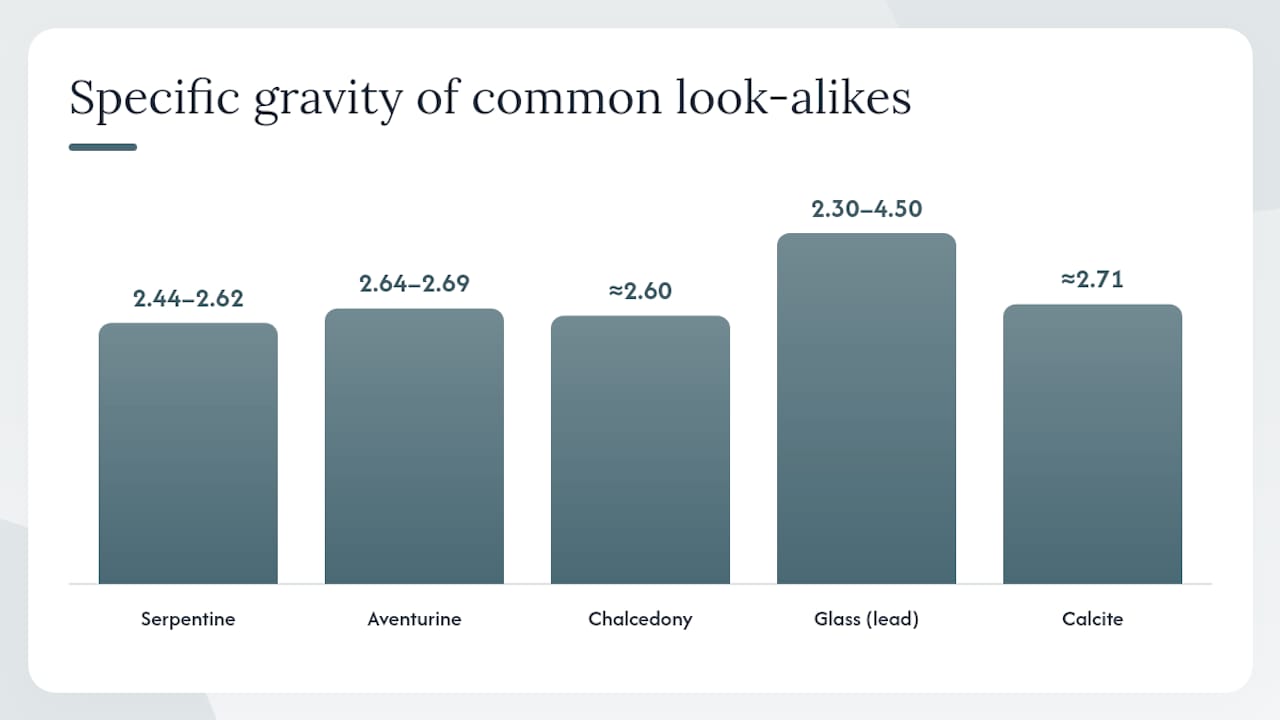
Skinner Inc. identifies serpentine, aventurine, chalcedony, and glass as the most common jade substitutes in the antique and collector market. Each has a practical triage check.
- Serpentine. SG typically falls around 2.44 to 2.62 for serpentine, a common jade substitute., noticeably lighter than either jade species. The heft test catches most serpentine immediately. Surface often feels slightly soapy. Mohs hardness around 3–4, so it scratches more easily than jade, though scratch testing is not recommended on finished pieces.
- Aventurine (green quartz). SG typically ranges around 2.64 to 2.69 for aventurine, another known jade look-alike., lighter than nephrite. Under a loupe, aventurine shows glittery inclusions (fuchsite mica) that jade does not. The difference between aventurine and jade is usually visible at 10× magnification.
- Chalcedony and dyed chalcedony. SG is close to 2.60 for chalcedony, which can be confused with jade… Lighter than jade. Chelsea filter: dyed green chalcedony typically stays green rather than turning red. UV may show unusual fluorescence in dyed pieces.
- Glass. SG varies widely, for example lead glass can range between 2.30 and 4.50. for lead glass). The loupe test is the fastest check: bubbles and swirl marks are visible in most glass imitations. Sound test: glass produces a duller tap than jade.
- Calcite. SG is around 2.71 for calcite, a mineral sometimes mistaken for jade… Much softer (Mohs 3). Reacts to dilute acid (fizzes), though acid testing is destructive and not recommended on finished jewellery.
- Vesuvianite (idocrase). Can visually resemble jadeite. SG ranges from about 3.27 to 3.45 for vesuvianite, which can resemble jadeite in appearance. overlaps with jadeite, making SG alone insufficient. RI and Raman are needed for a definitive separation.
- Plastic. Fails the heft test immediately. Warm to the touch. Loupe shows mould lines or a perfectly smooth, featureless surface.
Treatment categories. CAMEO records three treatment grades used in the trade:
- Type A: Untreated jade. May have surface wax polish only.
- Type B: Bleached and polymer-impregnated. Acid bleaching removes brown staining; resin fills the resulting voids. SG is lower than untreated material of the same species. UV fluorescence often chalky blue-white.
- Type C: Dyed. Colour is introduced artificially. Acetone test, Chelsea filter, and UV can detect many dye treatments. Dye concentrates along grain boundaries under a loupe.
Some polymer-impregnated stones pass the cold test and feel appropriately dense. Lab analysis is the only reliable check for Type B jade.
Pro Tip: When buying online, request a photo taken with a bright backlight (penlight held directly behind the piece) and a loupe image at 10× or higher. Sellers who decline both requests are a red flag regardless of the price point.
How to buy jade safely in Canada
Questions to ask any seller before purchasing:
- Does a lab report exist for this piece? If so, which lab issued it and what tests were performed?
- What is the exact weight in grams and the dimensions?
- Has the piece received any treatment (bleaching, polymer filling, dyeing)?
- What is the provenance or country of origin?
- What is the return policy if the piece does not match the description?
Red flags:
- “Imperial” quality claimed at unusually low prices. Fine translucent jadeite is expensive; a price that seems too good is almost always a sign of misrepresentation.
- Vague or absent origin information. “Asian jade” or “natural stone” without species identification is not adequate disclosure.
- Refusal to provide close-up or backlit photos.
- Pressure to decide quickly or no returns accepted on high-value items.
- Lab report names an unfamiliar or unaccredited lab, or the report lists only “jade” without specifying jadeite or nephrite and without treatment disclosure.
British Columbia nephrite. BC is a documented source of nephrite jade, primarily from the Cassiar and Fraser River areas. Pieces with verifiable BC provenance typically shows the characteristic waxy luster and green-to-grey-green colour range of nephrite. Provenance documentation from a Canadian supplier adds a layer of trust, but it does not replace physical testing or a lab report for high-value pieces.
For significant purchases, a local appraiser accredited through the Canadian Jewellers Association or a gemologist certified by GIA can examine the piece in person before money changes hands. This is particularly practical for estate sales, auction lots, or private sales where no lab report exists.
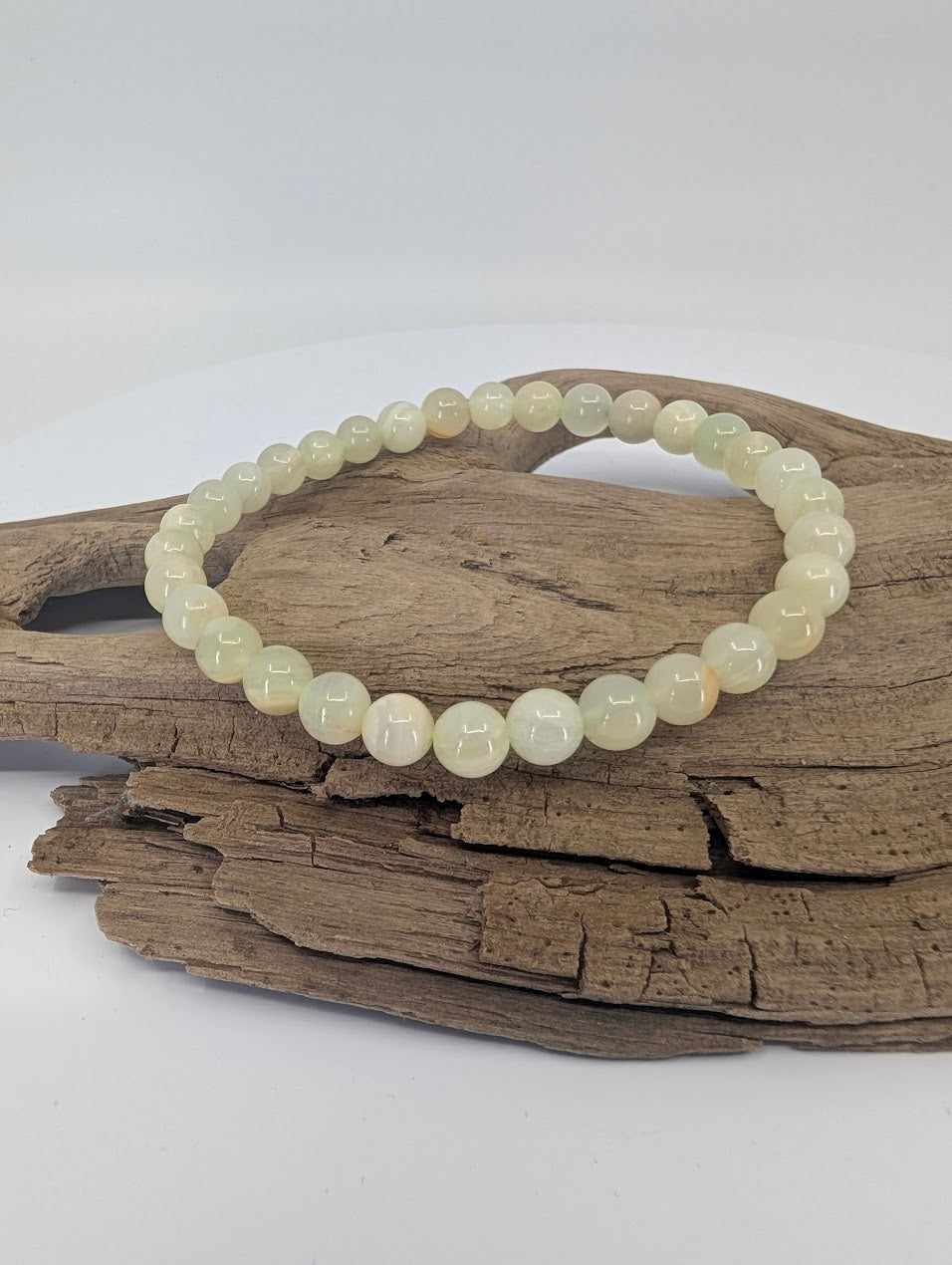
A green jade bracelet listing that includes close-up photos, stated bead dimensions, and clear treatment disclosure is the baseline standard to expect from any reputable seller.
Authenticated jade at Legacy Crystals and Minerals
Collectors who want to skip the guesswork have a direct option. Legacy Crystals and Minerals provides detailed product photography, stated measurements, and honest treatment disclosure on every jade listing. High-value pieces come with optional lab report support, and customer service is available for verification questions before purchase.
The coral jade bracelet listing is a practical example of what a transparent seller presentation looks like: close-up bead photos, exact bead size, and material identification. The milk jade bracelet follows the same standard. Every listing includes a return policy, so buyers are not locked into a purchase if the piece does not match expectations.
Two trust signals to expect from any reputable seller: itemised photos that show the surface texture and translucency under direct light, and explicit treatment disclosure stating whether the piece is Type A, B, or C. Legacy Crystals and Minerals meets both. Browse the authenticated jade collection and contact the team directly with any provenance or certification questions.
Sources
- What Is Jade Gemstone | Jade Stone – GIA
- Jade - CAMEO
- Jadeite jewellery and gemstone information – Gem Society
- Guide to antique jade — Skinner Inc.
FAQ
How does the flashlight test work for jade?
Hold a penlight directly against the piece in a dark room. Real jade transmits light with an uneven, fibrous or cloudy internal glow, while glass shows clean, uniform transmission and plastic transmits very little. The test helps distinguish jade from glass imitations but does not separate jadeite from nephrite.
What does low-quality jade look like?
Low-quality jade tends to be opaque or heavily mottled, with dull colour and a coarse surface texture visible under magnification. Type B and C jade (bleached, polymer-filled, or dyed) may appear artificially bright or evenly coloured in a way that natural material of the same grade would not.
What materials are most often mistaken for jade?
Serpentine, aventurine, and green chalcedony are the most common look-alikes. Serpentine is noticeably lighter (SG 2.44–2.62) and often has a soapy feel; aventurine shows glittery mica inclusions under a loupe; chalcedony stays green under a Chelsea filter rather than turning red as chromium-coloured jade does.
Is there a simple way to tell jadeite from nephrite at home?
Specific gravity measurement is the most reliable home method. Jadeite SG runs 3.24–3.43 and nephrite SG runs 2.90–3.03; the ranges do not overlap. Surface luster is a secondary cue: jadeite appears glassy and vitreous, nephrite appears waxy or oily.
Who should avoid wearing jade?
There are no documented physical contraindications to wearing jade for most people. Those with known nickel or metal allergies should check the metal components in jade jewellery settings rather than the stone itself. For metaphysical or cultural guidance on jade wearing practices, consult a practitioner in the relevant tradition.
Recommended
- How to spot fake crystals online: a practical guide – Legacy Crystals and Minerals
- How to Identify Natural vs Synthetic Crystals – Legacy Crystals and Minerals
- How to Buy Crystals Online Without Getting Scammed – Legacy Crystals and Minerals
- What are phantom crystals: how to identify, use and care for them – Legacy Crystals and Minerals


