

Real vs fake turquoise: how to tell the difference
Real turquoise has irregular colour variation, organic matrix veining, a waxy or matte surface, and no dye transfer when wiped with acetone. If a stone is perfectly uniform in colour, has painted-looking lines, feels light, or leaves blue residue on a cotton swab, it is almost certainly an imitation.
Quick checks at a glance:
- Colour: Natural turquoise ranges from robin’s egg blue to greenish blue. Perfectly even, vivid colour is a red flag.
- Matrix: Authentic veining is irregular and three-dimensional. Uniform, printed-looking lines are not.
- Temperature: Real turquoise feels cool and stays cool briefly. Plastic warms up fast.
- Acetone wipe: Dyed fakes transfer colour to a cotton swab. Genuine untreated turquoise does not.
- Weight: Natural stone has noticeable heft. Plastic and resin feel noticeably lighter.
Pro Tip: The fastest two-step confirmation is a 10× loupe check of the matrix followed by an acetone wipe on an inconspicuous spot. Together, these two tests catch the most common fakes without damaging the stone.
Table of Contents
- What are the most common turquoise fakes?
- What does real turquoise look like under inspection?
- Non-destructive tests you can do at home
- Chemical and destructive tests: what they show and when to avoid them
- Stabilised, dyed, reconstituted, and synthetic: what the trade terms mean
- When is professional testing worth it in Canada?
- Buying checklist and red flags
- Ethical and legal considerations for turquoise trade in Canada
- Key takeaways
- Verified turquoise and natural stones at Legacy Crystals and Minerals
- Useful sources
- FAQ
What are the most common turquoise fakes?
The history of turquoise simulants stretches back thousands of years, from Egyptian faience to modern dyed howlite. Today, four categories dominate the market.
Dyed howlite and magnesite are the most prevalent fakes. Both minerals are white with natural grey veining, which makes them visually convincing once dyed blue or blue-green. The matrix pattern on dyed howlite can look surprisingly organic, which is why the acetone test matters so much. Howlite has a Mohs hardness of roughly 3.5, noticeably softer than genuine turquoise.
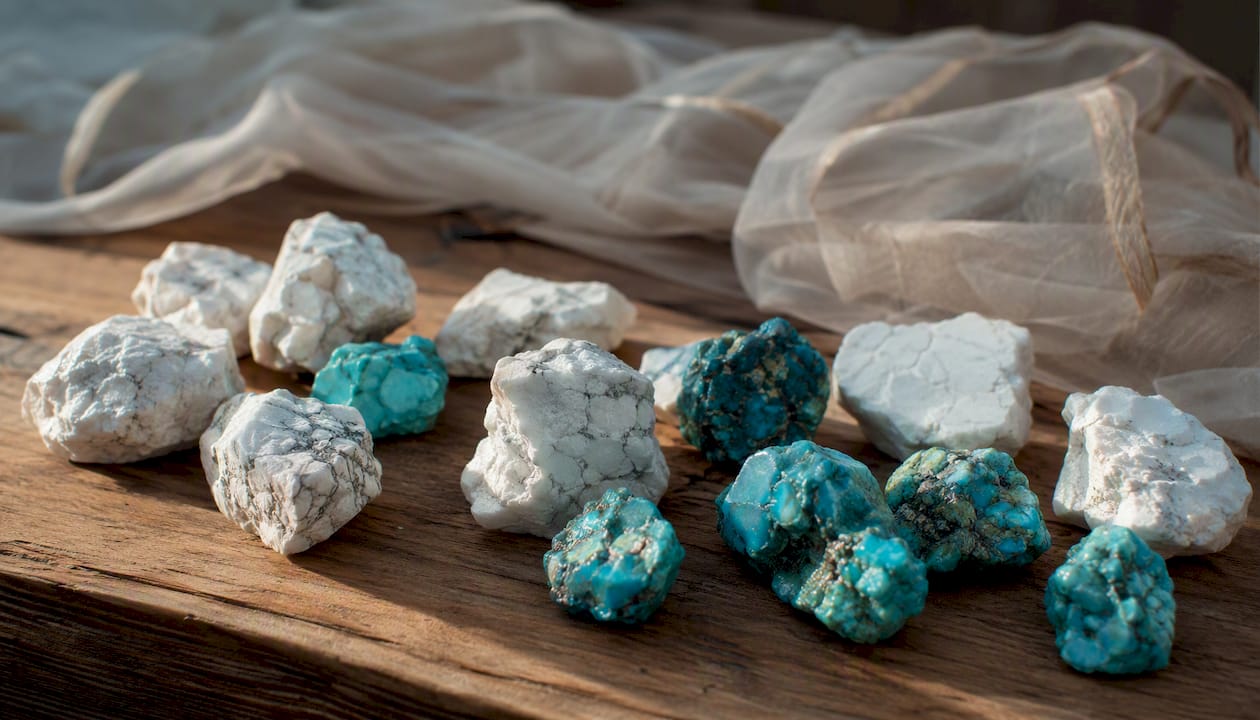
Plastic and resin imitations are cheap to produce and common in mass-market jewellery. They feel warm, weigh less than stone, and often have a slightly glossy or sugary surface. Under magnification, mould seams or tiny air bubbles are sometimes visible.
Reconstituted turquoise is made from genuine turquoise powder or chips compressed with a resin binder. It contains real turquoise material but is not a solid natural stone. Colour tends to be more uniform than natural material, and the binder can affect how the stone reacts to solvents.
Glass and enamel simulants are less common but still appear in vintage and costume pieces. Glass is harder than turquoise, has a glassy luster rather than waxy, and shows no porosity. Enamel over metal is identifiable by its perfectly smooth surface and the metal base visible at edges or drill holes.
The turquoise market is widely estimated to contain a very high proportion of treated, dyed, or simulated material. Some trade sources suggest that up to around 90% of what is sold as turquoise is either treated or not genuine turquoise at all. Knowing the fakes is not optional; it is the baseline.
Reconstituted material and treated turquoise occupy a middle ground. They are not outright fakes, but they are not natural gem-grade stones either. Their value is lower, and reputable sellers are required to disclose treatment status.
What does real turquoise look like under inspection?
Visual inspection is the first and most practical step in genuine turquoise identification. No tools beyond a 10× loupe or a phone camera with macro mode are needed.
Colour range and uniformity
According to GIA, the most prized turquoise colour is an even, intense medium blue often called robin’s egg or Persian blue. Natural stones also occur in greenish blue, blue-green, and yellowish green depending on their iron and copper content. The key word is natural variation: colour in genuine turquoise shifts slightly across the surface and between stones from the same deposit. A stone with perfectly uniform, saturated colour from edge to edge warrants closer examination.
Matrix clues
Matrix refers to the host rock material left in the stone during formation. Turquoise forms in veins and nodules within host rock, so matrix is a natural byproduct, not a defect. Under a 10× loupe, authentic matrix veins are three-dimensional, irregular in width, and often show slight colour gradation at the edges. Fine spiderweb matrix is considered desirable by collectors. Painted or printed lines, by contrast, sit on the surface, have uniform width, and show no depth.
Surface texture and luster
Genuine turquoise has a waxy to sub-vitreous luster and often shows fine surface porosity under magnification. Tiny natural pits are normal. Plastic imitations have a smoother, more uniform surface with a slightly glassy sheen. Reconstituted stones can look grainy or show a faint granular texture where the binder meets the turquoise particles.
Photographing a stone for a seller query
- Macro shot of the matrix from directly above
- Side profile showing the cabochon dome height
- Edge and back view showing the base material and any drill holes
- One shot in natural daylight, one under indoor light to show colour shift
Non-destructive tests you can do at home
These checks are practical for consumers and carry no risk of damaging the stone when done carefully.
Weight and temperature
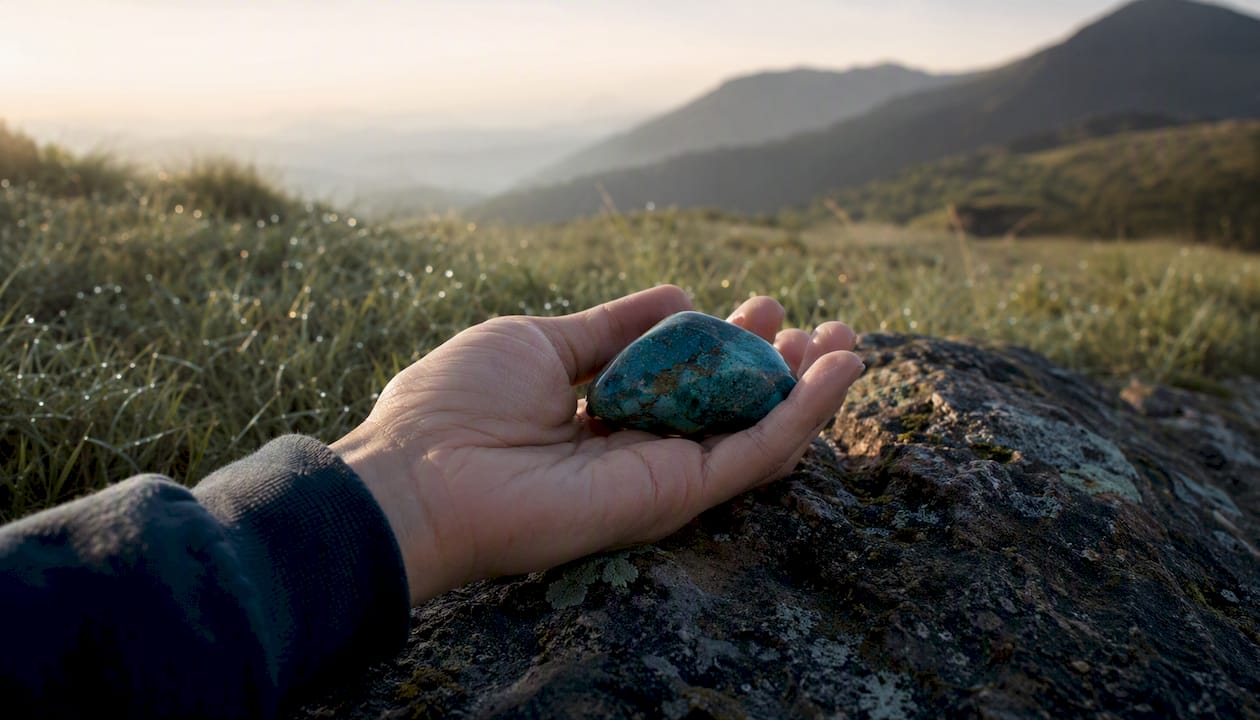
Hold the stone in your palm for 10–15 seconds, then set it down and pick it up again. Natural turquoise has a specific gravity of roughly 2.6–2.9, so it has noticeable heft for its size. More telling is the temperature: stone stays cool for a moment when you first pick it up. Plastic reaches body temperature almost immediately.
Magnification
A 10× jeweller’s loupe is the single most useful tool for turquoise authenticity checks. Look for:
- Dye pooling in cracks or matrix lines (a sign of dyed material)
- Air bubbles or mould lines (plastic or glass)
- Grain boundaries where turquoise particles meet binder (reconstituted)
- Natural porosity and irregular surface texture (genuine)
Magnet test
Turquoise is not magnetic. A strong rare-earth magnet held near the stone should produce no attraction. This test is more useful for ruling out metallic inclusions or certain iron-rich fakes than for confirming authenticity on its own.
UV light
Natural turquoise typically shows weak or no fluorescence under long-wave UV. Some synthetic and treated stones fluoresce more strongly. UV is a supporting check, not a definitive one, because results vary by deposit and treatment type.
Water absorption
Untreated natural turquoise is porous and will absorb a small drop of water quickly, leaving a slightly darkened spot that fades as it dries. Stabilised turquoise resists water absorption because the resin fills the pores. Plastic shows no absorption at all.
Pro Tip: Run the weight, magnification, and water absorption checks together before moving to any chemical test. If all three are consistent with natural stone, you have reasonable confidence without touching the surface with any solvent.
Chemical and destructive tests: what they show and when to avoid them
These tests can be decisive, but several carry a real risk of permanent damage. Use them only on inconspicuous spots, and avoid them entirely on valuable or finished pieces.
Acetone (solvent) test
Dampen a cotton swab with acetone (nail polish remover) and rub it gently on an inconspicuous area, such as the back of a cabochon or inside a drill hole. Dyed howlite and magnesite typically release blue or green dye onto the swab. Genuine untreated turquoise leaves the swab clean. Stabilised turquoise may also leave the swab clean because the resin seals the dye in place, so a clean result does not automatically confirm natural untreated stone.
Hot-needle test
Heating a needle and pressing it briefly against the stone can reveal plastic: plastic melts, smells of burning polymer, and leaves a small indentation. Natural stone does not melt. This test is destructive and leaves a visible mark. It is not recommended on any piece you intend to keep or sell.
Scratch and hardness check
Turquoise sits at a mid-range hardness on the Mohs scale, while howlite is approximately 3.5 and glass is around 5.5–7. A steel nail file (roughly Mohs 6.5) will scratch howlite and magnesite but will not scratch genuine turquoise or glass. This test leaves a mark, so apply it only to the back or base of the stone.
For any stone worth more than a modest amount, skip the destructive tests entirely. Non-destructive lab methods — refractive index measurement, specific gravity, and FTIR spectroscopy — provide definitive identification without touching the surface. A credentialed gemologist can run these checks in a single appointment.
- Acetone: useful, low-risk on inconspicuous spots, but does not distinguish natural from stabilised
- Hot needle: definitive for plastic, but permanently damages the stone
- Scratch test: useful for ruling out howlite, but leaves a mark
- Lab tests (RI, SG, FTIR): definitive, non-destructive, recommended for anything of value
Stabilised, dyed, reconstituted, and synthetic: what the trade terms mean
The turquoise trade uses specific terms that directly affect value and how a stone behaves during testing. Knowing them prevents misunderstandings when buying.
| Treatment | What it is | Effect on tests | Typical value |
|---|---|---|---|
| Natural/untreated | No treatment applied | Absorbs water; acetone may lift surface dust only | Highest |
| Stabilised | Resin injected to harden porous stone | Resists water; acetone often clean | Lower than untreated |
| Enhanced (dyed/stabilised) | Dyed and resin-impregnated | Acetone may or may not transfer dye | Lower still |
| Reconstituted | Turquoise powder + binder pressed into shape | Granular under loupe; variable acetone result | Low |
| Synthetic (e.g. Gilson) | Lab-created with turquoise composition | Passes basic tests; needs spectroscopy | Low to moderate |
| Simulant | Different material (howlite, plastic, glass) | Fails acetone, hardness, or RI tests | Negligible |
GIA notes that untreated gem-grade turquoise commands the highest prices, and that matrix type and colour saturation are the primary quality drivers. Stabilised turquoise is still genuine turquoise, but the resin alters its porosity and can affect long-term colour stability if the stone is exposed to heat or harsh chemicals. Reconstituted material contains real turquoise but is essentially a manufactured product. Gilson turquoise, the best-known synthetic, has a composition close enough to natural turquoise that it requires spectroscopic testing to separate definitively.
Disclosure of treatment is standard practice among reputable sellers. If a seller cannot or will not state the treatment status of a stone, that is a meaningful red flag.
When is professional testing worth it in Canada?
Simple at-home tests catch the most common fakes, but they cannot replace lab analysis for high-value purchases. The decision to escalate depends on price, provenance, and intended use.
When to seek a gemologist or lab
- The stone is priced above a few hundred dollars
- The seller claims the stone is natural and untreated without documentation
- The piece is described as Persian or Nishapur turquoise without a provenance certificate
- The stone is intended for resale, insurance, or a collection of record
What labs check
Gemologists use refractive index (RI) measurement, specific gravity, FTIR spectroscopy, and microscopic inclusion analysis. Together, these tests can distinguish natural from stabilised, reconstituted, and synthetic material with certainty. A written lab report documents the findings and is the standard deliverable for any certified examination.
Finding accredited help in Canada
The Gemological Institute of America (GIA) trains gemologists worldwide, and GIA-certified gemologists practise across Canada in major cities including Toronto, Vancouver, Calgary, and Montreal. The Canadian Gemmological Association (CGA) also certifies gemologists and maintains a directory of members. For a stone of significant value, request a written report on letterhead from a credentialed professional, not just a verbal opinion.
Turnaround times and fees vary by lab and service level; expect to pay a fee for any formal written report, and confirm the cost before submitting a stone. Costs are not publicly standardised, so contact the lab directly for current pricing.
Seller transparency checklist before paying for a lab test
- Written disclosure of treatment status
- Clear macro photographs of matrix, back, and edges
- Stated provenance (mine or region of origin)
- Return policy in writing
- Lab report for any stone described as natural and untreated above a modest price point
Buying checklist and red flags
Use this before purchasing turquoise online, at a market, or in a shop. For more detail on buying crystals online safely, the same principles apply across gemstone categories.
Buyer checklist
- Ask for treatment disclosure in writing
- Request 10× loupe-quality photographs of matrix, back, and drill holes
- Confirm provenance (mine or region) for any stone above a modest price
- Check the return policy before paying
- Request a lab report for any natural/untreated claim above a few hundred dollars
Red flags
- Price far below comparable natural turquoise on the market
- Perfectly uniform colour with no matrix variation
- Seller refuses to disclose treatment status
- No return policy or paperwork
- Claims of “Persian” or “Nishapur” origin without documentation
- Glue-set stones where the base material is hidden
- Photographs taken only in heavily filtered or low-resolution lighting
Ethical and legal note for Canadian buyers
When purchasing turquoise described as originating from Indigenous-operated mines or carrying cultural significance, verify the sourcing chain. Canada’s Cultural Property Export and Import Act governs the import of certain culturally significant objects, and buyers should confirm that any piece with claimed Indigenous provenance complies with applicable Canadian and international regulations. For turquoise from the United States, note that some mines operate under Indigenous land agreements, and ethical sourcing means confirming the seller has a legitimate supply relationship. When provenance matters, ask for it in writing.
Ethical and legal considerations for turquoise trade in Canada
Turquoise sold in Canada arrives from a range of sources: the American Southwest (Nevada, Arizona, New Mexico), Iran, China, Mexico, and elsewhere. Each origin carries different ethical and legal considerations.
Import regulations
Canada Border Services Agency (CBSA) applies standard import rules to gemstones and jewellery. Turquoise itself is not a restricted material under CITES (the Convention on International Trade in Endangered Species), but any piece that incorporates protected materials alongside turquoise (certain coral, shell, or ivory inlays, for example) may require documentation. Buyers importing directly should verify the full composition of any piece before it crosses the border.
Indigenous sourcing and cultural considerations
A significant portion of the world’s most valued turquoise comes from mines in the American Southwest with ties to Navajo, Zuni, Pueblo, and other Indigenous communities. Authentic Native American jewellery is protected under the U.S. Indian Arts and Crafts Act, which prohibits misrepresentation of non-Native-made goods as Native-produced. Canadian buyers purchasing pieces described as Native American should ask for documentation confirming the maker’s tribal affiliation. Purchasing from verified Indigenous-owned businesses or certified traders is the clearest way to support ethical sourcing.
Disclosure obligations for Canadian sellers
In Canada, consumer protection legislation at the federal and provincial levels requires accurate product description. Selling dyed howlite as turquoise, or stabilised turquoise as natural untreated stone, without disclosure can constitute misrepresentation under the Competition Act. Buyers who believe they have been misled about a gemstone’s identity have recourse through provincial consumer protection offices.
For guidance on spotting fake crystals more broadly, the same disclosure and provenance principles apply across mineral categories.
Key takeaways
Genuine turquoise identification comes down to three reliable checks: irregular matrix under magnification, no dye transfer on an acetone swab, and stone-like weight and temperature — with lab testing reserved for any piece above a modest price point.
| Point | Details |
|---|---|
| Matrix is the strongest visual indicator | Authentic matrix is irregular and three-dimensional; uniform or printed-looking lines indicate a fake. |
| Acetone test catches dyed fakes | Dyed howlite and magnesite transfer colour to a swab; untreated natural turquoise does not. |
| Hardness separates howlite from turquoise | Turquoise rates 5–6 on the Mohs scale; howlite is around 3.5 and scratches more easily. |
| Lab testing is necessary above modest price points | GIA-certified gemologists and CGA members across Canada can provide written reports using RI, SG, and FTIR. |
| Legacy Crystals and Minerals | Offers verified natural stone pieces with clear product descriptions and sourcing transparency for collectors. |
Pro Tip: Start with the 10× loupe check of the matrix, then follow with an acetone wipe on the back of the stone. These two steps together identify dyed howlite and most plastic imitations without any risk of damage.
Verified turquoise and natural stones at Legacy Crystals and Minerals
Knowing how to spot a fake is most useful when there is a reliable source to turn to. Legacy Crystals and Minerals stocks natural stone pieces with clear descriptions of material, origin, and finish — no vague claims, no undisclosed treatments.
The product listings include macrophotography, material details, and sourcing information so buyers can apply the checks in this article before purchasing. For collectors who want finished jewellery alongside raw specimens, the turquoise chip bracelet is listed with full material disclosure. Verified natural stone pieces across categories, from malachite to museum-grade specimens, are available with the same transparency standard. Browse the full collection at Legacy Crystals and Minerals and use the buying checklist above to evaluate any piece before checkout.
Useful sources
The following sources were used in preparing this article. For any high-value purchase, seek a lab with recognised credentials (GIA, CGA, or equivalent) and request a written report.
- Turquoise Gemstone | Turquoise Stone – GIA
- ターコイズの品質を決定する要因 | ターコイズのさまざまな種類と色 | GIA
- Turquoise - Wikipedia
- How to Tell if Turquoise Is Real: 7 Tests That Work | Jewelry Identifier
- Turquoise gemstone color, types, properties | Rockhounding.org
- Turquoise Buying Guide: Spot Fakes, Grades, Prices | Joalys
- History and legend of turquoise | Gem Society
- How turquoise forms and how to identify it | HowStuffWorks
FAQ
How can you tell if turquoise is genuine?
Check for irregular matrix veining under a 10× loupe, confirm the stone feels cool and has noticeable heft, and wipe an inconspicuous spot with acetone. Genuine untreated turquoise shows no dye transfer and has organic, three-dimensional matrix rather than uniform printed lines.
What is the tongue test for turquoise?
Placing the stone briefly on the tip of the tongue tests porosity: porous natural turquoise creates a slight sticking sensation as it absorbs moisture. Plastic and glass show no reaction. This test is a rough indicator only and is less reliable than the acetone or magnification check.
Does real turquoise glow under UV light?
Natural turquoise typically shows weak or no fluorescence under long-wave UV light. Some treated or synthetic stones fluoresce more noticeably. UV is a supporting check rather than a definitive test, since results vary by deposit and treatment.
How does a magnet test help with turquoise?
Turquoise is not magnetic, so a strong rare-earth magnet should produce no attraction to a genuine stone. The test is most useful for ruling out metallic fakes or heavily iron-rich imitations, but it does not distinguish natural turquoise from dyed howlite or plastic on its own.
When should a Canadian buyer request a lab report?
Request a written lab report from a GIA-certified gemologist or Canadian Gemmological Association member whenever a stone is priced above a few hundred dollars, described as natural and untreated without documentation, or claimed to be from a prestigious origin such as Nishapur without a provenance certificate.
Recommended
- How to spot fake crystals online: a practical guide – Legacy Crystals and Minerals
- How to Identify Natural vs Synthetic Crystals – Legacy Crystals and Minerals
- How to Buy Crystals Online Without Getting Scammed – Legacy Crystals and Minerals
- Turquoise Chip Bracelet – Natural Blue-Green Stone - Legacy Crystals and Minerals – Legacy Crystals and Minerals


