

UV minerals: properties, applications, and benefits
UV minerals are defined as minerals that absorb ultraviolet radiation and instantly emit visible light through a process called fluorescence. This effect is driven by trace activator elements, such as manganese, europium, and chromium, embedded within crystal lattices at concentrations as low as a few parts per million. The result is a vivid, colour-shifting display that serves purposes far beyond aesthetics. Collectors, geologists, and energy healing practitioners all rely on UV reactive minerals for identification, research, and personal practice. Common fluorescent species include fluorite, calcite, willemite, and sodalite.
How do UV minerals work at a chemical level?
Fluorescence in minerals occurs when specific atoms absorb high-energy ultraviolet radiation and emit visible light at longer wavelengths. The process begins the moment UV light strikes the mineral surface. Understanding it requires looking at what happens inside the crystal structure itself.
When a UV photon hits an activator atom, it pushes an electron from its ground state into a higher energy level. That electron cannot stay elevated. It drops back down almost immediately, releasing the excess energy as a photon of visible light. Because visible light has a longer wavelength than UV, the emitted colour differs from the source light. This shift is called the Stokes shift, and it is what makes fluorescence visible to the naked eye.
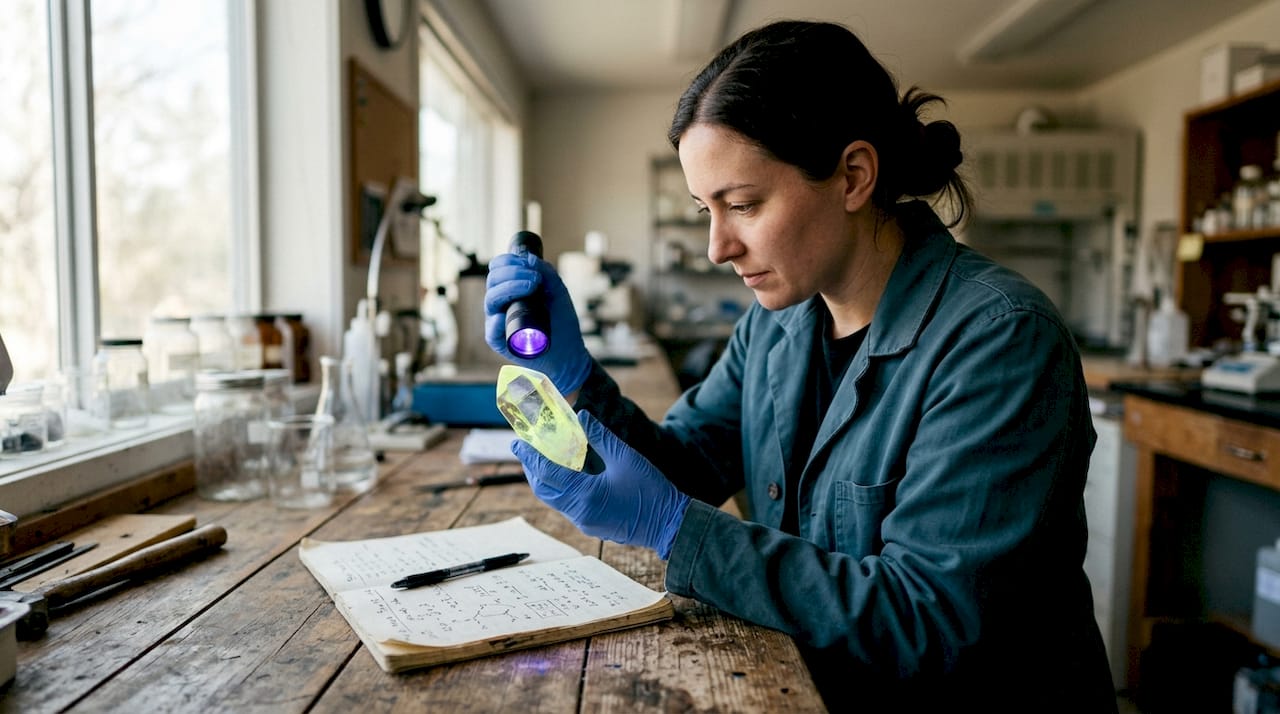
The activator element determines the colour of the emitted light. Manganese, for example, causes red or orange fluorescence in calcite. Europium produces the blue glow seen in many fluorite specimens. Chromium drives red fluorescence in ruby. Each activator has a characteristic emission signature tied to its electron configuration.
Not every mineral fluoresces, even when activators are present. Certain elements, particularly iron, act as quenchers. They absorb the energy before it can be released as light. This is why two calcite samples from different deposits can behave completely differently under the same UV lamp.
- Activators like manganese, europium, and chromium trigger fluorescence at trace concentrations.
- Electrons absorb UV energy, rise to an excited state, then release visible light on return.
- Fluorescence is instantaneous: it starts and stops with the UV light, unlike phosphorescence, which lingers.
- Iron and similar elements suppress fluorescence through quenching.
- The same mineral species can fluoresce differently depending on its deposit of origin.
Pro Tip: If a specimen does not fluoresce under one UV lamp, try a different wavelength before concluding it is non-fluorescent. Many minerals respond only to shortwave or longwave UV, not both.
What are the different types of UV light for minerals?
UV light used in mineralogy falls into three main categories: longwave, shortwave, and midwave. Each interacts with minerals differently, and choosing the right source is as important as choosing the right specimen.
Longwave UV, at 365 nm, is the most widely used. It is safer for casual handling and triggers fluorescence in many common species, including calcite, fluorite, and sodalite. Most collectors start here. Shortwave UV, at 254 nm, produces stronger and more vivid reactions in many species but requires careful handling. Direct exposure to shortwave UV can damage eyes and skin within seconds. Midwave UV sits between these two and is less commonly used, though it reveals fluorescence in certain minerals that neither longwave nor shortwave activates effectively.
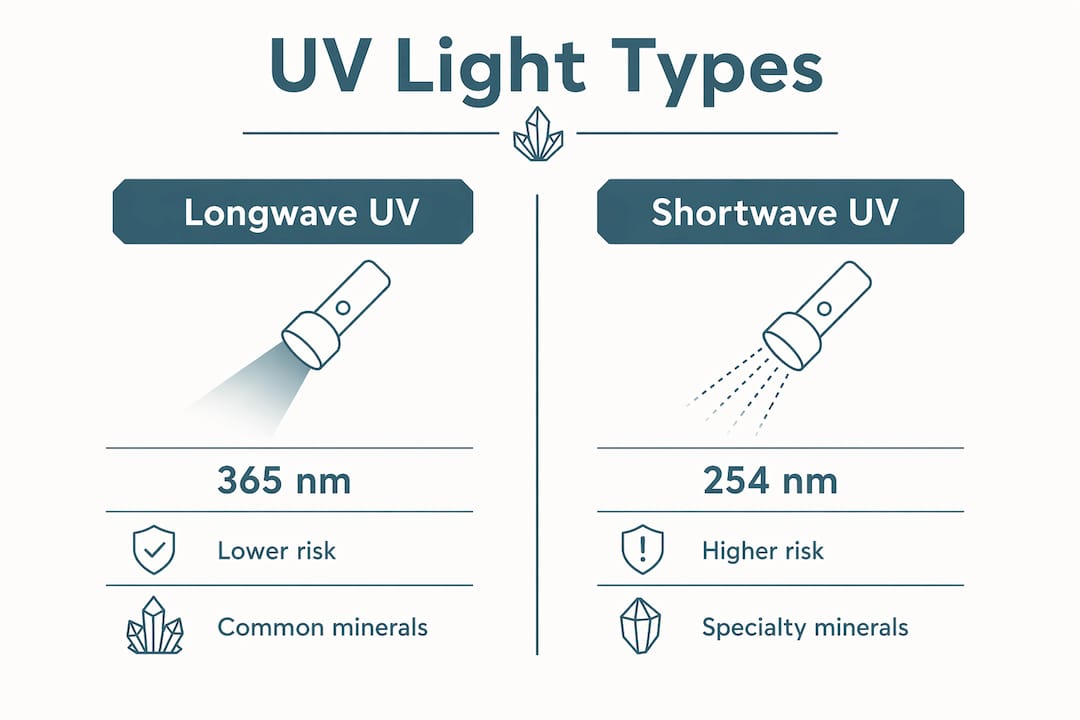
| UV type | Wavelength | Safety level | Best for |
|---|---|---|---|
| Longwave | 365 nm | Lower risk | Calcite, fluorite, sodalite |
| Shortwave | 254 nm | Higher risk | Willemite, scheelite, many rare species |
| Midwave | ~302 nm | Moderate risk | Niche fluorescence detection |
Proper UV wavelength selection is essential because some minerals react only to one wavelength type, and the colour of fluorescence can vary significantly depending on which lamp you use. A specimen that appears dull under longwave UV may produce a vivid reaction under shortwave, and misidentification is a real risk when the wrong source is used.
Pro Tip: Always use UV-blocking safety glasses rated for the specific wavelength you are working with. Standard sunglasses do not block shortwave UV adequately.
Which minerals are the most well-known UV reactive specimens?
Certain minerals have become iconic in the fluorescence world because of their reliable, vivid reactions under UV light. Their activator profiles and geographic origins make each one distinct.
- Fluorite fluoresces blue under UV due to europium activators. Specimens from certain Chinese and English deposits produce particularly intense reactions.
- Calcite displays red or orange fluorescence linked to manganese. Calcite may fluoresce red in one deposit and be completely inert in another, depending on local activator and quencher concentrations.
- Willemite produces a bright green glow and is most famously sourced from Franklin, New Jersey. Specimens from Franklin are prized because complex activator combinations produce vivid multi-colour fluorescence that is rarely duplicated elsewhere.
- Sodalite fluoresces orange or pink, with intensity varying by provenance. Afghan sodalite is particularly well regarded among collectors.
- Scheelite glows blue-white under shortwave UV and is used in tungsten exploration because of this reliable reaction.
Fluorescence variability is one of the most practically useful properties of these minerals. Because fluorescence depends on impurity profiles rather than fixed species traits, it serves as a fingerprint for geographic origin. A calcite specimen that fluoresces red under shortwave UV and orange under longwave UV carries a chemical signature tied to its deposit. This makes UV testing a fast, non-destructive tool for authenticity verification and provenance assessment.
The Franklin, New Jersey deposits deserve special mention. They contain an unusually complex mix of activator elements, producing specimens that display multiple colours simultaneously under UV. No other deposit on Earth reliably replicates this effect, which is why Franklin specimens command significant collector interest.
What are the practical benefits of UV minerals?
The applications of ultraviolet minerals extend well beyond display cases. Researchers, collectors, and practitioners across several fields use fluorescence as a functional tool.
-
Mineral identification. Geologists use UV fluorescence to identify minerals quickly in the field without destructive testing. UV fluorescence maps vein zones, assesses carbonate rocks, and distinguishes species that look identical under white light.
-
Authenticity verification. Treated or synthetic stones often fluoresce differently from natural specimens. UV testing is a standard first step in gemological assessment because artificial treatments alter the activator profile.
-
Mineral exploration. Scheelite fluoresces reliably under shortwave UV, making it a direct indicator of tungsten deposits. Uranium minerals also fluoresce, and geologists use this property to locate ore zones without chemical sampling.
-
Energy healing practice. Collectors and practitioners in energy healing communities value UV reactive minerals for their vibrational properties and the way fluorescence makes their internal structure visible. Fluorite and calcite are among the most commonly used species in this context.
-
Environmental science. Fluorescence helps researchers trace mineral-derived elements through ecosystems. Carbonate minerals, for example, carry fluorescent signatures that allow scientists to track sediment movement and assess water chemistry.
Pro Tip: When using UV fluorescence for identification, always test under both longwave and shortwave UV and record the colour and intensity for each. A single-wavelength test can produce misleading results.
Beyond these applications, awareness of fluorescence enhances the collecting experience itself. A specimen that appears grey under white light can reveal vivid internal structure under UV. This is not just visually striking. It reflects the actual chemistry of the mineral, making every fluorescent specimen a record of its geological history.
Natural UV protection minerals represent a separate but related category. Zinc oxide and titanium dioxide are mineral compounds that physically block UV radiation by reflecting and scattering both UVA and UVB rays. These minerals are photostable, meaning zinc oxide maintains efficacy under prolonged sunlight exposure without breaking down. This is a distinct application from fluorescence, but it demonstrates how mineral chemistry interacts with UV radiation across multiple practical domains.
How to safely observe and use UV minerals
Safe UV mineral observation requires the right equipment and a few consistent habits. The risks are real but manageable with basic precautions.
- Eye protection is non-negotiable. Use UV-blocking glasses rated for the specific wavelength you are using. Shortwave UV at 254 nm causes corneal damage with brief, unprotected exposure.
- Protect your skin. Wear gloves or keep hands out of the beam during extended shortwave UV sessions. Longwave UV at 365 nm carries lower risk but still warrants care.
- Use a dark room. Fluorescence is most visible when ambient light is minimised. Even a dim room improves contrast significantly compared to bright indoor lighting.
- Select the correct lamp for your specimens. Collectors who use inadequate UV sources risk misidentifying non-fluorescent minerals as inert when they simply need a different wavelength. Match the lamp to the mineral group you are studying.
- Avoid prolonged UV exposure for specimens. Some minerals, particularly coloured varieties, can fade with extended UV exposure. Observe, then store in a dark environment.
- Label your specimens with fluorescence data. Record the wavelength used, the colour observed, and the intensity. This data adds scientific value and helps with future identification.
For beginners, a longwave UV lamp at 365 nm is the safest starting point. It activates fluorescence in the most common species and poses minimal risk with basic eye protection. Professionals working with scheelite, willemite, or rare uranium minerals will need a shortwave lamp and full safety protocols. The visual guide to fluorescent minerals at Legacy Crystals and Minerals provides a useful reference for matching specimens to the correct UV source.
UV fluorescent minerals at Legacy Crystals and Minerals
Legacy Crystals and Minerals carries a curated selection of genuine UV reactive specimens, including fluorite and calcite pieces sourced for their documented fluorescence properties.

Each specimen is selected for authenticity and visual quality. The collection includes raw specimens and polished stones suited to both research use and display. For collectors interested in wearable mineral pieces, the fluorite on quartz specimen from the Yaogangxian Mine in Hunan, China, is a documented UV reactive piece with strong provenance. Legacy Crystals and Minerals also offers mineral-based jewellery and collectibles for those who want to incorporate fluorescent minerals into daily practice or a personal collection.
FAQ
What makes a mineral fluoresce under UV light?
Fluorescence occurs when trace activator elements, such as manganese, europium, or chromium, absorb UV photons and release them as visible light. The activator type determines the colour of the glow.
Is fluorescence the same as phosphorescence in minerals?
No. Fluorescence stops instantly when the UV light is turned off, while phosphorescence produces a lingering glow after the light source is removed. Most UV reactive minerals fluoresce rather than phosphoresce.
Which UV lamp is best for viewing fluorescent minerals?
A longwave UV lamp at 365 nm is the safest and most practical starting point for most collectors. Shortwave UV at 254 nm produces stronger reactions in species like willemite and scheelite but requires eye and skin protection.
Can all specimens of a mineral species fluoresce?
No. Fluorescence is not a fixed trait of a mineral species. It depends on the impurity profile of each individual specimen, which varies by deposit and even by location within a single deposit.
How is UV fluorescence used in mineral exploration?
Geologists use fluorescence to locate tungsten and uranium deposits because scheelite and uranium minerals glow reliably under shortwave UV. This allows rapid field assessment without chemical sampling.
Key takeaways
UV minerals fluoresce because trace activator elements within their crystal structures absorb ultraviolet radiation and release it as visible light, a property that serves identification, exploration, and energy healing applications.
| Point | Details |
|---|---|
| Activators drive fluorescence | Elements like manganese, europium, and chromium cause fluorescence at trace concentrations within crystal lattices. |
| Wavelength selection matters | Longwave UV (365 nm) suits most collectors; shortwave UV (254 nm) reveals stronger reactions but requires safety precautions. |
| Fluorescence varies by provenance | The same mineral species can fluoresce differently across deposits due to local activator and quencher profiles. |
| Practical applications are broad | UV fluorescence supports mineral identification, authenticity testing, ore exploration, and energy healing practice. |
| Safety is required with UV lamps | UV-blocking glasses and skin protection are necessary, especially when using shortwave UV sources. |
Recommended
- Fluorescent & UV Reactive Minerals: A Visual Guide | Legacy Crystals – Legacy Crystals and Minerals
- Purple Fluorite – Yindu, Inner Mongolia UV-Active Crystal - Legacy Crystals and Minerals – Legacy Crystals and Minerals
- What Are Vugs and Why Are They So Valuable in Mineral Collecting? – Legacy Crystals and Minerals


