
Watermelon tourmaline meaning: the heart-chakra guide
Watermelon tourmaline is a concentrically zoned variety of elbaite tourmaline with a pink or red core and a green outer rim, and its primary metaphysical meaning centres on the heart chakra: balancing the giving and receiving of love. GIA classifies it as a distinct gem variety based on that concentric zoning pattern, not simply any pink-and-green tourmaline. Three things to know before reading further:
- Primary chakra: Heart (Anahata) — the stone is used to open, balance, and heal heart-centred energy.
- Top practical use: Emotional healing, self-compassion, and repairing relationship dynamics.
- Buying caution: Seek cross-section slices showing concentric zoning; longitudinal bicolour pieces are frequently mislabelled as watermelon tourmaline.
Key takeaways
Watermelon tourmaline is a concentrically zoned elbaite tourmaline with a pink core and green rim, and its metaphysical meaning centres on heart-chakra healing, emotional balance, and the integration of love and compassion.
Table of Contents
- What does watermelon tourmaline mean spiritually?
- Healing properties: what watermelon tourmaline is used for
- How to use watermelon tourmaline in practice
- How watermelon tourmaline forms and where it comes from
- What are the gemological properties of watermelon tourmaline?
- How to buy watermelon tourmaline in Canada with confidence
- The history and naming of watermelon tourmaline
- Legacy Crystals and Minerals: authentic watermelon tourmaline and related pieces
- Sources
- FAQ
What does watermelon tourmaline mean spiritually?
Watermelon tourmaline carries a dual energy that practitioners describe as rare among heart-centred stones: the green rim grounds and nurtures while the pink core radiates love and compassion. Together, they model the balance between giving care outward and receiving it inward — a dynamic that makes the stone useful in practice rather than merely symbolic.
According to Rock & Gem Magazine, the stone is prized specifically for these heart-centred metaphysical associations, with green read as healing and nurturing and pink connected to emotional repair and love.
Green rim energy: Practitioners associate the outer green zone with nature, stability, and the kind of steady, patient care that sustains relationships over time. It functions as a grounding anchor during emotionally charged moments.
Pink core energy: The inner pink zone maps to compassion, romantic and familial love, and the willingness to be emotionally open. In practice, it is used to soften defensiveness and rekindle warmth after conflict.
Three common practice examples where the stone’s bicolour meaning shows up clearly:
- After grief or loss: Held at the chest during quiet reflection, the stone is used to ease the contraction that grief creates in the heart space.
- Repairing relationship dynamics: Placed between two people during a mediation or honest conversation, it is said to encourage both empathy and honest expression simultaneously.
- Strengthening self-compassion: Worn as a bracelet or carried daily, it serves as a tactile reminder to extend the same care inward that one gives to others.
Pro Tip: Watermelon tourmaline’s energy is considered most effective during emotional transitions — after a breakup, during a period of grief, or when beginning heart-centred practices such as loving-kindness meditation. Its visual symmetry of green and pink makes it a grounding focal point even for those new to crystal work.
Healing properties: what watermelon tourmaline is used for
Practitioners commonly associate watermelon tourmaline with healing across four domains: spiritual, emotional, mental, and physical. These are metaphysical uses; they are not medical advice and do not replace professional health care.
Spiritual
- Opens and activates the heart chakra, supporting compassion-based spiritual practices.
- Used in Reiki sessions placed directly over the heart centre to encourage energetic flow.
- Supports heart-centred meditation and loving-kindness (metta) practices.
- Associated with connecting personal love to a broader sense of universal compassion.
Simple ritual: Hold the stone over the heart during a five-minute seated meditation. Set an intention related to giving or receiving love before beginning.
Emotional
- Easing heartbreak and the emotional residue of past relationships.
- Encouraging vulnerability without loss of personal boundaries.
- Reducing emotional reactivity during conflict.
- Supporting the processing of grief at a manageable pace.
Simple ritual: Place a watermelon tourmaline slice on a flat surface and write one sentence about what you are releasing and one about what you are welcoming. Keep the stone nearby for the day.
Mental
- Calming repetitive anxiety patterns rooted in relationship fear.
- Encouraging a more balanced internal dialogue — less self-criticism, more self-acceptance.
- Helping shift perspective from scarcity thinking in relationships to an abundance mindset.
- Supporting focus during journalling or reflective writing practices.
Simple ritual: Keep a small tumbled piece at your desk or workspace. When anxious thoughts arise, hold it briefly and take three slow breaths before continuing.
Physical
- Associated with calming the nervous system during stress responses (non-medical, supportive use).
- Used in crystal layouts placed along the sternum or heart area during relaxation sessions.
- Sometimes included in bath rituals for general relaxation (use polished, sealed specimens only near water).
- Carried as a tactile comfort object during physically demanding or stressful periods.
Simple ritual: Lie flat, place a watermelon tourmaline slice on the chest, and breathe slowly for ten minutes. No visualisation required — the weight and temperature of the stone alone can anchor attention.
How to use watermelon tourmaline in practice
Wearing, meditating, and laying the stone directly on the body are the three most accessible entry points for working with watermelon tourmaline’s properties.
A short heart-chakra meditation
- Sit comfortably with your spine upright and hold the stone in both hands at chest height.
- Close your eyes and take three slow breaths, lengthening each exhale.
- Visualise the green rim of the stone as a steady, calm light expanding outward from your chest.
- Then bring attention to the pink centre: imagine warmth radiating inward, filling the chest.
- Hold that dual image for two to three minutes, breathing naturally.
- Open your eyes slowly and set one intention for the day related to compassion or emotional openness.
Wearing and pairing
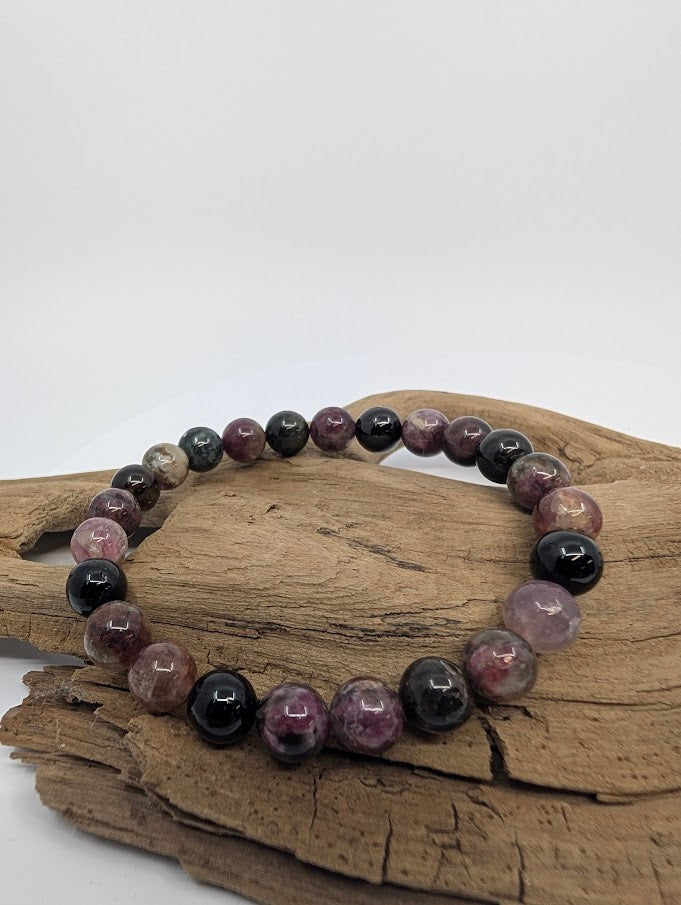
- Wear as a bracelet on the left wrist (the receiving side in many crystal traditions) for daily emotional support; the watermelon tourmaline bracelet in 8mm polished round beads is a practical wearable option.
- Pair with rose quartz to amplify the love frequency, or with black tourmaline for grounding.
- Set in silver or copper settings; both metals are considered energetically compatible with tourmaline in crystal traditions.
- Avoid prolonged exposure to direct sunlight, which can fade colour in some specimens over time.
Cleansing and charging
- Safe methods: Moonlight (full moon overnight), sound (singing bowl or tuning fork), selenite charging plate, or brief smoke cleansing with sage or palo santo.
- Avoid: Saltwater immersion, which can damage polished surfaces and some inclusions; prolonged water exposure generally.
- Recharge frequency: Once a month is a common guideline; more often during periods of heavy emotional use.
Who should use caution with tourmaline? Individuals with very sensitive energy systems sometimes find strongly charged stones overstimulating; in that case, limit initial sessions to five to ten minutes and build gradually. There are no contraindications based on zodiac sign or birth month — the “do not wear” warnings circulating online are not supported by any gemological or established metaphysical authority.
How watermelon tourmaline forms and where it comes from
Concentric colour zoning in watermelon tourmaline forms as changing chemistry in pegmatitic fluids shifts the mineral composition of the growing crystal over time. Gem Rock Auctions explains the sequence clearly: an early manganese-rich growth phase produces the pink or red core, then a later iron-rich phase deposits the green outer rim. The colour zones are a direct record of the crystal’s formation history.
Tourmaline grows in granite pegmatites — coarse-grained igneous rocks that form slowly from mineral-rich fluids deep in the earth. The slow cooling gives individual crystals time to grow large and to record compositional shifts in their zoning. Research on afghanistan tourmaline from the Paprok mine in Nuristan shows measurable iron and manganese variations across the concentric zones, confirming that the visual colour pattern maps directly to changes in fluid chemistry during crystallisation. The Paprok specimens also show varying proportions of elbaite, rossmanite, and liddicoatite components across zones.
Common source localities:
- Maine, USA — historic source; the Dunton and Plumbago mines produced early gem-quality material.
- Brazil (Minas Gerais) — the largest commercial source; wide range of quality.
- Afghanistan (Paprok, Nuristan) — produces distinctively zoned specimens prized by collectors.
- Madagascar — active source with strong colour saturation in some lots.
- Pakistan (Gilgit-Baltistan) — smaller production; some fine material reaches the collector market.
Provenance note for Canadian buyers: Most watermelon tourmaline reaching Canadian retailers originates from Brazil or Madagascar, with Afghan and Pakistani material appearing mainly through specialist dealers and gem shows. When buying online, ask the seller to state the country of origin and, where possible, the mine or region. Depletion at some historic localities has pushed prices upward for well-zoned museum-grade specimens, as Rock & Gem Magazine notes in its field guide.
What are the gemological properties of watermelon tourmaline?
Watermelon tourmaline belongs primarily to the elbaite species (sometimes fluor-elbaite or liddicoatite), with a Mohs hardness making it durable enough for everyday jewellery wear [watermelon tourmaline hardness]. GIA classifies it as a concentrically zoned tourmaline variety and notes it is commonly Type III, meaning eye-visible inclusions are expected and normal.
| Property | Details |
|---|---|
| Mineral species | Elbaite, fluor-elbaite, or liddicoatite (tourmaline group) |
| Mohs hardness | 7 |
| Common forms | Slices (cross-sections), cabochons, polished rounds, raw crystals |
| Daily wear durability | Good; avoid hard impacts and abrasive surfaces |
| Typical inclusions | Eye-visible needles, fractures, growth tubes; Type III clarity |
| Key value factors | Colour saturation, evenness of zoning, clarity of concentric pattern |
Per the International Gem Society, colour zoning, saturation, and the sharpness of the concentric pattern drive value more than absolute size in most purchases.
Authenticity checklist
- Concentric cross-section zoning: A genuine watermelon slice shows a pink or red centre surrounded by a green rim when cut perpendicular to the crystal’s length. This is the defining feature.
- Colourless or white transition zone: Many authentic specimens show a thin pale band between the pink core and green rim.
- Not just any bicolour tourmaline: A longitudinal cut showing pink on one end and green on the other is a bicolour tourmaline, not a true watermelon. These are sometimes mislabelled, as Rock Identifier notes.
- Natural inclusions: Gem-quality material typically contains visible inclusions. Flawless, inclusion-free pieces at low prices warrant scepticism.
- Lab reports: For pieces above a few hundred dollars, request a report from a recognised lab (GIA, SSEF, Gübelin).
Pro Tip: Always ask sellers for cross-section photos taken perpendicular to the crystal’s length, plus a magnified image of the core-to-rim transition. For high-value pieces, a lab report confirming species (elbaite) and natural colour is worth the additional cost. A guide on identifying natural vs synthetic crystals covers the broader authentication process.
How to buy watermelon tourmaline in Canada with confidence
Buying with confidence in Canada starts with two things: provenance documentation and cross-section verification before purchase. The International Gem Society is clear that a true watermelon tourmaline must show a pink core and green rind in cross-section — colour alone is not enough.
Buying checklist
- Ask for the country of origin and, where possible, the mine or region.
- Request cross-section photos showing concentric zoning (not just a side view).
- Confirm the mineral species: elbaite, fluor-elbaite, or liddicoatite.
- For pieces priced above CAD $200–$300, request a gemological lab report.
- Check the seller’s return policy before purchasing; reputable Canadian online retailers offer at least 14–30 days for returns on undamaged items.
- Ask whether the seller can provide any documentation of the supply chain (mine to market).
Red flags and common mislabels
- Any pink-and-green tourmaline sold as “watermelon” without cross-section images.
- Prices significantly below market rate for well-zoned, saturated material.
- Dyed or heat-treated material presented as natural colour (ask explicitly).
- Glass or synthetic resin imitations; these lack natural inclusions and feel lighter than stone.
- Vague origin descriptions such as “Africa” or “Asia” with no further detail.
Canadian import and tax note: Gemstones and jewellery imported into Canada are subject to applicable customs duties and GST/HST depending on country of origin and declared value. For personal purchases, items under the de minimis threshold may clear without duty, but this varies; check the Canada Border Services Agency for current thresholds before ordering from international sellers.
Legacy Crystals and Minerals sources museum-grade specimens with documented provenance and provides cross-section images on request, which addresses the most common authenticity gap Canadian buyers encounter. For further guidance on avoiding fakes, the how to buy crystals online without getting scammed resource covers the full process.
The history and naming of watermelon tourmaline
The name “watermelon tourmaline” was coined in connection with specimens from Maine around 1910 and appears in early 20th-century mineral literature, as Mindat.org documents. The name is descriptive rather than technical: the cross-section resembles a slice of watermelon, with a red or pink flesh and a green rind.
Brief timeline:
- Early 1900s: The name emerges in connection with Maine localities, particularly the gem pegmatites of Oxford County.
- Mid-20th century: Brazilian production scales up, bringing watermelon tourmaline to a wider commercial market.
- Late 20th century onward: Afghan material from Paprok (Nuristan) gains collector recognition for its distinct zoning and mineralogical complexity.
In folk practice and popular metaphysical narratives, the stone has long been associated with the heart because its visual structure — a warm centre surrounded by a nurturing outer layer — maps naturally onto ideas about love, protection, and emotional balance. That visual logic is part of why the stone has remained a consistent fixture in crystal healing traditions.
Legacy Crystals and Minerals: authentic watermelon tourmaline and related pieces
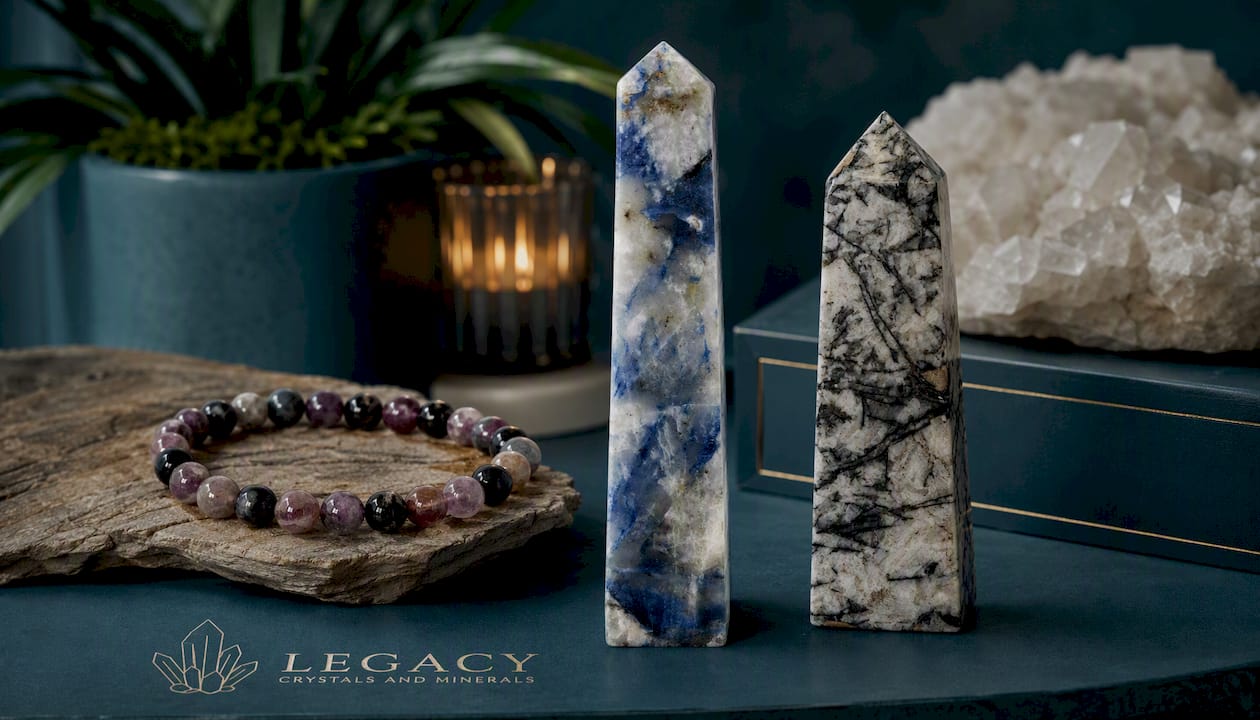
Legacy Crystals and Minerals curates museum-grade crystals and mineral jewellery with documented provenance — the sourcing standard that matters most when buying watermelon tourmaline. Cross-section images are available on request for specimens where zoning verification is relevant, and the team can provide provenance details for high-value pieces. The shop carries a range of wearable and collectible options, including the White Sea Urchin Quartz Bracelet – 12mm Polished Crystal | AAA Grade as an example of the AAA-grade standard applied across the inventory. For heart-chakra work, the chakra spectrum bracelet pairs well with watermelon tourmaline in daily practice. Returns are accepted on undamaged items; contact the shop directly to request cross-section photos or lab documentation before completing a purchase.
Sources
The following sources were used for gemological facts, formation chemistry, and metaphysical associations in this guide:
- GIA
- International Gem Society
- Rock & Gem Magazine
- Mindat
- Watermelon tourmaline from the Paprok mine (Nuristan, Afghanistan) - Neues Jahrbuch für Mineralogie - Abhandlungen
- Gem Rock Auctions
- Rock Identifier
FAQ
What is the spiritual meaning of watermelon tourmaline?
Watermelon tourmaline is a heart-chakra stone whose spiritual meaning centres on balancing the giving and receiving of love. The green rim represents nurturing and grounding energy, while the pink core connects to compassion and emotional healing.
What are the main benefits of watermelon tourmaline?
Practitioners use it primarily for emotional healing — easing heartbreak, reducing anxiety rooted in relationship fear, and strengthening self-compassion. It is also used in Reiki and crystal grid work focused on the heart centre.
Who should not wear watermelon tourmaline?
There are no established gemological or widely accepted metaphysical contraindications for wearing watermelon tourmaline. Those with very sensitive energy systems may prefer to start with short sessions (five to ten minutes) before wearing the stone throughout the day.
Who can wear watermelon tourmaline?
Watermelon tourmaline is considered suitable for anyone drawn to heart-chakra work, regardless of zodiac sign or birth month. It is commonly recommended for those going through emotional transitions, grief, or relationship challenges.
How do you tell if watermelon tourmaline is real?
A genuine piece shows a pink or red core surrounded by a green rim when viewed in cross-section (cut perpendicular to the crystal’s length). Ask sellers for cross-section photos; any pink-and-green tourmaline sold without them may be a mislabelled longitudinal bicolour piece.


