
Collectors: Spot Real Herkimer Diamond Quartz Without a Lab
A Herkimer diamond is a naturally double-terminated quartz crystal, not a true diamond, prized for exceptional clarity and its origin in the Little Falls dolostone of New York’s Herkimer County. Collectors value it for sharp, natural facets on both ends and unusually clean interior structure. This guide covers identification, formation, buying tips, care, and where to find genuine Herkimer-style jewellery.
TL;DR:
- Authentic Herkimer diamonds form in sealed vugs within Cambrian limestone, resulting in natural double terminations and characteristic inclusions like black hydrocarbons.
- Genuine specimens show clear, natural facet faces on both ends, with transparent interiors and typical quartz optical properties, not the perfect symmetry of cut stones.
- Their value depends on size, clarity, and intact terminations, with flawless, larger specimens fetching higher premiums, especially for collectors.
- Identification relies on visual cues and simple tests; authenticity is confirmed by natural growth features and provenance from Little Falls Dolostone.
- Buying from reputable dealers who disclose locality and provide detailed photos, provenance, and lab verification ensures genuine Herkimer quartz.
Table of Contents
- What makes Herkimer diamond quartz different from other quartz?
- How did Herkimer diamonds form 500 million years ago?
- How can you tell a real Herkimer diamond from a fake?
- What are Herkimer quartz benefits and typical value?
- Where should you buy authentic Herkimer diamond quartz?
- How do you clean and store Herkimer quartz safely?
- Why are Herkimer diamonds historically significant?
- What are the most famous Herkimer diamond discoveries?
- How does Herkimer quartz differ from other quartz varieties?
- Find genuine Herkimer-style quartz jewellery
- Sources
- FAQ
What makes Herkimer diamond quartz different from other quartz?
Herkimer diamond quartz is chemically identical to any other quartz crystal: silicon dioxide (SiO2), arranged in a trigonal crystal system. What sets it apart is habit and clarity, not chemistry. Every measurable property lines up with standard quartz data, which is exactly why the “diamond” label causes so much confusion among new collectors.
The geological record for Herkimer specimens confirms a Mohs hardness near 7 and a refractive index within the range typical for quartz, consistent across the Little Falls locality.
- Hardness: about 7 on the Mohs scale, tougher than glass but softer than topaz.
- Refractive index: within the typical quartz range, giving a bright, glassy sparkle.
- Crystal system: trigonal, the same lattice found in every quartz variety.
- Habit: doubly terminated, meaning both ends taper to natural points instead of one end attaching to a matrix.
- Lustre: vitreous, with most specimens running clear to smoky, occasionally tinted by trace inclusions.
Statistic callout: A Herkimer’s refractive index of 1.543–1.554 sits within the standard quartz range documented by geology.com, confirming these crystals are optically and structurally ordinary quartz despite their nickname.
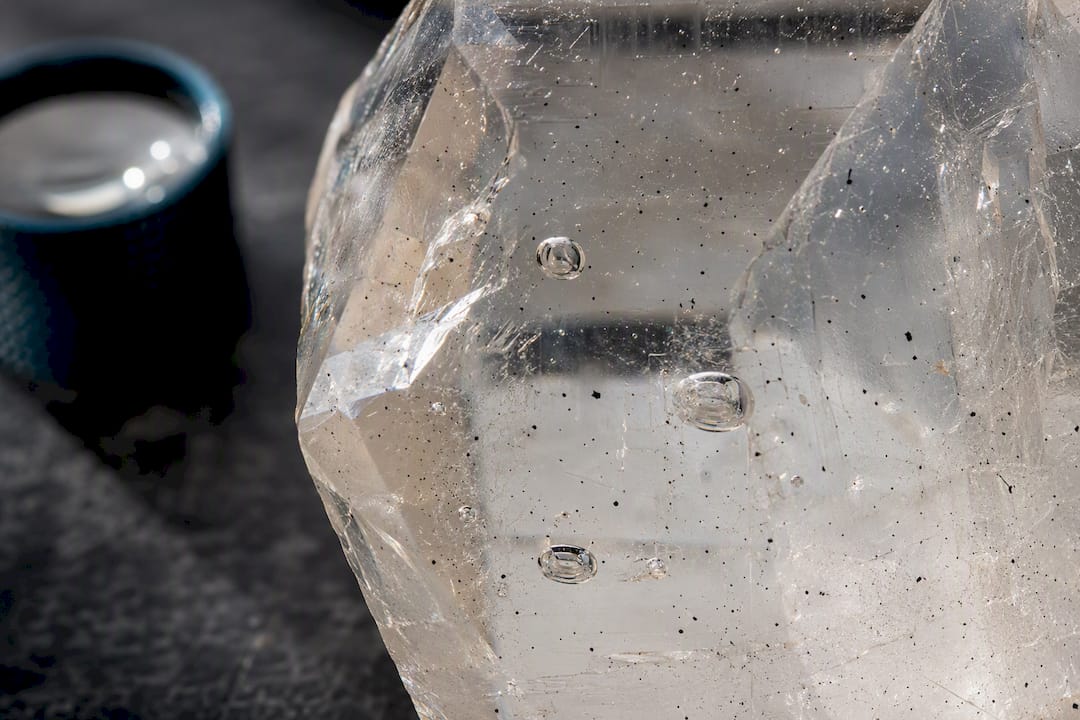
Inclusions matter here more than in most quartz varieties. Black flecks of hydrocarbon and tiny trapped liquid pockets called enhydros show up often enough that their absence or presence becomes a genuine talking point among collectors comparing specimens.
How did Herkimer diamonds form 500 million years ago?
Every authentic Herkimer diamond traces back to one geological setting: the Little Falls Dolostone, a Cambrian-age carbonate rock running through the Mohawk Valley in Herkimer County, New York. The formation dates to roughly 500 million years ago, long before the Appalachian mountains existed in their current form.
Quartz crystals grew inside sealed cavities called vugs, small pockets left behind as the dolostone formed and later fractured. Silica-rich fluid seeped into these enclosed spaces and precipitated slowly, with no matrix wall to interrupt growth on either end. That is the mechanical reason Herkimers come out double-terminated: they grew suspended in open space rather than anchored to rock.
- Host rock: Little Falls Dolostone, Cambrian period.
- Cavity type: sealed vugs, often lined with clay.
- Growth pattern: unattached crystal growth producing points on both ends.
- Common companions: black hydrocarbon inclusions and enhydro pockets, byproducts of the sealed, mineral-rich environment.
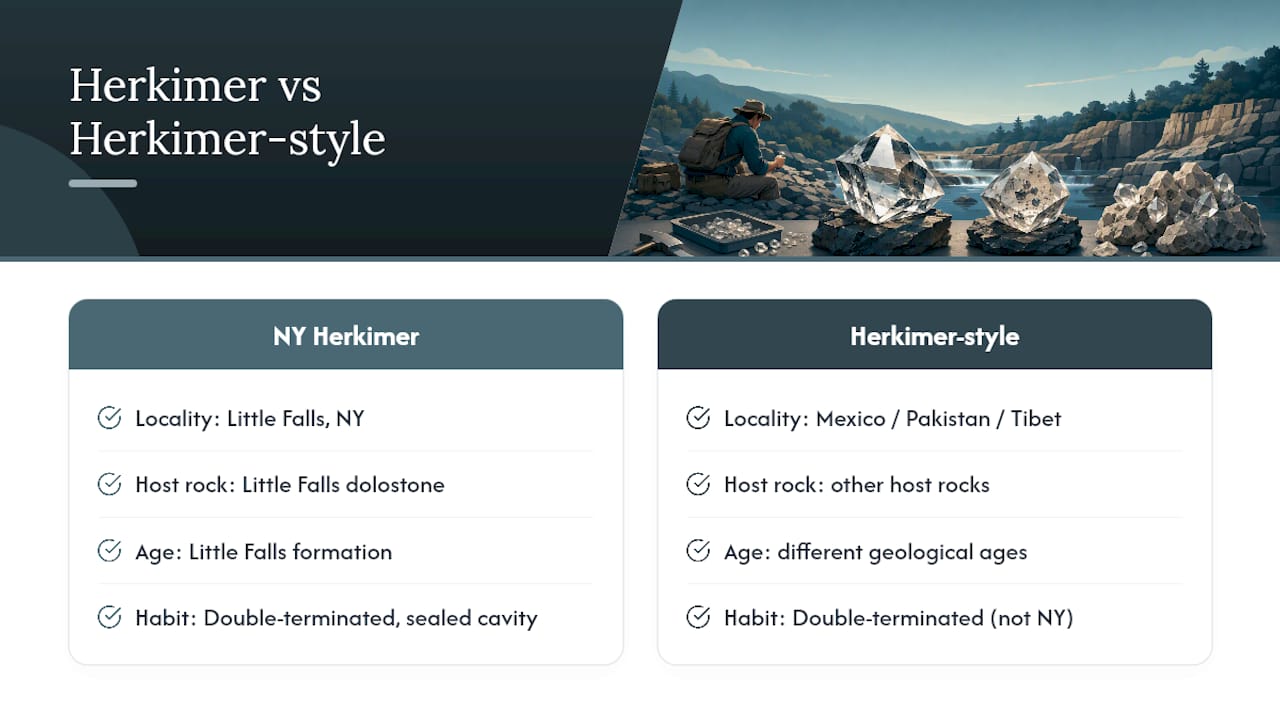
Crystals marketed as “Herkimer-style” from Mexico, Pakistan, or Tibet share the double-terminated habit but formed under different conditions and in different rock. They can look similar at a glance, yet true provenance ties the name specifically to Herkimer County.
How can you tell a real Herkimer diamond from a fake?
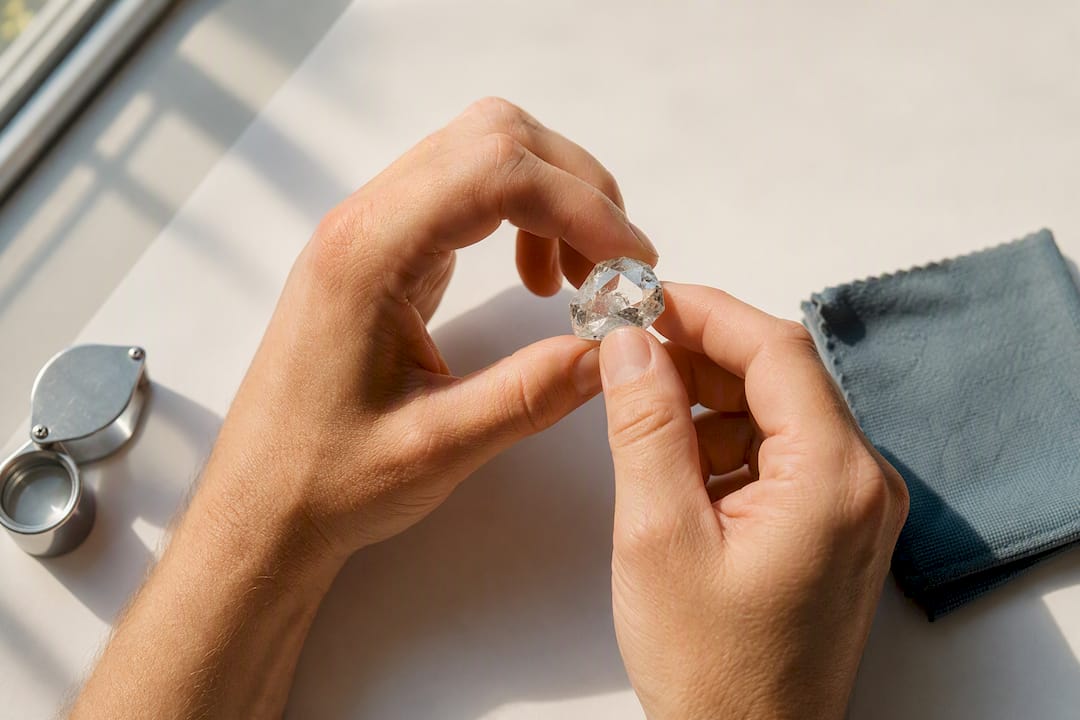
Authentication starts with the eyes, not a lab. A genuine Herkimer shows clean double terminations on both ends, natural facet faces (not the too-perfect symmetry of a cut stone), and the kind of clarity that lets you see straight through to any inclusions inside.
- Check both ends. A real specimen tapers to a point on each side; a single-terminated crystal or one glued to a base is not a true Herkimer.
- Look for characteristic inclusions. Black hydrocarbon specks or a visible enhydro bubble are strong positive signs, though their absence doesn’t disqualify a piece.
- Run a simple hardness check. Quartz scratches calcite easily; if a “Herkimer” scratches as soft as chalk, it’s likely calcite or a composite fake.
- Ask about the matrix. Specimens collected with surrounding clay or dolostone attached carry stronger provenance than a loose, cleaned crystal.
- Request seller documentation for expensive pieces. Reputable dealers will disclose locality and, for larger purchases, offer lab verification.
Field-collecting guides describe locating vuggy float with tan pocket clay still clinging to it, a practical tell that a specimen came straight out of the ground rather than a bulk import bin.
Pro Tip: Photograph the crystal against a plain white background and rotate it slowly. Inclusions and termination quality that a seller’s studio photos hide often show up immediately under natural light.
What are Herkimer quartz benefits and typical value?
Value in this market comes down to four factors: size, clarity, intact terminations, and notable inclusions. A one-inch crystal with sharp points and no chips will consistently outsell a larger, cloudy piece with a broken tip.
- Collector grade: small to mid-size crystals with visible flaws sell cheaply and make solid starter specimens.
- Museum grade: flawless, larger crystals with both terminations intact are genuinely scarce, and premiums on top-tier pieces reflect that scarcity rather than hype.
- Jewellery use: Mohs 7 hardness holds up to daily wear reasonably well, though Herkimers are usually left uncut and set whole rather than faceted, since cutting sacrifices the natural double termination that makes them distinctive.
- Metaphysical use: practitioners commonly describe Herkimer quartz as an amplifying or attunement stone in energy work; these are traditional beliefs, not scientific claims, and are worth treating as personal or spiritual practice rather than fact.
Most retail Herkimers, especially the small tumbled or bracelet-grade pieces, sit at accessible price points. Larger, clean, well-terminated specimens climb quickly because so few come out of the ground that way. A crystal roughly the size of a fingernail with visible inclusions and both points intact is a genuinely good entry piece for a new collector, while flawless inch-plus specimens are where prices start to separate serious collector pieces from casual souvenirs.
Where should you buy authentic Herkimer diamond quartz?
Buy from specialty mineral dealers, museum-affiliated shops, or online retailers that state locality plainly and back it up with real photos of the actual piece, not stock imagery. Transparency about origin is the single biggest signal separating a trustworthy seller from a bulk importer relabelling generic double-terminated quartz.
- Confirm the listing states Herkimer County or Little Falls Dolostone origin specifically.
- Ask for high-resolution photos showing both terminations and any inclusions.
- Check the return policy before buying anything above a casual price point.
- For larger or “museum-grade” claims, request documentation or provenance history.
- Favour sellers who disclose that these are quartz, not diamond, without being asked.
Legacy Crystals and Minerals carries three relevant pieces worth knowing about if you’re shopping for wearable Herkimer-style quartz. The Double-Terminated Quartz “Herkimer Style” Bracelets in 6 mm and 7 mm suit everyday wear at a comfortable size range. The High Clarity Double-Terminated Quartz “Herkimer Style” Bracelet at 6.8 mm, HQ grade, fits collectors who want visibly cleaner stones and sharper terminations. The Garden Quartz Bracelet in 6 mm is a related alternative for readers drawn to visible mineral inclusions rather than pure clarity.
| Piece | Best suited for |
|---|---|
| Double-Terminated Quartz “Herkimer Style” Bracelets, 6 mm/7 mm | Everyday wearers wanting classic double-terminated look |
| High Clarity Bracelet, 6.8 mm HQ grade | Collectors prioritizing clarity and termination sharpness |
| Garden Quartz Bracelet, 6 mm | Buyers who like visible inclusions over pure clarity |
How do you clean and store Herkimer quartz safely?
Herkimer quartz is durable, but its natural terminations are the most fragile part of any specimen, so care routines should protect those points specifically.
- Rinse gently with lukewarm water and a mild soap, using a soft brush only on the body of the crystal, never scrubbing directly on a point.
- Avoid acids, bleach, and extended soaking, which can dull the vitreous lustre or stress natural fractures inside the stone.
- Dry thoroughly with a soft cloth before storing, since trapped moisture can encourage cloudiness over time.
- Store in padded pouches or lined boxes, separated from harder minerals that could chip the points during handling.
- Keep out of prolonged direct sun, and always pick specimens up by the body rather than the terminations.
For jewellery pieces worn regularly, a quick monthly check for chips near the setting or loosened mounting catches problems before they worsen. Legacy Crystals and Minerals’ guide on caring for crystals and its display guide both cover routines that apply directly to double-terminated quartz.
Why are Herkimer diamonds historically significant?
The name itself is a product of 19th-century commerce, not mineralogy. Miners and traders working the Mohawk Valley started calling these unusually clear, naturally faceted quartz crystals “diamonds” because their brilliance and natural faceting resembled cut gemstones, a nickname that stuck even though geologists have always classified them as quartz.
Herkimer County itself became a magnet for rock hounds well before organized quarries existed there. Farmers turning soil in the region routinely turned up loose crystals in the clay-rich pockets left by the dissolving dolostone, and word spread through mineral trading circles throughout the 1800s. That grassroots discovery pattern shaped how the crystals are still collected today: much of the supply comes from small-scale digging operations and pay-to-dig sites rather than industrial mining.
Collector culture kept the “diamond” name alive for well over a century, even as scientific classification never wavered. Reputable dealers today disclose the quartz identity upfront, treating the nickname as branding rather than a factual claim, a distinction that separates transparent sellers from those hoping a customer won’t ask.
The Herkimer name also became shorthand within the wider mineral trade for describing any double-terminated quartz habit, regardless of where it formed. That secondary usage, “Herkimer-style” or “Herkimer-cut,” now shows up on listings for similar crystals mined in Mexico and Pakistan, a linguistic spillover that traces directly back to the New York locality’s cultural weight in the hobby.
What are the most famous Herkimer diamond discoveries?
Herkimer County’s reputation rests less on single record-breaking specimens and more on the sheer density of quality material coming from a concentrated area. The region around Middleville, Fonda, and Little Falls has produced consistent, commercially significant quantities of gem-clarity double-terminated quartz for well over a century, which is unusual for a locality this specific.
Several long-running pay-to-dig operations in the area, including sites near Middleville and Herkimer itself, have become destinations for collectors specifically because they reliably produce clean, well-terminated crystals rather than the occasional lucky find. That consistency is part of what built the locality’s reputation within mineralogy circles documented on reference sites like Mindat.
Exceptionally large or flawless individual crystals do surface periodically and draw attention within collector networks, since museum-quality Herkimers, meaning pieces with both terminations intact, minimal internal fracturing, and significant size, remain genuinely rare against the volume of small, common material that dominates the market. Most Herkimer output is modest in size; the standout pieces are the exception, not the norm, which is exactly why they command outsized attention when they do appear at gem and mineral shows.
How does Herkimer quartz differ from other quartz varieties?
The core difference is habit, not composition. Amethyst, citrine, smoky quartz, and clear rock crystal all share the same SiO2 chemistry and trigonal structure as Herkimer diamonds; what changes between varieties is colour (driven by trace elements or irradiation) and, in Herkimer’s case specifically, the double-terminated growth pattern.
Rock crystal quartz typically grows attached to a matrix at one end, forming a single point. Herkimers grow free-floating in a sealed cavity, producing points on both ends, a structural distinction that has nothing to do with colour or clarity grade.
Garden quartz, sometimes called lodolite, contains visible internal mineral inclusions like chlorite or hematite that create landscape-like patterns inside an otherwise clear crystal. It can occasionally show double terminations too, but the defining trait is the inclusion pattern, not the habit, which is why Legacy Crystals and Minerals lists its Garden Quartz Bracelet as a related but distinct option from true Herkimer-style pieces.
Crystals from Mexico, Pakistan, or Tibet marketed as “Herkimer diamonds” or “Herkimer-style quartz” share the double-terminated habit but formed in entirely different host rock and geological ages. They are legitimate double-terminated quartz, just not from the Little Falls Dolostone, and honest sellers will say so plainly rather than let the word “Herkimer” imply New York provenance it doesn’t have.
Find genuine Herkimer-style quartz jewellery
Sourcing a real double-terminated quartz piece online means trusting photos and descriptions you can’t hold in your hand first, which is exactly where a lot of buyers get burned by vague listings that skip locality and grade entirely. Legacy Crystals and Minerals lists clarity grade and crystal habit plainly on every double-terminated quartz product, so you know what you’re buying before checkout, not after.
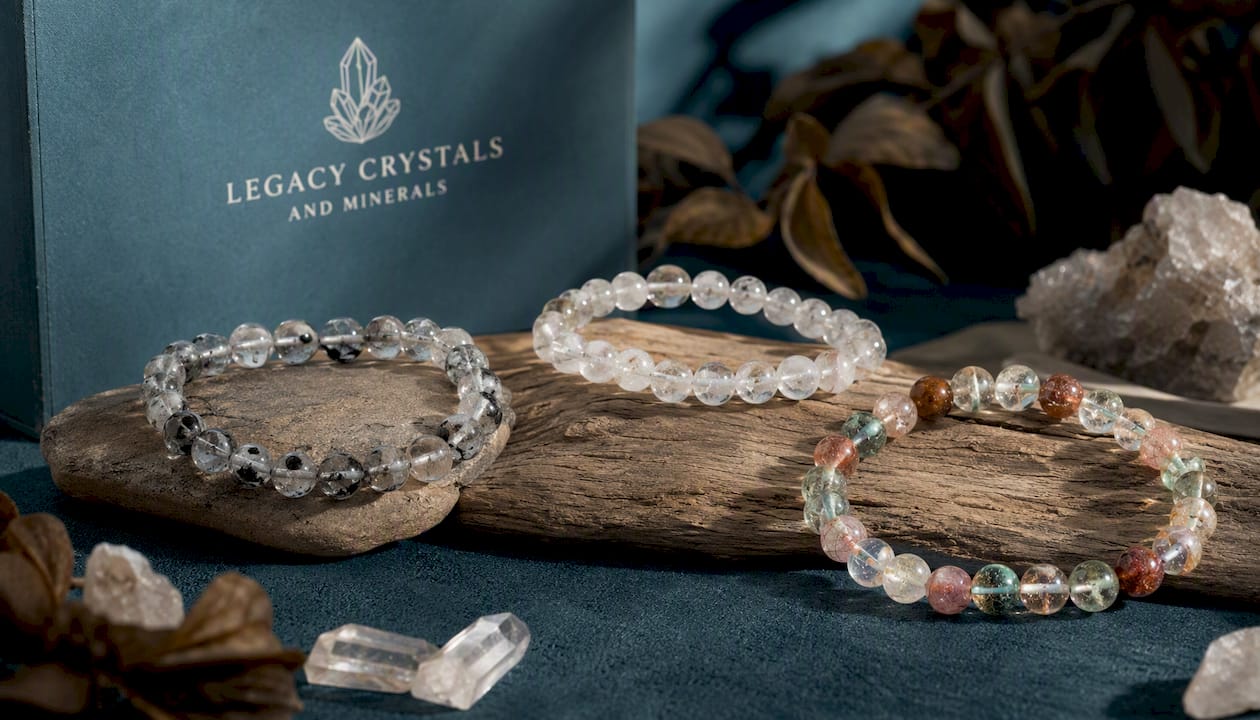
Three options cover most of what collectors and jewellery buyers are looking for right now. The Double-Terminated Quartz “Herkimer Style” Bracelets in 6 mm and 7 mm work as an everyday entry point. The High Clarity Double-Terminated Quartz “Herkimer Style” Bracelet at 6.8 mm, HQ grade, suits anyone prioritizing visible clarity and sharp natural terminations over price. The Garden Quartz Bracelet gives inclusion lovers a related, equally natural alternative. Browse the current double-terminated quartz selection and pick the grade and size that matches your collection or your wrist.
Sources
- Geology
- Herkimer diamond — Wikipedia
- Herkimer Diamond Mineral: Identification, Properties & Uses — RockHoundR
- Mindat
FAQ
Is a Herkimer diamond worth anything?
Yes, though value ranges widely. Small, common crystals sell cheaply as starter specimens, while large, flawless, well-terminated pieces command real premiums because that combination of size and clarity is genuinely scarce.
Are Herkimer diamonds just quartz?
Yes. Herkimer diamonds are quartz (SiO2) with a Mohs hardness around 7, not true diamonds. The name is a historical nickname based on their brilliance and natural faceting, not a mineralogical classification.
What are the benefits of Herkimer quartz?
Practically, its Mohs 7 hardness makes it durable enough for jewellery, and its natural double terminations mean it needs no cutting to look finished. Many people also value it in energy work as an amplifying or attunement stone, though that’s a traditional belief rather than a scientific claim.
What does a Herkimer diamond do spiritually?
Practitioners commonly describe Herkimer quartz as helping amplify intention or support mental clarity during meditation. These uses come from longstanding metaphysical tradition rather than scientific evidence, so treat them as personal practice.


