

Fonctionnement des autels de cristal : guide pratique pour 2026
Un autel de cristaux est un espace dédié et aménagé de manière intentionnelle qui utilise les qualités énergétiques des cristaux et des éléments rituels pour soutenir la concentration spirituelle, la méditation et le travail énergétique personnel. Comprendre le fonctionnement des autels de cristaux signifie reconnaître qu'ils fonctionnent à deux niveaux : comme des arrangements physiques d'objets significatifs et comme des ancres psychologiques qui entraînent l'esprit à entrer dans des états plus calmes et plus concentrés. La pratique s'appuie sur la géométrie rituelle, le symbolisme élémentaire et une utilisation quotidienne cohérente. Legacy Crystals and Minerals propose des spécimens de qualité musée adaptés à chaque étape de la construction d'un autel, des pierres d'ancrage fondamentales aux amplificateurs rares.
Comment les autels de cristaux fonctionnent-ils énergétiquement ?
Un autel de cristaux fonctionne principalement comme un point d'ancrage visuel qui déclenche des états de cerveau méditatifs par association répétée. Chaque fois que vous vous asseyez devant le même arrangement, votre système nerveux commence à reconnaître l'espace comme sûr et calme. Au fil du temps, cette reconnaissance s'approfondit et la transition vers un état concentré ou méditatif se produit plus rapidement.
Le principe énergétique derrière les autels de cristaux est simple. Les cristaux possèdent des qualités vibratoires distinctes basées sur leur composition minérale, leur structure et leur couleur. Lorsqu'ils sont arrangés avec intention, ils créent un champ d'indices sensoriels et symboliques qui soutiennent la concentration du praticien. Ce n'est pas passif. L'autel répond à l'attention que vous lui portez.
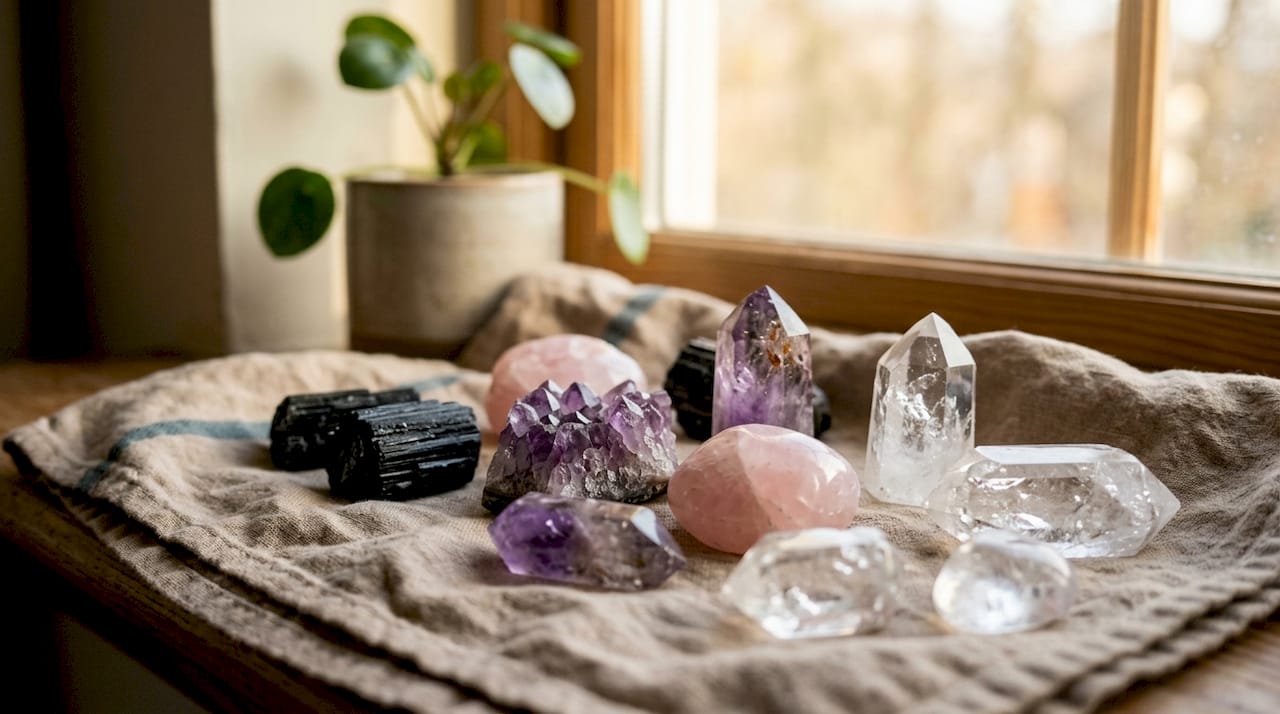
L'utilisation constante du même espace d'autel entraîne le système nerveux à entrer plus rapidement dans des états méditatifs. Considérez cela comme une boucle de rétroaction : plus vous utilisez l'espace, plus il vous procure un sentiment de calme et de clarté. Les praticiens décrivent souvent cet effet comme un "chargeur de batterie pour l'âme", et le mécanisme sous-jacent est le conditionnement environnemental, pas la seule magie.
Les rituels quotidiens sont le moteur qui fait fonctionner un autel. Ces rituels n'ont pas besoin d'être élaborés.
- Tenez une pierre pendant 30 secondes en fixant une intention pour la journée.
- Allumez une bougie pour signaler le début d'une séance ciblée.
- Prononcez une affirmation à voix haute en touchant le cristal central.
- Asseyez-vous tranquillement devant l'autel pendant une à cinq minutes chaque matin.
- Réarrangez une pierre lorsque vos besoins énergétiques changent.
L'investissement rituel quotidien peut être aussi court que 30 secondes pour maintenir la résonance énergétique. Cette brièveté est importante car elle élimine la barrière de l'effort. Une pratique que vous pouvez maintenir quotidiennement est bien plus efficace qu'un rituel élaboré effectué une fois par semaine.
Conseil de pro : Placez votre autel là où vous le verrez en premier le matin. Le simple contact visuel, même sans s'asseoir, renforce l'association énergétique et maintient la pratique vivante.
Comprendre le fonctionnement énergétique des bracelets de cristaux offre un contexte utile ici. Les mêmes principes de soutien vibratoire et de contact constant s'appliquent aussi bien aux cristaux à porter qu'aux arrangements d'autels.
Comment choisir et arranger les cristaux pour une énergie d'autel efficace
Le choix des cristaux est la partie la plus personnelle de l'installation d'un autel de cristaux. Chaque pierre correspond à une intention spécifique, et vos choix doivent refléter ce sur quoi vous travaillez dans votre vie en ce moment.
Les cristaux placés sur les autels représentent des intentions spécifiques telles que l'ancrage, l'abondance, la guérison émotionnelle et la communication. Les choix courants incluent la tourmaline noire pour l'ancrage, la citrine pour l'abondance, le quartz rose pour la guérison émotionnelle et la sodalite pour la communication. Ceux-ci ne sont pas arbitraires. La structure minérale et la couleur de chaque pierre portent un poids symbolique et énergétique dans la pratique.
Le tableau ci-dessous décrit les rôles courants des cristaux dans l'arrangement de l'autel.
| Cristal | Rôle principal | Emplacement |
|---|---|---|
| Quartz clair | Amplificateur central | Centre de l'autel |
| Tourmaline noire | Ancrage et protection | Position nord ou de base |
| Quartz rose | Soutien émotionnel | Position ouest ou du cœur |
| Citrine | Abondance et clarté | Position est ou supérieure |
| Sodalite | Communication et calme | Toute position de soutien |
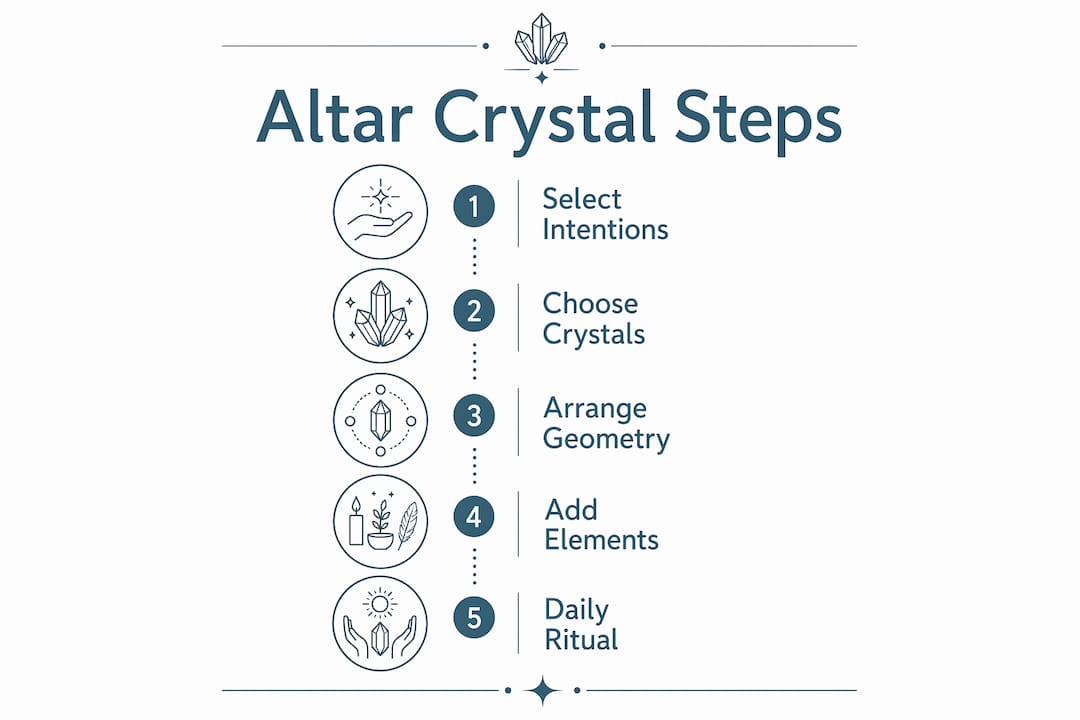
Les agencements d'autel efficaces utilisent un espacement intentionnel et une géométrie rituelle, plaçant généralement les cristaux aux quatre points cardinaux pour la stabilisation et une pierre maîtresse centrale pour l'amplification. Le quartz clair est la pierre centrale la plus utilisée car il amplifie l'énergie de chaque cristal qui l'entoure. Cette approche géométrique n'est pas décorative. Elle crée un champ énergétique structuré qui renforce le but de l'autel.
L'équilibre des cristaux pour représenter les quatre éléments classiques relie l'énergie de l'autel aux forces naturelles et favorise l'harmonie énergétique. La Terre se trouve au nord, représentée par des pierres sombres ou lourdes. L'Air se trouve à l'est, souvent représenté par des cristaux plus légers ou translucides. Le Feu occupe le sud, et l'Eau l'ouest. Ce cadre élémentaire donne à l'autel une logique interne cohérente que les praticiens trouvent stabilisante.
Pour des conseils sur la façon d'arranger les cristaux à la maison au-delà de l'autel, Legacy Crystals and Minerals propose un guide d'affichage détaillé couvrant la protection et le placement esthétique. Les grilles de cristaux suivent une logique géométrique similaire. Le guide sur le fonctionnement des grilles de cristaux explique comment les arrangements géométriques ciblés amplifient des intentions spécifiques, ce qui complète bien la conception d'un autel.
Quel rôle jouent les éléments rituels et l'environnement ?
L'environnement physique d'un autel de cristaux détermine son efficacité autant que les cristaux eux-mêmes. Une surface encombrée et mal éclairée nuit à la fonction de l'autel en tant que point focal. Un espace propre et intentionnellement aménagé le renforce.
Les bougies servent d'élément Feu et agissent comme des marqueurs d'intention. Allumer une bougie signale le début d'une séance rituelle. La flamme attire le regard et concentre l'esprit. L'eau, placée dans un petit bol ou représentée par une pierre associée à l'eau, relie l'autel à l'élément de fluidité et de traitement émotionnel. Ce ne sont pas des ajouts décoratifs. Chaque élément joue un rôle fonctionnel dans la structure énergétique de l'autel.
Les cristaux sur un autel wiccan fonctionnent comme des amplificateurs secondaires au sein d'une géométrie rituelle structurée pour renforcer l'équilibre élémentaire et la clarté de l'intention. Ce principe s'applique largement à toutes les traditions d'autel, pas seulement à la pratique wiccanne. La précision du placement renforce la concentration rituelle quelle que soit la tradition spécifique que vous suivez.
Facteurs environnementaux à prendre en compte lors de l'installation de votre autel :
- Choisissez un endroit avec de la lumière naturelle, mais évitez la lumière directe du soleil sur les pierres sensibles.
- La lumière directe du soleil peut altérer des pierres comme l'améthyste et le quartz rose, alors faites-les pivoter ou protégez-les si nécessaire.
- Choisissez une surface qui reste exempte de désordre quotidien.
- Positionnez l'autel à une hauteur où vous pouvez vous asseoir ou vous tenir confortablement devant lui.
- Évitez les zones très fréquentées où l'espace serait souvent perturbé.
Conseil de pro : Si la lumière naturelle est limitée, utilisez une lampe à lumière chaude positionnée sur un côté de l'autel. Un éclairage zénithal agressif aplatit la profondeur visuelle de l'arrangement et réduit son efficacité en tant que point focal.
Le son contribue également à l'énergie de l'autel. Des bols chantants, des cloches, ou même une brève parole peuvent purifier et activer l'espace avant une séance. Ces outils fonctionnent aux côtés des cristaux plutôt que de les remplacer.
Comment entretenir et activer votre autel de cristaux
Un autel qui n'est jamais entretenu perd sa charge énergétique. L'entretien n'est pas facultatif. C'est la pratique elle-même.
- Nettoyez régulièrement vos cristaux. Les techniques de nettoyage régulières incluent la combustion de sauge ou de palo santo, l'utilisation du son et la vaporisation d'eau salée ou d'eau de lune pour dissiper l'énergie stagnante. Choisissez la méthode qui convient à vos cristaux, car l'eau peut endommager les pierres poreuses comme la sélénite.
- Réinitialisez votre intention. Asseyez-vous devant l'autel et exprimez votre intention actuelle à voix haute ou par écrit. Cela réaligne le but de l'autel avec là où vous êtes maintenant, pas là où vous étiez lorsque vous l'avez construit pour la première fois.
- Réévaluez vos choix de pierres. À mesure que vos besoins énergétiques changent, vos cristaux devraient aussi changer. Une pierre qui vous a servi pendant une période de deuil pourrait ne pas être ce dont vous avez besoin pendant une période de croissance. Échangez les pierres sans culpabilité.
- Activez avec la visualisation. Tenez la pierre centrale, fermez les yeux et visualisez le résultat vers lequel vous travaillez. C'est le rituel d'activation. Il prend moins de deux minutes et ancre une intention fraîche dans l'arrangement.
- Évitez les longues périodes de négligence. Un autel laissé intact pendant des semaines accumule de l'énergie stagnante. Même une brève reconnaissance quotidienne, un regard, un toucher, un souffle, maintient la connexion énergétique vivante.
Pour ceux qui débutent avec les cristaux, comprendre l'harmonisation des cristaux est une base utile. L'harmonisation est le processus d'alignement de votre énergie personnelle avec les qualités d'un cristal avant de le placer sur un autel. Elle approfondit la connexion entre le praticien et la pierre.
Les autels évoluent également. Une configuration d'autel de cristal qui fonctionne à une saison de la vie peut nécessiter une refonte complète à une autre. Traitez l'autel comme une pratique vivante, pas comme un objet fini. Les pierres que vous choisissez pour l'alignement des chakras peuvent éclairer quelles cristaux appartiennent à votre autel à un moment donné, car le travail des chakras et la pratique de l'autel se chevauchent souvent.
Des cristaux de qualité pour votre autel chez Legacy Crystals and Minerals
Construire un autel de cristaux commence par l'approvisionnement en pierres auxquelles vous pouvez faire confiance. Legacy Crystals and Minerals propose une sélection organisée de spécimens authentiques de qualité musée, adaptés à chaque objectif d'autel, des ancrages de mise à la terre aux amplificateurs centraux.
Le bracelet en quartz oursins blancs en cristal poli de qualité AAA est un excellent choix pour les praticiens recherchant une pièce focale tactile qui sert également de support énergétique portable. Pour ceux qui construisent autour du quartz clair, le bracelet en quartz craquelé clair offre une option polie et très claire, adaptée aux centres d'autel ou aux travaux d'amplification. Legacy Crystals and Minerals propose également des spécimens bruts, des sculptures et des pièces de collection rares qui apportent à la fois une profondeur esthétique et énergétique à tout espace sacré.
FAQ
À quoi sert un autel de cristaux ?
Un autel de cristaux est un espace dédié à la méditation, à la fixation d'intentions et au travail énergétique. Il fonctionne comme un point d'ancrage visuel et énergétique qui soutient une pratique spirituelle ciblée.
À quelle fréquence devez-vous interagir avec votre autel de cristaux ?
Une interaction quotidienne est la plus efficace. L'investissement rituel quotidien peut être aussi court que 30 secondes, comme tenir une pierre ou allumer une bougie, pour maintenir la résonance énergétique de l'autel.
Quel cristal doit être placé au centre d'un autel ?
Le quartz clair est la pierre centrale la plus utilisée car il amplifie l'énergie des cristaux environnants. Les configurations géométriques courantes le placent au centre avec des pierres de soutien aux quatre points cardinaux.
Comment nettoie-t-on un autel de cristaux ?
Brûler de la sauge ou du palo santo, utiliser un bol chantant, ou vaporiser de l'eau de lune sont les méthodes de nettoyage les plus courantes. Choisissez en fonction des cristaux présents, car l'eau peut endommager les pierres poreuses comme la sélénite.
Un autel de cristaux peut-il fonctionner pour les débutants ?
Oui. La pratique s'adapte à tous les niveaux d'expérience. Un arrangement simple de deux ou trois pierres avec une intention claire est entièrement fonctionnel et un bon point de départ.
Points clés à retenir
Les autels de cristaux fonctionnent parce qu'ils combinent les propriétés énergétiques de pierres spécifiques avec la géométrie rituelle, l'équilibre élémentaire et une pratique quotidienne cohérente pour créer un ancrage fiable pour la méditation et l'intention.
| Point | Détails |
|---|---|
| Ancrage visuel et énergétique | L'utilisation répétée entraîne le système nerveux à entrer plus rapidement dans des états calmes et concentrés. |
| La pratique quotidienne maintient l'autel | Même 30 secondes d'interaction intentionnelle maintiennent la résonance énergétique de l'autel. |
| La géométrie et le placement sont importants | Placer les cristaux aux quatre points cardinaux avec un amplificateur central renforce la structure énergétique de l'autel. |
| L'équilibre élémentaire favorise l'harmonie | Représenter la Terre, l'Air, le Feu et l'Eau par le choix des pierres relie l'autel aux forces naturelles. |
| Le nettoyage régulier prévient la stagnation | La sauge, le son et l'eau de lune éliminent l'énergie accumulée et maintiennent l'efficacité de l'autel au fil du temps. |
Recommandé
- Qu'est-ce que l'harmonisation des cristaux : un guide pour les débutants – Legacy Crystals and Minerals
- Comment fonctionnent les grilles de cristaux (et comment en fabriquer une) – Legacy Crystals and Minerals
- Cristaux pour l'alignement des chakras : votre guide 2026 – Legacy Crystals and Minerals
- Guide d'affichage des cristaux à la maison : arranger et protéger votre collection – Legacy Crystals and Minerals


