

Qu'est-ce que la géométrie sacrée dans les cristaux : un guide clair
La géométrie sacrée dans les cristaux est l'étude des formes et des motifs géométriques fondamentaux qui se forment naturellement au sein des structures cristallines et influencent leurs propriétés énergétiques. Chaque cristal se développe selon des lois mathématiques strictes, produisant des arrangements atomiques répétitifs qui donnent lieu à des formes reconnaissables. Ces formes ne sont pas des accidents décoratifs. Elles reflètent des principes universels que les traditions anciennes et la cristallographie moderne reconnaissent. Comprendre ce qu'est la géométrie sacrée dans les cristaux vous offre un cadre pratique pour choisir et utiliser les cristaux avec une intention réelle.
Qu'est-ce que la géométrie sacrée dans les cristaux et pourquoi est-elle importante ?
La géométrie sacrée est une science métaphysique qui considère les formes géométriques comme le plan sous-jacent de la nature, des structures atomiques aux spirales des coquillages. Dans les cristaux, ce concept est ancré dans la cristallographie, l'étude scientifique de la manière dont les atomes s'organisent en motifs tridimensionnels répétitifs. Ces motifs ne sont pas aléatoires. Ils suivent des lois mathématiques qui produisent des formes cohérentes et prévisibles pour chaque spécimen du même type de minéral.
Le terme industriel reconnu pour l'étude de ces motifs est cristallographie, et il est au cœur de ce qui fait de la géométrie sacrée dans les cristaux plus qu'une métaphore spirituelle. Le quartz forme toujours un prisme hexagonal. La pyrite se développe toujours en cube. Ces formes émergent parce que les atomes à l'intérieur suivent la même géométrie à chaque fois. Cette cohérence est ce qui relie les interprétations scientifiques et spirituelles de la forme cristalline.
L'importance de la géométrie dans les cristaux devient claire lorsque l'on réalise que la forme d'un cristal n'est pas appliquée de l'extérieur. Elle se développe de l'intérieur, poussée par la structure atomique. C'est pourquoi les praticiens qui travaillent avec les modèles énergétiques des cristaux traitent la forme comme une variable primaire, et non comme une considération secondaire.
Comment les cristaux se forment-ils selon les lois géométriques ?
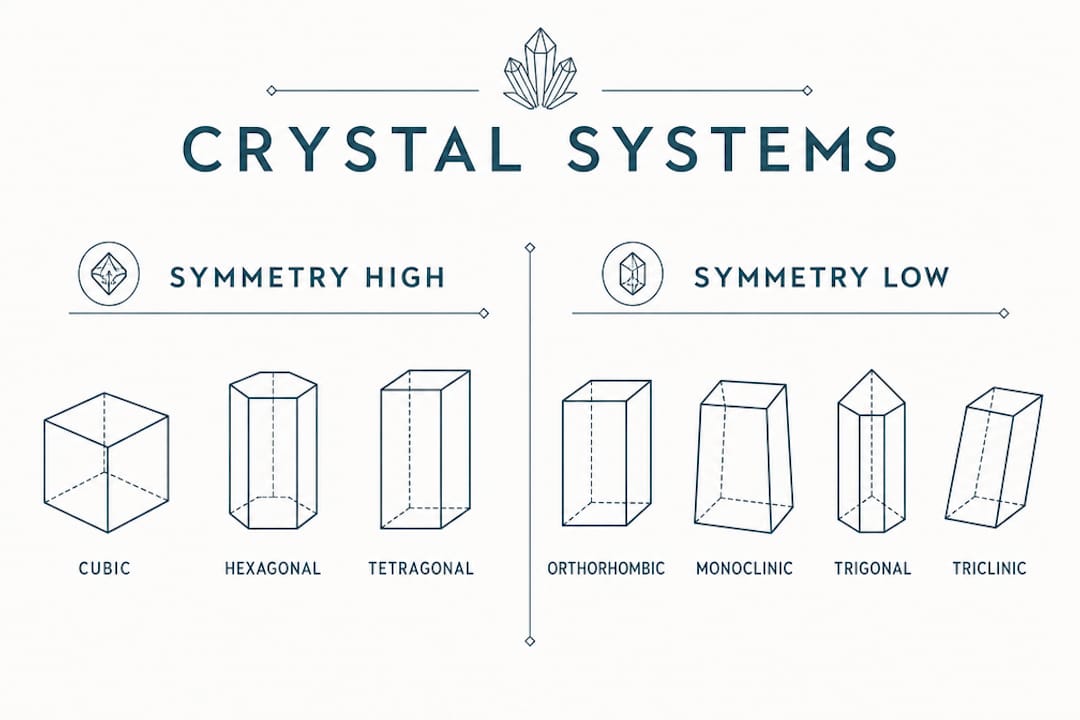
Tous les minéraux se forment selon l'un des sept systèmes cristallins fondamentaux seulement, chacun étant défini par l'arrangement ordonné et répétitif de ses atomes. Ces systèmes sont cubique, tétragonal, orthorhombique, hexagonal, trigonal, monoclinique et triclinique. Chaque système produit un ensemble distinct d'angles et de longueurs d'axes, ce qui détermine la forme externe du cristal.
Comprendre les systèmes cristallins est le fondement de la cristallographie et de la pratique de la géométrie sacrée. Les cristaux cubiques, comme la pyrite et la fluorite, ont trois axes égaux se rencontrant à des angles de 90°. Les cristaux hexagonaux, comme le quartz et l'émeraude, ont une contrainte métrique différente qui produit la forme de prisme à six faces si largement reconnue dans le travail des cristaux.
L'efficacité de l'empilement atomique varie selon les systèmes. Les structures hexagonales compactes remplissent jusqu'à 74 % de l'espace disponible, tandis que les réseaux cubiques simples ne remplissent que 52 %. Cette différence de densité affecte directement la façon dont les praticiens énergétiques décrivent le « poids » ou la « densité » du champ énergétique d'un cristal.
| Système cristallin | Exemple de minéral | Arrangement des axes | Efficacité d'empilement |
|---|---|---|---|
| Cubique (isométrique) | Pyrite, fluorine | Trois axes égaux, angles à 90° | Jusqu'à 74 % (face centrée) |
| Hexagonal | Quartz, émeraude | Quatre axes, axe c unique | Élevée, couches compactes |
| Tétragonal | Zircon, apophyllite | Deux axes égaux, un différent | Modérée |
| Orthorhombique | Topaze, aragonite | Trois axes inégaux, angles à 90° | Modérée |
| Monoclinique | Sélénite, azurite | Trois axes inégaux, un oblique | Inférieure |
Les sept groupes cristallins sont classés du plus symétrique au moins symétrique. Les cristaux cubiques se situent au sommet de cette échelle de symétrie, ce qui est l'une des raisons pour lesquelles les praticiens les associent à la stabilité et à l'ancrage. La géométrie n'est pas symbolique. Elle est structurelle.
Quelles sont les principales formes géométriques sacrées trouvées dans les cristaux ?
Les cinq solides de Platon sont les formes sacrées les plus citées dans les cristaux : le tétraèdre (quatre faces triangulaires), le cube (six faces carrées), l'octaèdre (huit faces triangulaires), le dodécaèdre (douze faces pentagonales) et l'icosaèdre (vingt faces triangulaires). Les philosophes anciens croyaient que ces cinq formes composaient toute la matière. Le cube de Métatron contient les cinq solides de Platon dans sa géométrie, c'est pourquoi il est considéré comme l'un des symboles de géométrie sacrée les plus complets utilisés dans le travail des cristaux.
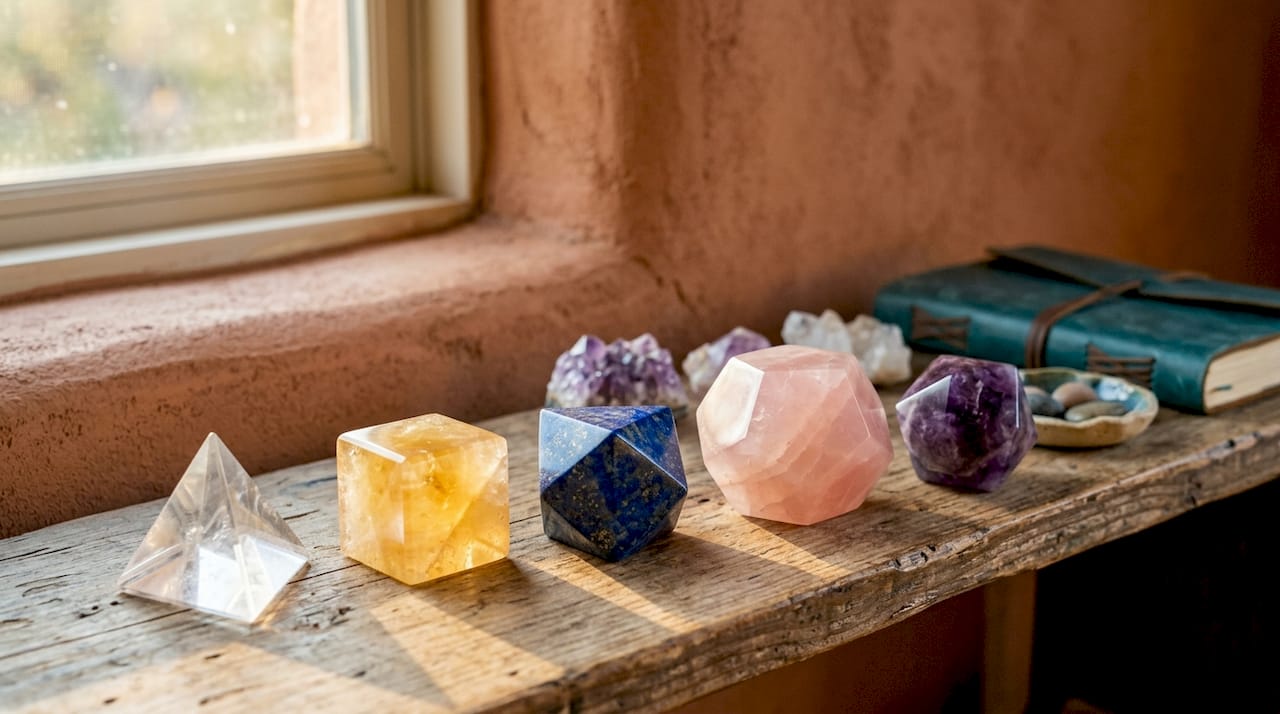
Au-delà des solides de Platon, les formes cristallines sculptées portent des profils énergétiques distincts. Les sphères, les pyramides et les merkabas sont les trois formes les plus couramment utilisées dans la pratique spirituelle, chacune dirigeant l'énergie d'une manière différente.
| Forme | Forme physique | Propriété énergétique |
|---|---|---|
| Sphère | Parfaitement ronde, pas de facettes | Rayonne l'énergie dans toutes les directions, à 360° |
| Pyramide | Base carrée, quatre faces triangulaires | Projete l'énergie vers le haut et vers l'extérieur |
| Merkaba | Deux tétraèdres imbriqués | Utilisé pour le travail du corps de lumière et l'activation énergétique avancée |
| Cube | Six faces carrées égales | Ancre l'énergie, associé à l'élément terre |
| Octaèdre | Huit faces triangulaires | Équilibre l'énergie, associé à l'air et à l'intégration |
La forme physique d'un cristal affecte directement le flux et la direction de son énergie. Les sphères rayonnent l'énergie à 360 degrés. Les pyramides projettent l'énergie directionnellement vers le haut. Les merkabas sont considérés comme des outils avancés pour l'activation du corps de lumière. Ce n'est pas interchangeable. Choisir la mauvaise forme pour votre intention produit un résultat énergétique différent.
Conseil de pro : Lors de la première sélection d'une forme de cristal, choisissez en fonction de votre intention actuelle. Si vous voulez remplir une pièce d'énergie calme, choisissez une sphère. Si vous définissez une intention ou un objectif précis, choisissez une pyramide. Faites correspondre la géométrie à la direction dans laquelle vous souhaitez que l'énergie se déplace.
Les cristaux et la conception géométrique se croisent le plus clairement dans les spécimens sculptés. Une pointe de quartz brute et une sphère de quartz polie contiennent le même minéral, mais elles fonctionnent différemment en tant qu'outils énergétiques en raison de leur géométrie différente. Comprendre les formes de cristaux bruts et sculptés vous aide à faire cette distinction clairement.
Comment la géométrie affecte-t-elle les modèles énergétiques des cristaux ?
La géométrie d'un cristal détermine la manière dont son énergie se propage. Les sphères rayonnent l'énergie de manière omnidirectionnelle, ce qui les rend idéales pour être placées au centre d'une pièce ou d'une grille de cristaux. Les pyramides concentrent l'énergie vers le haut par leur apex, ce qui convient au travail d'autel et à la définition d'intentions. Les merkabas sont des outils avancés pour le travail du corps de lumière et nécessitent un placement intentionnel pour être efficaces.
La géométrie sacrée sous-tend les formations de grilles de cristaux. Une grille de cristaux est un arrangement délibéré de pierres selon un motif géométrique pour amplifier une intention commune. La géométrie de la grille elle-même est aussi importante que les cristaux qui y sont placés. Trois formations sont les plus utilisées :
- Fleur de Vie : Un motif de cercles superposés qui crée un réseau d'hexagones. Il est utilisé comme grille de base pour la guérison générale et le travail d'abondance.
- Cube de Métatron : Contient les cinq solides de Platon. Les praticiens l'utilisent avec de la tourmaline noire et de la sélénite pour la protection et le travail spirituel profond.
- Sri Yantra : Un motif de triangles imbriqués utilisé dans les grilles méditatives et de manifestation.
Ces motifs sont considérés comme des plans anciens de l'univers dans les traditions métaphysiques. Chacun organise le flux d'énergie entre les cristaux d'une manière spécifique. La Fleur de Vie distribue l'énergie uniformément. Le Cube de Métatron la concentre. Le Sri Yantra la canalise vers un point central.
Combiner la bonne forme de cristal avec le bon motif de grille multiplie l'effet des deux. Une sphère de quartz placée au centre d'une grille de la Fleur de Vie rayonne l'énergie vers l'extérieur le long de chaque ligne du motif. Un cube de pyrite placé aux coins d'une grille du Cube de Métatron ancre la structure avec une énergie d'ancrage. La géométrie du cristal et la géométrie de la grille fonctionnent ensemble.
Comment travailler avec les cristaux de géométrie sacrée en pratique
Travailler avec des cristaux de géométrie sacrée nécessite trois décisions : quelle forme utiliser, quel motif de grille appliquer et où placer l'arrangement. Chaque décision découle de votre intention.
- Choisissez votre forme en fonction de la direction de l'énergie. Décidez si vous voulez que l'énergie rayonne vers l'extérieur (sphère), se concentre vers le haut (pyramide), ou active un champ spécifique (merkaba). Ce choix précède la sélection du type de minéral.
- Sélectionnez un motif de grille qui correspond à votre objectif. Utilisez la Fleur de Vie pour la guérison générale ou l'abondance. Utilisez le Cube de Métatron pour la protection ou la purification spirituelle profonde. Utilisez le Sri Yantra pour la manifestation ou la concentration méditative.
- Placez d'abord une pierre centrale. La pierre centrale ancre l'intention de la grille. Choisissez un cristal dont les propriétés minérales s'alignent avec votre objectif. Le quartz amplifie toute intention. La tourmaline noire ancre et protège. La sélénite purifie et élève.
- Placez les pierres environnantes en séquence géométrique. Placez les pierres à partir du centre, en suivant les lignes du motif choisi. Travaillez dans le sens des aiguilles d'une montre pour construire l'énergie, ou dans le sens inverse des aiguilles d'une montre pour la libérer.
- Énoncez clairement votre intention avant d'activer la grille. Utilisez une pointe de quartz ou une baguette pour connecter chaque pierre en traçant les lignes géométriques du motif. Cette étape complète le circuit énergétique.
Les débutants devraient faire confiance à leur attirance intuitive pour des formes de cristaux spécifiques, car cette attirance peut indiquer un besoin énergétique personnel pour cette forme. Les praticiens avancés traitent chaque forme comme une buse d'énergie qui exige un placement intentionnel. La forme n'est pas passive.
Conseil de pro : Évitez de placer un merkaba dans une grille sans intention claire. Contrairement aux sphères, qui diffusent l'énergie librement, les merkabas la concentrent et la dirigent. Un merkaba non focalisé dans un espace de vie peut être troublant plutôt que calmant. Définissez une intention spécifique avant de l'activer.
Un piège courant est de traiter toutes les formes de cristaux comme interchangeables. Une sphère et une pyramide faites du même minéral ne sont pas le même outil. La géométrie modifie la fonction. L'intégration de cristaux de géométrie sacrée dans un autel de cristaux ou un espace sacré fonctionne mieux lorsque la sélection de la forme est délibérée.
Stephen Skinner, chercheur en géométrie sacrée, met en garde contre l'interprétation de la géométrie sans alignement physique, notant que projeter une signification géométrique sur des objets sans ancrage peut conduire à une mauvaise interprétation. Cet avertissement s'applique directement au travail des cristaux. La géométrie doit correspondre à l'intention et au placement pour que la pratique soit cohérente.
Points clés
La géométrie sacrée dans les cristaux est le résultat direct de la structure atomique, et la forme d'un cristal détermine la manière dont son énergie se déplace, faisant de la sélection de la forme une décision pratique, et non décorative.
| Point | Détails |
|---|---|
| Sept systèmes cristallins | Tous les minéraux se forment dans l'un des sept systèmes, chacun produisant une forme géométrique distincte. |
| La forme dirige l'énergie | Les sphères rayonnent à 360°, les pyramides se concentrent vers le haut et les merkabas activent des champs énergétiques avancés. |
| L'importance de la géométrie de la grille | Le motif d'une grille de cristaux (Fleur de Vie, Cube de Métatron) façonne la façon dont l'énergie circule entre les pierres. |
| Les solides de Platon dans les cristaux | Les cinq solides de Platon apparaissent dans les formes cristallines et sous-tendent les symboles de géométrie sacrée les plus puissants. |
| L'intention motive le placement | La forme, le motif de la grille et le placement doivent s'aligner sur une intention claire pour que la pratique soit efficace. |
Cristaux de géométrie sacrée chez Legacy Crystals and Minerals
Legacy Crystals and Minerals propose des cristaux sélectionnés pour leur qualité minérale et leur intégrité géométrique.
Les bracelets de perles polies, comme le Bracelet en Jade Corail et le Bracelet en Malachite Éclatée, portent la géométrie sphérique de chaque perle, rayonnant l'énergie vers l'extérieur au contact de la peau. Des spécimens comme la Fluorite de Shangbao avec Quartz mettent en valeur les systèmes cristallins cubiques et hexagonaux sous leur forme naturelle, ce qui en fait de solides ancrages pour le travail de grille ou l'exposition. Chaque pièce du catalogue est choisie pour son authenticité et sa clarté structurelle. Les lecteurs qui souhaitent approfondir leur pratique avec des cristaux géométriquement sains peuvent parcourir la sélection complète chez Legacy Crystals and Minerals.
FAQ
Quelle est la signification de la géométrie sacrée dans les cristaux ?
La géométrie sacrée dans les cristaux fait référence aux formes et aux motifs géométriques qui se forment naturellement au sein de la structure atomique d'un cristal, reflétant les lois mathématiques universelles. Ces formes influencent la façon dont l'énergie d'un cristal se déplace et comment il est utilisé dans la pratique spirituelle.
Quels sont les sept systèmes cristallins ?
Les sept systèmes cristallins sont cubique, tétragonal, orthorhombique, hexagonal, trigonal, monoclinique et triclinique. Chaque système produit un ensemble distinct d'angles et de longueurs d'axes qui déterminent la forme externe du minéral.
Comment la forme d'un cristal affecte-t-elle son énergie ?
La forme d'un cristal détermine la direction et le motif de son flux énergétique. Les sphères rayonnent l'énergie dans toutes les directions, les pyramides projettent l'énergie vers le haut et les merkabas sont utilisés pour l'activation avancée du corps de lumière.
Qu'est-ce que le Cube de Métatron et pourquoi est-il utilisé avec les cristaux ?
Le Cube de Métatron est un symbole de géométrie sacrée qui contient les cinq solides de Platon dans sa structure. Les praticiens l'utilisent comme cadre de grille de cristaux, souvent en l'associant à la tourmaline noire et à la sélénite pour la protection et la purification spirituelle profonde.
Les débutants peuvent-ils travailler avec des grilles de cristaux de géométrie sacrée ?
Les débutants peuvent travailler avec des grilles de cristaux en commençant par un simple motif de la Fleur de Vie et une pierre centrale de quartz. Faire confiance à votre attirance intuitive pour des formes de cristaux spécifiques est un point de départ fiable avant de développer une pratique plus structurée.
Recommandé
- Créer un espace sacré avec des cristaux – Legacy Crystals and Minerals
- Cristaux pour l'alignement des chakras : votre guide 2026 – Legacy Crystals and Minerals
- Pourquoi la clarté, la couleur et la géométrie sont importantes dans les cristaux – Legacy Crystals and Minerals
- Qu'est-ce que la guérison énergétique par les cristaux : un guide clair – Legacy Crystals and Minerals


