

Aquamarine Meaning: 5 Science Backed Uses That Calm, Clarify, and Protect
Aquamarine is a blue to blue-green variety of beryl, named from the Latin aqua (water) and marina (of the sea). Its chief symbolic associations are calm, protection, and clear communication, and it holds the title of March birthstone. The meaning of aquamarine blends real mineralogy with centuries of maritime superstition, which is exactly why the stone still resonates today.
TL;DR:
- Aquamarine’s value increases with intense, saturated blue to teal colours, while pale or washed-out shades are significantly less desirable.
- The stone’s clarity is usually eye-clean, but visible tubes or inclusions can affect both appearance and price, especially if the cut does not optimize colour saturation.
- Heat treatment is common for enhancing aquamarine’s colour but does not alter its symbolic associations of calm, protection, and clear communication.
- Daily wear considerations include choosing well-cut, clean stones for rings and bracelets, and avoiding ultrasonic cleaners or harsh chemicals to prevent damage.
- Provenance and proper grading are important for authenticity, especially with treated or synthetic stones, so buyers should ask for detailed origin and clarity information before purchase.
Table of Contents
- What is the meaning of aquamarine as a mineral and a name?
- What is the spiritual meaning of aquamarine?
- How do colour, clarity, and cut affect an aquamarine’s value?
- How do you choose and care for an aquamarine piece?
- What does wearing aquamarine actually signify?
- What history and folklore surround aquamarine?
- Legacy Crystals and Minerals’ approach to sourcing aquamarine
- Natural, treated, and synthetic aquamarine: what’s the real difference?
- What treatments are common, and do they change the stone’s meaning?
- Find your aquamarine at Legacy Crystals and Minerals
- Sources
- FAQ
What is the meaning of aquamarine as a mineral and a name?
The word itself tells you almost everything. Aqua plus marina gives you “sea water,” a name early gem traders chose because the stone’s colour mirrored the shallows of a calm ocean. That connection between name and appearance isn’t a coincidence dreamed up by marketers. It’s a description that has held for centuries, backed by GIA’s history of the stone.
Aquamarine belongs to the beryl family, the same mineral group that produces emerald. Its chemical formula is Be3Al2Si6O18, and it crystallizes in a hexagonal, prismatic system, which is why raw aquamarine often looks like elongated six-sided columns before a cutter touches it. The blue-to-blue-green colour range comes from trace iron in the crystal lattice; more iron generally shifts the stone toward deeper blue, while less produces the pale, almost transparent tone many people picture first, according to Geology.
Durability matters as much as colour if you plan to wear the stone daily. Key physical facts:
- Mohs hardness of 7.5 to 8, durable enough for rings, bracelets, and everyday jewellery, per GIA
- Hexagonal crystal system, producing naturally elongated rough
- Colour driven by iron content, ranging from pale sky blue to saturated teal
- Classified as a variety of beryl, not a standalone mineral species, confirmed by Merriam-Webster’s definition
That hardness rating puts aquamarine well above softer stones like opal or moonstone, but below sapphire or diamond. It’s tough, not indestructible.
What is the spiritual meaning of aquamarine?
Sailors carried aquamarine as a talisman long before anyone wrote down a formal reason why. The belief was straightforward: a stone that looked like the sea would calm the sea, protecting anyone who crossed it, a tradition GIA traces back through maritime history.
That protective root has grown into a broader set of themes practitioners associate with the stone today:
- Calm — aquamarine is worn or held to settle anxious thoughts before a stressful event, a flight, or a difficult conversation.
- Clarity — the stone is linked to clearer thinking, useful when you’re untangling a decision or trying to see a situation without emotional static.
- Courage — the same calm that soothes nerves is said to make space for honest, sometimes difficult, self-expression.
- Communication — this is where the throat chakra connection comes in. Aquamarine is one of the stones most commonly placed at the throat during meditation, meant to support speaking your truth without fear.
- Renewal — because water constantly moves and refreshes itself, aquamarine carries a symbolic association with emotional reset and letting go of what’s stagnant.
Beyond the throat chakra, some practitioners also connect aquamarine to the heart chakra, pairing it with rose quartz for emotional openness or with amethyst for a calming, higher-mind combination. If you’re building a small ritual around the stone, keep it simple: hold a tumbled piece during meditation, rest it at your throat while doing voice or speech work, or carry one in a pocket before a conversation you’re dreading.
Pro Tip: If you’re new to working with aquamarine, start by simply holding a piece for five minutes before bed and noticing whether your thoughts settle. You don’t need an elaborate ritual to get a feel for the stone.
How do colour, clarity, and cut affect an aquamarine’s value?
Colour intensity is the single biggest factor in what a specific stone is worth. A pale, almost washed-out blue aquamarine and a deep, saturated teal aquamarine can come from the same mine and sell for very different prices, because buyers consistently favour the stronger hue, a pattern confirmed across Geology.
Clarity works differently here than with, say, diamonds. Aquamarine is classified as a Type I gemstone, meaning it’s typically found eye-clean, without inclusions visible to the naked eye, according to GemsExplained’s grading guide. That doesn’t mean inclusion-free. Common features include:
- Long, hollow growth tubes running parallel to the crystal’s length
- Needle-like mineral inclusions
- Liquid-filled cavities left over from formation
In rare cases, densely packed parallel tubes create a cat’s-eye effect when the stone is cut as a cabochon, a phenomenon GIA documents as chatoyancy.
You’ll often see sellers label stones GEM, AAAA, AAA, or AA. Treat these as convenient shorthand, not scientific measurement. There is no single global grading standard for coloured gemstones, and grading terms vary from one seller to the next. Cut and size still matter on top of colour and clarity: a well-proportioned cut can deepen apparent colour saturation, while a shallow or poorly angled cut leaves a stone looking washed out even if the rough material was excellent.
How do you choose and care for an aquamarine piece?
Match the stone to how you’ll actually wear it. If a bracelet or ring is going on your hand every day, prioritize a clean, well-cut stone with fewer surface-reaching inclusions, since daily friction and knocks will find any weak point. If the piece is for occasional wear or display, you have more flexibility to choose a stone with visible natural texture and a lower price.
A few habits will keep you from buying the wrong stone or damaging the right one:
- Inspect in natural daylight, not under a jeweller’s spotlight, since artificial lighting can flatter a weak colour.
- Ask for close-up photos and provenance before buying online, especially for anything described as rare or high-grade.
- Clean with mild soap, warm water, and a soft brush rather than reaching for anything abrasive.
- Skip the ultrasonic cleaner if the stone has visible inclusions, since vibration can widen internal fractures.
- Store separately from harder stones to avoid surface scratches, and keep it away from harsh household chemicals.
Pro Tip: A slightly paler stone with excellent clarity often wears better day to day than a deeply saturated one riddled with visible tubes, even though the darker stone photographs better online.
Price and quality trade off constantly here. If your budget is limited, spend it on colour first and treat minor inclusions as part of the stone’s natural character rather than a flaw to avoid at all costs.
What does wearing aquamarine actually signify?
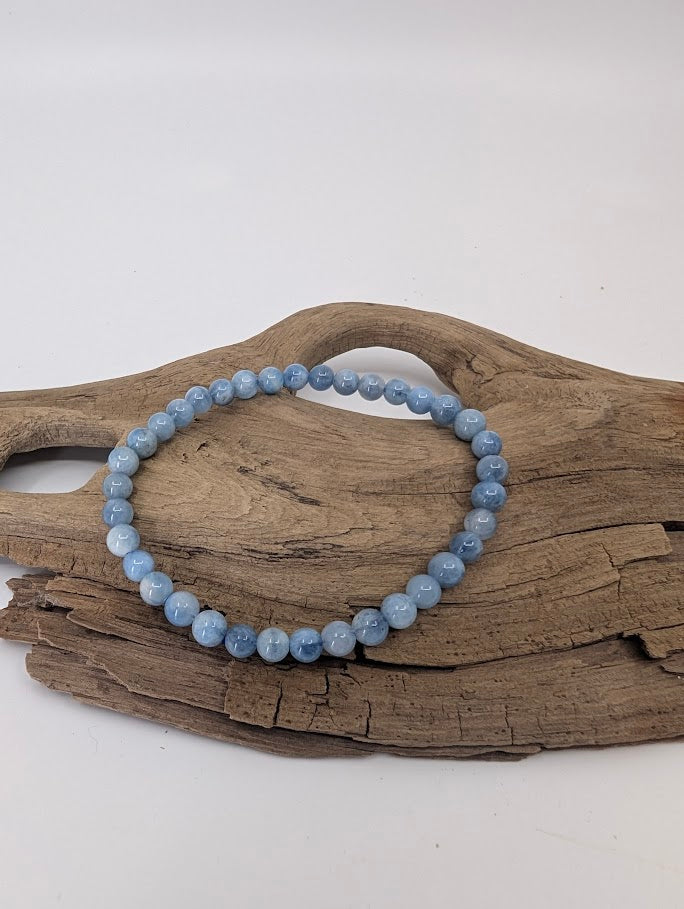
Wearing aquamarine is generally read as carrying a small daily reminder to stay calm, speak honestly, and act with quiet courage. That’s a lot of symbolic weight for a small stone, but it’s consistent with why it has stayed popular as jewellery for generations, a point echoed in GemsNY’s overview of the stone’s appeal.
It shows up most often in a few forms:
- Bracelets, worn close to the pulse point, often chosen for daily talismanic use
- Rings, kept in constant view as a reminder throughout the day
- Pendants, positioned near the throat to reinforce the communication association
If you want a physical ritual rather than just wearing the stone, try carrying a tumbled piece in a pocket during a stressful day, or resting a pendant against your throat during meditation. Aquamarine also makes a natural gift for March birthdays, anniversaries near water, or as a travel talisman before a trip.
What history and folklore surround aquamarine?
Ancient Greek and Roman writers associated aquamarine with the sea gods and calm waters, treating it as a stone with a direct line to the ocean’s moods. Sailors carried it specifically for protection on voyages, believing it would keep seas calm and bring them home safely, a tradition well documented by GIA.
- Mermaid legend held that aquamarine came from mermaids’ treasure chests, washed ashore or found in shipwrecks.
- Its birthstone status for March made it a standard gift for spring birthdays long before modern gemstone marketing existed.
- It has also traditionally been given for maritime departures and safe-return wishes. If travel talismans interest you beyond aquamarine itself, MotherOdessa’s travel and safe passage charm draws on that same protective tradition.
Legacy Crystals and Minerals’ approach to sourcing aquamarine
Legacy Crystals and Minerals curates specimens with attention to provenance, the same standard applied across its museum-grade mineral collections. That focus on documented origin matters for a stone where grading terms vary so widely between sellers.
Three current aquamarine pieces cover different use cases:
- Aquamarine Bracelet 5mm — a polished beaded bracelet suited to daily wear, where a consistent bead size and smooth polish matter more than dramatic natural texture.
- Aquamarine Freeform Bracelet — Natural Polished Blue Beryl — this freeform design keeps the stone’s natural shape, appealing if you want visible character over uniformity.
- Aquamarine Chip Bracelet – Natural Tumbled Brazilian Beryl — a tumbled chip style from Brazilian material, a lower-cost entry point for anyone new to working with the stone.
| Product | Style | Best suited for |
|---|---|---|
| Aquamarine Bracelet 5mm | Polished beads, uniform size | Everyday wear |
| Aquamarine Freeform Bracelet | Natural freeform shape | Buyers who want visible character |
| Aquamarine Chip Bracelet | Tumbled chips, Brazilian beryl | Budget-conscious first purchase |
If you want grading details or provenance photos for any piece before buying, ask directly. For readers curious about how colour and clarity distinctions apply across other coloured stones, Legacy Crystals and Minerals’ tourmaline buying guide covers similar ground.
Natural, treated, and synthetic aquamarine: what’s the real difference?
Natural aquamarine forms over geological time inside host rock, developing the hexagonal, prismatic crystal structure and irregular inclusion patterns discussed earlier. Treated aquamarine starts as natural rough that’s been altered, most often through heating, to shift or improve its colour. Synthetic aquamarine, by contrast, is grown in a laboratory and shares aquamarine’s chemistry without ever having formed underground.
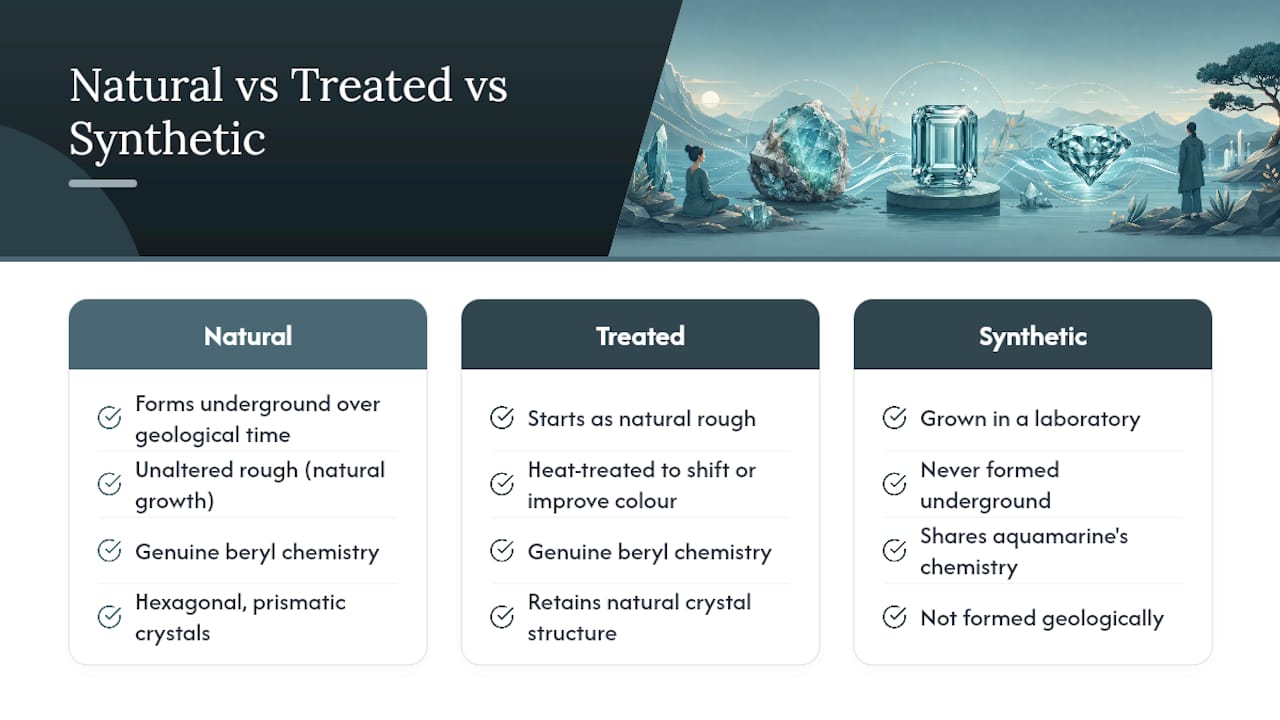
Telling them apart usually comes down to magnified inspection. Natural stones tend to show the irregular tube and needle inclusions described in the clarity section above. Synthetic or heavily treated material can show growth zoning patterns or inclusion types that look distinctly different from natural formation, a distinction Geology.com notes is a useful authentication clue for anyone examining a stone closely.
None of this makes treated aquamarine a lesser purchase; heat treatment is common in the trade and widely accepted. What it does mean is that the meaning you’re buying into, calm, protection, connection to the sea, rests on genuine beryl either way, but the price and rarity attached to a stone should reflect honestly whether it’s natural, treated, or lab-grown. Ask directly if a listing doesn’t specify.
What treatments are common, and do they change the stone’s meaning?
Heat treatment is by far the most common enhancement applied to aquamarine. Much of the rough material mined shows a slightly greenish tint before treatment; controlled heating shifts that tint toward the pure blue most buyers associate with the stone. This process is stable, widely disclosed in the trade, and doesn’t require ongoing special care once complete.
Less commonly, some stones are coated or dyed to intensify colour artificially, a practice worth asking about specifically since it isn’t always disclosed as readily as heat treatment. A coated stone can lose its enhanced colour with wear, exposure to chemicals, or aggressive cleaning, which is exactly why the care guidance earlier about avoiding harsh chemicals and ultrasonic cleaners matters even more for a treated piece.
Does treatment change the symbolic meaning? Not really. The calm-and-clarity associations attach to the stone’s identity as sea-coloured beryl, not to whether heat was applied to bring out that colour. What treatment does change is value and expectations: a heat-treated stone sold at natural-stone pricing without disclosure is a fair price complaint, not a metaphysical one. Buying from a source willing to describe treatment history honestly protects both your wallet and your trust in the piece.
Find your aquamarine at Legacy Crystals and Minerals
Some retailers sell aquamarine as authenticated, sourced pieces rather than unlabelled stock, which matters in a market where grading terms shift from seller to seller. Instead of guessing whether “AAA” means the same thing on two different websites, buyers benefit from specimens described with colour, clarity character, and origin included.
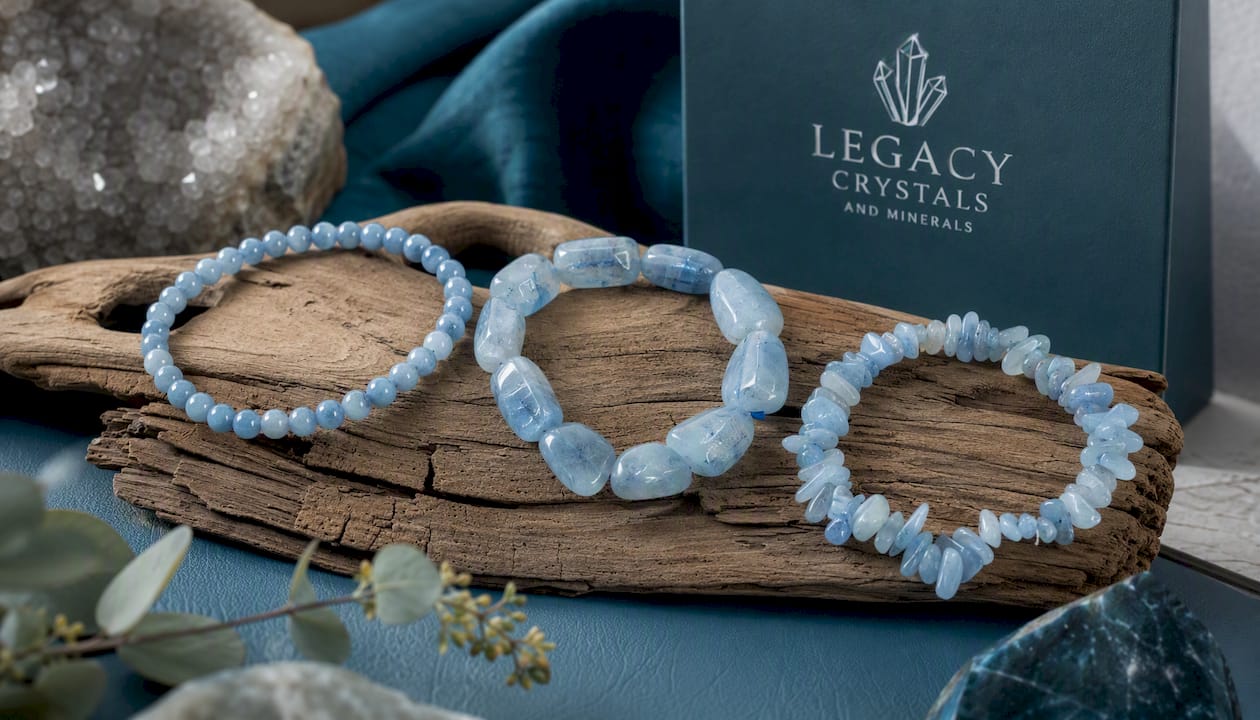
The three current bracelet styles cover the range most buyers ask about: the 5mm polished bracelet for everyday wear, the freeform natural bracelet for visible natural character, and the tumbled chip bracelet for a lower-cost first purchase. Each product page welcomes questions about provenance or grading before you buy, so if you want a closer look at a specific stone’s clarity or origin, ask before you order. Browse the current aquamarine selection and pick the piece that matches how you plan to wear it, then check the listing for care notes specific to that stone.
Sources
- Aquamarine history and lore | GIA
- Geology
- AQUAMARINE Definition & Meaning | Merriam-Webster
- Aquamarine clarity grading | GemsExplained
- Aquamarine education: March birthstone overview | GemsNY
FAQ
What is the spiritual meaning of aquamarine?
Aquamarine’s spiritual meaning centres on calm, protection, and clear communication, historically tied to sailors’ safe-passage talismans and, in modern practice, to the throat chakra.
What does wearing aquamarine mean?
Wearing aquamarine is generally understood as carrying a reminder to stay calm and speak honestly, which is why it’s commonly worn as a bracelet, ring, or pendant close to the body.
What does blue aquamarine symbolize?
The blue colour, caused by trace iron in the beryl structure, symbolizes the sea itself, calm waters, emotional steadiness, and renewal.
Is aquamarine a lucky stone?
Aquamarine is traditionally considered a protective stone for travellers, particularly sailors, rather than a general luck charm, though many wearers today treat it as both.
How durable is aquamarine for everyday jewellery?
Aquamarine rates 7.5 to 8 on the Mohs hardness scale, durable enough for daily rings and bracelets, though it should still be kept away from harsh chemicals and ultrasonic cleaning if the stone has visible inclusions.


