

3 Step Confidence Crystals Routine You Can Wear and Travel With
Tiger’s eye, citrine, carnelian, sunstone, pyrite and rose quartz are the stones most consistently recommended for confidence, each tied to the solar plexus or sacral chakra and traditionally carried or worn before a challenging moment. The fastest way to start is to wear one as a bracelet or pendant, or slip a tumble stone in your pocket with a clear intention before a presentation or social event. Treat the stone as a physical anchor for the mindset you’re building, not a fix on its own.
TL;DR:
- Carry or wear tiger’s eye, citrine, or carnelian as a bracelet or pendant before a challenging event to promote confidence rooted in the solar plexus or sacral chakra.
- Choose softer stones like rose quartz or sunstone for social situations to balance confidence with emotional receptivity and reduce the risk of performance anxiety.
- Set a clear intention with your confidence stone by holding it and naming your desired mindset, then check in with it at day’s end to reinforce progress.
- Match the stone’s color and chakra to your specific confidence goal, and select forms that suit your habits to maximize consistent use.
- Remember that crystals support a confidence practice but do not replace preparation, rehearsal, or professional support, and their effect largely comes from ritual and belief.
Table of Contents
- Best confidence crystals and what each one does
- How to use crystals for confidence day to day
- Choosing the right confidence crystal for your situation
- Caring for and cleansing confidence crystals safely
- Where crystals fit and where they don’t
- What the research actually says about crystals and confidence
- A short history of stones and self-belief
- The energetic properties behind each stone, explained simply
- Common myths about confidence crystals, cleared up
- Legacy Crystals and Minerals: curated pieces to start your confidence practice
- Sources
- FAQ
Best confidence crystals and what each one does
Every stone on this list earns its place for a different reason. Some are grounding, some are activating, and a couple work best paired with something softer so the confidence they build doesn’t turn brittle.
Tiger’s eye looks like banded amber and gold, often polished into a smooth tumble or bracelet bead. It’s the stone practitioners reach for most often before public speaking or a tense negotiation, tied to the solar plexus chakra, the energy centre associated with willpower and personal power. Carry it in a pocket or wear it on your wrist during the event itself.
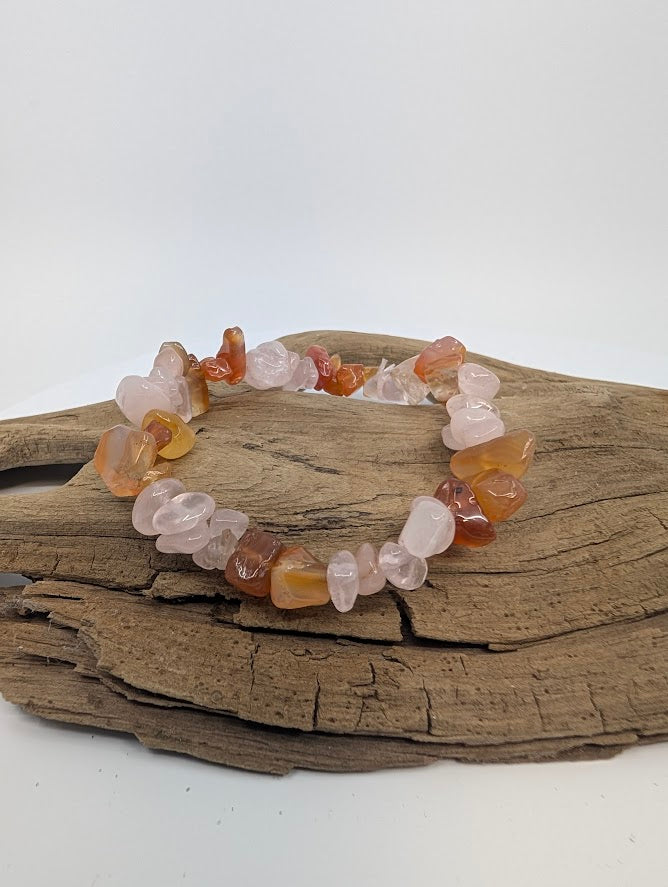
Citrine ranges from pale honey to deep amber and rarely needs treatment to hold its colour. It’s linked to the same solar plexus chakra as tiger’s eye but leans more toward optimism and motivation than raw nerve. People place a citrine cluster on a desk as a daily visual cue rather than carrying it, since its bulkier natural form suits a stationary spot better than a pocket.
Carnelian shows up in warm orange to reddish tones and connects to the sacral chakra, the seat of creativity and emotional confidence. Tiger’s eye, citrine, carnelian and sunstone are the four names that come up again and again in confidence-focused collections, and carnelian is the one most associated with creative risk taking, auditions, first dates, pitching an idea out loud.
Sunstone carries a shimmering, almost glittery inclusion that catches light differently from every angle. It shares sacral chakra territory with carnelian but is more about joyful self-expression than nerve control, making it a good pick for social events where the goal is to relax and be seen, not to perform.
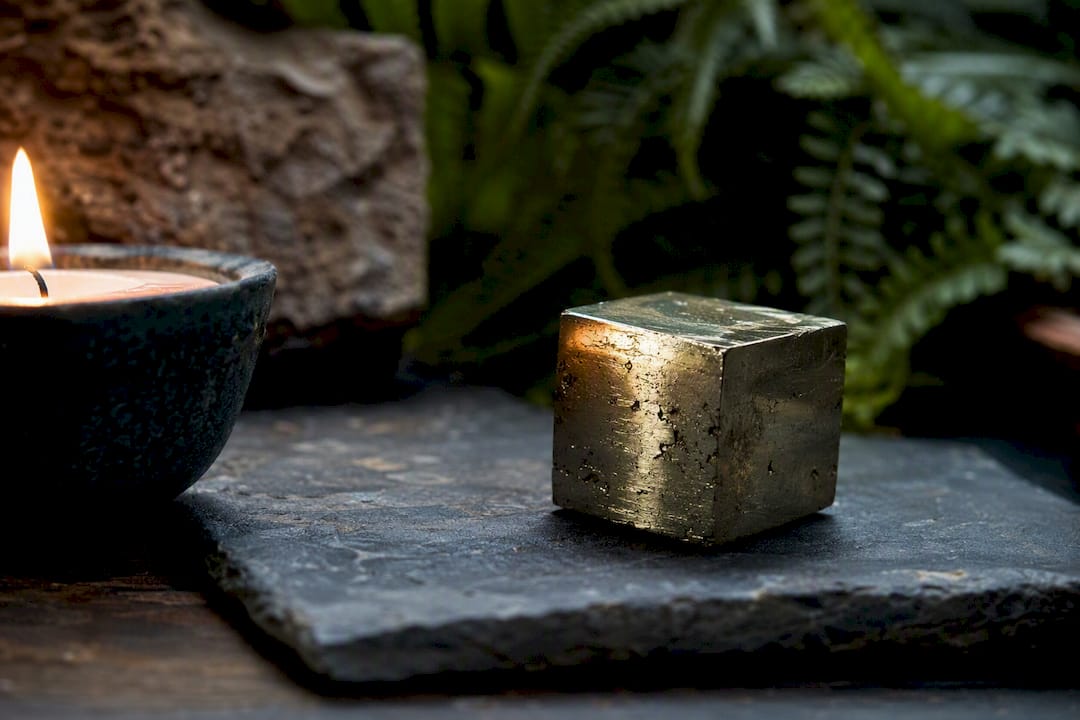
Pyrite is metallic, angular, and looks almost like raw gold. It’s associated with willpower and abundance rather than a specific chakra in most traditions, and its heft makes it a desk or altar stone more than a wearable. Hold it for thirty seconds before a difficult phone call.
Rose quartz is the pale pink counterbalance to all of the above. Tied to the heart chakra, it doesn’t build outward confidence so much as soften the self-criticism that undermines it. Practitioner guides frequently recommend pairing an activating stone like tiger’s eye with a heart-centred stone such as rose quartz, so the confidence you build doesn’t curdle into performance anxiety or arrogance.
A handful of others round out the shortlist for specific situations:
- Lapis lazuli (deep blue with gold flecks) supports the throat chakra, useful for anyone whose confidence gap is really about speaking up in meetings.
- Black tourmaline is a near-black protective stone many carry for grounding before confrontational conversations.
- Red jasper offers steady, slow-burning sacral energy for endurance rather than a single burst of nerve.
- Orange calcite is a lighter, more playful sacral stone often used to shake off procrastination before a task.
- Blue lace agate is a pale, banded stone for calming throat-chakra anxiety, particularly useful right before you have to speak.
How to use crystals for confidence day to day
The stone matters less than what you do with it. Here’s a simple sequence that works whether you’re wearing a bracelet or carrying a tumble stone in your bag.
- Choose your format for the day. Wear the stone as jewellery if you want it accessible all day without thinking about it. Carry a loose tumble in a pocket if you want the option to hold it deliberately at a specific moment, like right before walking into an interview.
- Set the intention once. Hold the stone for a few seconds before you leave the house and name, out loud or silently, what you want it to support: “steady voice,” “no second-guessing,” whatever fits.
- Run a one-minute check-in. At the end of the day, hold the stone again and jot one line about how the intention played out. This turns the stone into a feedback loop instead of a static object.
For a pre-presentation ritual specifically, grip the stone in your dominant hand, take three slow breaths, and release your grip on the exhale. It sounds almost too simple, but the physical action of holding something stable is a recognized tactile grounding technique used in therapeutic settings to calm nerves before you even consider whether you believe in crystal energy.
Pair the stone with something concrete, an affirmation, a rehearsed opening line, a fixed posture cue, rather than expecting it to do the work alone.
Pro Tip: Keep the stone in the same pocket or on the same wrist every time you use it for this purpose. Repetition trains your brain to associate that specific object with the calm state, the same way athletes use a consistent pre-game routine.
Choosing the right confidence crystal for your situation
Start with the situation, not the stone. Public speaking calls for something you can grip discreetly, a tumble or a bracelet, while daily motivation is better served by a desk piece like a citrine cluster you’ll actually see every morning.
A few practical filters help narrow the field:
- Match colour and chakra to your goal. Solar plexus stones (tiger’s eye, citrine, pyrite) suit willpower and assertiveness; sacral stones (carnelian, sunstone, orange calcite) suit creative or social confidence.
- Check hardness if you plan to wear it daily. Quartz-family stones like citrine and rose quartz hold up well as bracelets; softer stones scratch easily and suit display more than daily wear.
- Pick a form that fits your habits. If you know you’ll never remember to carry a loose stone, buy the bracelet.
- Notice which stone you keep picking up. Practitioners often suggest a quick attraction test, laying out a few stones and seeing which one you touch first, as a simple way to trust your own read.
- Verify sourcing before buying online. Look for sellers who state where a stone comes from and how it was cut or polished; vague listings with stock photos are a red flag.
A crystal-identification app can help confirm what you’re looking at, but visual matching apps work best alongside seller provenance, not instead of it, especially for anything sold as a rarer or higher-value specimen.
Caring for and cleansing confidence crystals safely
Not every stone tolerates the same care. A few rules keep your pieces intact:
- Skip direct sunlight for citrine and rose quartz. Prolonged sun exposure fades their colour over time.
- Avoid water for softer or porous stones like sunstone or some tumbled pyrite, since moisture can cause pitting or rust spots on pyrite specifically.
- Use moonlight, sound, or smoke instead of water for cleansing anything you’re unsure about; safer cleansing methods matter more than most beginners realize.
- Store bracelets separately in soft pouches to prevent harder stones like tiger’s eye from scratching softer ones.
- Wrap wearable pieces individually when travelling so clasps don’t tangle and beads don’t rub against each other in a bag.
Where crystals fit and where they don’t
Crystals work as companions to a confidence practice, not replacements for it. They’re a physical cue, similar to a stress ball or a fidget object, that can support the mindset you’re already building through preparation and repetition.
If low confidence shows up as persistent low mood, panic that disrupts daily life, or anxiety that doesn’t ease with rehearsal, that’s a signal to talk to a therapist or doctor, not a stone. Crystals pair well alongside evidence-based approaches like cognitive behavioural therapy, coaching, or simple rehearsal, but they aren’t a substitute for any of them.
What the research actually says about crystals and confidence
No controlled study has shown that a mineral emits energy that measurably changes self-esteem or performance. That’s the honest starting point, and it’s worth saying plainly rather than dancing around it.
What research does support is the value of the physical act of holding something stable. Tactile grounding, engaging touch to regulate emotion, appears in psychological literature as a genuine calming strategy, and a crystal serves as one accessible object for that purpose, the same way a stress ball, a smooth stone from a beach, or even a set of keys might. The ritual around the object, choosing it, setting an intention, holding it before a stressful moment, likely does more work than the mineral itself.
There’s also a well-documented psychological phenomenon where believing an object will help you perform better can genuinely improve performance, often described as a placebo-adjacent confidence effect. None of this proves crystals carry energy. It does mean the practice of using one isn’t meaningless, even for a skeptic, because the behaviour built around the stone, the pause, the breath, the intention, is doing real psychological work regardless of the mineral’s composition.
A short history of stones and self-belief
People have carried stones for protection and courage for thousands of years, long before the term “crystal healing” existed. Ancient Egyptians used carnelian in amulets and jewellery, associating its red hue with vitality and life force. Roman soldiers reportedly carried carnelian into battle believing it steadied nerve.
Lapis lazuli held enormous status in ancient Mesopotamia and Egypt, ground into pigment for royal artifacts and worn by rulers as a symbol of authority and truthful speech, which is part of why it’s linked to the throat chakra today. Tiger’s eye has roots in ancient Egyptian and Roman use as a protective talisman, worn by soldiers who believed it granted courage and clear sight in combat.
The chakra framework itself comes from far older Indian spiritual traditions, later adopted into Western crystal practice over the past century as an organizing system for matching stones to specific areas of the body and mind. Modern “confidence crystal” sets are a fairly recent commercial packaging of ideas that are genuinely old, drawing on Egyptian, Roman, South Asian, and other traditions that all separately landed on the idea that carrying a meaningful object could steady the mind before a hard moment.
The energetic properties behind each stone, explained simply
“Energetic properties” in crystal practice describes the traditional qualities attributed to a stone, not a measurable physical force. Understanding what practitioners actually mean by the term helps you use these stones with clearer expectations.
Solar plexus stones like tiger’s eye, citrine, and pyrite are described as carrying an activating, outward-facing energy tied to willpower, decisiveness, and personal drive. In traditional terms, the solar plexus chakra governs how you assert yourself, so these stones are said to “unblock” hesitation or self-doubt.
Sacral stones like carnelian, sunstone, and orange calcite are described in warmer, more emotionally expressive terms, tied to creativity, sensuality, and social ease rather than raw willpower. The sacral chakra sits lower in the body in traditional frameworks and is associated with how you relate to others and to pleasure.
Rose quartz, as a heart-chakra stone, is described as carrying a softer, receptive energy focused on self-compassion rather than assertion, which is exactly why it’s recommended as a counterbalance to sharper solar plexus stones. Lapis lazuli and blue lace agate, tied to the throat chakra, are described as supporting clear, honest communication. Black tourmaline is consistently described as a protective, grounding stone that absorbs or deflects negative energy, which is why it’s reached for before confrontational situations rather than creative ones.
Common myths about confidence crystals, cleared up
Myth: A crystal will make you confident by itself. No stone replaces preparation, rehearsal, or professional support. It’s a cue, not a mechanism.
Myth: The more expensive or rare the stone, the stronger the effect. Traditional practice doesn’t scale this way. A polished $10 tiger’s eye tumble is used the same way as a large museum-grade specimen, price reflects rarity and craftsmanship, not potency.
Myth: You need to buy a matched set to see any benefit. One stone, worn or carried consistently, does more than five stones bought and forgotten in a drawer.
Myth: Cleansing removes negative energy the crystal “absorbed.” There’s no way to measure this, but cleansing does have a practical benefit, it’s a moment of intentional reset, similar to journalling or a mindfulness pause, which is a real psychological habit even if the “energy” framing is symbolic.
Myth: Crystals work identically for everyone. Different traditions assign slightly different meanings to the same stone, and personal resonance, which one you’re drawn to, is treated as more important than following a rigid formula.
Legacy Crystals and Minerals: curated pieces to start your confidence practice
If you’d rather start with something already thought through than piece together stones one at a time, Legacy Crystals and Minerals gives you a curated, sourced starting point instead of guesswork at a general gift shop. The Healing Crystal Intention Sets group complementary stones, an activating piece alongside a grounding one, so you get the pairing practitioners recommend without having to research each combination yourself.
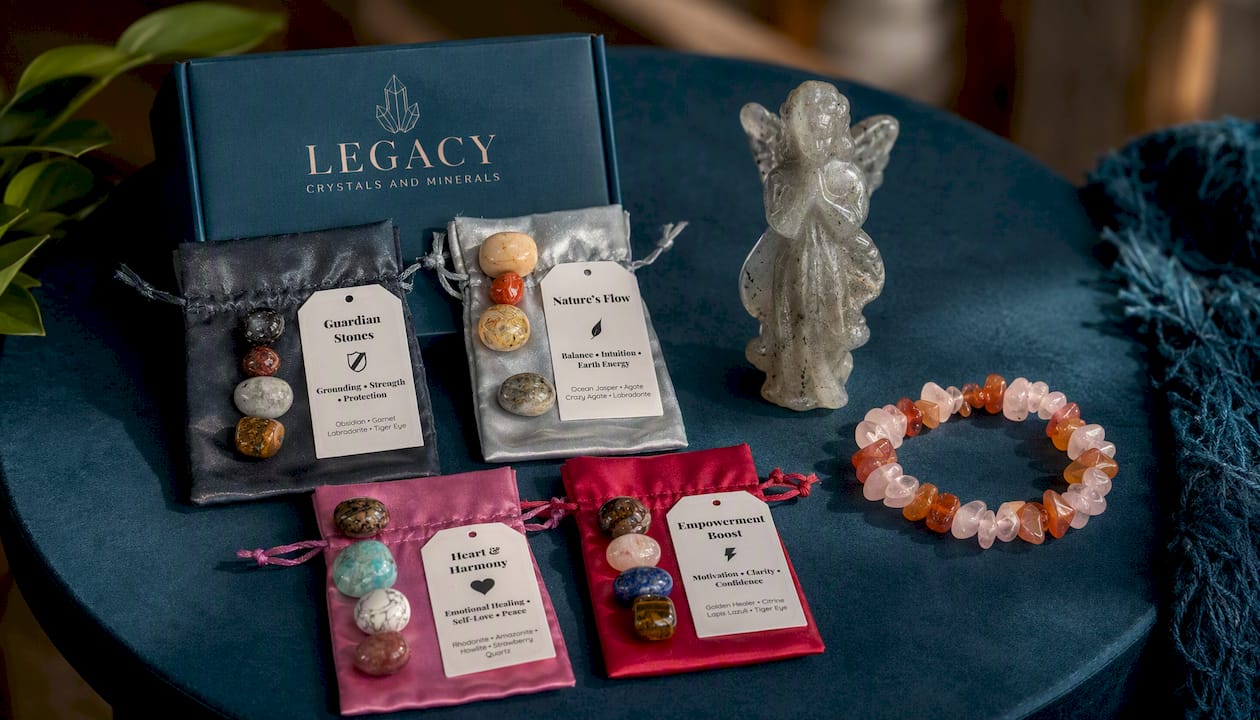
For daily wear, the Rose Quartz & Carnelian Chip Bracelet puts the exact heart-and-action pairing described earlier onto your wrist, sacral confidence balanced by heart-centred self-compassion, in a form you put on once and forget about. If you’re drawn to something more symbolic for your desk or altar, the Guardian Angel Spirit carving offers a decorative daily reminder of protection and intention rather than a wearable piece. Every specimen comes with sourcing information, so you’re not guessing at authenticity the way you might with an unlabelled online listing. Browse the current sets and pick the pairing that matches the situation you’re actually facing this month.
Sources
FAQ
What is the best crystal for confidence?
Tiger’s eye is the stone most consistently recommended for confidence because it’s tied to the solar plexus chakra and is easy to carry or wear daily, though citrine and carnelian are close alternatives depending on whether you need assertiveness or creative courage.
Which stone is for confidence?
Tiger’s eye, citrine, carnelian, sunstone, and pyrite are the stones most often used for confidence, each connected to the solar plexus or sacral chakra and traditionally carried before challenging situations like interviews or presentations.
Which chakra helps with confidence?
The solar plexus chakra, located around the upper stomach, is most closely associated with willpower and confidence in traditional crystal practice, while the sacral chakra supports social and creative confidence specifically.
What stone should I wear for confidence?
A tiger’s eye or carnelian bracelet is the most practical daily option since wearable jewellery keeps the stone accessible without requiring you to remember to carry a loose stone in your pocket.


