

Fluorescent minerals: the collector's complete guide
Fluorescent minerals are naturally occurring mineral specimens that emit visible light when exposed to ultraviolet (UV) light. The glow comes from specific impurity ions called activators, embedded within the crystal structure. A proportion of known mineral species fluoresce visibly under UV light. Common examples include fluorite, calcite, aragonite, and willemite. Fluorescence stops the instant the UV source is removed. Phosphorescence, by contrast, persists for seconds to hours after the light is gone.
Key facts at a glance:
- Fluorescence is caused by activator ions absorbing UV energy and re-emitting it as visible light.
- Fluorescence ceases instantly when UV light is removed; phosphorescence lingers.
- Fluorite, calcite, aragonite, willemite, scheelite, sodalite, apatite, and agrellite are among the most collected fluorescent mineral types.
- The same mineral species can fluoresce differently depending on the locality and local chemistry.
- Shortwave UV (254 nm) and longwave UV (365 nm) are the two primary wavelengths used by collectors.
What causes fluorescence in minerals?
Fluorescence in minerals is an electronic process. When UV light strikes a mineral, activator ions within the crystal structure absorb that energy and boost electrons to a higher energy state. Those electrons quickly fall back to their resting state, releasing the excess energy as visible light. The emitted light has a longer wavelength than the UV that triggered it, which is why you see colour rather than invisible radiation.
The electron excitation and emission process involves activator ions absorbing UV energy and re-emitting light at longer, visible wavelengths, around 365 nm for longwave or 254 nm for shortwave UV. Mineralogists classify fluorescence into four main types: intrinsic (the activator is part of the mineral’s own chemistry, as in scheelite), impurity (a trace element like manganese causes the glow), defect (crystal structure imperfections create emission centres), and inclusion-based (microscopic inclusions of another substance fluoresce instead of the host mineral).
Not every activator works alone. In calcite, for example, lead ions act as coactivators, absorbing UV and transferring energy to manganese ions so they can fluoresce more strongly. Without that energy transfer, the fluorescence would be faint even with manganese present.
Quenchers like iron, nickel, and cobalt can inhibit or completely suppress fluorescence even when activators are present. They intercept excited electrons and dissipate the energy as heat rather than light. A specimen that looks promising under normal light may show no glow at all if its iron content is high enough.
Pro Tip: When evaluating a specimen for fluorescence, check the locality’s known chemistry before purchasing. High-iron deposits frequently produce non-fluorescent material even in species like calcite that are commonly fluorescent elsewhere.
Common fluorescent minerals and their characteristics
Over 500 mineral species are known to fluoresce visibly, though only a fraction appear regularly in collections. The fluorescence colour, intensity, and activating wavelength vary by species and locality.
Notable colour variations by species:
- Fluorite: blue, purple, green, yellow, white, red, or pink depending on activators (Eu, Y, Ce); longwave UV often produces the most vivid response.
- Calcite: red, orange, pink, purple, blue, yellow, or white; manganese is the most common activator; organic inclusions can produce white.
- Aragonite: orange, pink, or yellow under both 365 nm and 254 nm; activators include Mn, Pb, and organic inclusions.
- Willemite: bright green under shortwave UV; manganese activates both willemite and co-occurring calcite.
- Scheelite: yellow, blue, or white; the tungstate ion (WO₄²⁻) is an intrinsic activator; molybdenum shifts the colour toward pale blue.
- Sodalite: yellow, orange, red, white, or pink; sulphur-based activators; hackmanite (a variety) also shows tenebrescence.
- Apatite (fluor-apatite): yellow or orange under both longwave and shortwave UV; rare earth elements (REE) are the primary activators.
- Agrellite: a rare Canadian silicate mineral found at Kipawa, Québec; fluoresces pink to orange under shortwave UV due to REE activators.
| Mineral | Wavelengths | Fluorescence colours | Known activators |
|---|---|---|---|
| Fluorite | 365 nm / 254 nm | Blue, purple, green, yellow, white, red, pink | Eu, Y, Ce |
| Calcite | 365 nm / 254 nm | Red, orange, pink, purple, blue, yellow, white | Mn, Pb, organic inclusions |
| Aragonite | 365 nm / 254 nm | Orange, pink, yellow | Mn, Pb, organic inclusions |
| Willemite | 365 nm / 254 nm | Bright green | Mn (as ZnS analogue) |
| Scheelite | 365 nm / 254 nm | Yellow, blue, white | W (WO₄²⁻), Mo |
| Sodalite | 365 nm / 254 nm | Yellow, orange, red, white, pink | S |
| Apatite | 365 nm / 254 nm | Yellow, orange | REE |
| Agrellite | 254 nm | Pink, orange | REE |
The same mineral species from different localities may fluoresce differently due to differences in local chemistry affecting activator presence and concentration. A calcite from Mont Saint-Hilaire, Québec, glows cream-white, while calcite from New Mexico’s Waldo mine produces a vivid orange-red. Both are calcite; the activator chemistry differs.
Phosphorescent examples are worth separating from pure fluorescence. Phosphorescent minerals such as certain willemites and calcites emit light for seconds to minutes after UV source removal, due to electron traps in the crystal structure. Willemite from Franklin, New Jersey, is the classic example, but Canadian calcite specimens also show this behaviour.
How to view fluorescent minerals safely and effectively
Three UV wavelengths are used in mineral fluorescence viewing. Shortwave UV (254 nm) is the most energetic and activates the widest range of minerals, but carries the highest health risk. Longwave UV (365 nm) is safer and activates minerals like fluorite and sodalite particularly well. Midwave UV (305–310 nm) is less common but reveals fluorescence patterns that neither shortwave nor longwave captures alone.
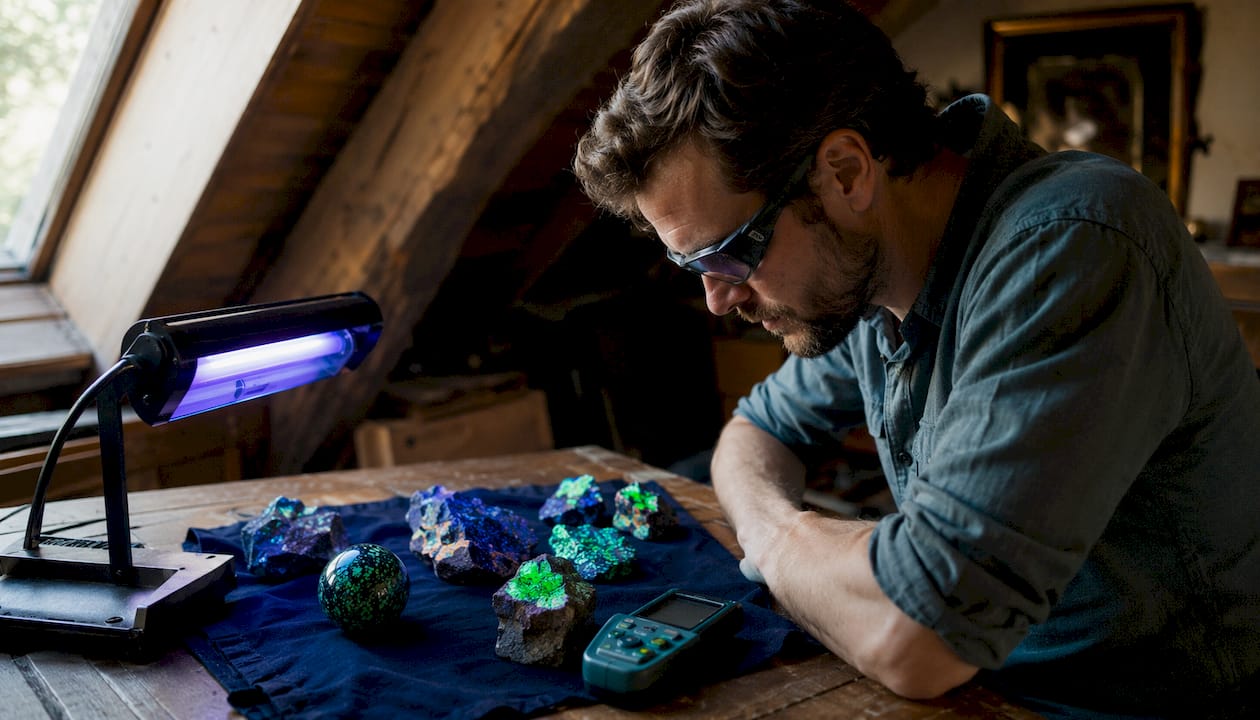
Different UV wavelengths excite different activators and can produce varied fluorescence colours or intensities in the same specimen. Shortwave UV penetrates less deeply into a mineral and is more energetic, sometimes exciting different activator centres than longwave. This is why a specimen may appear one colour under longwave and a completely different colour under shortwave.
Safety is not optional with UV equipment, particularly shortwave lamps:
- Wear UV-blocking glasses rated for the wavelength in use; standard sunglasses do not provide adequate protection.
- Avoid direct skin exposure; shortwave UV causes sunburn rapidly and carries long-term skin cancer risk.
- Never look directly at a UV lamp, even briefly.
- Use shortwave UV lamps only in well-ventilated spaces. Shortwave UV reacts with atmospheric oxygen to produce ozone, which is toxic at elevated concentrations.
- Prefer longwave UV when shortwave is not specifically needed; it is safer and still activates many species effectively.
- Wear nitrile gloves when handling specimens to avoid skin oils contaminating the surface, which can affect fluorescence readings.
Safety precautions for UV mineral viewing include using UV-blocking glasses, avoiding direct skin exposure, providing ventilation to manage ozone buildup, and preferring longer wavelength UV when possible.
Pro Tip: Conduct shortwave UV viewing sessions near an open window or with a small fan running. Even brief ozone buildup in a closed room can cause headaches and respiratory irritation.
Fluorescent minerals found in Canada: locations and notable examples
Canada is geologically diverse, and several provinces yield specimens of genuine interest to fluorescence collectors. Québec leads in documented fluorescent finds, with Ontario and British Columbia also producing notable material.
Mont Saint-Hilaire in Québec is the most internationally recognised Canadian site for fluorescent minerals. Calcite from this locality fluoresces cream-white under all UV wavelengths, with the brightest response under longwave. The second-generation calcite at this site also shows a brief but vivid phosphorescence sequence: an initial red “brief intense phosphorescence,” transitioning to cream-white, then green, all within roughly 1–1.5 seconds. Mont Saint-Hilaire is also the type locality for agrellite, a rare silicate that fluoresces pink to orange under shortwave UV.
The Kipawa alkaline complex in western Québec has produced agrellite, eudialyte, and other REE-bearing silicates, several of which show fluorescence. Diopside from various Ontario localities fluoresces pale to medium blue under shortwave UV, activated by trace REE content. Calcite is widespread across Canadian shield exposures and frequently fluoresces, though the colour and intensity depend entirely on local activator chemistry.
Field collecting in Canada requires attention to provincial regulations. Many productive sites are on Crown land where surface collecting is permitted, but removing material from provincial parks or protected areas is restricted. The Geological Survey of Canada and provincial geological surveys publish locality data useful for planning collecting trips. Joining a regional chapter of the Fluorescent Mineral Society connects collectors with current site information and group outings.
Compared to globally famous localities like Franklin, New Jersey, Canadian fluorescent specimens tend toward subtler colours, with cream, white, and pale blue being more common than the vivid greens and reds of Franklin willemite and calcite. That said, Mont Saint-Hilaire material is prized internationally for its mineralogical diversity and the quality of its phosphorescence sequences.
Expert insights on mineral fluorescence and collecting
The Fluorescent Mineral Society, founded in 1971 and registered as a 501©(3) non-profit in 2018, is the primary international organisation for fluorescence collectors. Its Henkel Glossary of Fluorescent Minerals, edited by Dr. Earl Verbeek and Dr. Peter Modreski, remains the most exhaustive reference catalogue of fluorescent mineral species. The Society’s peer-reviewed journal covers both specimen documentation and the underlying physics of fluorescence, afterglow, and tenebrescence.

Use of multiple UV wavelengths by dedicated collectors reveals complex fluorescence patterns and zones that single-wavelength lighting misses entirely. A specimen photographed under shortwave, midwave, and longwave UV separately can show three distinct colour maps, each corresponding to different activator populations within the same piece of rock.
Fluorescence also serves as an educational tool. The Sterling Hill Mining Museum in New Jersey built its public programme around fluorescent mineral demonstrations, transforming static geological specimens into dynamic exhibits that engage visitors in both physics and earth science. Canadian natural history museums, including the Canadian Museum of Nature in Ottawa, hold fluorescent mineral collections that serve similar educational functions.
Care and storage affect long-term fluorescence. Organic activators are the most vulnerable: prolonged UV exposure can degrade bituminous or organic inclusions, reducing or eliminating fluorescence in specimens that rely on them. Store specimens away from direct sunlight and avoid unnecessary shortwave UV exposure during display. Stable temperature and low humidity are standard best practices for mineral storage generally, and they apply equally to fluorescent specimens.
Legacy Crystals and Minerals curates museum-grade fluorescent specimens with documented locality data, supporting both the scientific and collecting aspects of the hobby.
How to identify genuine fluorescence vs. artificial enhancements or imitations
Genuine fluorescence is a property of the mineral’s crystal chemistry, not its surface. A few straightforward tests separate authentic fluorescence from coatings, dyes, or phosphorescent paint applied to non-fluorescent material.
The first check is surface vs. internal glow. Authentic fluorescence originates from within the crystal structure and appears consistent through the specimen’s depth. A painted or coated surface glows only at the outermost layer; under magnification, the glow often shows brush marks, uneven coverage, or a film that does not follow crystal faces. Washing a suspect specimen with water or isopropyl alcohol removes surface coatings; genuine fluorescence is unaffected.
Colour consistency across wavelengths is another indicator. Real fluorescent minerals often respond differently to shortwave vs. longwave UV, sometimes changing colour entirely between the two. A specimen that glows identically under every wavelength with no variation is more likely coated with a broadband phosphorescent material than genuinely fluorescent.
Locality verification matters. Fluorescence response varies by locality due to differences in activators; not every specimen of a fluorescent mineral will glow. If a seller claims a species is “always fluorescent” without specifying the locality, treat that claim with caution. Scheelite and autunite are among the few species that fluoresce reliably across localities; most others, including calcite and fluorite, vary widely.
Phosphorescent paint is a common imitation technique. It produces a uniform, often blue-green afterglow that persists for many minutes, far longer than natural phosphorescence in most mineral species. Natural phosphorescence in calcite, for example, typically lasts only seconds. An afterglow lasting ten minutes or more on a specimen sold as “natural” warrants close scrutiny.
For collectors building a serious collection, a UV mineral visual guide documenting authentic fluorescence colours by species and locality is a practical reference tool.
Equipment options beyond UV lamps for observing and photographing fluorescent minerals
UV lamps are the starting point, but serious collectors use additional equipment to document and study fluorescence in detail.
Optical filters placed over a camera lens block residual visible light from the UV lamp, allowing the camera to capture only the fluorescent emission. Without a filter, the lamp’s own visible output washes out the specimen’s glow in photographs. Bandpass filters matched to the lamp’s UV wavelength are the standard choice.
Camera settings for fluorescence photography require a dark room, a stable tripod, and manual exposure. Long exposures (typically 10–30 seconds) at a low ISO capture the full colour range of the fluorescence without noise. A remote shutter release prevents camera shake during the exposure. Mirrorless cameras with high sensor sensitivity perform well in this application.
Spectroscopes and spectrometers allow collectors to record the emission spectrum of a fluorescent mineral, which can help identify the activator ion responsible for the glow. Manganese produces a characteristic broad emission peak around 580–620 nm (orange-red); uranyl ions produce a distinctive series of sharp peaks in the green range. Handheld spectrometers designed for field use are available and connect to smartphones for data logging.
Multi-wavelength UV setups are the most significant upgrade for advanced collectors. Multi-wavelength UV lighting allows collectors to fully reveal mineral fluorescence, detecting colours and phosphorescence not visible under standard blacklights. A three-lamp setup covering shortwave (254 nm), midwave (305 nm), and longwave (365 nm) reveals the full fluorescence profile of a specimen in a single session.
Phosphorescence timers are a simple but useful addition. Recording how long a specimen glows after the UV source is removed, and under which wavelength, adds quantitative data to a collection record. This is particularly relevant for calcite and willemite specimens where phosphorescence duration is a distinguishing characteristic.
For collectors interested in the properties and applications of UV minerals, understanding the full equipment toolkit makes the difference between casual observation and systematic documentation.
Key takeaways
Fluorescent minerals glow under UV light because of specific activator impurities in their crystal structure, and A proportion of known mineral species exhibit this property visibly.
| Point | Details |
|---|---|
| Activators cause fluorescence | Trace impurity ions like manganese, lead, and REE absorb UV energy and re-emit it as visible light. |
| Fluorescence vs. phosphorescence | Fluorescence stops instantly when UV is removed; phosphorescence persists for seconds to minutes. |
| Proportion of minerals that fluoresce | About 10–15% of the known 5,000 mineral species fluoresce visibly under UV light, but fluorite and calcite are among the most common due to favorable activator chemistry. |
| Canada’s key localities | Mont Saint-Hilaire, Québec, produces cream-white fluorescent and phosphorescent calcite and rare agrellite. |
| Safety and equipment | Shortwave UV requires UV-blocking glasses, ventilation, and skin protection; multi-wavelength setups reveal the most detail. |
Collectors looking for museum-grade fluorescent specimens
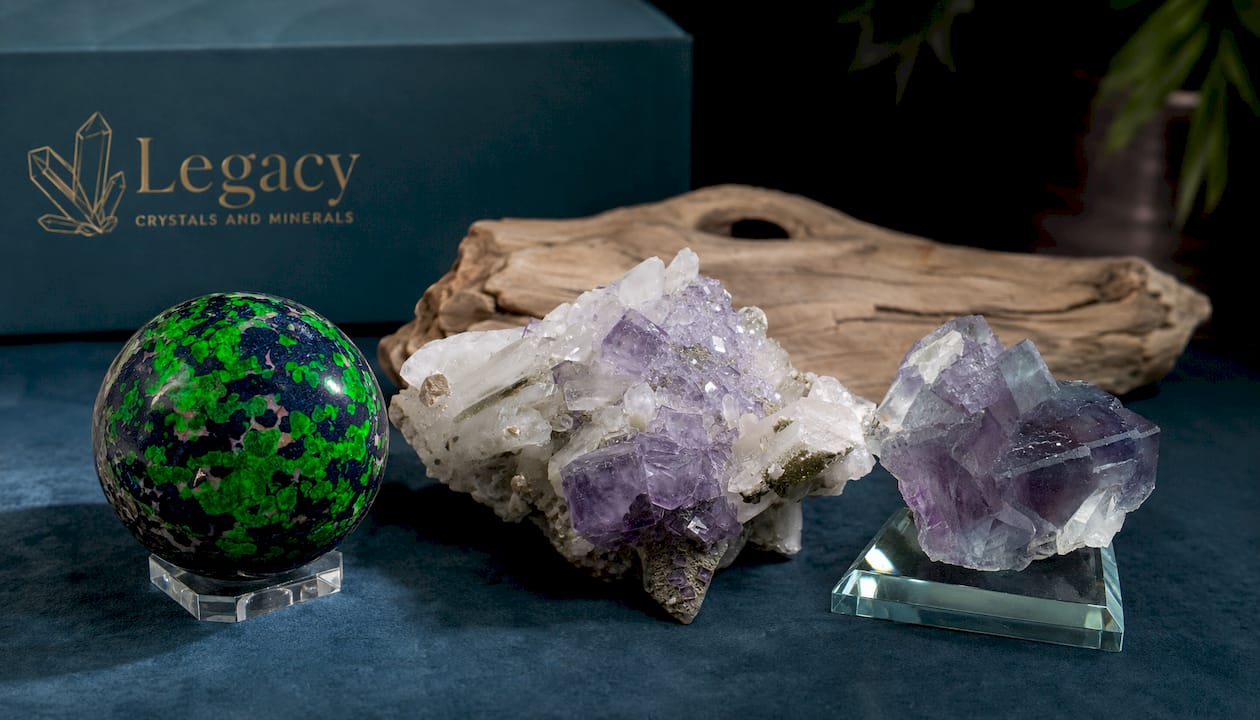
Legacy Crystals and Minerals carries documented, locality-verified fluorescent specimens for collectors at every level. The bi-color willemite sphere displays a vivid neon green glow under shortwave UV, consistent with manganese-activated willemite. For fluorite collectors, the fluorite on quartz with chlorite from the Yaogangxian Mine in Hunan, China, shows pronounced UV fluorescence alongside strong matrix aesthetics. The purple fluorite with quartz and mica from the YGX Mine is a rare collector’s specimen combining visual appeal with documented fluorescence.
FAQ
What fluorescent minerals are found in Ontario?
Ontario produces fluorescent calcite, diopside, and scapolite at various shield localities. Diopside from several Ontario sites fluoresces pale to medium blue under shortwave UV due to trace REE content.
Where can collectors find fluorescent minerals in Canada?
Mont Saint-Hilaire in Québec is the most documented Canadian locality, known for fluorescent calcite and rare agrellite. Provincial geological surveys and regional chapters of the Fluorescent Mineral Society provide current collecting site information.
What materials are naturally fluorescent?
Minerals with specific activator impurities are naturally fluorescent, including fluorite, calcite, willemite, scheelite, and sodalite. Organic compounds and some biological materials also fluoresce, but in mineral collecting the phenomenon is driven by inorganic ion chemistry.
Are fluorescent rocks rare?
A proportion of known mineral species fluoresce visibly under UV light, so fluorescent minerals are not rare as a category. Strongly fluorescent specimens from specific localities, however, can be uncommon and are actively sought by collectors.
How do you tell if a mineral’s fluorescence is genuine?
Genuine fluorescence originates from within the crystal structure, responds differently to shortwave vs. longwave UV, and is unaffected by washing with water or isopropyl alcohol. Surface coatings or phosphorescent paint show uniform glow, often with visible coverage patterns under magnification.
Recommended
- Fluorescent & UV Reactive Minerals: A Visual Guide | Legacy Crystals – Legacy Crystals and Minerals
- Why Some Crystals Fluoresce Under UV Light – Legacy Crystals and Minerals
- Why Some Crystals Fluoresce – Legacy Crystals and Minerals
- UV minerals: properties, applications, and benefits – Legacy Crystals and Minerals


