
Buy Smarter: Jadeite vs Nephrite: 3.3–3.4 vs 2.9–3.1
Jadeite and nephrite are two distinct minerals that both get sold under the single trade name “jade.” Jadeite is the rarer of the two and typically commands higher prices, especially in vivid, semitransparent green. Nephrite is more widely available and generally more affordable. The clearest measurable gap between them is density and hardness: jadeite runs harder and denser than nephrite.
TL;DR:
- Jadeite’s density and hardness make it feel heavier and more resistant to scratching, but nephrite’s fibrous structure offers superior impact toughness.
- The most valuable jadeite is vivid, semitransparent green called Imperial green, which is rare and often treated with resin or dye.
- Nephrite deposits are widespread, with major sources in British Columbia, New Zealand, and Siberia, making it more affordable and readily available than jadeite.
- Authenticity verification requires lab tests measuring refractive index and specific gravity, especially for high-value pieces, while visual checks can only suggest probable identity.
- When choosing, consider provenance, treatment history, and intended use; jadeite is preferred for small, color-focused jewelry, and nephrite for large carvings and durable bangles.
Table of Contents
- Jadeite vs nephrite comparison at a glance
- Physical properties: hardness, density, and why toughness isn’t the same thing
- Colour, translucency, and what actually drives the price
- How to identify jadeite vs nephrite before you buy
- Choosing jadeite or nephrite for your specific goal
- What the experts and museums say about jade
- Where jadeite and nephrite come from, geologically
- Jade’s cultural weight, from imperial China to Māori taonga
- Where jadeite and nephrite are actually mined today
- Shop museum-grade crystals and jade-adjacent jewellery at Legacy Crystals and Minerals
- Sources
- FAQ
Jadeite vs nephrite comparison at a glance
Before getting into lab numbers and trade terminology, here is the shorthand version collectors use when sorting one from the other.
- Hardness: Jadeite measures roughly 6.5–7 on the Mohs scale; nephrite sits slightly softer at 6–6.5.
- Specific gravity: Jadeite ranges around 3.3–3.4; nephrite runs lighter, around 2.9–3.1.
- Colour range: Jadeite spans green, lavender, pink, red, and black, with the best pieces reaching semitransparency. Nephrite leans toward muted, oily greens and the prized “mutton fat” white.
- Texture: Jadeite often shows a granular, slightly pebbled surface once polished. Nephrite polishes to a smoother, waxier finish.
- Typical use: Jadeite dominates fine jewellery and small carved pendants where colour and clarity matter most. Nephrite has long been the material of choice for large carvings, bangles, and tool-like objects where toughness counts more than transparency.
The buying implication follows directly from those traits. Choose jadeite when you want a vivid, semitransparent green stone for a ring or pendant and you’re prepared to pay for rarity. Choose nephrite when you want a large, durable carving or an everyday bangle that can take a few knocks without you worrying about it. A property-by-property comparison from gemmological references backs up this same split between the two materials.
Physical properties: hardness, density, and why toughness isn’t the same thing
The lab numbers tell a consistent story. Jadeite measures Mohs 6.5–7 with a specific gravity around 3.3–3.4, while nephrite comes in slightly softer and noticeably lighter at Mohs 6–6.5 and specific gravity 2.9–3.1. Pick up a jadeite piece and an equally sized nephrite piece, and the jadeite will feel heavier in your hand. That density difference is one of the fastest gut checks a buyer can do without any equipment.
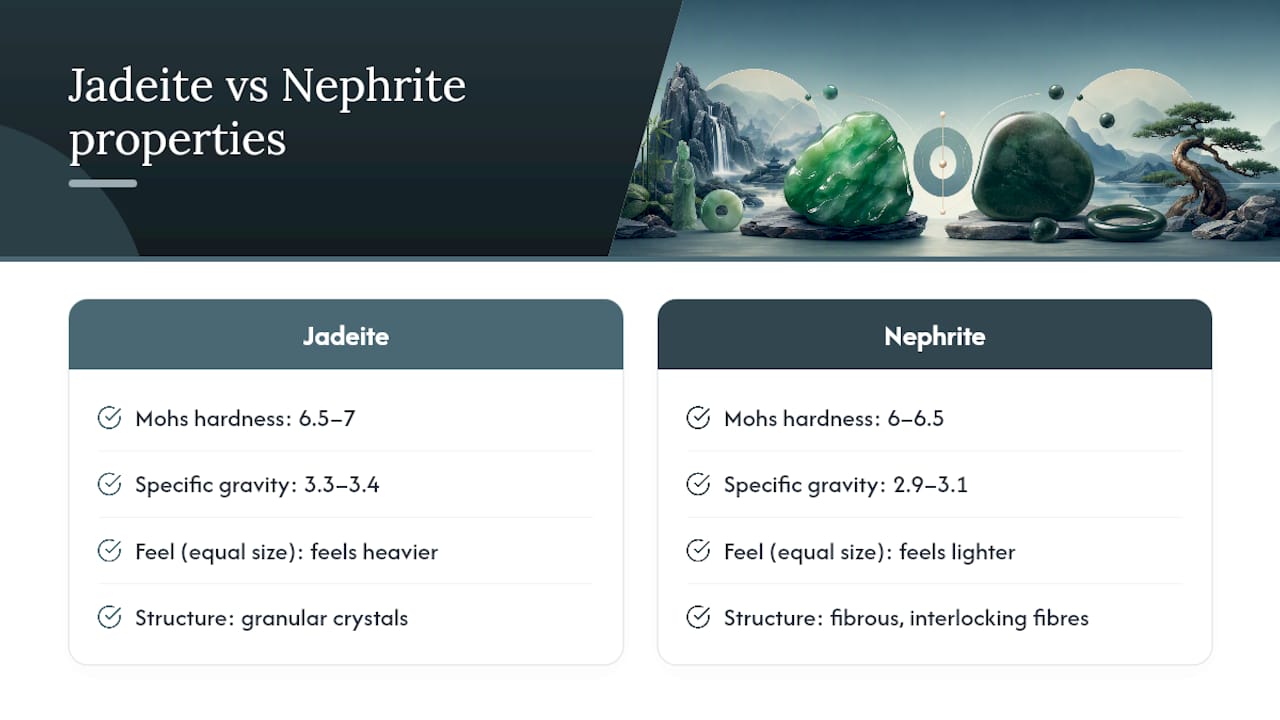
Hardness and toughness are not interchangeable, though jewellery shoppers often assume they are. Hardness measures resistance to scratching. Toughness measures resistance to breaking or chipping under impact. Jadeite’s microstructure is granular, made of tightly interlocking crystals, which gives it that slightly higher hardness score. Nephrite’s structure is fibrous and felted, almost like compressed fibreglass at a microscopic level, and that interlocking fibre network resists fracture even better than jadeite’s granular crystals do.
What does that mean day to day? A jadeite ring will resist surface scratching slightly better, but a nephrite carving dropped on a tile floor has a real structural advantage against cracking straight through. That’s exactly why nephrite historically ended up as tools, weapons, and oversized ceremonial carvings, while jadeite gravitated toward small, wearable, colour-driven pieces.
Colour, translucency, and what actually drives the price
Colour and clarity move jadeite’s price more than almost anything else in the mineral’s profile. The trade term “Imperial green” describes a vivid, saturated, semitransparent jadeite that represents the top tier of the market, and jadeite’s colour palette extends well beyond green into lavender, pink, red, and black. Two jadeite stones can look similar at a glance and still differ enormously in value once you compare their translucency and evenness of tone side by side.
Nephrite plays a different game entirely. Its classic look is a softer, oilier green, and in some collecting traditions the most prized nephrite is a fine, even white known as mutton fat jade rather than anything green at all. Nephrite rarely reaches the glassy semitransparency that top jadeite achieves, and buyers in that market aren’t chasing it. They’re chasing evenness of colour and a smooth, waxy surface instead.
Treatments complicate both sides of the comparison. Since the 1980s, some finished jadeite has been resin impregnated to boost apparent transparency, and dye or wax coatings show up on lower-grade material from both minerals to mask uneven colour. None of that is necessarily fraudulent when disclosed, but undisclosed treatment on a piece sold as natural can quietly cut its resale value by a lot.
How to identify jadeite vs nephrite before you buy
You don’t need a gem lab to do a first-pass check on a piece you’re considering, though a lab is the only way to be certain on anything expensive.
- Feel the heft. Jadeite’s higher specific gravity means it feels noticeably denser than a nephrite piece of the same size.
- Hold it to light. Fine jadeite often glows with a semitransparent quality; nephrite stays more opaque with an oily surface sheen even in strong light.
- Check the surface texture. A granular, slightly pebbled polish points toward jadeite; a smooth, waxy polish points toward nephrite.
- Ask about treatment history. Wax coatings, dye, and resin impregnation are common enough that a direct question to the seller is fair and expected.
- Request lab documentation on anything valuable. Gemmological labs measure refractive index, specific gravity, and structure under polarized light to confirm identity and flag treatment.
Granular “orange peel” texture under magnification is one of the more reliable field signs of jadeite, even on a polished cabochon.*
A credible lab report confirms three things: which mineral you’re actually holding, whether it has been treated, and whether that treatment is stable over time. For anything above a casual price point, that report is worth more than any visual test you can run yourself.
Choosing jadeite or nephrite for your specific goal
Your priorities should decide which mineral you buy, not the other way around.
If you’re building a serious collection, provenance and paperwork matter more than raw beauty. Look for a lab report confirming natural, untreated material, ask where the piece was sourced, and weigh translucency heavily. Untreated, evenly coloured, semitransparent jadeite holds and often grows in value; treated or dyed material does not carry the same long-term worth.
If you’re buying jewellery to actually wear, nephrite is frequently the more practical pick. Its superior toughness means a bangle or bracelet survives daily knocks better, and its lower price per gram lets you buy a substantial piece without a jadeite-level budget. A white jade bracelet is a good example of how nephrite’s wearability translates into an everyday piece rather than a display-only object.
If you’re commissioning or buying a large carving, cost per weight tips heavily toward nephrite, and its fracture resistance makes it the safer choice for big, load-bearing shapes. Watch for two red flags regardless of which mineral you’re buying: a seller who won’t discuss treatment, and a price that seems low for the stated translucency or colour grade.
What the experts and museums say about jade
Gemmological references consistently back the same set of facts: jadeite is rarer, denser, and harder than nephrite, and both are widely sold under the shared “jade” label despite being separate minerals. The GIA’s jade overview and the museum-grade entries at CAMEO remain the most reliable public references on measured properties and trade history. If you want a deeper walk through detection methods, Legacy Crystals and Minerals’ guide on telling real jade from fake covers the practical side in more detail than a quick retail check can. For anything above casual spending, request a lab report before you commit.
Where jadeite and nephrite come from, geologically
Jadeite and nephrite form through completely different geological processes, despite sharing a trade name. Jadeite crystallizes under high-pressure, relatively low-temperature conditions along subduction zones, where oceanic crust gets forced beneath a continental plate. That specific pressure-temperature window is rare on Earth’s surface, which is a big part of why gem-quality jadeite deposits are so limited globally.
Nephrite forms differently, typically through metamorphism where magnesium-rich rock, often serpentinite, comes into contact with silica-rich fluids at the boundary between different rock types. This reaction, called metasomatism, produces the dense, felted mass of fibrous actinolite-tremolite crystals that gives nephrite its characteristic toughness. Because the geological conditions for nephrite formation occur in more places around the world than the narrow subduction-zone conditions jadeite needs, nephrite deposits are correspondingly more widespread.
Both minerals belong to a family of silicate minerals but aren’t chemically identical. Jadeite is a sodium-aluminum silicate belonging to the pyroxene group, while nephrite is a calcium-magnesium-iron silicate in the amphibole group. That chemical difference is exactly why the two stones behave differently under a jeweller’s tools and why their hardness and density readings never quite line up, even though both get called jade at the counter.
Jade’s cultural weight, from imperial China to Māori taonga
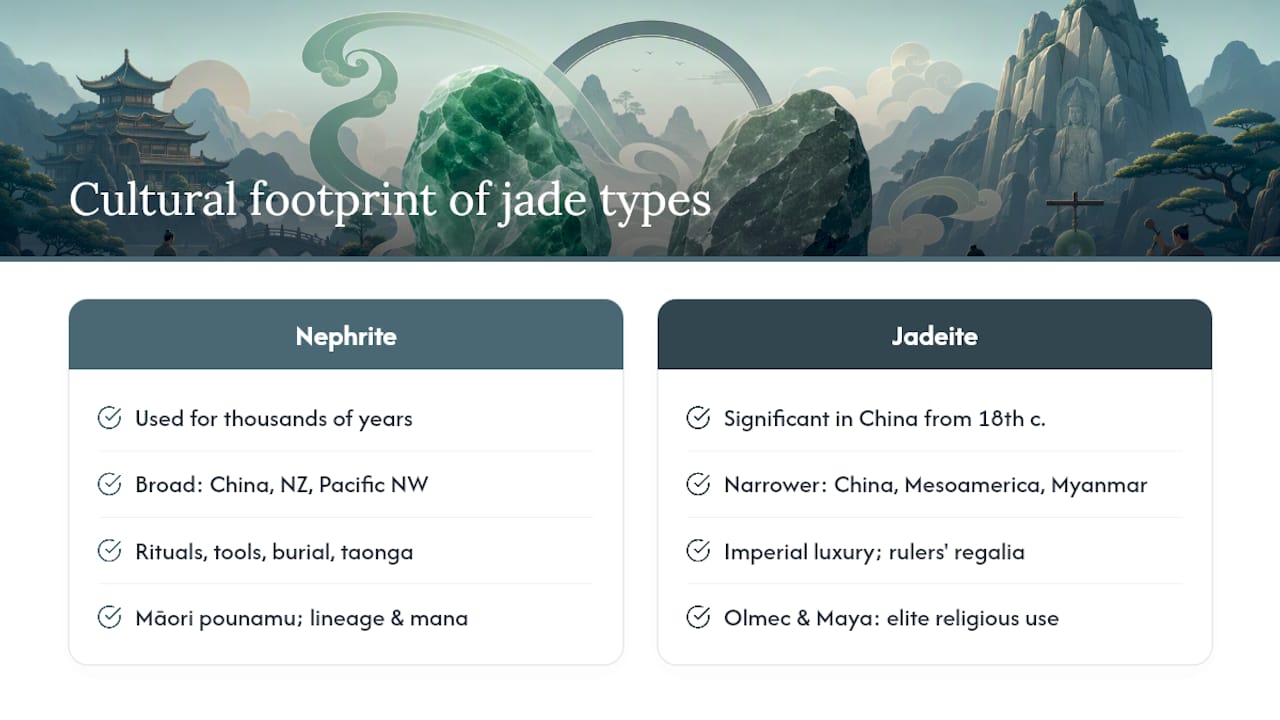
Nephrite carries the older cultural record by a wide margin. Chinese artisans worked nephrite for thousands of years before jadeite entered the picture, carving ritual objects, burial pieces, and ceremonial tools long before the material became associated with imperial luxury. Jadeite only arrived in China in significant quantities starting around the 18th century, imported from Myanmar, and it was that newer, more vivid material that eventually became linked with Qing dynasty imperial taste and the “Imperial green” standard collectors still chase today.
Nephrite holds equally deep significance outside China. In New Zealand, Māori carvers have worked nephrite, known there as pounamu, into taonga (treasured objects) including ceremonial adzes, ornaments, and weapons, with meaning tied to lineage and mana rather than just material value. Indigenous peoples across the Pacific Northwest, including groups in British Columbia, also worked local nephrite deposits into tools and ornamental pieces long before European contact.
Jadeite’s cultural footprint is narrower geographically but no less intense. Mesoamerican civilizations, including the Olmec and Maya, prized jadeite for centuries before Myanmar’s deposits became known to the wider world, carving it into masks, figurines, and jewellery reserved for rulers and religious use. Two unrelated cultures, on opposite sides of the planet, arrived at the same conclusion: whichever green stone they had access to was worth more than gold.
Where jadeite and nephrite are actually mined today
Jadeite’s commercial supply is concentrated almost entirely in one place: Myanmar, historically called Burma, which has produced the overwhelming majority of gem-quality jadeite reaching the world market for well over a century. Smaller jadeite occurrences exist in Guatemala, Russia, and a handful of other locations, but none come close to matching Myanmar’s output or quality range. That geographic concentration is the single biggest reason jadeite stays expensive: there simply isn’t a broad supply base to fall back on if demand rises.
Nephrite’s supply picture looks completely different. Nephrite is widely distributed, with notable deposits in British Columbia, New Zealand, Siberia, and China’s Xinjiang region, among other locations. British Columbia in particular has become one of the world’s largest nephrite producers, supplying both the carving trade and the jewellery market with material that ranges from utility grade to fine, translucent green.
That wider distribution is exactly why nephrite trades at a lower price per gram even at comparable quality. When you’re evaluating a piece, ask where it was sourced. A seller who can point to a specific mining region, rather than a vague “jade from Asia” answer, is generally more trustworthy about the rest of the piece’s history too.
Shop museum-grade crystals and jade-adjacent jewellery at Legacy Crystals and Minerals
Once you know what separates jadeite from nephrite, the next step is finding pieces with real provenance behind them, not just a trade label. Some retailers focus on museum-grade, provenance-backed specimens and wearable mineral pieces, which matters just as much for jade as it does for any other collected stone.
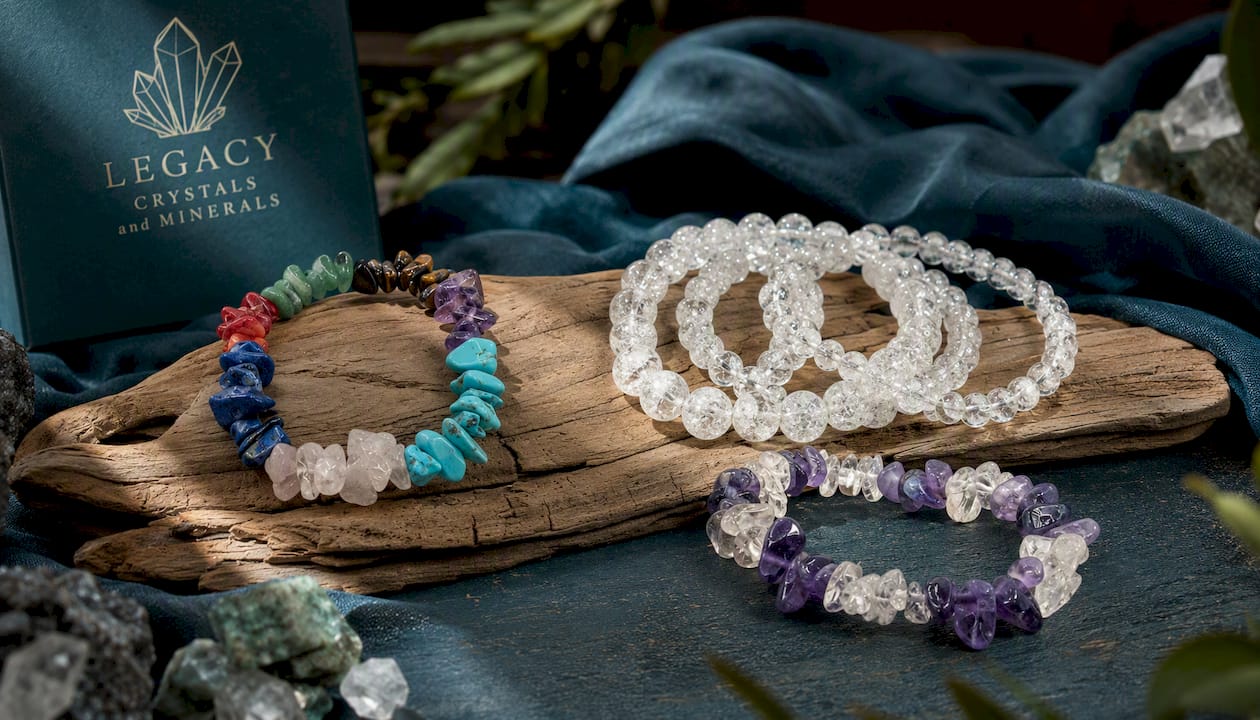
While some bracelet collections centre on other crystal varieties rather than jade specifically, they can be a solid place to see how mineral toughness, colour, and craftsmanship come together in real wearable pieces. The Mixed Crystal Chip Bracelet in the Chakra Spectrum shows how varied mineral colour ranges get worked into a single wearable design, similar to how jadeite’s colour spread gets showcased in fine jewellery. The Clear Crackle Quartz Bracelet, available in 6mm, 8mm, and 12mm beads, demonstrates how translucency and clarity affect a stone’s visual depth, the same property that drives jadeite’s top-tier pricing. And the Amethyst & Clear Quartz Chip Bracelet is a practical example of durable, everyday wearable mineral jewellery, the same wearability priority that pushes many jewellery buyers toward nephrite over jadeite.
Browse product pages for specimen details, and reach out directly if you need provenance information or documentation on any piece before you buy.
Sources
FAQ
Is nephrite more expensive than jadeite?
No. Nephrite is generally more affordable than jadeite because it’s more widely distributed and more common overall, while fine jadeite’s rarity and vivid colour range push its prices considerably higher.
How can you tell if jade is nephrite or jadeite?
Check density (jadeite feels heavier for its size), surface texture (jadeite often shows a granular finish while nephrite polishes smooth and waxy), and translucency (jadeite reaches semitransparency more often). For anything valuable, a gemmological lab report confirming refractive index and specific gravity is the only certain method.
Is jadeite or nephrite better?
Neither is universally “better.” Jadeite tends to be the stronger choice for fine jewellery where colour and semitransparency drive value, while nephrite’s superior toughness makes it the more practical pick for large carvings and everyday wearable pieces that need to survive daily knocks.
What is the highest quality jade?
The most prized jade is Imperial green jadeite: a vivid, evenly saturated, semitransparent green that represents the top grade of the jadeite market. Within nephrite, the equivalent high-value benchmark is fine mutton fat white, valued for its even tone and smooth, waxy texture rather than for transparency.


