
Obsidian Varieties: ID by Cooling Clues, 3 Snowflake Picks
Obsidian comes in many recognized forms, from common black and mahogany to rare fire, rainbow, and golden sheen types, plus the widely collected snowflake variety, among others. What separates one from another isn’t mineral content but cooling history: how fast the lava hardened, what microscopic inclusions got trapped inside, and whether devitrification had time to begin. The catalogue below covers identification cues, notable localities, and what to look for before you buy.
TL;DR:
- Most obsidian varieties, including rainbow and fire types, derive their unique optical effects from microscopic inclusions and layering formed during rapid cooling.
- Authentic snowflake obsidian can be distinguished by depth-shifting cristobalite clusters that sit at different layers, not surface patterns or dye.
- Provenance from specific volcanic fields, such as Glass Buttes or Jalisco, can significantly influence the value and rarity of particular obsidian types.
- Key identification checks include conchoidal fracture, translucency when thin, natural flow banding, and weight consistency, avoiding destructive testing.
- Rarer obsidian colors like blue and true fire typically require verified locality documentation due to their scarce geological conditions.
Table of Contents
- What is obsidian, and why do obsidian varieties exist?
- The main obsidian varieties: a visual identification catalogue
- How to identify and authenticate obsidian before you buy
- Notable obsidian localities and why origin matters
- Uses and care for obsidian specimens and jewellery
- Legacy Crystals and Minerals’s snowflake obsidian collection
- Find your obsidian piece at Legacy Crystals and Minerals
- Sources
- FAQ
What is obsidian, and why do obsidian varieties exist?
Obsidian isn’t a mineral. It’s a natural glass, formed when silica-rich lava cools so fast that atoms never get the chance to arrange into crystal structures. That’s the whole story of how obsidian forms, and it’s also why obsidian comes in so many visual forms: no two cooling events happen quite the same way, and the details of that cooling get frozen into the glass itself, as Oregon State University’s Volcano World explains.
Colour and pattern in obsidian trace back to a short list of physical causes, and once you know them, every variety on this page starts to make sense.
- Microscopic mineral inclusions — tiny particles of iron oxide or magnetite scatter light and produce the brown and red tones in mahogany obsidian.
- Trapped gas bubbles — flattened and aligned along flow layers, these create the metallic shimmer in gold and silver sheen types.
- Flow banding — streaks left behind as still-molten layers of lava stretched and folded before hardening.
- Devitrification — a slow, partial crystallization process that produces cristobalite, the mineral behind snowflake obsidian’s white bursts.
- Thin-film interference — light bending across ultra-thin layered structures, responsible for rainbow (iris) effects.
Because these are optical and textural categories rather than distinct minerals, obsidian classification is fundamentally descriptive. Two pieces of “black obsidian” can have identical chemistry and still look nothing alike, simply because one cooled a few metres closer to the surface.
For identification purposes, obsidian shares a few properties across every variety: a curved, shell-like conchoidal fracture when it breaks, a glassy vitreous luster, and a moderate hardness on the Mohs scale typical of natural volcanic glass, similar to a pocketknife blade. Those three traits are your baseline before you ever get to colour.
The main obsidian varieties: a visual identification catalogue
Each named type below reflects a specific combination of the causes just described. Some are common enough to find in almost any rock shop; others are tied to a single volcanic field and command real collector premiums.
1. Black obsidian
The default form, and the one most people picture when they hear the word “obsidian.” Pure black obsidian gets its colour from evenly distributed magnetite and iron oxide particles suspended through the glass. Hold a thin edge up to a strong light and you’ll often see a deep grey-brown translucency instead of solid black, a quick way to confirm you’re holding true volcanic glass rather than dyed glass or plastic.
2. Mahogany obsidian
Mahogany obsidian shows swirling bands of reddish-brown against black, caused by iron oxide staining concentrated in specific flow layers rather than spread evenly through the glass. The pattern tends to follow the direction the lava was moving when it froze, so streaks often run in one dominant orientation across a polished face. It’s a favourite for cabochons because the contrast photographs well and the material is relatively easy to source.
3. Snowflake obsidian
Snowflake obsidian is one of the most recognizable and widely available varieties, and its “snowflakes” are actually white clusters of cristobalite, a mineral produced through devitrification, the slow crystallization that begins working on obsidian almost as soon as it forms. What makes authentic snowflake obsidian worth examining closely is that these spherulites sit at different depths inside the stone, giving the pattern real three-dimensional structure rather than a flat, surface-level design, according to Crystal Almanac’s mineralogical overview. Tilt a genuine piece under a lamp and the white bursts appear to shift depth; a printed or dyed imitation won’t do that.
Snowflake obsidian is technically a transitional form. It sits partway between fresh volcanic glass and a more fully crystallized rock, which is why mineralogists sometimes call its pattern a record of arrested devitrification rather than a fixed decorative feature.
4. Rainbow (iris) obsidian
Rainbow obsidian displays bands of red, green, blue, and gold that shift as you rotate the stone. The effect comes from oriented microscopic crystals or flattened bubbles aligned in tight layers along the flow direction, which bend light the same way a thin film of oil does on water, per findings documented at GemRocks. To see it properly, hold the stone under a single directional light source, angle it slowly, and rotate it in your fingers. Rainbow obsidian rarely reveals its full colour range under flat, diffuse lighting, which is why photos of it online can look deceptively plain.
5. Gold sheen and silver sheen obsidian
These varieties owe their metallic shimmer to the same mechanism: rows of flattened gas bubbles trapped along flow layers during cooling, which reflect light in a single sweeping band when the stone catches directional light. Gold sheen results from bubbles reflecting warmer wavelengths; silver sheen reflects a cooler, more mirror-like tone. Both require rotation to appreciate. A piece that looks flat black from one angle can suddenly flash a full stripe of gold or silver the moment you turn it, which makes sheen obsidian one of the more satisfying types to handle in person rather than shop for online.
6. Fire (flame) obsidian
Fire obsidian is genuinely rare, and its iridescent, flame-like surface comes from nanoscale crystal layering that most volcanic fields never produce in usable quantity. Glass Buttes in Oregon is repeatedly cited as one of the few reliable sources for gem-quality fire obsidian, alongside sheen, mahogany, and rainbow material from the same field. Because the effect depends on an extremely specific, thin crystal structure forming at the surface during cooling, fire obsidian typically commands a real premium over other varieties, and buyers should expect to pay accordingly for confirmed locality material.
7. Apache tears
Apache tears are small, rounded nodules of obsidian, usually a few centimetres across (size varies depending on locality), often found embedded in perlite. Many specimens sold in North America trace back to Arizona and other western US localities. Held to light, thin edges typically show translucent grey-brown rather than opaque black, a helpful field check since Apache tears are sometimes confused with plain tumbled black obsidian at a glance.
8. Rarer named varieties worth knowing
A handful of other names show up regularly in collector circles, usually tied to a specific locality or an unusually distinctive pattern:
- Midnight lace obsidian — fine, lace-like grey or white banding through black glass, often from Glass Buttes.
- Velvet obsidian — a soft-looking, matte-textured sheen caused by densely packed micro-inclusions near the surface.
- Pumpkin obsidian — an orange-toned variety, less common than mahogany and prized for its warmer hue.
- Blue (royal) obsidian — a genuinely scarce colour form, typically commanding higher prices due to limited known sources.
How to identify and authenticate obsidian before you buy
Field identification for obsidian doesn’t require lab equipment, but it does require checking the right things in the right order.
Start with the basics. A genuine piece should show conchoidal fracture on any broken edge, curved and shell-like rather than flat or splintery. Under a hand lens or jeweller’s loupe, inclusions like cristobalite spherulites or iron oxide streaks should appear to sit at different depths within the glass, not painted onto the surface. Shine a strong light through a thin edge; natural obsidian nearly always shows some translucency, even in “solid black” pieces.
A few checks worth running before you commit to a purchase:
- Examine flow banding for consistency. Natural bands follow organic, slightly irregular curves; mechanically repeated patterns suggest a manufactured imitation.
- Rotate sheen and rainbow pieces under a single light source. Real optical effects shift and move; a surface coating tends to look static from most angles.
- Check weight against size. Obsidian is denser than most glass imitations of similar size, and a piece that feels unusually light is worth a second look.
- Look for uniform, evenly spaced gas bubbles throughout the piece. Some regularity is natural, but perfectly uniform bubble patterns can indicate manufactured glass rather than volcanic material.
Pro Tip: Never scratch, cut, or acid-test a specimen to “prove” it’s obsidian. Destructive testing damages value and is rarely necessary. Conchoidal fracture, inclusion depth under magnification, and consistent banding are reliable field indicators on their own, according to Wikipedia’s summary of obsidian classification. Save lab verification for high-value pieces where locality documentation genuinely matters.
If a seller can’t answer basic questions about where a rare-sounding variety came from, treat that as a red flag rather than a technicality.
Notable obsidian localities and why origin matters
Obsidian’s visual variety is often hyper-local. A single volcanic field can produce a signature pattern found almost nowhere else on Earth, which is exactly why locality-focused collecting has become its own niche.
- Glass Buttes, Oregon produces an unusually wide range of gem-quality material in one location, including fire, gold sheen, mahogany, and rainbow obsidian, making it one of the most productive single sites for variety-focused collectors.
- Jalisco, Mexico is a well-known source for rainbow obsidian, sometimes marketed as “Mayan” rainbow material.
- Milford, Utah has produced notable snowflake and black obsidian deposits.
- Obsidian Cliff in Yellowstone is historically significant and heavily protected, meaning collecting there is restricted.
- Volcanic regions of Italy and the Caucasus contribute additional black and banded material to the global market.
Because certain patterns, like fire obsidian or midnight lace, are tied to one field, provenance documentation carries real weight for buyers. When a rare variety is offered without any locality information, that absence is itself worth asking about before paying a premium price. A labelled locality specimen is a useful reference for what proper provenance labelling should look like on any mineral purchase.
Uses and care for obsidian specimens and jewellery
Different varieties naturally suit different purposes. Snowflake and mahogany obsidian, with their strong contrast, are popular choices for cabochons and beads. Solid black material is the standard choice for carvings, spheres, and display towers, since flaws are easier to hide in an even, dark colour. Rainbow and sheen varieties are usually saved for smaller cut pieces, where their optical effect can be appreciated up close.
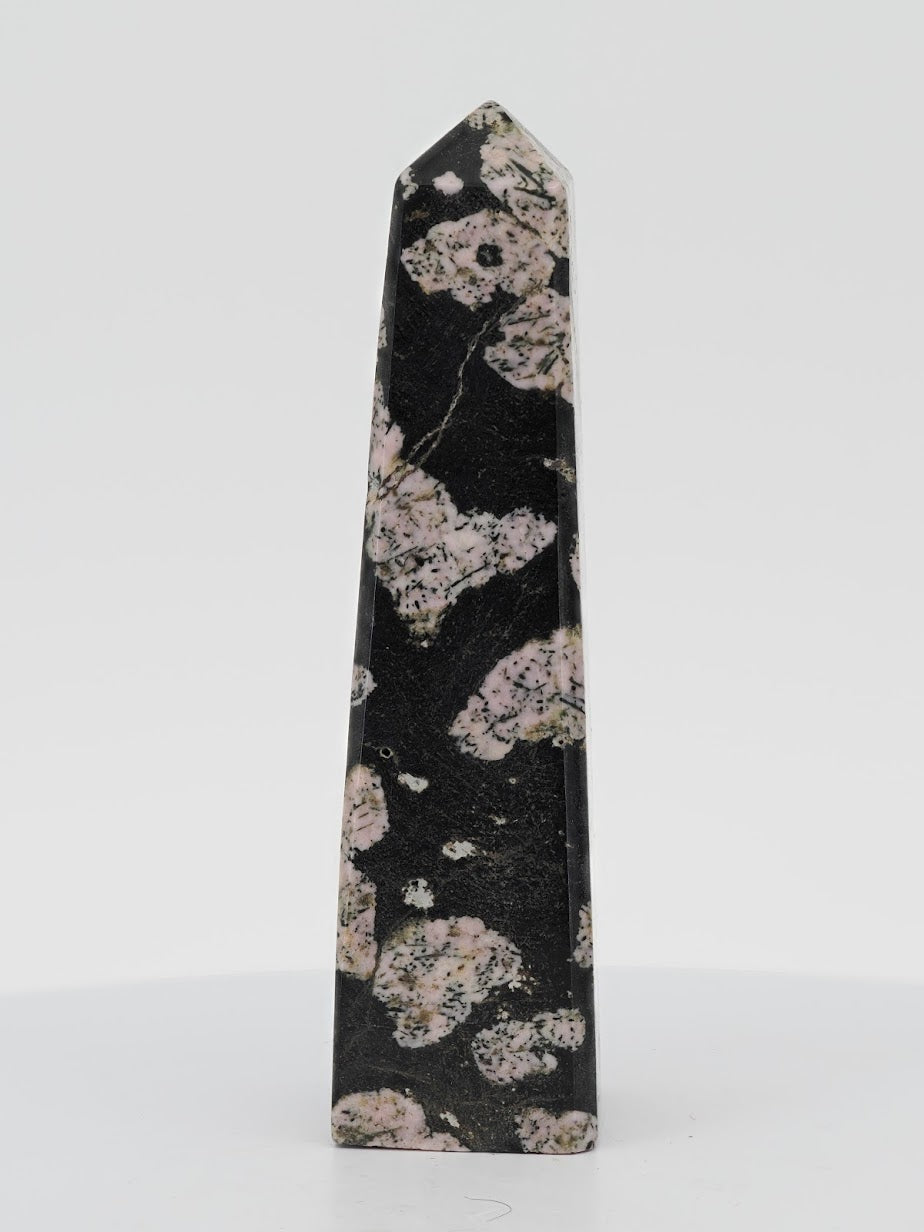
For jewellery, obsidian’s glassy structure means edges chip more easily than harder gemstones, so bracelets and pendants benefit from smooth, rounded cuts rather than sharp facets. If you’re deciding between a raw display piece and a polished wearable one, it helps to understand the practical differences between raw and polished crystals before choosing.
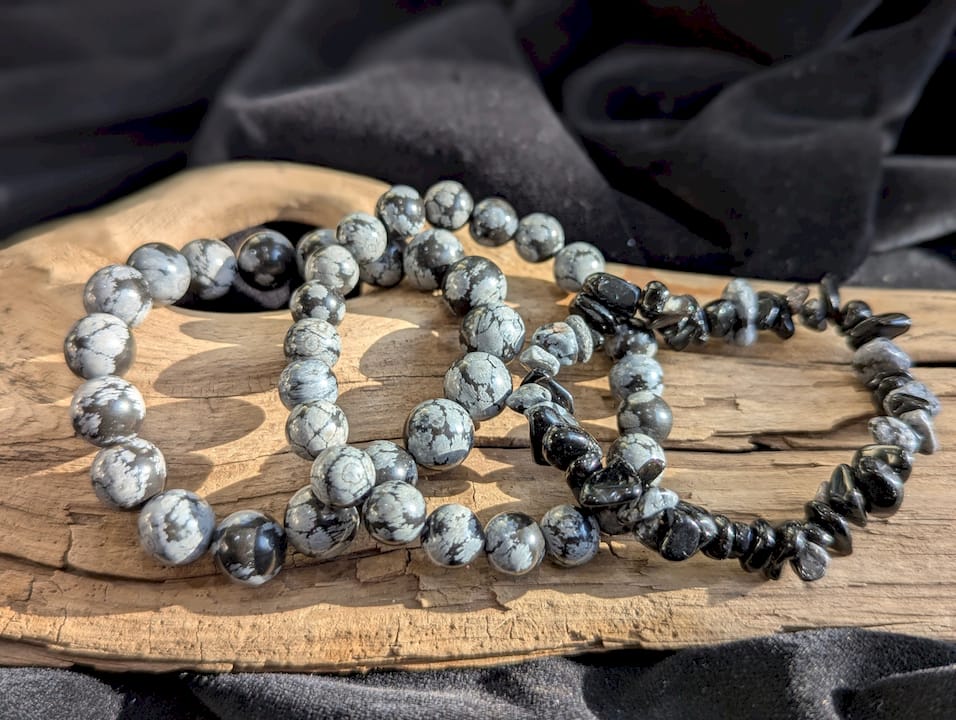
Care is straightforward: clean with a soft cloth and mild soap only, store away from harder stones that could scratch the surface, and avoid ultrasonic cleaners or harsh chemicals, which can dull the polish. Keep bracelets off abrasive surfaces like sand or concrete to protect both the sheen and the stringing material.
Legacy Crystals and Minerals’s snowflake obsidian collection
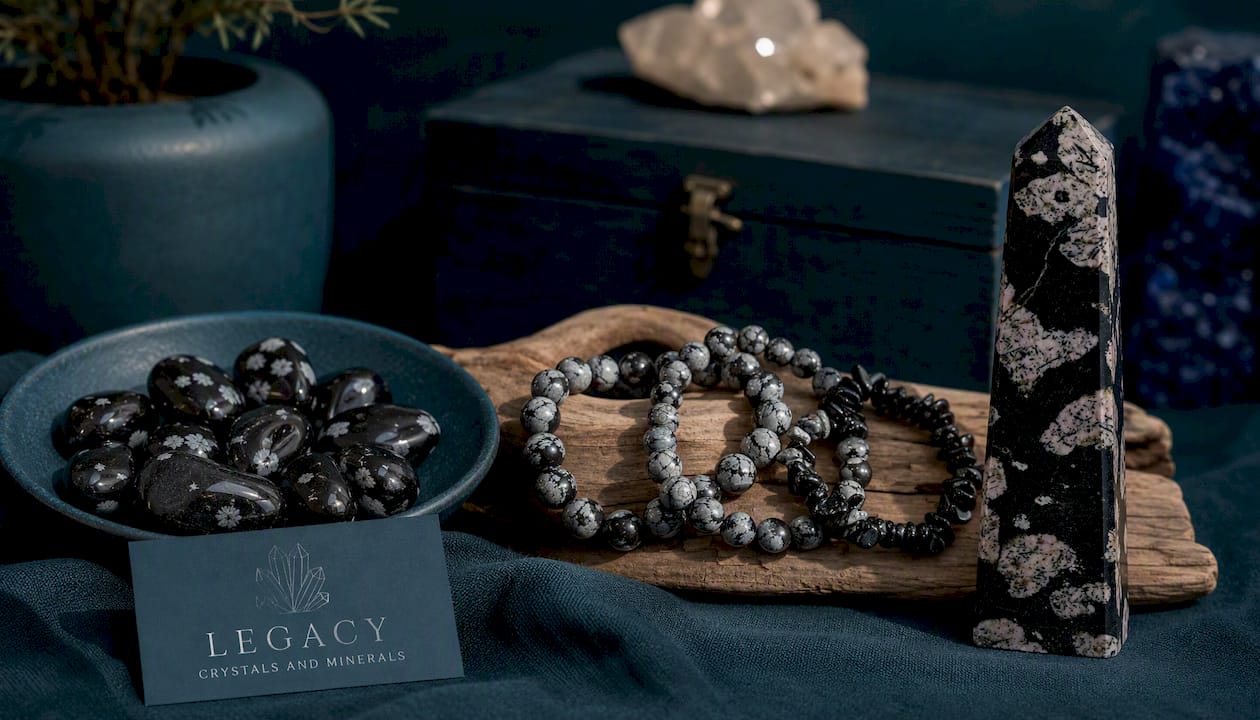
Snowflake obsidian remains one of the most collected varieties precisely because it’s affordable, visually striking, and easy to verify using the depth checks covered earlier. Legacy Crystals and Minerals carries three snowflake obsidian pieces built around that appeal.
- Snowflake Obsidian Tumbled Stone — AA Grade: a polished, pocket-sized specimen graded for consistent cristobalite pattern density and smooth, chip-free finishing.
- Snowflake Obsidian Bracelets in 8mm and 10mm round or chip styles, offering a wearable option for readers who want the pattern in daily jewellery.
- Snowflake Obsidian Tower, a 4-inch display piece sourced from Pakistani volcanic glass deposits, suited to shelf or desk display.
[brand_signal]
Before buying any snowflake obsidian piece, run through a short checklist: confirm the spherulite pattern shows depth under a loupe rather than sitting flat on the surface, check bracelet strands for even bead spacing and a secure, knot-free finish, and ask about tower or carving provenance if the piece is priced above typical tumbled-stone rates. has examined each listing against these same standards before it goes live.
Find your obsidian piece at Legacy Crystals and Minerals
Sourcing obsidian on your own means chasing locality documentation across scattered rock shops and online listings, with no guarantee the seller can back up a rare variety claim. Legacy Crystals and Minerals removes that guesswork by curating pieces with verified sourcing built in, so you’re not left comparing seller claims against the identification checks covered above on your own.
Beyond the snowflake obsidian line, the collection includes handcrafted pieces like Obsidian and Howlite ghost carvings and the Black Obsidian Skull Broom, both useful references for how polished obsidian carvings should look and feel in hand. If you’re weighing a raw specimen against a finished wearable piece, the guide to raw versus polished crystal jewellery walks through that decision, and for bracelet quality benchmarks outside the obsidian category, handcrafted talisman bracelet picks offer a useful comparison point for bead strand construction. Browse the Snowflake Obsidian Tumbled Stone or the full snowflake obsidian range today to find a piece that matches the identification standards covered in this guide.
Sources
For readers who want to verify the geology behind these classifications directly, a few primary sources cover the material well. Oregon State University’s Volcano World is the strongest resource for formation processes and locality-specific varieties like Glass Buttes fire obsidian. Wikipedia’s obsidian entry offers a solid overview of devitrification and classification terminology. For sheen and rainbow optics specifically, GemRocks’ obsidian page explains the bubble-alignment mechanism in more technical detail than most general references attempt.
- Obsidian | Volcano World | Oregon State University
- Obsidian — Wikipedia
- GemRocks: Obsidian
- Snowflake Obsidian - The Stone of Balance | Crystal Almanac
FAQ
How many types of obsidian are there?
Mineralogists recognize a wide set of named varieties based on colour and optical pattern rather than a fixed taxonomic count, but the most commonly collected forms include black, mahogany, snowflake, rainbow, gold and silver sheen, fire, and Apache tears, plus rarer types like midnight lace and blue obsidian.
What is the rarest colour of obsidian?
Fire obsidian and true blue (royal) obsidian are generally considered the rarest, since both depend on specific nanoscale crystal conditions or locality factors that most volcanic fields never produce in gem quality.
Who cannot wear black obsidian?
There’s no scientific or medical restriction on wearing black obsidian; concerns around it come from metaphysical traditions rather than any established physical property, and readers should treat those claims as personal belief rather than fact.
Is obsidian a stone or a gem?
Obsidian is a natural volcanic glass, not a mineral or a crystalline gemstone, though it’s classified as a gemstone material and cut, polished, and sold the same way many true gemstones are.


