

Selenite Meaning for Collectors: Care, Provenance & 3 Starter Pieces
Selenite is a translucent variety of gypsum (CaSO4·2H2O) prized for its high-vibration associations with energy clearing and the crown chakra. Its metaphysical reputation rests on purity, clarity, and connection to higher consciousness, drawn from a name that literally means “stone of the moon.” It’s also very soft and dissolves in water, so every ritual, cleaning method, and display choice has to work around that fragility.
TL;DR:
- True selenite is transparent or milky white with flat, glassy crystal faces, and should transmit light clearly when held to a source.
- Selenite is water soluble and extremely soft, with a Mohs hardness of about 2, requiring careful cleaning and handling to avoid damage.
- Most commercial “selenite” products are actually satin spar, a fibrous form of gypsum with a silky appearance, not the transparent, tabular variety.
- Proper identification involves examining clarity, crystal habit, and provenance details; avoid water-based cleaning methods to preserve the mineral.
- Selenite is primarily used for energy clearing, spiritual connection, and meditation, especially connected to the crown chakra and lunar symbolism.
Table of Contents
- What is selenite made of? The mineralogy behind selenite meaning
- Where the name “stone of the moon” comes from
- Selenite meaning in metaphysical practice
- How to use selenite: cleansing, charging, and meditation
- How to identify real selenite (and care for it properly)
- Selenite vs satin spar: what’s the real difference?
- Buying with confidence: what to look for in a real specimen
- Where to start with selenite: three pieces worth considering
- Sources
- FAQ
What is selenite made of? The mineralogy behind selenite meaning
Selenite belongs to the gypsum family, with the chemical formula CaSO4·2H2O, calcium sulfate combined with water molecules locked into its crystal lattice. Despite the name, it has nothing to do with the element selenium. That mix up trips up a lot of newcomers, and Gem-A’s explainer on selenite addresses it directly, noting the term refers to the colourless, transparent variety of gypsum and its luminous, almost lit-from-within appearance.
That glow is the real story. Selenite forms in flat, tabular crystals with a glassy sheen that seems to hold light rather than just reflect it, which is exactly why ancient observers linked it to moonlight rather than sunlight. But that same optical clarity comes from a crystal structure that is structurally weak in one direction. Selenite has perfect cleavage), meaning it splits cleanly along flat planes, and a Mohs hardness of about 2, soft enough that a fingernail can scratch it.
That softness isn’t a flaw. It’s baked into how the mineral behaves, and it explains almost every care instruction you’ll come across. HowStuffWorks describes selenite as literally softer than your fingernail, and because it’s water soluble, soaking or rinsing it will slowly dissolve the surface, leaving it cloudy, pitted, or in worse cases, structurally weakened.
Selenite shows up in a few recognizable forms. You’ll see it as clear, blade-like crystals, as chunky tabular pieces collectors prize for transparency, and as satin spar, a fibrous, silky variety of the same mineral that dominates the crystal shop market (more on that distinction below). It forms in evaporite deposits, gypsum caves, and sedimentary basins where mineral-rich water slowly evaporated, leaving these crystals behind over thousands of years.
A few quick facts worth keeping in your back pocket:
- Chemical formula: CaSO4·2H2O (calcium sulfate dihydrate)
- Mohs hardness: approximately 2, one of the softer common crystals
- Cleavage: perfect in one direction, meaning it splits easily along flat planes
- Solubility: water soluble, never soak or rinse it
- Common forms: tabular crystals, blades, towers, wands, and fibrous satin spar
- Contains no selenium, despite the similar name
Where the name “stone of the moon” comes from
Selenite’s name traces back to the Greek word “selenites,” built from “selene,” meaning moon. Merriam-Webster’s entry confirms the etymology runs through Latin and into English, always carrying that lunar thread. Ancient naturalists believed transparent gypsum crystals waxed and waned in brightness along with the moon’s phases, an idea that has no basis in mineralogy but stuck around because the visual metaphor was too good to abandon.
That belief wasn’t a minor footnote. Pliny the Elder and other classical writers documented the moon-linked theory as accepted natural history for centuries, and the association carried forward into folk practice long after anyone could verify or disprove it. Wikipedia’s overview of selenite notes the name was historically applied to transparent gypsum varieties precisely because of that glow, an internal luminosity that made the stone look like it was generating light rather than simply catching it.
Writers and collectors have long described that effect as “liquid light,” a phrase that shows up again and again in mineral literature and crystal shop descriptions alike. It’s a fitting image. Hold a clear selenite blade up to a window and the light doesn’t just pass through, it seems to pool and diffuse across the surface. That visual quality is almost certainly why selenite became shorthand for purity and clarity in spiritual practice long before “high vibration” was a phrase anyone used.
The moon connection also carries associations most people don’t expect:
- Feminine energy and intuition, tied to the moon’s traditional symbolism across many cultures
- Cycles and renewal, echoing the (mistaken) belief that the stone changed with lunar phases
- Night and reflection, making it a common choice for bedside tables and meditation corners
- Calm and stillness, drawing on moonlight’s quieter, cooler quality compared to sunlight
Selenite meaning in metaphysical practice
Ask any crystal practitioner what selenite does and you’ll hear some version of the same answer: clearing, clarity, and connection. Selenite’s core metaphysical meaning centres on purification, spiritual clarity, and access to higher states of consciousness, the reasons it shows up so often in meditation spaces and energy work.
The crown chakra is where most practitioners anchor selenite’s energetic role. Sitting at the top of the head, the crown chakra governs consciousness, spiritual connection, and a sense of being linked to something larger than the self. Selenite’s association with light and the moon fits neatly into that framework, and many practitioners keep a piece near the head during meditation or sleep specifically to support that connection. Some extend the association to the third eye chakra for intuition and insight, or the throat chakra when the intention involves speaking truth clearly.
Elementally, selenite is tied to air and to the moon, which explains its “high vibration” label. In crystal work, that phrase generally describes a stone believed to carry a fast, light, clarifying energy rather than a grounding or heavy one. Practitioners often contrast selenite with denser, earth-associated stones like hematite or smoky quartz, using selenite when the goal is mental clarity or spiritual opening rather than stability.
In practice, selenite gets called on for a handful of recurring intentions:
- Clearing stagnant energy from a room, an object, or another crystal, often by placing items directly on a selenite slab.
- Supporting meditation and mental clarity, held or placed nearby during sitting practice to quiet mental noise.
- Encouraging peaceful sleep, kept on a nightstand for a calmer, quieter mind before bed.
- Deepening spiritual connection, used during prayer, journalling, or contemplative practice tied to the crown chakra.
- Amplifying intention setting, paired with an affirmation such as “I release what no longer serves me” or “My mind is clear and my spirit is open.”
None of this is scientifically verifiable, and Legacy Crystals and Minerals presents it the way most of the practitioner community does: as a long-standing tradition of meaning and intention, not a medical or clinical claim. What keeps selenite at the centre of that tradition is consistency. Across generations of crystal literature, the same handful of associations, clearing, clarity, moon, crown chakra, repeat with unusual agreement, which is part of why selenite has earned a reputation as a kind of energetic reset button rather than a stone tied to one narrow use.
If you’re building out a broader energy practice, it’s worth exploring how selenite fits alongside other approaches. Practitioners working with energetic clearing and multidimensional healing often use selenite as a supporting tool rather than a standalone practice, layering it into meditation, spatial clearing, or intention work.
How to use selenite: cleansing, charging, and meditation
Selenite’s biggest practical draw is that it’s often described as self-cleansing and capable of clearing other stones, which is why so many collections include at least one slab or tower even among people who own dozens of other crystals.
Cleansing and charging other crystals is the most common use. Place a crystal or piece of jewellery directly on a selenite slab or inside a selenite bowl for anywhere from a few hours to overnight. The idea is that selenite’s clearing energy resets whatever the other stone has absorbed, leaving it “recharged” for its next use. There’s no need to do anything active here, just proximity and time.
Choosing a shape depends on what you’re trying to do. A flat slab works best for laying other stones on top. A tower or wand is better suited to directing energy during a session, sweeping it around the body or a room the way you might use a smudge stick. Bowls double as both a charging dish and a decorative catch-all for smaller stones or jewellery. Selenite lamps, carved into a hollow shape with a light source inside, are popular for ambient use since the glow reinforces that “liquid light” quality without any active practice required.
A simple selenite meditation routine looks like this:
- Settle into a quiet space and hold a selenite wand or small tower in your dominant hand.
- Take five slow breaths, letting your shoulders drop and your attention settle.
- Visualize light entering through the crown of your head, mirroring the stone’s own translucence.
- Hold an intention or affirmation silently for two or three minutes, something short and specific.
- Close by setting the stone down nearby, letting it sit within arm’s reach for the rest of your sitting practice.
For a more structured approach to building sessions like this into a regular habit, a practical guide to meditating with crystals walks through placement and timing in more depth.
Space clearing works the same way it does for personal energy work: pass a wand or small tower through a room, corner to corner, or simply place a piece near a doorway or window where energy is believed to enter and exit. Daily maintenance is minimal. Selenite doesn’t need much upkeep beyond an occasional wipe with a dry cloth, but that “occasional” is doing a lot of work in that sentence.
Pro Tip: Never rinse selenite under a tap, even briefly. Because it’s water soluble, even a quick splash can leave a cloudy film or start dissolving fine surface detail on carved pieces. Stick to dry brushing or a soft, dry cloth every time.
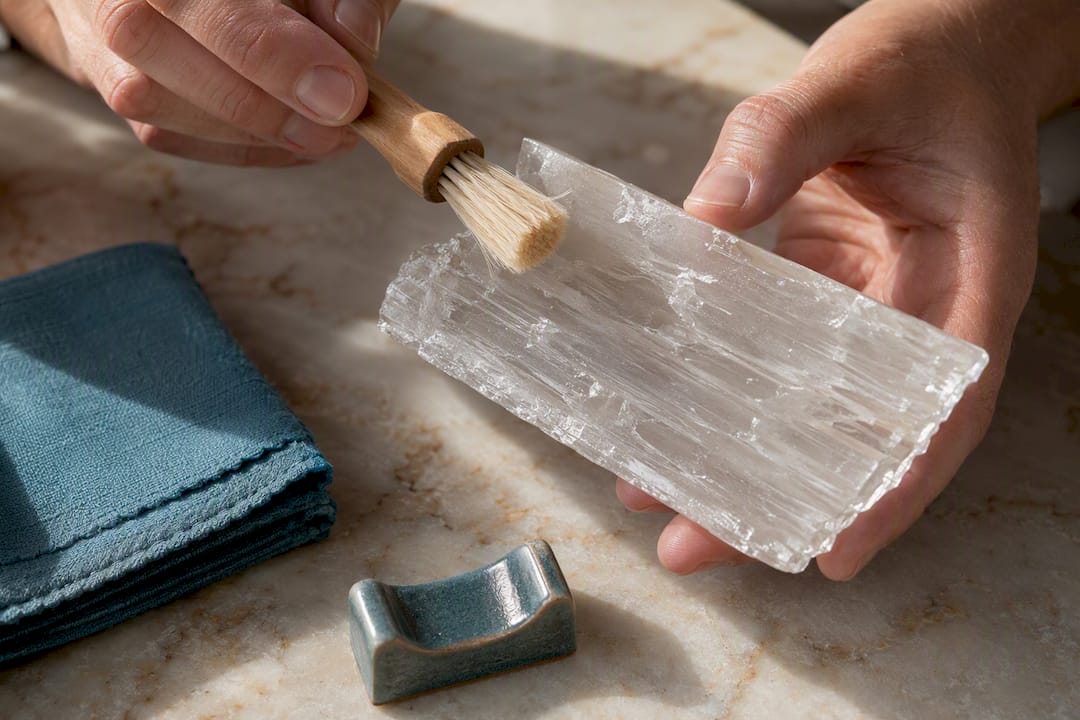
Rough handling is the other risk. Because selenite splits along perfect cleavage planes, dropping it or knocking it against a hard surface can cause it to flake or crack along flat lines rather than absorb the impact. Treat towers and wands the way you’d treat a piece of glass, not a tumbled stone.
How to identify real selenite (and care for it properly)
Authentic transparent selenite has a distinct look: clear to milky white, tabular crystal faces, and that characteristic glassy luminosity when held to light. Run your fingers along a genuine piece and you’ll feel smooth, flat cleavage planes rather than a grainy or fibrous texture. If a “selenite” piece feels silky or shows a soft chatoyant sheen that shifts as you rotate it, you’re almost certainly holding satin spar rather than transparent selenite proper, a distinction covered in more detail below.
A few identification cues worth checking before you buy:
- Hold it to a light source. True selenite transmits light with a clear, glassy quality rather than a milky, fibrous shimmer.
- Check for tabular, blocky crystal faces rather than long, thin fibres running in one direction.
- Ask for provenance and locality information. Reputable sellers can tell you where a specimen was sourced, which also helps confirm it’s genuine gypsum rather than a resin or plaster imitation.
- Request clear, well-lit photos from multiple angles before buying online, especially for larger towers or carved pieces where flaws can hide in shadow.
Because selenite is water soluble and only about 2 on the Mohs hardness scale, cleaning it demands more restraint than most crystals in a collection. Skip water, skip household cleaners, and skip ultrasonic cleaners entirely. Instead:
- Wipe with a soft, dry cloth to remove dust, which is usually all a piece needs.
- Use a soft-bristle brush for detailed carvings where dust settles into grooves.
- Rely on moonlight or sound (a singing bowl, a bell) for energetic cleansing rather than water based methods used on other stones.
- Avoid direct, prolonged sunlight on some pieces, which can occasionally cause fading in certain gypsum varieties.
Storage matters just as much as cleaning. Wrap selenite in soft cloth or place it in a padded box away from harder stones that could scratch or chip it in a drawer or display case. Keep it somewhere with stable humidity, since gypsum’s water content makes it more sensitive to environmental swings than quartz-based crystals. When transporting a piece, wrap it individually rather than letting it knock against other specimens in a bag or box. For a broader routine covering your whole collection, a full crystal care and cleaning guide is worth bookmarking alongside this one.
One more thing worth knowing before you panic over a flaw: selenite’s perfect cleavage means small white marks, flakes, or hairline splits can appear naturally over time, even with careful handling. These aren’t defects so much as expected behaviour for a mineral built this way.
Selenite vs satin spar: what’s the real difference?
Here’s the distinction most product listings blur: selenite technically refers to the clear, transparent, tabular variety of gypsum, while satin spar is the fibrous, silky variety of the exact same mineral. Both share the identical chemical formula, CaSO4·2H2O, and the same Mohs hardness of about 2. The difference is entirely about crystal habit, how the mineral grew, not composition.
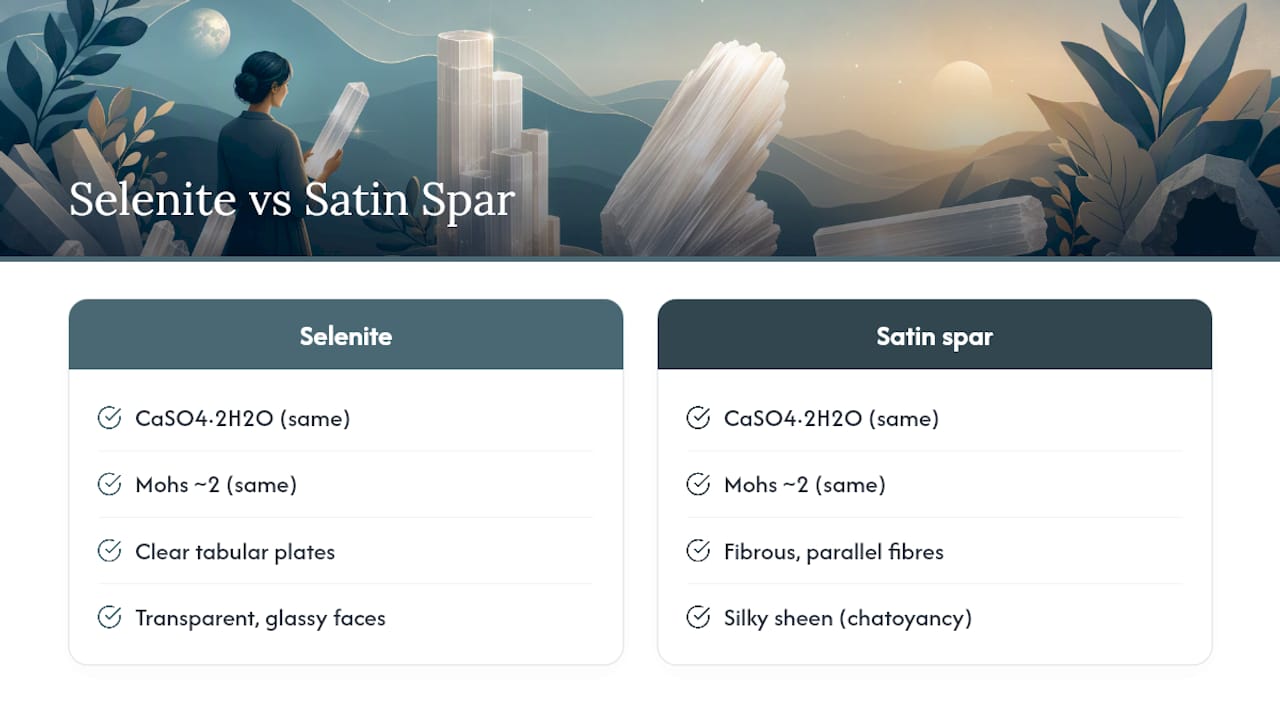
Visually, they’re easy to tell apart once you know what to look for. True selenite shows flat, glassy, tabular faces you can see through, almost like thick glass. Satin spar grows in parallel fibres, giving it a silky, pearl-like sheen called chatoyancy, the same optical effect you see in tiger’s eye or cat’s eye stones, but softer and paler. Wikipedia’s mineralogical overview draws this line clearly, and it’s a useful one to hold onto, especially online where “selenite” gets used as a catch-all term.
That catch-all use matters practically. The vast majority of “selenite” towers, wands, and lamps sold in shops and online are satin spar, not transparent selenite. It’s not a case of being misled so much as an industry convention: satin spar is more abundant, easier to carve into towers and wands, and visually reads as “selenite” to most buyers who aren’t looking for the tabular, glass-clear form. If your goal is a display piece or a tool for charging other crystals, satin spar performs the role most people expect. If you’re a collector after true optical clarity and tabular crystal structure, you’ll want to specifically seek out labelled “selenite” rather than assume a tower or wand qualifies.
Durability and care are functionally identical between the two, since both are water soluble and equally soft. The only meaningful practical differences show up in how they photograph, how they catch light, and how collectors value them. Raw, unpolished specimens in a collection of raw minerals and crystals tend to make that distinction obvious, since natural crystal habit is far easier to judge before a piece has been carved or polished into a uniform shape.
Buying with confidence: what to look for in a real specimen
Clear product information solves most of the confusion buyers run into with selenite. A listing that states whether a piece is transparent selenite or satin spar, gives its approximate size and weight, and includes multiple photos in natural light gives you what you need to judge authenticity before it arrives.
Listings build around transparency, prioritizing authenticity and clear provenance over vague, generic descriptions. That approach matters more with a mineral like selenite, where crystal habit (tabular versus fibrous) changes what you’re actually getting, and where a low-resolution photo can hide the difference entirely.
A few things worth checking on any specimen page before you buy:
- Specimen photos taken in natural or neutral light, not heavily filtered or backlit in a way that exaggerates the glow
- Stated dimensions and weight, since selenite pieces vary enormously in size for a similar price point
- A clear return policy, particularly for fragile carved or tabular pieces that can chip in transit
- Locality or provenance notes, which add real collector value beyond the metaphysical appeal
If you’re ready to start or expand a collection, three starter options are worth a look for their combination of size, craftsmanship, and versatility for both display and practice.
Where to start with selenite: three pieces worth considering
Building a first collection doesn’t require guessing at what pieces work well together. A few specific options make good entry points for readers moving from research into practice.
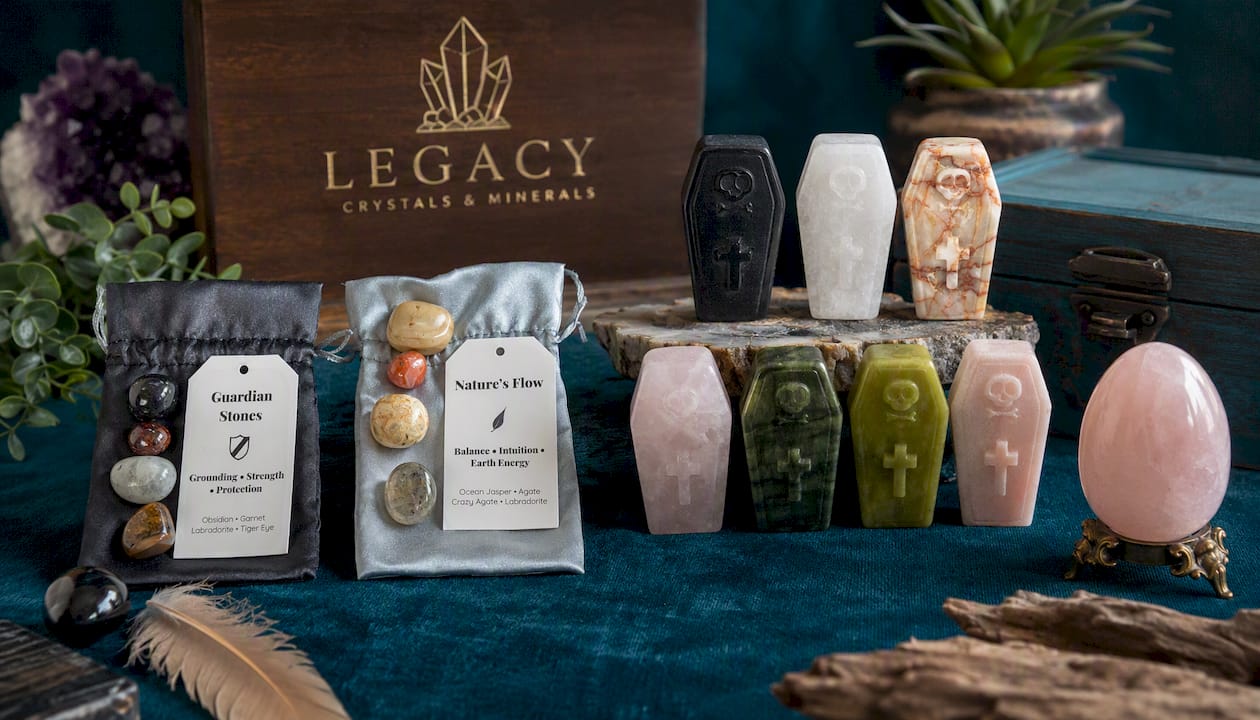
The Healing Crystal Intention Sets are curated specifically for people setting up their first intentional practice, pairing selenite alongside complementary stones so you’re not guessing which pieces work well together. For something smaller and more personal, the Crystal Coffin Carvings in a compact 2 inch by 1 inch format make a striking keepsake or altar piece, small enough for a desk or bedside table without dominating the space. And if your practice leans toward heart-centred work alongside crown chakra clearing, the Rose Quartz Egg pairs naturally with selenite, balancing its clarifying, moon-linked energy with rose quartz’s traditional association with gentleness and emotional warmth.
Before you buy any selenite piece, run through a short checklist: confirm the size against where you plan to display or use it, ask for clear photos if they’re not already posted, and check the seller’s return policy in case a fragile piece arrives damaged. Legacy Crystals and Minerals also carries broader collections worth browsing directly, including raw and unpolished specimens, polished pieces, detailed carvings, wearable jewellery and bracelets, and for serious collectors, the museum quality minerals and crystals and top shelf collector minerals lines. For something a little different, the rotating mystery items selection is worth a browse too. Whichever piece you start with, look closely at the listing photos and locality notes first, since that’s where authenticity and value both show up before the box ever arrives.
Sources
The mineralogical and etymological claims in this guide draw on a small set of reliable references worth reading directly if you want to dig deeper.
- Selenite, the Crystal Softer Than Your Fingernail | HowStuffWorks
- SELENITE Definition & Meaning - Merriam-Webster
- Understanding selenite | Gem-A
FAQ
What does selenite do spiritually?
Selenite is primarily associated with energy clearing, spiritual clarity, and connection to the crown chakra, which is why practitioners use it to cleanse spaces, meditate, and recharge other crystals.
What do witches use selenite for?
Many practitioners use selenite for space clearing, ritual cleansing, and charging other tools or crystals, relying on its “self-cleansing” reputation and its lunar, high-vibration associations.
What does selenite protect against?
Selenite is traditionally believed to clear stagnant or negative energy from a space or object rather than acting as a protective barrier itself, a role some practitioners pair with grounding stones for a fuller effect.
What zodiac is selenite good for?
Selenite is generally linked to Taurus and Cancer in crystal astrology traditions, largely because of its moon connection and its associations with calm, intuitive, emotionally grounded energy.
Is satin spar the same as selenite?
Both are the same mineral, gypsum (CaSO4·2H2O), but they differ in crystal habit: true selenite is transparent and tabular, while satin spar is fibrous with a silky sheen, and most commercial “selenite” towers and wands are actually satin spar.


