

Shungite properties: what to expect and how to use it
Shungite is a carbon-rich Precambrian mineraloid from Karelia, Russia, with three properties that matter most: measurable electrical conductivity, documented adsorption capacity for certain heavy metals and contaminants in water, and a long tradition of metaphysical use for grounding and energetic protection. Laboratory studies confirm some physical behaviours; robust human health evidence does not yet exist.
Core properties at a glance:
- Geological origin: Karelian deposits, estimated ~2 billion years old, classified as a mineraloid rather than a crystalline mineral
- Carbon content: ranges from roughly 30% (Type III) to over 90% (elite/Type I), with trace fullerenes at approximately 1–10 ppm
- Conductivity: measurable with a standard multimeter; a distinguishing physical trait most crystals lack
- Adsorption: lab-tested removal of heavy metals and some organic contaminants in water-treatment contexts
- Metaphysical claims: grounding, root-chakra association, energetic protection, and EMF mitigation — widely practised, not clinically validated
- Key safety note: raw shungite can leach heavy metals into water unless properly washed; no shungite product should replace medical treatment
The sections below cover each of these areas in order: metaphysical uses and how-to steps, geological and chemical structure, what peer-reviewed research actually shows, practical instructions for everyday use, and a buying guide for authentic specimens.
Key takeaways
Shungite’s most defensible uses are physical: adsorption in water-treatment contexts (with proper preparation) and as a conductive, grounding-tradition stone for intentional practice — not as a clinically proven health device.
| Point | Details |
|---|---|
| Grade determines performance | Type I (elite) shungite outperforms Type III in every lab-measured water-treatment metric; grade matters when buying. |
| Wash before water use | Raw shungite leaches heavy metals unless pre-washed for 24–48 hours; skip this step and the water may be unsafe. |
| EMF claims are unsupported | No peer-reviewed evidence supports shungite blocking non-ionizing radiation; the benefit is intentional and symbolic. |
| Conductivity confirms authenticity | A multimeter continuity test is the fastest way to distinguish real shungite from dyed fakes. |
| Legacy Crystals and Minerals | Carries Karelian-sourced polished towers and shungite bracelets for verified, grade-documented purchases. |
Table of Contents
- What are the metaphysical properties of shungite?
- Shungite’s physical and chemical makeup
- What does the science actually show about shungite?
- How to use shungite safely
- How to identify real shungite and buy with confidence
- Authentic shungite from Legacy Crystals and Minerals
- Sources
- FAQ
What are the metaphysical properties of shungite?
Shungite carries a dense set of metaphysical associations, most of them centred on protection and grounding. Practitioners link it to the root chakra, describing it as an anchor that draws scattered or anxious energy downward and stabilises the body’s energetic field. The stone is also associated with energetic purification — the idea that it absorbs or neutralises discordant frequencies in a space. EMF mitigation sits in this same tradition: placing shungite near a router or phone is a common ritual, understood within metaphysical practice as a form of energetic buffering rather than a physics-based shield.
Common metaphysical uses include:
- Wearing as a bracelet or pendant for continuous grounding throughout the day
- Carrying a tumbled piece in a pocket during stressful situations
- Placing a tower or sphere near electronic devices as an intentional protective gesture
- Holding a palm stone during meditation to anchor attention and reduce mental scatter
- Laying flat pieces at the corners of a room or sleep space in a grounding grid
How to use shungite for grounding (wearing):
- Choose a polished piece with direct skin contact, such as a shungite bracelet.
- Set a clear intention before putting it on — a single sentence about what you want to feel grounded from.
- Wear it on the left wrist if you follow the tradition of the left side as the receiving side.
- Remove and rinse with cool water weekly; dry thoroughly before wearing again.
How to use shungite in meditation:
- Hold a tumbled piece or small tower in your non-dominant hand.
- Sit with feet flat on the floor to reinforce the grounding intention physically.
- Focus attention on the weight and texture of the stone for the first two minutes before broadening your awareness.
- After the session, set the stone on the earth or a natural surface briefly if possible.
How to place shungite near electronics:
- Position a polished tower or sphere within roughly 30 cm of the device.
- Cleanse the piece monthly by rinsing with water and leaving it in sunlight for a few hours.
- Pair with a grounding stone like raw black tourmaline if you prefer layered protective symbolism.
Pro Tip: Metaphysical traditions around shungite are rich and consistent across many cultures, but they developed independently of controlled scientific testing. Treating shungite as a tool for mindfulness and intentional practice is well-supported by those traditions; treating it as a medically proven shield against radiation is not. Both can coexist — just keep the distinction clear in your own expectations.
Shungite’s physical and chemical makeup
Shungite is not a mineral in the strict geological sense. It does not have a defined crystalline lattice, which is why geologists classify it as a mineraloid. Think of it the way you would think of obsidian or amber: a naturally occurring solid with a consistent composition, but without the repeating atomic structure that defines true minerals. Its carbon matrix is amorphous, built from nanoclusters roughly 10 nanometres in size, interspersed with silicate fractions that contain oxygen-deficiency centres.
The deposit at Lake Onega in the Republic of Karelia, Russia, is the primary and most studied source. The rock formed approximately 2 billion years ago during the Precambrian era, making it one of the oldest carbon-bearing geological formations on Earth. Exactly how so much organic carbon accumulated there remains debated; hypotheses range from ancient microbial mats to abiogenic carbon precipitation.
Key physical traits:
- Electrical conductivity: present in high-carbon varieties; verifiable with a multimeter (a useful authenticity test)
- Porosity and surface area: higher in elite shungite, which supports adsorption of contaminants
- Hardness: roughly 3.5–4 on the Mohs scale, softer than quartz
- Fullerene content: approximately 1–10 ppm in natural samples — trace amounts, not the concentrated quantities sometimes implied in marketing
Shungite grades and carbon content:
| Grade | Common name | Typical carbon % | Primary uses |
|---|---|---|---|
| Type I | Elite / Noble shungite | over 90% | Collectors, water treatment, high-end jewellery |
| Type II | Semi-bright shungite | roughly 30% to over 90% | Jewellery, general use |
| Type III | Regular / Dull shungite | roughly 30% | Carvings, decorative pieces, lower-cost items |
| Commercial mixes | Variable | approximately 20% | Mass-market products; provenance often unclear |
Quick glossary:
- Mineraloid: a naturally occurring solid lacking a crystalline structure
- Fullerene: a carbon molecule arranged in a closed cage (C60 being the most studied); present in shungite at trace levels
- EPR (Electron Paramagnetic Resonance): a spectroscopic method used to detect unpaired electrons and conduction-electron behaviour in carbon materials
- SEM (Scanning Electron Microscopy): imaging technique that reveals nanoscale surface structure
- Raman spectroscopy: identifies molecular vibration signatures; used to confirm carbon structure in shungite samples
SEM, Raman, and EPR analyses together show that the carbon nanoclusters in shungite are responsible for its conductivity, while the silicate matrix contributes to its sorption behaviour. These are measurable, reproducible physical facts — not metaphysical claims.
What does the science actually show about shungite?
The honest answer is: some things, within specific conditions, at laboratory scale. That is meaningfully different from the broad health claims that circulate in consumer marketing.
Water purification: real but limited
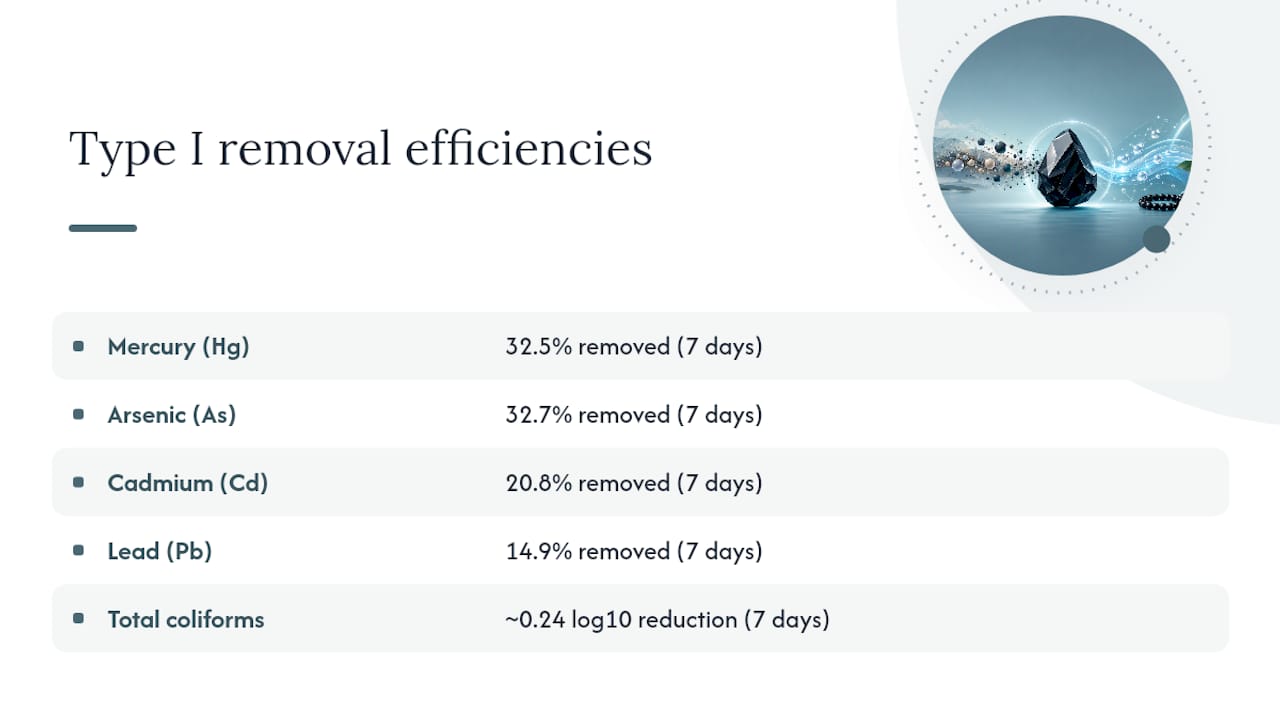
The most credible body of evidence concerns shungite’s behaviour in water. Controlled batch tests using Type I shungite from the Zazhoginsky deposit reported the measurable removal of several heavy metals after seven days of contact: mercury at 32.5%, arsenic at 32.7%, cadmium at 20.8%, and lead at 14.9%. Distribution-coefficient values (Kd) for some elements reached up to 1,300 L/kg, indicating meaningful sorption. Microbial indicators also decreased modestly, with total coliforms dropping by approximately 0.24 log10.
Type I generally outperformed Type III in removal tests. Most mass-market shungite sold for water use is lower carbon grade or mixed, not the high-carbon elite grade tested in the lab.
Antioxidant and antimicrobial activity: measurable but modest
A PMC-published study on Karelian shungite found antioxidant activity and adsorption capacity in tested samples. The Sh20 sample registered measurable antiradical activity. For comparison, quercetin, a common plant flavonoid, has much stronger antioxidant potency. Antimicrobial results come from in vitro and animal contexts; no peer-reviewed human clinical trials have confirmed these effects at doses or exposures relevant to everyday use.
Key limitations of the current evidence base:
- Most studies are in vitro (cell cultures) or animal models, not human trials
- Sample sizes are small and replication across independent labs is limited
- Lab conditions (pH, contact time, water chemistry) rarely match household use
- Carbon content and grade of tested samples vary widely between studies
EMF and 5G claims: not supported
This is where the evidence gap is widest. Wikipedia’s shungite entry, drawing on mainstream physics and health-authority positions, notes that claims shungite can block 5G or other non-ionizing radiation are unsupported. A conductive stone placed near a device does not create a Faraday cage around a person’s body; the geometry and physics simply do not work that way. Healthline’s review similarly notes that perceived benefits in this area often align with mindfulness and placebo effects rather than measurable radiation reduction.
This does not mean placing shungite near electronics is without value as a ritual or mindfulness anchor. It means the mechanism is psychological and intentional, not electromagnetic.
How to use shungite safely
Making shungite water
- Rinse raw shungite pieces thoroughly under running water for at least two to three minutes to remove surface dust and particulates.
- Soak the stones in a separate container of water for 24–48 hours, then discard that water. This pre-wash step reduces initial heavy-metal leaching.
- Place the washed stones in a glass or ceramic container (not plastic or metal) and fill with clean water.
- Allow a minimum contact time of 48–72 hours before drinking.
- Remove the stones, filter the water through a standard carbon filter if possible, and store in a sealed glass container.
- Repeat the pre-wash cycle every two to three weeks of regular use.
Safety notes: WebMD’s overview specifically flags nickel, lead, cadmium, and zinc as metals that can leach from improperly prepared shungite. Pregnant individuals, children, and anyone with kidney conditions should consult a physician before drinking shungite-prepared water. Shungite water is not a substitute for tested, municipal, or filtered drinking water.
Pro Tip: Before using any shungite for water preparation, wipe a damp white cloth across the stone’s surface. A black smear indicates carbon dust that needs more washing. Keep washing until the cloth comes away clean. This simple check also helps distinguish genuine high-carbon shungite from dyed or coated fakes.
Dos and don’ts for wearing and carrying:
- Do rinse jewellery pieces weekly and dry completely before wearing
- Do remove shungite bracelets before swimming in chlorinated water or using chemical cleaning products
- Don’t allow children under three to handle small tumbled pieces unsupervised (choking hazard)
- Don’t assume skin sensitivity is impossible; a small number of people react to the silicate or trace-metal content in direct skin contact
- Do store pieces away from prolonged direct sunlight if they are polished, as heat can affect surface finish over time
Sleeping with shungite
Placing a shungite piece on a bedside table or under a pillow is a common practice in grounding traditions. There is no documented physical risk to sleeping near shungite, provided the stone is not a raw crumbling specimen that sheds dust. Polished pieces are the better choice for bedroom use. Whether the practice improves sleep is entirely anecdotal; the most plausible mechanism is the same as any intentional bedtime ritual that signals the nervous system to wind down.
Charging and clearing
Shungite does not need “charging” in the energetic sense that porous or crystalline stones are said to need. Its conductivity and carbon structure are stable physical properties, not a reservoir that depletes. Rinsing with water and brief sunlight exposure are the practical maintenance steps. Burying in soil, placing on selenite, or using sound bowls are all harmless rituals if they fit your practice — just understand they are symbolic rather than physically restorative for this particular material.
How to identify real shungite and buy with confidence
Authentic shungite has a few reliable physical tells. Elite (Type I) shungite has a bright, almost metallic silver-black sheen on fresh surfaces and feels heavier than it looks. Type III is matte black and lighter. Both should leave a faint black mark on unglazed ceramic (similar to a streak test), and both should conduct electricity.
Identification checklist:
- Conductivity test: touch both probes of a multimeter set to continuity mode to the stone’s surface. Genuine shungite conducts; most fakes and dyed stones do not
- Streak: rub the stone on unglazed white ceramic; real shungite leaves a grey-black carbon streak
- Weight: shungite is denser than most black plastics or dyed resin fakes
- Sheen: elite shungite has a distinctive metallic lustre; Type III is uniformly matte
- Provenance: authentic specimens come from Karelia, Russia; ask for this specifically
Buying checklist — questions to ask any seller:
- What is the grade (Type I, II, or III) and approximate carbon percentage?
- Can you confirm Karelian provenance?
- Is there any lab documentation or certificate of authenticity?
- What is the return policy if the stone fails a conductivity test?
- Is the piece natural or has it been treated, coated, or dyed?
For general guidance on vetting crystal sellers, the how to spot fake crystals guide and the natural vs. synthetic crystal identification resource from Legacy Crystals and Minerals cover the broader authentication landscape. The same due-diligence principles that apply to certified jewellery purchases — asking for documentation, checking return policies, and buying from transparent sellers — apply equally here.
Price and quality expectations:
| Tier | Grade | Typical use | What to expect |
|---|---|---|---|
| Budget | Type III / commercial mix | Decorative, casual use | Matte finish, lower carbon, less reliable provenance |
| Mid-range | Type II / verified Type III | Jewellery, general practice | Consistent appearance, seller provides grade info |
| Collector | Type I / Elite | Water treatment, display, high-end jewellery | Metallic sheen, Karelian provenance documented, conductivity confirmed |
A note on sustainability: Shungite mining is concentrated in a specific region of Karelia, and the deposit is finite. Buying from sellers who can confirm responsible sourcing and Karelian origin supports both quality and the long-term availability of genuine material. Vague provenance claims (“from Russia” without deposit specifics) are a yellow flag.
Authentic shungite from Legacy Crystals and Minerals
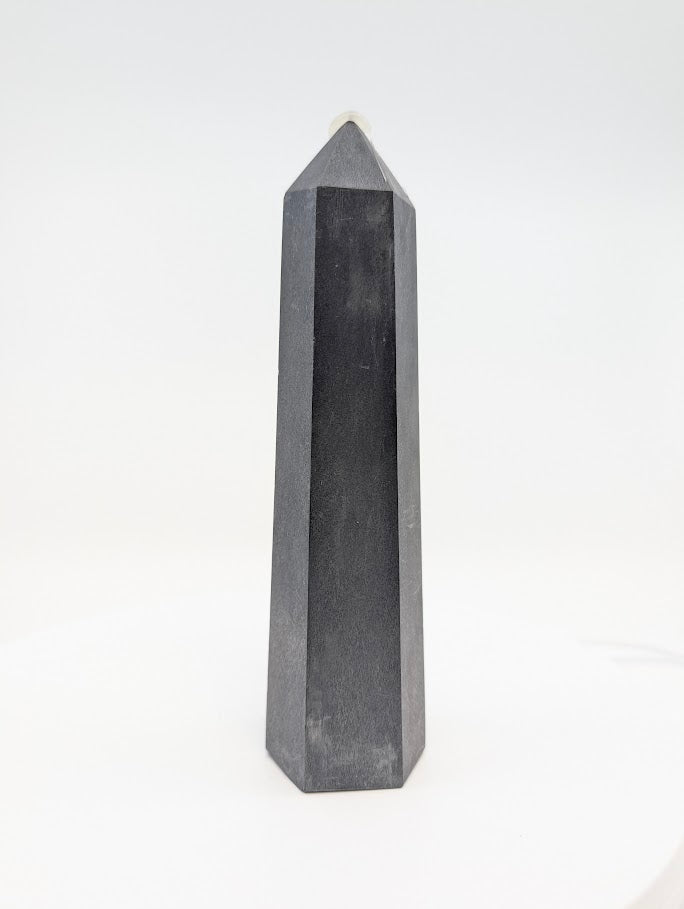
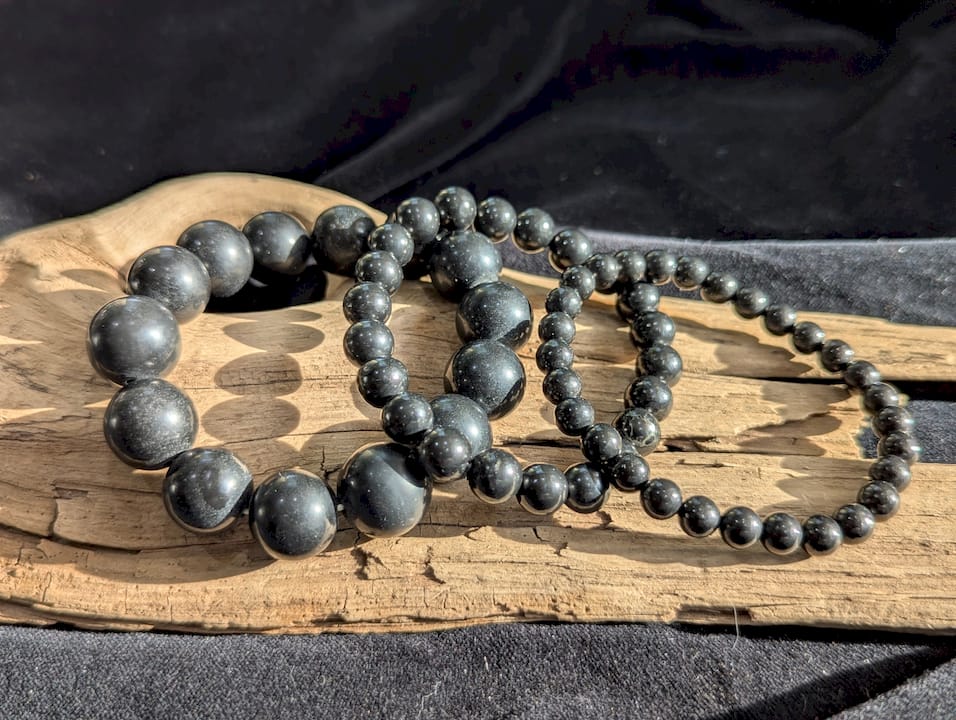
Readers who want to move from research to practice will find that sourcing matters as much as intent. Legacy Crystals and Minerals carries polished shungite towers sourced from Karelia, Russia — suited for desk placement, display, or use near electronics — and shungite bracelets in 7mm, 8mm, and 14mm polished round beads for daily wear and grounding practice.
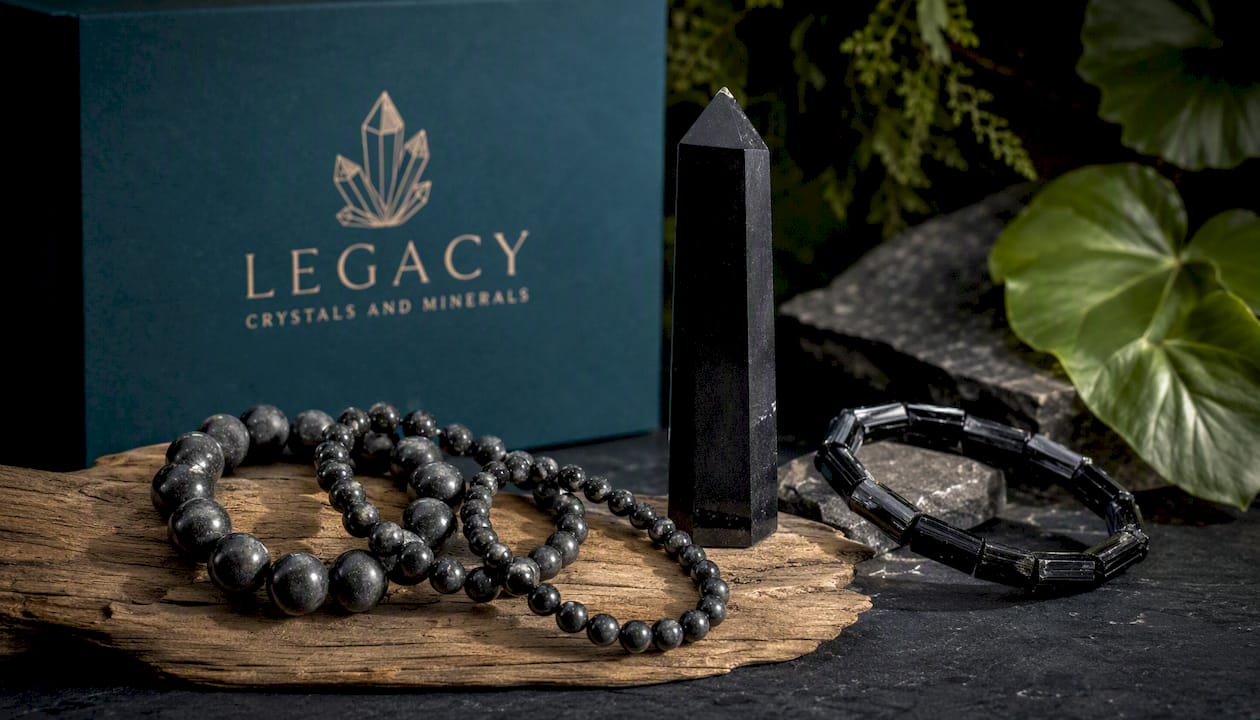
Each piece is selected for authenticity and provenance. For readers who want to layer protective symbolism, the raw black tourmaline bar bracelet pairs naturally with shungite: tourmaline is an insulating schorl with its own grounding tradition, while shungite brings conductivity and carbon-based adsorption to the combination. Browse the current shungite collection at Legacycrystalsandminerals and use the product pages to confirm grade details before purchasing.
Sources
The findings in this article draw on peer-reviewed studies, government-adjacent health summaries, and geological references. When reading laboratory papers yourself, note whether results come from in vitro, animal, or human studies — the distinction changes how much weight a finding can carry for personal health decisions.
- Shungite multifunctional potential for water purification - DOI
- Spectroscopic and EPR studies of shungite (PMC article)
- Shungite - Wikipedia
- Shungite Stones: Benefits and Uses - WebMD
FAQ
What are the spiritual properties of shungite?
Shungite is associated with grounding, energetic protection, and root-chakra stabilisation in metaphysical traditions. Practitioners use it to anchor scattered energy, neutralise discordant frequencies in a space, and support calm, centred states during meditation.
How do you activate shungite?
Most practitioners simply set a clear intention while holding the stone, then rinse it with water to clear any residual energy from handling. Shungite’s physical properties — conductivity and carbon structure — are stable and do not require activation in any measurable sense.
Can you sleep with shungite?
Placing a polished shungite piece on a bedside table or nearby surface carries no documented physical risk. Raw, crumbling specimens that shed dust are better kept out of the sleep space; polished pieces are the practical choice for overnight use.
How do you charge shungite?
Rinsing with water and a brief period in sunlight are the standard maintenance steps. Unlike porous or crystalline stones, shungite’s conductivity is a fixed physical property rather than an energetic charge that depletes, so elaborate charging rituals are not necessary for the stone to function as intended.
How do you tell if shungite is real?
Touch both probes of a multimeter set to continuity mode against the stone’s surface — genuine shungite conducts electricity and most fakes do not. A grey-black streak on unglazed white ceramic and a metallic sheen on elite-grade pieces are additional confirmation.
Recommended
- Shungite Bracelet – 8MM Polished Round Beads - Legacy Crystals and Minerals – Legacy Crystals and Minerals
- Crystals for EMF protection: practical picks and placements – Legacy Crystals and Minerals
- The Enchanting Beauty of Shangbao Fluorite – Legacy Crystals and Minerals
- UV minerals: properties, applications, and benefits – Legacy Crystals and Minerals


