
Heart Abundance and Provenance for Collectors: Uvarovite Meaning
Uvarovite is widely known as the stone of abundance, prized for its ties to the heart chakra and its rare, sparkling green presence. That reputation comes from its unusual mineral character: a chromium‑bearing garnet that grows as tiny drusy crystals rather than large gems. The sections below unpack how mineralogy, rarity, and metaphysical practice all feed into that meaning.
TL;DR:
- Uvarovite is a rare, tiny-crystal garnet primarily found as drusy coatings, with the largest specimens suited mainly for collectors rather than jewelry.
- Its rich green color and chromium content make it distinct from tsavorite, which is a trace element garnet suitable for faceting into gemstones.
- Provenance and detailed compositional verification are crucial when purchasing uvarovite to avoid mislabeling or confusing it with other garnets.
- Short, heart-centered meditation routines with uvarovite can support emotional openness and abundance, especially when paired with grounding stones.
- Handling and display should prioritize gentle cleaning, stable storage, and avoiding moisture or vibration to preserve delicate crystal structures.
Table of Contents
- What does uvarovite mean, symbolically and spiritually?
- Uvarovite crystal benefits: healing uses and chakra work
- Uvarovite properties: formula, crystal habit, and formation
- Uvarovite vs tsavorite: rarity, value, and telling them apart
- How to work with uvarovite: meditation, placement, and pairings
- Caring for uvarovite specimens at home
- A note from Simon on provenance and collecting uvarovite
- Related uvarovite and green garnet pieces from Legacy Crystals and Minerals
- Sources
- FAQ
What does uvarovite mean, symbolically and spiritually?
Uvarovite’s green colour and garnet lineage anchor most of its symbolic weight. Garnets as a family have carried associations with vitality, passion, and protection since antiquity, but uvarovite’s colour shifts that meaning toward the heart rather than the root or the blood. Green stones, across nearly every metaphysical tradition, point to growth, renewal, and the natural world’s steady capacity to regenerate. Uvarovite inherits that symbolism and layers garnet’s grounded, embodied energy on top of it.
The “stone of abundance” label isn’t only about money. Practitioners describe uvarovite as supporting abundance in three overlapping senses:
- Emotional abundance — a felt sense of having enough warmth, patience, and goodwill to go around.
- Creative abundance — an openness to new ideas rather than a scarcity mindset that clings to one plan.
- Material abundance — the more conventional reading, tied to prosperity and financial ease.
There’s also a quieter metaphor built into how uvarovite actually grows. It typically forms as a druse, meaning hundreds of tiny individual crystals clustered together on a single matrix rather than one large stone standing alone. Collectors and practitioners alike read that structure as a lesson in community: individual points of light contributing to a shared brilliance, rather than one dominant crystal outshining the rest. It’s a fitting image for a stone tied to shared prosperity instead of hoarded wealth.
The name itself has a fixed historical anchor. Uvarovite was first described in the 1830s and named for Count Sergei Semyonovich Uvarov, a Russian statesman and minerals patron, a naming convention confirmed in the Handbook of Mineralogy. That gives uvarovite a documented pedigree most crystal shop labels never mention, and it matters if you care about provenance as much as vibration.
Uvarovite crystal benefits: healing uses and chakra work
Practitioners who work with uvarovite tend to describe it as an emotional stone first, a manifestation stone second. The metaphysical tradition around it centres on heart‑healing, on learning to receive rather than only give, and on shifting a scarcity mindset toward genuine openness. None of these effects are clinically measured; they belong to the same body of crystal‑healing folklore that surrounds most gemstones, and they’re worth approaching as a framework for reflection rather than a guaranteed outcome.
The heart chakra, or Anahata, is uvarovite’s primary point of contact. Practitioners suggest three simple ways to work with that connection:
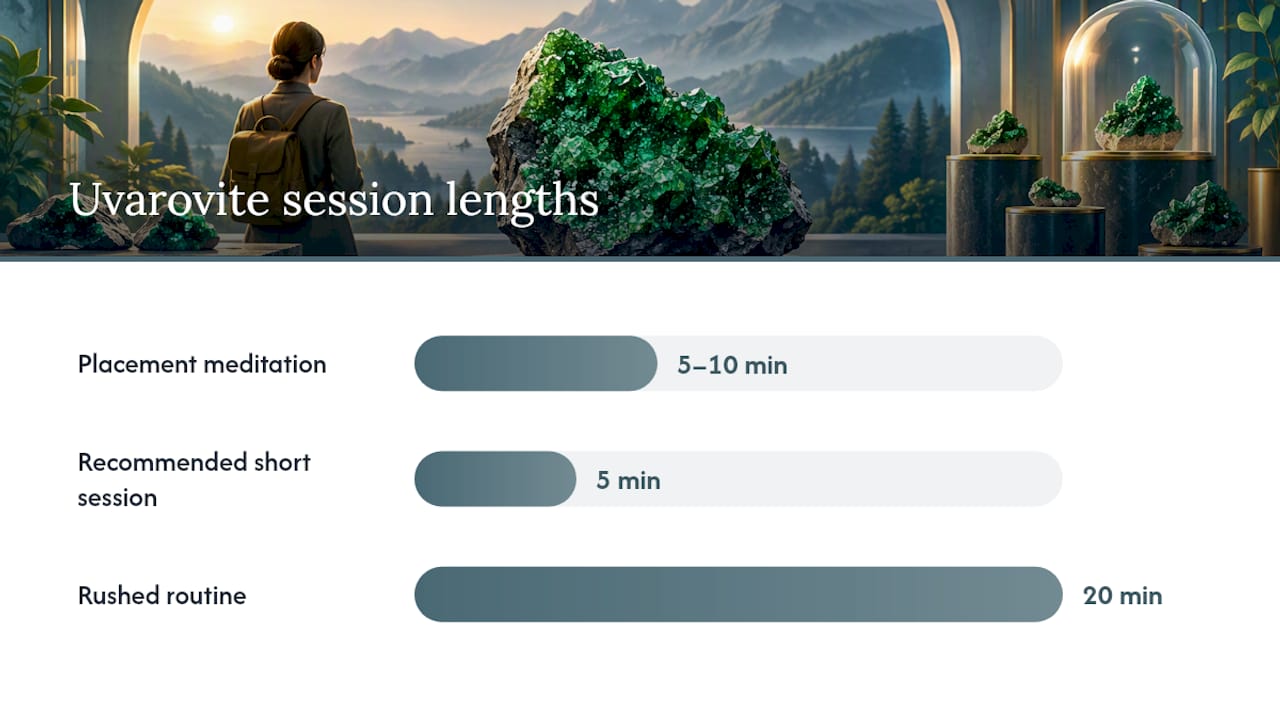
- Placement meditation — lie down and rest a small uvarovite specimen or tumbled piece over your sternum for five to ten minutes, breathing slowly into the chest rather than the belly.
- Breath and intention pairing — inhale while imagining warmth expanding outward from the centre of your chest, and exhale while releasing a specific worry tied to lack or scarcity.
- Journaling prompt — after the meditation, write down one area of your life where you feel you’re “not enough,” and one small piece of evidence that contradicts it.
Uvarovite is often paired with other stones to round out its effect. Green aventurine complements it well as a gentler, more affordable abundance stone for daily carrying, while grounding stones like smoky quartz or black tourmaline help keep heart‑opening work from tipping into ungrounded idealism. Practitioners working on the sacral chakra sometimes add carnelian to balance uvarovite’s heart focus with creative and material drive lower in the body.
Pro Tip: Keep your uvarovite session short at first. Five minutes of focused heart‑chakra breathwork with the stone in hand tends to land better than a rushed twenty‑minute routine you won’t repeat.
Uvarovite properties: formula, crystal habit, and formation
Uvarovite’s chemistry sets it apart from every other garnet on the market. Its ideal formula is Ca3Cr2(SiO4)3, meaning chromium occupies the position that most other garnets fill with aluminum or iron. That single substitution is what makes uvarovite the only consistently green garnet species, rather than one that merely appears green under certain trace conditions. Chromium’s electron structure absorbs light in a way that reflects back a saturated emerald green, distinct from the yellowish or bluish greens you get from vanadium‑bearing garnets.
Uvarovite almost never forms as large, clean crystals. Instead, you’ll typically encounter it as:
- Drusy coatings of tiny, sparkling crystals over a host rock.
- Small euhedral (well‑formed) crystals rarely exceeding a few millimetres.
- Crusts intergrown with chromite, its usual host mineral.
- Faceted stones, which are exceptionally rare because there’s almost never enough clean material to cut.
Canada has its own documented occurrence worth knowing about. Recent petrographic work on the Pikoo Property in central eastern Saskatchewan characterized uvarovite‑grossular garnet mantles growing around zinc‑rich chromite cores, showing high chromium oxide and zinc oxide contents within a detailed compositional range, according to research published on the Pikoo Property. That core‑to‑rim zoning reflects a metasomatic process, where fluids gradually alter existing minerals rather than crystallizing from a fresh melt, and it gives Canadian collectors a genuinely local point of reference for museum‑grade material.
Uvarovite vs tsavorite: rarity, value, and telling them apart
Uvarovite is considered rare among common garnets. Because it rarely grows large enough or cleanly enough to facet, it stays largely in the specimen and collector market rather than the gem‑cutting trade, keeping supply limited for well‑formed pieces.
Several factors drive value for a given piece:
- Crystal size and definition — sharper, larger individual crystals within the druse command more than a fine, dusty coating.
- Matrix quality — an intact, aesthetically balanced host rock adds significant appeal over a loose or damaged fragment.
- Provenance — documented locality data, especially from well‑studied deposits, raises both scientific and collector value.
- Colour saturation — a deeper, more even green generally outperforms pale or patchy material.
Uvarovite by the numbers: its ideal formula, Ca3Cr2(SiO4)3, makes it the only garnet species where chromium consistently dominates the composition rather than appearing as a trace colourant.
The comparison with tsavorite comes up constantly, and the confusion is understandable since both are vivid green garnets. Tsavorite is a variety of grossular garnet coloured by vanadium and chromium as trace elements, while uvarovite is a distinct species where chromium occupies the structural formula itself rather than showing up as an impurity, a distinction laid out clearly in gemological reference material on tsavorite. Tsavorite’s rise as a commercial gemstone was driven partly by targeted marketing after its 1960s discovery and its suitability for faceting into clean, eye‑catching gems. Uvarovite never had that path open to it, so it remained a specimen mineral valued by mineralogists and collectors rather than jewellers.
Buying uvarovite means watching for mislabelled material. Collector resources note that stones sold under the uvarovite name sometimes turn out to be chromium‑bearing grossular or andradite instead, according to gemstone collector guides, so ask any seller for compositional data or locality documentation before paying a premium price.
How to work with uvarovite: meditation, placement, and pairings
A short, repeatable practice works better than an elaborate ritual you’ll abandon after a week. Try this sequence:
- Choose your setting. Sit somewhere quiet, hold the uvarovite specimen or wear a uvarovite‑adjacent piece, and let your shoulders drop before you begin.
- Ground first. Take three slow breaths, feeling your feet or seated weight against the floor.
- Bring the stone to heart level. Rest it against your chest or hold it between both palms at sternum height.
- Set a single intention. Name one specific area where you want more openness, whether emotional, creative, or financial.
- Close with gratitude. Spend the final minute naming one thing you already have enough of.
Whether you reach for a raw specimen or a piece of jewellery depends on your goal. A drusy specimen suits stationary meditation and desk or altar placement, where its fragility isn’t a concern. For daily carrying, a greener companion stone in a tumbled or wearable form, like the 7mm Tsavorite Garnet Bracelet, gives you heart‑centred green energy without the wear risk that a delicate uvarovite druse would face on your wrist.
Good pairings extend the work. Grounding stones like the Variscite Tumbled Stone balance uvarovite’s heart‑opening focus with calm and stability, while a gentler abundance stone kept in a pocket throughout the day reinforces the same intention between formal sessions. Because uvarovite’s crystals are tiny and easily knocked loose from their matrix, handle raw pieces by the base rather than the crystal face, and avoid tossing them into a bag with harder stones.
Caring for uvarovite specimens at home
Drusy uvarovite is delicate, and most damage happens from careless handling rather than age. A soft, dry brush removes dust from the crystal surface without knocking individual points loose; skip water and ultrasonic cleaners entirely, since moisture trapped in the druse can encourage tarnishing on the host chromite.
Store specimens away from vibration and temperature swings, ideally on a padded shelf rather than stacked with other minerals. A stable room humidity, similar to normal indoor conditions, protects the matrix from cracking over time.
For display, angled LED lighting brings out the crystal sparkle without the heat a halogen bulb would add over long exposure. Legacy Crystals and Minerals covers this in more depth in guides on display lighting for minerals and general specimen storage and cleaning.
A note from Simon on provenance and collecting uvarovite
Simon, a contributor at Legacy Crystals and Minerals who focuses on mineral provenance, spends most of his working hours matching specimens against locality records before they’re ever offered for sale.
Provenance documentation and compositional verification separate genuine uvarovite from look‑alike green garnets sold under the same name.
Related uvarovite and green garnet pieces from Legacy Crystals and Minerals
If uvarovite’s abundance symbolism speaks to you, Legacy Crystals and Minerals carries several ways to bring that meaning into daily practice or a display case.
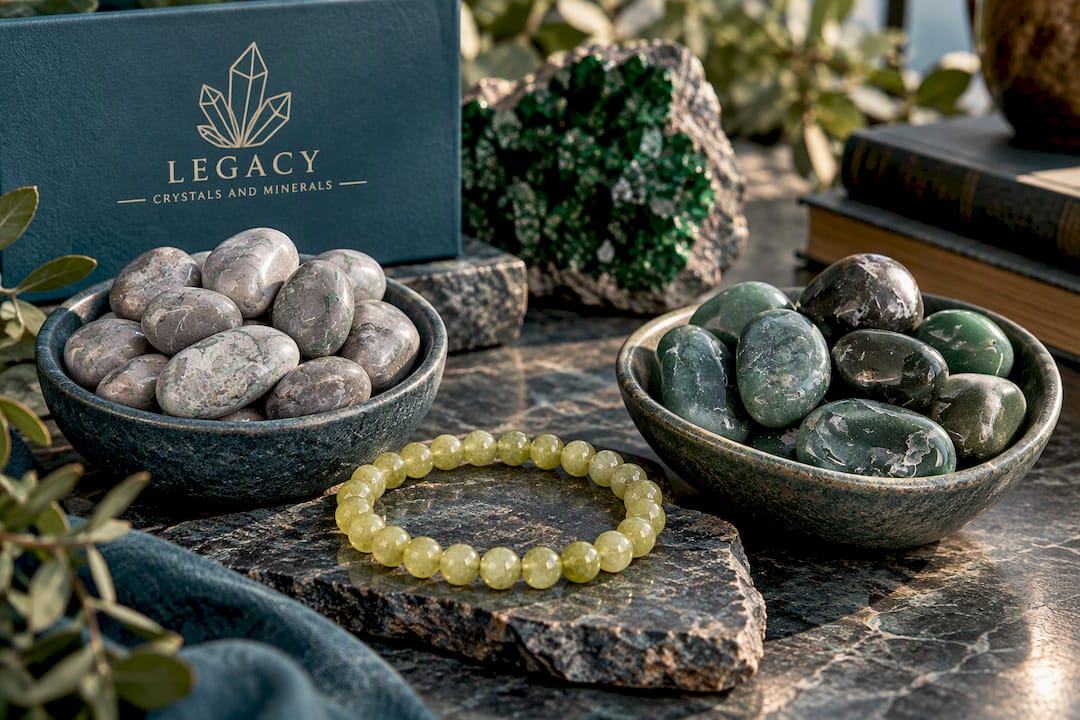
For readers drawn to the heart‑chakra work described above, the 7mm Tsavorite Garnet Bracelet offers a wearable green garnet alternative built for daily carrying, since raw uvarovite druse is too delicate for constant wear. Those who want a grounding companion for meditation sessions can look to the Variscite Tumbled Stone — AA Grade, and anyone wanting a gentler, more budget‑friendly abundance piece to carry between sessions will find the Green Aventurine Tumbled Stone — A Grade a natural fit. Collectors chasing documented uvarovite specimens themselves should start with the Museum Quality Minerals and Crystals collection, where provenance and specimen quality get the same scrutiny Simon applies to every piece before it’s listed. Browse the wider Raw Minerals and Crystals category to compare specimen options side by side, and check current availability directly on the collection page before your favourite piece sells out.
Sources
- Characterizing zinc-rich chromite cores and uvarovite‑grossular garnet mantles from the Pikoo Property, central eastern Saskatchewan (2023)
- Uvarovite — Wikipedia
- Tsavorite — Gem Society article (2018)
- Uvarovite garnet meaning, properties and uses — GemsLore
FAQ
What is the spiritual meaning of uvarovite?
Uvarovite is known as a stone of abundance, associated with the heart chakra and used in practices meant to shift emotional scarcity toward openness, receiving, and renewal. This meaning draws heavily on its green colour, since green stones across metaphysical traditions typically symbolize growth and prosperity.
Is uvarovite a rare gemstone?
Yes. Uvarovite is the rarest of the common garnet species and the only one that’s consistently green, largely because it almost never grows large or clean enough to facet into a traditional gemstone.
What are the differences between uvarovite and tsavorite garnet?
Uvarovite is a distinct garnet species where chromium is a structural part of its formula, while tsavorite is a grossular garnet variety coloured by vanadium and chromium as trace elements, as gemological reference sources explain. Tsavorite facets cleanly into gemstones; uvarovite typically stays as tiny drusy crystals suited to specimens rather than jewellery.
How much is uvarovite worth?
Uvarovite’s price depends heavily on crystal size, matrix quality, colour saturation, and documented provenance rather than any single fixed rate. Legacy Crystals and Minerals lists current pricing directly on its Museum Quality Minerals and Crystals collection page, since well‑documented specimens vary widely from casual drusy pieces to museum‑grade examples.


