
Mineral display lighting: what actually makes crystals shine
High-CRI LED spotlights and strips handle general mineral displays, while dedicated short-wave and long-wave UV lamps are non-negotiable for fluorescent specimens. Mixing the two systems, rather than picking one, is how serious collectors get both accuracy and drama out of a case.
Here’s a quick shortlist by use case:
- Budget shelf display: a single warm-white LED strip (CRI 90+) in an aluminum channel, angled slightly downward.
- Collector cabinet: micro-spot LED heads at CRI 95+ paired with a case-top wash strip.
- Fluorescent case: a long-wave (365 nm) UV lamp for daily viewing, plus a short-wave (254 nm) unit for special showings.
- Museum-style showcase: layered lighting combining concealed wash, adjustable spots, and perimeter cove lighting, a practice borrowed directly from professional museum lighting design.
Legacy Crystals and Minerals stocks specimens across all four categories, so the lighting choice usually comes down to what’s already in the case, not the other way around.
Key Takeaways
Mineral display lighting works best as a layered system: high-CRI LED for general viewing, dedicated UV wavelengths for fluorescence, and point-source placement to bring out facets that flat panels wash out.
| Point | Details |
|---|---|
| Default to high-CRI LED | Choose CRI 90+ for everyday display, 95+ or higher for colour-critical or photographed specimens. |
| Match UV wavelength to goal | Use short-wave (254 nm) for broader fluorescent reactions, long-wave (365 nm) for safer daily viewing. |
| Stage specimens, don’t lay them flat | Suspend or step fluorescent minerals off glass so UV light reaches the surface directly. |
| Start with the specimen, not the fixture | Legacy Crystals and Minerals offers faceted, translucent, and UV-reactive pieces suited to spot, backlight, and UV setups. |
Table of Contents
- Recommended mineral display lighting fixtures and what each is best for
- How do you choose the right mineral display lighting?
- How do you set up lighting for fluorescent mineral displays?
- LED vs halogen vs UV: which light works for which mineral?
- How do you protect specimens and yourself under display lighting?
- What lighting techniques do museums use for mineral exhibits?
- Where to find display-ready specimens for your lighting setup
- Sources
- FAQ
Recommended mineral display lighting fixtures and what each is best for
Five fixture categories cover almost every collection: LED micro-spots, high-CRI LED tape, short-wave UV lamps, long-wave UV lamps, and hybrid multi-wavelength UV units. Each solves a different problem, and most serious cases end up running two or three of them at once.
LED micro-spots throw a tight beam that catches facets and creates sparkle, which matters most on faceted or cluster specimens. High-CRI LED tape, mounted in an aluminum channel, gives even background illumination across a shelf or case floor without the hot spots a bare strip produces. Short-wave (254 nm) UV lamps trigger fluorescence in a wider range of minerals than long-wave units, according to Georgia Tech’s UV mineral resource, though they demand more caution. Long-wave (365 nm) lamps are gentler to work around and still reveal plenty of glow on common fluorescents like calcite and willemite. Hybrid units combine both wavelengths in one housing for collectors who don’t want to swap lamps mid-session.
A few notes on the price brackets: budget LED strips get you serviceable colour rendering but often thin out in the green and blue bands, per the same high-CRI LED strip documentation. Higher-grade 97+ CRI tape reduces this issue. Museum-grade UV fixtures at the top of the range typically add adjustable output and better shielding, not just more lumens.
Quick stat to remember: LED tape rated at 97+ CRI can deliver up to roughly 768 lumens per foot, enough to light an entire display shelf from a single channel run.
Specimens like the Natural Amethyst Crystal Cluster Tower respond well to micro-spot placement because the faceted surfaces throw light back at sharp angles. A polished piece like the White Sea Urchin Quartz Bracelet behaves differently: the small, rounded beads scatter light more evenly, so beam angle changes the sparkle pattern more than raw specimens do.
How do you choose the right mineral display lighting?
Specs on a box rarely tell the whole story, so run through this checklist before buying anything.
CRI and colour rendering:
- Aim for CRI above 90 for everyday display; go 95+ if you photograph specimens or care about true colour.
- Warm white (3000K-3500K) flatters amber, brown, and warm-toned minerals.
- Cooler daylight (5000K-6500K) renders blues and greens more accurately and gets closer to balanced daylight, according to John Betts’s lighting notes.
Beam angle and dimming:
- Narrow beams (15-30 degrees) create sparkle on faceted pieces; wide beams (60-120 degrees) wash a whole shelf evenly.
- Dimmable drivers let you tune brightness per specimen without swapping fixtures.
- Constant-voltage drivers suit LED tape; constant-current drivers suit single high-power LED spots. Mixing the two on one power supply usually ends badly.
Before ordering, ask any vendor for the measured CRI (not just a marketing claim), the stated wavelength on UV products, lumen or lux output at your typical viewing distance, and the surface temperature at continuous run time. If they can’t answer those four questions, keep shopping. Collector forums like Mindat’s lighting threads are worth a scan too. Long-time users report which LED brands hold their colour over years of use, a detail spec sheets rarely mention.
How do you set up lighting for fluorescent mineral displays?
Fluorescent specimens need a different playbook than ordinary minerals, starting with wavelength choice. Short-wave UV (254 nm) tends to provoke fluorescence in more mineral types, while long-wave (365 nm) is gentler to work around and still lights up common fluorescents nicely. Many collectors run both in the same case to catch the full range of reactions, a practice backed by UV mineral display research.
Here’s a practical setup sequence:
- Suspend specimens or stage them on steps rather than laying them flat on glass, which blocks UV exposure and flattens the display, per Uvminerals.
- Keep UV sources roughly 15 to 30 centimetres from the specimen surface, adjusting for lamp wattage.
- Use dark, non-reflective backing materials to maximize contrast against the glow.
- Sequence your lighting: ambient LED for general viewing, UV lamps on a timer or switch for demonstration cycles.
Pro Tip: Never look directly into a short-wave UV source, even briefly. Mount short-wave lamps inside the case, angled away from viewing height, and let a diffuser panel or shielded housing do the work of protecting eyes.
LED vs halogen vs UV: which light works for which mineral?
Each light type solves a different problem, and none of them replaces the others completely.
- High-CRI LEDs: low heat, long lifespan, CRI up to 97+, ideal for daily display and photography. Use them as your default for anything that sits under light for hours at a stretch.
- Quartz halogen (MR types): prized historically for a specific point-source brilliance, but the heat output is a real liability near delicate specimens, a trade-off John Betts’s mineral lighting guide flags directly. Reserve halogen only for short-duration tonal effects where you can manage the heat.
- Dedicated UV (short, mid, long-wave): the only category that reveals fluorescence at all; no substitute exists for this function.
Maintenance differs sharply between them. LEDs run for years with minimal upkeep, while halogen bulbs burn out on a predictable schedule and need routine replacement. UV lamp tubes also degrade in output over time, so budget for periodic swaps if fluorescence intensity starts fading.
How do you protect specimens and yourself under display lighting?
UV exposure and sustained heat are the two real risks in any mineral display lighting setup, and both are manageable with a bit of planning.
For personal safety: never view short-wave UV directly, even through glass, and treat any 254 nm source as something to shield rather than glance at. Use timers or remote switching so UV lamps aren’t running unattended, and keep a physical barrier between the lamp and viewing area on any case you build yourself.
For specimen preservation:
- Rotate light-sensitive specimens rather than leaving them under constant illumination.
- Keep surface temperatures low by choosing LED over halogen wherever the display runs for extended periods.
- Add diffusers or increase fixture distance if a specimen looks washed out under direct beam intensity.
One number worth remembering: LED tape at 97+ CRI produces meaningfully less heat than halogen at comparable brightness, which is the main reason it’s become the default choice for long-term display lighting. Test any new lighting setup on a low-value specimen for a week before committing valuable pieces to constant exposure.
What lighting techniques do museums use for mineral exhibits?
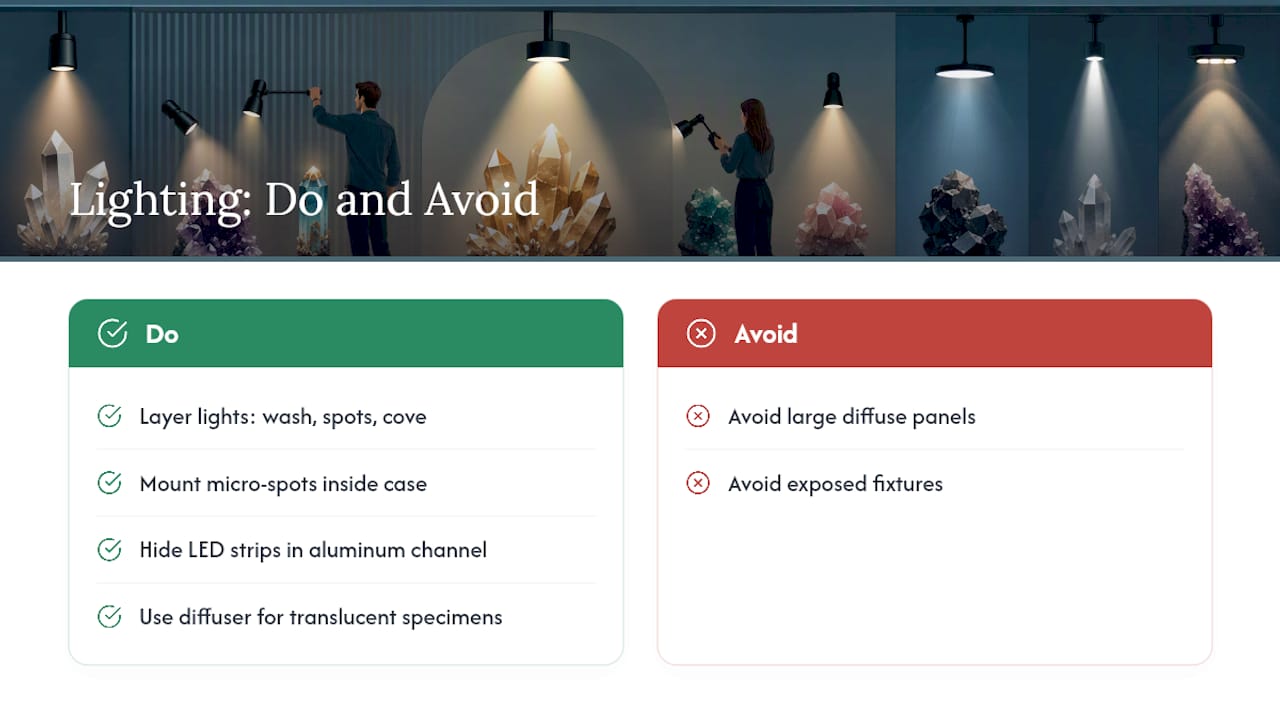
Professional exhibit designers rarely rely on one light source. They layer them: concealed case-top wash for general visibility, individually adjustable micro-spots for highlights, and perimeter cove lighting to add depth without glare, a structure documented in Phantom Lighting’s mineral display resources.
The bigger lesson is about restraint. Large diffuse panels flatten crystal faces, while several small point sources create the reflections that make a specimen look alive.
Exhibition designers focus on hiding the light source entirely. The goal is for the viewer to see light bouncing off mineral facets, never the fixture that produced it.
For a home setup, that translates into three habits: mount micro-spots inside the case rather than exposed above it, run LED tape through an aluminum channel so the strip itself stays hidden, and add a diffuser panel over any translucent specimen that needs softening rather than pinpoint brightness. A guide on building a museum-grade collection walks through the case-design side of this in more detail.
Where to find display-ready specimens for your lighting setup
Good lighting only matters once you have something worth lighting. Hiring a lighting consultant or exhibit designer is one route, but for most home collectors, the real gap isn’t design advice, it’s finding specimens that actually reward the light you’ve set up. Legacy Crystals and Minerals fills that gap directly, with a curated selection built around the same principles this guide covers: pieces with facets, clusters, and translucency that respond visibly to spot and wash lighting rather than sitting flat under it.
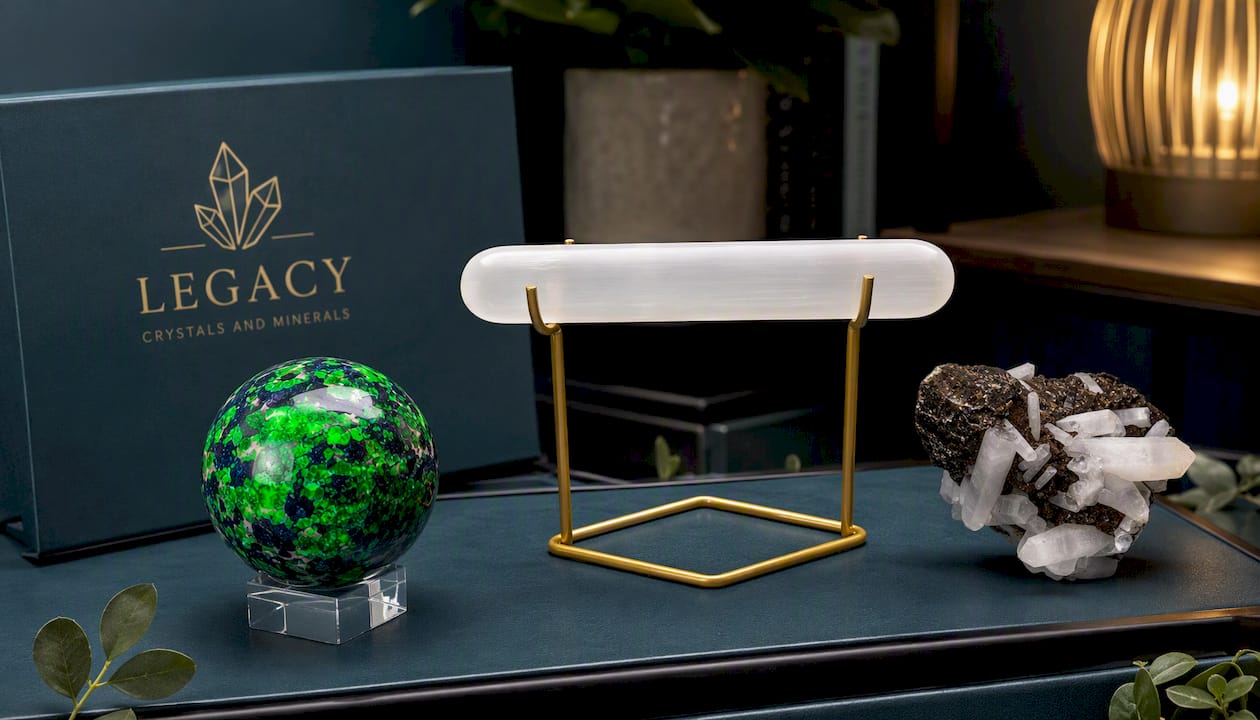
A faceted piece like the Natural Amethyst Crystal Cluster Tower rewards a high-CRI micro-spot immediately, no case redesign required. Translucent pieces like the Garden Quartz Bracelet show their internal structure best under backlighting, exactly the kind of specimen worth testing before committing an entire case to one lighting style. For collectors experimenting with fluorescent setups, Legacy Crystals and Minerals also carries UV-reactive specimens like the YGX fluorite with pyrite, a piece that shows clear response under long-wave lamps.
Browse the current specimen selection and match a piece to the fixture you already own, or the one you’re about to buy.
Sources
- 5m ultra-high 97 cri led strip light (product page)
- Lighting minerals (John Betts articles)
- Fluorescent Mineral Displays (Hamblen / Georgia Tech UV minerals)
- Lighting minerals and gems (Phantom Lighting resources)
- Uvminerals
FAQ
What is the best light for a mineral collection?
High-CRI LED (95+ CRI) in spot or strip form is the best general-purpose choice for mineral display lighting, offering strong colour rendering with far less heat than halogen.
Do fluorescent minerals need special lighting?
Yes. Fluorescent minerals require dedicated UV lamps at short-wave (254 nm) or long-wave (365 nm), since ordinary LED or halogen fixtures won’t trigger the reaction.
Is short-wave or long-wave UV better for fluorescent minerals?
Short-wave (254 nm) generally reveals fluorescence in a wider range of minerals, while long-wave (365 nm) is gentler to work around, which is why many collectors run both.
How hot do mineral display lights get?
LED fixtures run cool enough for close, continuous contact, while halogen bulbs generate significant heat that can stress delicate specimens over time.
Where can I buy specimens suited to different lighting setups?
Legacy Crystals and Minerals stocks faceted, translucent, and UV-reactive specimens, including pieces like the Mystery Crystal Tower and Natural Amethyst Crystal Cluster Tower, chosen to respond well under spot and UV lighting.
Recommended
- Display crystals at home guide: arrange and protect your collection – Legacy Crystals and Minerals
- How to Photograph Crystals for Social Media or Sale – Legacy Crystals and Minerals
- Fluorescent & UV Reactive Minerals: A Visual Guide | Legacy Crystals – Legacy Crystals and Minerals
- Skeletal crystals explained: science, ID, and buying tips – Legacy Crystals and Minerals


