

What are record keeper crystals: meaning and identification
Record keeper crystals are quartz or other mineral specimens that carry small, triangular markings on their termination faces. These markings, called record keepers or recorders, are believed to hold ancient wisdom and cosmic knowledge accessible through meditation and attunement. They appear most often on quartz but also occur on ruby and kunzite.
- Defining feature: pyramidal or triangular symbols on one or more crystal faces, either raised or indented
- Rarity: genuinely scarce, sought after by collectors and spiritual practitioners alike
- Believed purpose: storage of universal knowledge, higher consciousness, and esoteric wisdom
- Common host minerals: quartz (clear, smoky, amethyst), ruby, kunzite
- Types: standard record keepers carry one or two triangles; master record keepers display many triangles across the termination faces
- Community significance: widely regarded in crystal healing and metaphysical circles as among the most sacred stones available
The belief is that when a person attunes to a record keeper, the knowledge encoded within becomes accessible. That idea drives both their spiritual reputation and their price.
Table of Contents
- How do you identify record keeper crystals?
- What do record keeper crystals mean metaphysically?
- How to use record keeper crystals effectively
- What expert practitioners say about working with record keepers
- Explore quartz crystals from Legacy Crystals and Minerals
- Key takeaways
- FAQ
How do you identify record keeper crystals?
Spotting a record keeper takes patience and the right conditions. The triangular markings are often barely visible to the naked eye, and many crystals pass through hands unrecognised simply because no one looked closely enough.
Physical characteristics
- Shape: pyramidal or triangular, matching the geometry of the crystal’s termination face
- Texture: can be raised above the surface or indented into it; running a finger over the face often reveals nothing tactile
- Visibility: transparent or near-transparent, blending with the crystal face
- Location: on quartz, record keepers appear on termination faces almost exclusively; side markings on quartz are typically starbrary glyphs, not record keepers
- Size: ranges from barely perceptible micro-triangles to clearly defined facets several millimetres across
How to inspect a crystal for record keeper markings
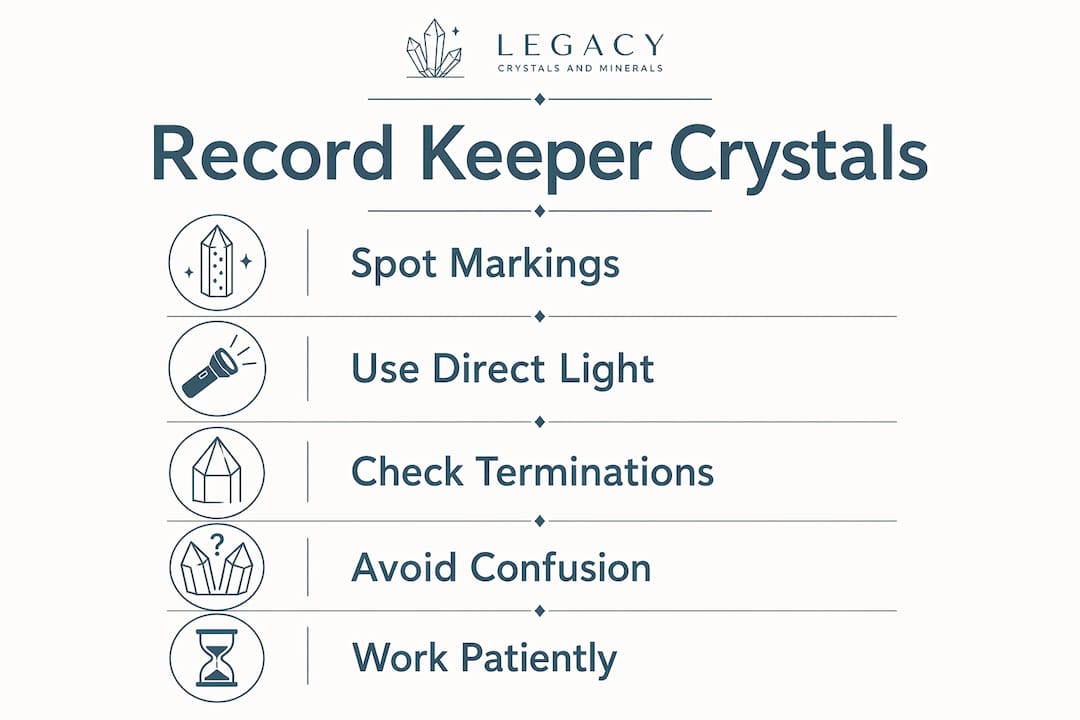
Hold the crystal face up to a bright, direct light source. Rotate it slowly, changing the angle every few degrees. The markings tend to catch light differently from the surrounding face, creating a brief flash or shadow that reveals their outline. Dim or diffuse light rarely works.
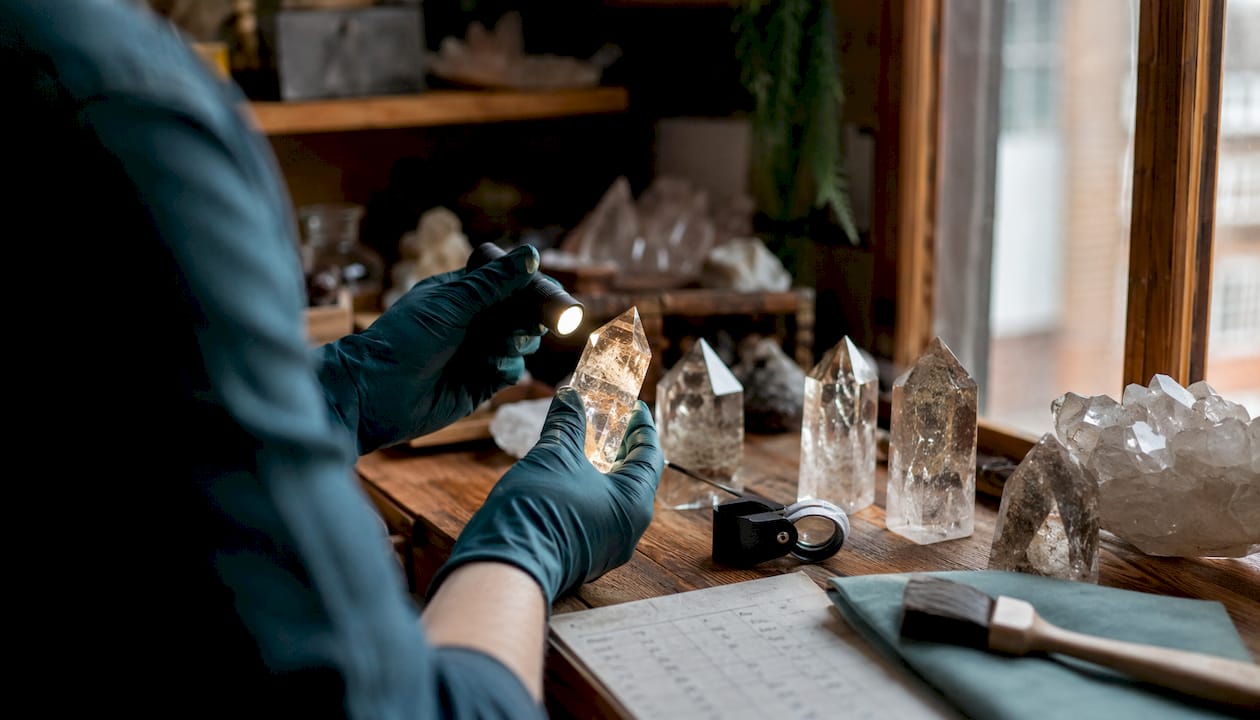
Pro Tip: Try examining the termination faces outdoors in direct sunlight rather than under indoor lighting. Natural light at a low angle, such as morning or late afternoon sun, makes subtle triangular facets far easier to detect.

Common identification mistakes
| Marking type | Location | Shape | Distinct feature |
|---|---|---|---|
| Record keeper | Termination face | Triangle only | Raised or indented; matches face geometry |
| Starbrary glyph | Crystal sides | Triangles, squares, circles, zig-zags | Etched into surface; varied shapes |
| Keyhole | Termination or side | Elongated cavity | Left by a crystal that grew and detached |
| Standard etching | Any face | Irregular | Common on many quartz; no consistent geometry |
Starbrary glyphs are the most frequent source of confusion. They appear on the sides of crystals rather than the termination faces, and their shapes vary widely, including rectangles, circles, and lightning-bolt patterns. A starbrary crystal and a record keeper are two distinct types, though a single crystal can carry both. Keyholes are cavities left when an adjacent crystal broke away during growth, not encoded markings. Standard surface etching, present on a large proportion of quartz specimens, lacks the precise triangular geometry of a genuine record keeper.
What do record keeper crystals mean metaphysically?
The core belief is that record keepers function as repositories. The wisdom stored within is described as ancient, containing knowledge of higher consciousness and esoteric understanding accumulated over vast periods. Practitioners treat the arrival of one of these crystals as the beginning of a teaching relationship, not a transaction.
Metaphysical properties by crystal type
| Crystal type | Associated metaphysical qualities |
|---|---|
| Clear quartz record keeper | Universal knowledge, clarity, amplification of intention |
| Smoky quartz record keeper | Grounding, shadow work, releasing old patterns |
| Amethyst record keeper | Intuition, dream access, spiritual protection |
| Ruby record keeper | Vitality, courage, deep ancestral memory |
| Kunzite record keeper | Emotional healing, heart-centred wisdom, compassion |
Key metaphysical themes
- Awakening: the markings are thought to activate dormant awareness in the person holding the crystal
- Memory recall: practitioners report accessing past-life impressions or ancestral knowledge during meditation
- Spiritual growth: regular work with a record keeper is believed to accelerate intuitive development
- Dream guidance: keeping the crystal under a pillow is a common practice for receiving guidance through dreams
- Subconscious access: messages often arrive not as conscious thoughts but as impressions, images, or feelings during quiet states
- Universal knowledge: the broader tradition holds that these stones carry information relevant to the entire arc of human and cosmic history
The record keeper crystals meaning varies somewhat depending on the host mineral, but the central theme stays consistent: these are teaching stones. They respond to readiness rather than demand.
How to use record keeper crystals effectively
Working with a record keeper requires a different approach than most crystals. The information encoded within unfolds gradually, and forcing the process tends to produce nothing useful.
Meditation practice
Sit quietly with the crystal held in your non-dominant hand, termination face resting against your palm. Close your eyes and focus on your breath for several minutes before shifting attention to the crystal. Do not expect a dramatic vision. Most practitioners report that impressions arrive as subtle shifts in thought or imagery rather than clear messages. Consistency matters more than session length.
Other ways to work with record keepers
- Carry it daily: keeping the crystal in a pocket or bag maintains a low-level energetic connection throughout the day
- Sleep with it nearby: placing it under a pillow or on a bedside surface is believed to influence dream content and subconscious processing
- Crystal grids: positioning a record keeper at the centre of a grid amplifies the grid’s intention, with the record keeper acting as the primary information source
- Tactile engagement: running a finger slowly across the termination faces, even when markings are invisible, is used as a meditative focusing technique
- Journalling: writing down impressions immediately after meditation sessions helps track patterns that may not be obvious in a single sitting
Cleansing and care
Cleansing record keeper crystals regularly maintains their energetic clarity. Accepted methods include smudging with sage or palo santo, placing the crystal under moonlight overnight, or a brief rinse under cool running water for minerals that tolerate moisture. Avoid prolonged water exposure for softer stones like kunzite. Do not use salt water on polished specimens, as it can damage surface features including the markings themselves.
A note on misconceptions: record keepers do not deliver instant answers. Practitioners who approach them expecting an immediate download of information typically report disappointment. The crystal’s information unfolds in proportion to the holder’s readiness, which is why patience is treated as a prerequisite rather than a virtue.
What expert practitioners say about working with record keepers
The most consistent observation among experienced practitioners is that the markings are easy to miss. Precise lighting and deliberate inspection are necessary, and many record keepers go unrecognised for years. A crystal that has passed through multiple hands may finally reveal its triangles to the person it was, in the metaphysical view, waiting for.
Pro Tip: When examining a crystal you already own, revisit it under different light conditions before concluding it has no record keeper markings. Many practitioners discover triangles on familiar stones they had examined before, simply by changing the angle or light source.
The concept of personal alignment runs through most practitioner accounts. The idea is not that the crystal hides its markings deliberately, but that the observer’s readiness affects their perception. Whether one reads that literally or metaphorically, the practical implication is the same: slow down, use good light, and look again.
Patience extends into the working relationship as well. Holding a record keeper for weeks or months before receiving a clear impression is considered normal, not a sign that the crystal is inactive. The arrival of the crystal is understood as the start of the process, not the delivery of the information itself. Practitioners who keep journals consistently report that patterns become clear over time in ways that were not apparent session by session.
Legacy Crystals and Minerals sources specimens with documented provenance, which matters when working with record keepers. Knowing a crystal’s origin adds context to its energetic character and supports the authentication process. For collectors building a serious collection, understanding how to evaluate rare metaphysical crystals is as relevant as the spiritual practice itself.
When purchasing record keepers online, the risk of misidentification is real. Standard surface etching on quartz is common, and photographs rarely capture the subtle geometry of genuine triangular markings. Reviewing how to spot fake crystals before buying reduces that risk considerably.
Explore quartz crystals from Legacy Crystals and Minerals
Legacy Crystals and Minerals carries a curated selection of high-quality quartz specimens and crystal jewellery, including pieces suited to both collectors and spiritual practitioners. The White Sea Urchin Quartz Bracelet offers AAA-grade polished quartz in a wearable format, while the High-Clarity Inclusion Quartz from the Goboboseb Mountains, Namibia, represents the kind of documented, museum-grade specimen that serious collectors seek. Each piece is selected for authenticity, clarity, and natural character.
Key takeaways
Record keeper crystals are rare, triangular-marked specimens believed to carry ancient wisdom, and identifying them correctly requires deliberate inspection under direct light at varied angles.
| Point | Details |
|---|---|
| Defining markings | Triangular or pyramidal symbols on termination faces, raised or indented, often transparent |
| Rarity and value | Genuinely scarce; price reflects both scarcity and perceived sacredness among collectors |
| Host minerals | Most common on quartz; also found on ruby and kunzite |
| Identification method | Hold face to bright light and rotate slowly; markings catch light differently from surrounding surface |
| Working practice | Meditation, carrying, and journalling over time; messages unfold gradually with patience |
FAQ
What makes a crystal a record keeper?
A crystal qualifies as a record keeper when it displays pyramidal or triangular markings on one or more of its termination faces. These markings can be raised or indented and are often nearly invisible without careful examination under bright light.
How is a record keeper different from a starbrary crystal?
Record keeper markings appear on termination faces and are triangular. Starbrary glyphs appear on the sides of crystals and include a wider range of shapes such as rectangles, circles, and zig-zag lines. A single crystal can carry both types of markings.
What crystals are most likely to have record keeper markings?
Quartz is by far the most common host, with clear quartz, smoky quartz, and amethyst all documented. Record keepers also appear on ruby and kunzite, though those occurrences are considerably rarer.
What is the rarest type of quartz crystal?
Master record keeper quartz, which carries many triangles across its termination faces rather than just one or two, is considered very rare among quartz formations. Most record keeper quartz specimens carry only one or two triangles.
How do you activate or work with a record keeper crystal?
Meditation is the primary method: hold the crystal in your non-dominant hand, quiet the mind, and remain open to impressions rather than seeking specific answers. Carrying the crystal daily or keeping it under a pillow are supplementary practices that support the gradual unfolding of its encoded information.
Recommended
- Crystal specimens: a collector’s guide to types and value – Legacy Crystals and Minerals
- Protection crystals explained: a complete beginner’s guide – Legacy Crystals and Minerals
- Crystal Knowledge Base: Mineral Education, Collecting, and Meaning – Legacy Crystals and Minerals
- How to Identify Natural vs Synthetic Crystals – Legacy Crystals and Minerals


