

What is crystal morphology: a complete scientific guide
Crystal morphology is defined as the external shape and form of a crystal, directly reflecting its internal atomic arrangement and the conditions under which it grew. The field sits at the intersection of crystallography and mineralogy, and it gives students, researchers, and hobbyists a practical window into a mineral’s history. Understanding crystal morphology means reading a crystal’s outer geometry as a record of its atomic lattice, its growth environment, and the forces that shaped it over time. Mineralogical classifications such as euhedral, subhedral, and anhedral describe how completely a crystal’s faces have developed, and these terms appear throughout geology, materials science, and collector communities worldwide.
What is crystal morphology and how does it differ from crystal structure?
Crystal morphology is the external shape and form of a crystal as a macroscopic expression of its internal atomic arrangement, influenced by temperature, pressure, and available space. Crystal structure, by contrast, refers specifically to the repeating three-dimensional arrangement of atoms within the lattice. The two concepts are related but not interchangeable. Morphology is what you see with your eyes; structure is what X-ray diffraction reveals at the atomic scale.
The distinction matters for accurate identification. Two minerals can share a similar external shape yet have completely different atomic structures. Pyrite and galena, for example, both form cubic crystals, but their internal lattices and chemical compositions differ entirely. Morphology gives you the first clue; structure gives you the definitive answer.

Crystal habit is a closely related term that collectors and geologists use alongside morphology. Crystal habit describes the characteristic shape or combination of shapes that a mineral typically displays, such as prismatic, tabular, or acicular. Habit is essentially the most common morphological expression of a given mineral species. Morphology is the broader scientific study; habit is the practical descriptor applied in the field.
How does crystal structure influence crystal morphology?
The internal atomic lattice controls which external faces a crystal can develop. Atoms arrange themselves into repeating units called unit cells, and the geometry of these cells determines the symmetry of the whole crystal. A cubic unit cell produces crystals with 90-degree angles and equal face lengths. A hexagonal unit cell produces the six-sided prisms seen in quartz and beryl.
Symmetry elements, including rotation axes, mirror planes, and inversion centres, define which crystal faces are geometrically possible. Crystallographers organize these symmetry combinations into 230 distinct space groups. Each mineral belongs to one space group, and that membership constrains the range of shapes the mineral can display. This is why halite always forms cubes and tourmaline always forms elongated prisms.
Packing efficiency also shapes morphology directly. Simple cubic packing achieves roughly 52% efficiency, body-centred cubic (BCC) reaches approximately 68%, and hexagonal close-packed (HCP) achieves around 74%. Higher packing efficiency means atoms are more tightly bound in certain directions, which affects how fast each crystal face grows and which faces dominate the final shape.
| Lattice type | Packing efficiency | Common crystal form |
|---|---|---|
| Simple cubic | ~52% | Open cubic structures |
| Body-centred cubic (BCC) | ~68% | Cubic, less dense minerals |
| Hexagonal close-packed (HCP) | ~74% | Hexagonal prisms, platy forms |
Crystal morphology links growth kinetics directly to physical properties. Faces that grow slowly become large and prominent because fast-growing faces shrink away. This principle, called growth rate anisotropy, explains why a quartz crystal develops long prism faces and small termination faces rather than a perfect sphere.
Pro Tip: When studying a crystal’s shape, look at which faces are largest. Large faces grew the slowest and are the most stable energetically. They reveal the dominant symmetry directions of the internal lattice.
What external factors influence crystal morphology?
The internal lattice sets the rules, but the environment writes the final result. Temperature, pressure, and the chemical composition of the surrounding fluid all modify which faces develop and how completely they form. A quartz crystal grown slowly from a low-temperature hydrothermal solution develops sharp, well-defined prism faces. The same mineral grown rapidly from a high-temperature melt may produce a stubby, poorly defined form.
Environmental growth conditions create the tension between internal atomic symmetry and external forces that ultimately determines morphological diversity. Impurities in the growth medium attach to specific crystal faces and slow their development, changing the final shape. Iron impurities in quartz, for instance, can suppress certain faces and produce the phantom growth patterns seen in smoky quartz specimens.
Space is one of the most decisive factors. A crystal growing freely in an open cavity develops all its faces fully. A crystal growing inside a tight rock matrix competes with neighbouring grains for space, and the result is a compressed or irregular form. This is why most crystals found inside granite are shapeless grains rather than geometric solids.
Factors that affect crystal morphology include:
- Temperature: Higher temperatures generally accelerate growth and can suppress face development.
- Pressure: Elevated pressure favours denser atomic packing and can shift which crystal form is stable.
- Chemical environment: The pH, salinity, and ionic composition of the growth fluid control which faces are exposed.
- Impurities: Foreign ions attach to specific faces and alter their growth rate.
- Growth rate: Rapid growth produces rough, poorly defined faces; slow growth produces sharp, flat faces.
- Available space: Confined spaces produce subhedral or anhedral forms regardless of the mineral’s natural habit.
Pro Tip: If you find a crystal with unusually large faces on one side and stunted faces on the other, it likely grew against a wall or another mineral. That asymmetry is a direct record of its growth environment.
How is crystal morphology classified and assessed in mineralogy?
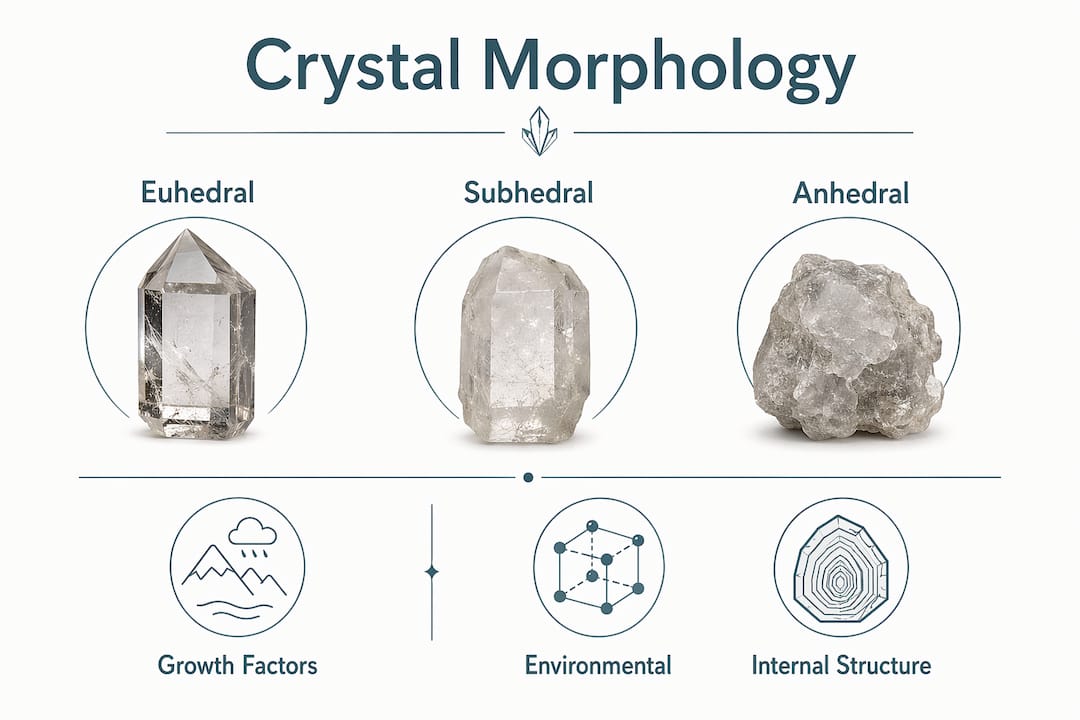
Mineralogists and collectors use three core terms to classify crystal morphology based on face development quality. Euhedral crystals display fully formed, well-defined faces that reflect the mineral’s ideal geometry. Subhedral crystals show partially developed faces, with some geometric features present but others missing or distorted. Anhedral crystals lack characteristic faces entirely and appear as irregular grains.
These classifications carry real weight in both scientific and collector contexts. A euhedral fluorite octahedron commands a premium price because perfect face development is rare. An anhedral quartz grain in a sandstone tells a geologist that the mineral recrystallised under pressure without free space to grow.
Crystal habit varies regionally for the same mineral species because local geological conditions differ. Calcite, for example, grows as scalenohedral “dogtooth” crystals in some limestone caves and as flat rhombohedral plates in others. Advanced collectors use these habit differences to identify a specimen’s locality without a label. That skill requires knowing both the mineral’s possible habits and the geological conditions of each region.
| Classification | Face development | Typical setting | Collector value |
|---|---|---|---|
| Euhedral | Fully formed, sharp faces | Open cavities, veins | High |
| Subhedral | Partially formed faces | Crowded rock matrices | Moderate |
| Anhedral | No characteristic faces | Dense, recrystallised rock | Low to moderate |
Collectors evaluating morphology quality look at face flatness, edge sharpness, and the symmetry of the overall form. A museum-grade specimen typically displays euhedral development across all visible faces, with no significant damage or overgrowth. Understanding these criteria helps collectors make informed decisions rather than relying on price alone.
For those building a collection, the collector-grade criteria for morphology quality are consistent: face integrity, symmetry, and the degree to which the specimen expresses its mineral’s natural habit.
What are common misconceptions about crystal morphology?
The most widespread misconception is that external shape defines a crystal’s identity. Scientific crystal definition requires an ordered, repeating atomic lattice, not just flat faces or a geometric outline. Obsidian has flat fracture surfaces and a glassy appearance, but it is an amorphous solid with no atomic periodicity. It is not a crystal by scientific definition, regardless of how it looks.
Polished stones create a related problem for hobbyists. A polished sphere of rose quartz has no natural crystal faces at all. Its shape is entirely artificial. Judging the morphology of a polished stone is not possible because the original face geometry has been removed. Morphological assessment applies only to specimens that retain their natural growth surfaces.
Most natural crystals are malformed due to spatial growth limitations, so the expectation of perfect geometry is unrealistic. Subhedral and anhedral forms are the norm in nature, not the exception. A collector who dismisses every imperfect specimen misses the majority of what geology produces. Imperfections often carry more scientific information than a perfect crystal, because they record the specific conditions of growth.
Morphological variability within a single mineral species also surprises many beginners. Quartz alone displays prismatic, massive, druzy, and pseudomorphic forms depending on where and how it grew. Assuming that a mineral always looks the same leads to misidentification. The types of crystal shapes a single mineral can produce span a wide range, and learning that range is part of developing genuine expertise.
Key takeaways
Crystal morphology is the external expression of internal atomic order, and classifying it correctly requires understanding both lattice geometry and growth environment.
| Point | Details |
|---|---|
| Morphology reflects atomic structure | External crystal shape is a direct result of internal lattice symmetry and unit cell geometry. |
| Packing efficiency shapes form | Simple cubic, BCC, and HCP arrangements produce different face geometries and growth patterns. |
| Environment modifies the outcome | Temperature, pressure, impurities, and space all alter which faces develop and how completely. |
| Three-tier classification applies | Euhedral, subhedral, and anhedral describe face development quality across all mineral specimens. |
| Shape alone does not define a crystal | Scientific crystal identity requires atomic periodicity, not just geometric external faces. |
Crystals selected for their morphology at Legacy Crystals and Minerals
Legacy Crystals and Minerals curates specimens and jewellery with morphology quality as a primary selection criterion. Each piece in the collection is chosen for face integrity, natural form, and the degree to which it expresses its mineral’s characteristic habit.

The Shangbao Fluorite with Quartz specimen is a strong example: it displays euhedral cubic fluorite faces alongside quartz overgrowths, making it both a scientific reference piece and a visually striking collectible. For wearable pieces that carry natural crystal morphology into everyday use, the Coral Jade Bracelet showcases the polished surface quality that results from working with well-formed source material. Legacy Crystals and Minerals also publishes educational guides on identifying natural vs synthetic crystals to help collectors make accurate, informed choices.
FAQ
What is crystal morphology in simple terms?
Crystal morphology is the study of a crystal’s external shape. It describes how a crystal looks on the outside as a result of its internal atomic arrangement and the conditions in which it grew.
What is crystal habit and how does it relate to morphology?
Crystal habit is the characteristic shape a mineral typically displays, such as prismatic or tabular. Habit is a practical descriptor within the broader field of crystal morphology.
Why do crystals of the same mineral have different shapes?
Regional geological conditions such as temperature, pressure, and chemical environment cause the same mineral to grow different habits in different locations. Calcite, for example, forms dogtooth crystals in some settings and flat plates in others.
What does euhedral mean in mineralogy?
Euhedral describes a crystal with fully formed, well-defined faces that clearly express the mineral’s ideal geometric form. It is the highest classification of face development quality.
Can a polished stone be assessed for crystal morphology?
Polishing removes the natural growth surfaces of a crystal, so morphological assessment is not possible on polished specimens. Morphology evaluation applies only to crystals that retain their original faces.
Recommended
- Crystal Growth Explained — From Molecule to Masterpiece – Legacy Crystals and Minerals
- Understanding Crystal Systems: Cubic, Hexagonal & More – Legacy Crystals and Minerals
- Building a Museum-Grade Crystal Collection: Expert Guide – Legacy Crystals and Minerals
- Display crystals at home guide: arrange and protect your collection – Legacy Crystals and Minerals


