
Why crystals crack or cleave: the science explained
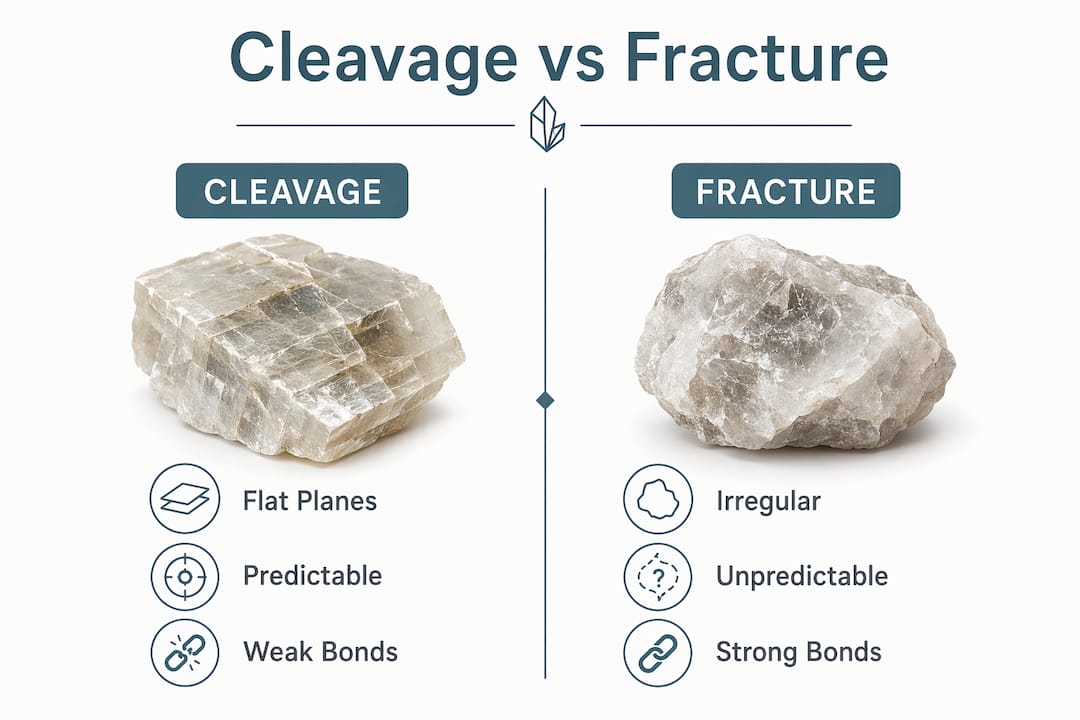
Crystal cleavage is defined as the predictable splitting of a crystal along flat planes dictated by its internal atomic bonding structure. Cracking, or fracture, occurs when breakage happens irregularly, outside those planes, wherever stress exceeds the material’s strength. Both phenomena are governed by crystallography, the science of atomic arrangement in solids, and understanding why crystals crack or cleave matters to collectors, gemologists, and anyone who has ever watched a beautiful specimen split unexpectedly. The difference between the two is not cosmetic. It reflects the fundamental architecture of the mineral itself.
Why do crystals crack or cleave at the atomic level?
Crystal cleavage originates in the crystal lattice, the repeating three-dimensional grid of atoms or ions that gives every mineral its internal order. Within that grid, not all atomic bonds are equal. Some directions pack atoms tightly with strong bonds; other directions hold atoms together with weaker forces. When stress is applied, the crystal breaks preferentially along those weaker planes, producing the flat, mirror-like surfaces that mineralogists call cleavage planes.
The number of cleavage directions a mineral has depends entirely on its atomic architecture. A mineral can have one, two, three, four, or six cleavage orientations, each reflecting a specific set of weak planes in the lattice. Mica, for example, has one perfect cleavage direction, which is why it peels into thin sheets. Calcite has three, producing its characteristic rhombohedral fragments.
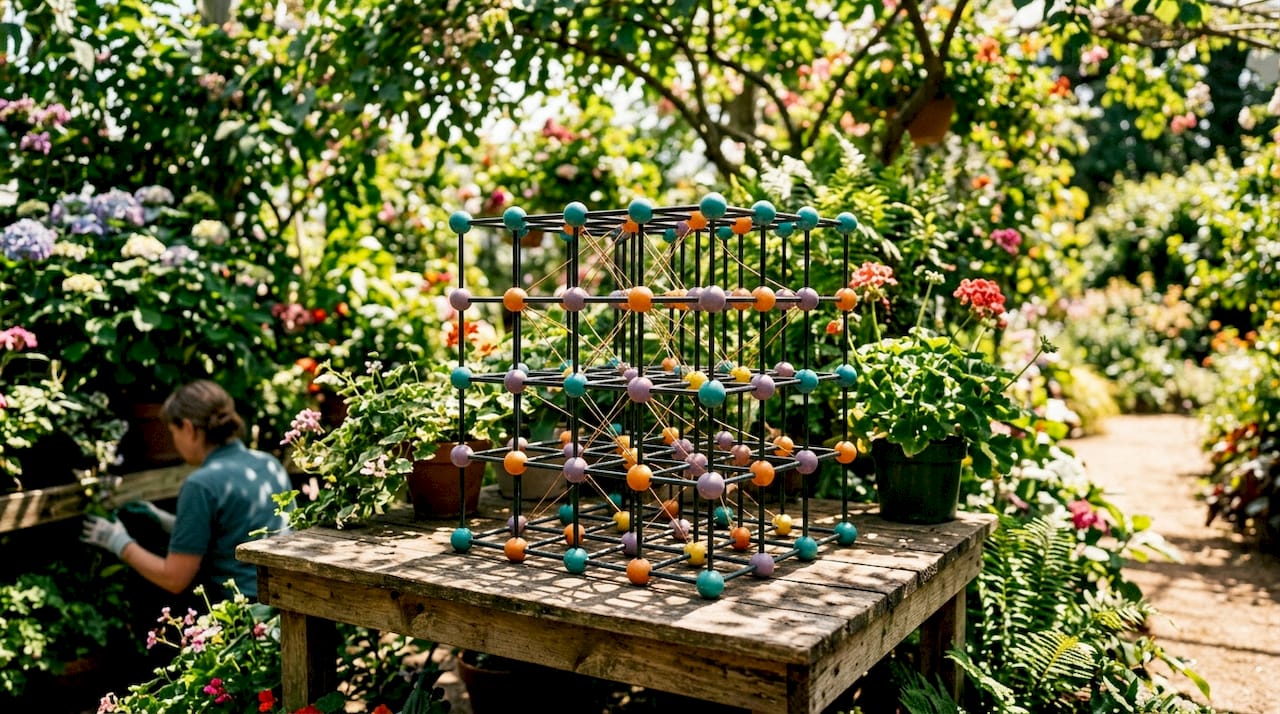
Ionic crystals illustrate the atomic cause of cleavage with particular clarity. In minerals like halite (table salt), atoms carry positive or negative charges and arrange themselves so that opposite charges sit adjacent to one another. When an external force shifts one layer relative to another, like-charged ions align, generating intense electrostatic repulsion. That repulsion is instantaneous and powerful enough to shatter the crystal cleanly along the affected plane.
The probability that a mineral cleaves along a given plane is not random. Material scientists calculate it using surface energy and bond density along specific crystallographic directions. Planes with low surface energy and fewer bonds per unit area are the weakest, and those are exactly where cleavage initiates under stress.
- Bond strength anisotropy: Mechanical strength varies by direction in all crystalline materials. Cleavage planes are the directions with the lowest bond density.
- Ionic repulsion: In ionic crystals, layer displacement causes like charges to face each other, producing a force that cleaves the crystal cleanly.
- Surface energy: Lower surface energy along a plane means less energy is needed to separate it, making cleavage there more likely.
- Lattice geometry: The shape of the unit cell determines how many cleavage directions exist and at what angles they intersect.
Pro Tip: When you handle a mineral specimen, look for flat, reflective surfaces. Those are almost always cleavage faces, not polished cuts. They reveal the crystal’s internal geometry directly.
How does fracture differ from cleavage in crystals?
Fracture is breakage that does not follow a cleavage plane. Where cleavage is predictable and directional, fracture is irregular, producing surfaces that are curved, jagged, splintery, or uneven. The distinction matters because it tells you something specific about the mineral’s internal structure.
Conchoidal fracture is the most recognisable type. It produces smooth, curved surfaces with concentric undulations that resemble the growth lines on a shell. Conchoidal fracture is common in quartz and obsidian, both of which lack usable cleavage planes. The curved surface forms because stress radiates outward from the point of impact in all directions equally, with no preferred atomic plane to guide it.
Amorphous materials, those with no repeating atomic lattice at all, always fracture rather than cleave. Obsidian is a classic example. It is a volcanic glass with no crystal structure, so every break it makes is a fracture. Ancient toolmakers exploited this property deliberately, striking obsidian at precise angles to produce razor-sharp conchoidal edges.
| Property | Cleavage | Fracture |
|---|---|---|
| Surface appearance | Flat, mirror-like | Curved, jagged, or irregular |
| Predictability | High. Follows fixed atomic planes | Low. Follows stress path |
| Cause | Weak bonding along lattice planes | Stress exceeding material strength |
| Common examples | Mica, calcite, fluorite | Quartz, obsidian, flint |
| Occurs in | Crystalline minerals with weak planes | Crystalline and amorphous materials |
One important nuance: conchoidal fracture can appear in both crystalline and amorphous materials. Quartz, which is crystalline, fractures conchoidally because its cleavage is so poor that stress finds no preferred plane to follow. This means fracture type alone does not confirm whether a material is amorphous or crystalline.
Pro Tip: Run your fingertip across a broken surface. A cleavage face feels glassy and flat. A fracture surface feels uneven or slightly rough, even when it looks smooth from a distance.
Why do crystals break along specific directions under stress?
The direction a crystal breaks under stress is not accidental. It reflects a property called directional anisotropy, meaning the material’s mechanical strength is not the same in every direction. Research on alpha-quartz shows a 10–15% variation in compressive stress response depending on crystallographic orientation. That variation is enough to determine whether a crystal cleaves cleanly or shatters unpredictably.
Here is how the process unfolds when a crystal is struck or compressed:
- Stress concentrates at a point. When force is applied, stress does not spread evenly. It concentrates at the weakest structural point, which is usually a surface defect, inclusion, or existing micro-crack.
- The crack tip seeks the lowest-energy path. From that concentration point, the crack propagates in the direction that requires the least energy to advance. In a crystal with strong cleavage, that path follows the weak atomic plane almost perfectly.
- Electrostatic forces accelerate separation. In ionic crystals, as the crack opens, displaced layers bring like charges into proximity. The resulting repulsion accelerates the separation, producing the clean, fast break characteristic of minerals like calcite and fluorite.
- Anisotropy locks in the direction. Because bond strength varies by orientation, the crack cannot easily deviate from the cleavage plane without encountering stronger bonds. The plane acts as a structural guide rail.
- Fracture takes over where cleavage planes are absent. When no weak plane exists in the direction of stress, the crack follows whatever path offers the least resistance, producing the irregular surfaces of fracture.
This is why two crystals of the same mineral, struck at different angles, can produce very different results. Strike fluorite along its octahedral cleavage and it splits into perfect triangular faces. Strike it at an oblique angle and it may shatter irregularly. The crystal’s response depends entirely on the relationship between the applied force and the crystallographic orientation. Understanding cleavage and fracture as diagnostic properties is standard practice in mineralogy for exactly this reason.
What do cleavage and fracture mean for crystal collectors?
Cleavage directly reduces a mineral’s toughness, even when its hardness is high. Hardness measures resistance to scratching; toughness measures resistance to breaking. A mineral can score high on the Mohs hardness scale and still be fragile if it has strong cleavage planes. Topaz is a well-known example. It rates 8 on the Mohs scale but has perfect basal cleavage, meaning a sharp knock in the wrong direction can split it cleanly. Cleavage planes represent intrinsic weak points that can cause a crystal to split under minor pressure, regardless of its hardness rating.
For collectors, this has direct practical consequences:
- Storage orientation matters. Minerals with strong cleavage, such as fluorite, selenite, and kyanite, should be stored so that their cleavage planes are not under constant pressure from adjacent specimens.
- Impact direction is critical. A knock that would leave a quartz point unharmed can cleave a calcite rhombohedron in two. Knowing a specimen’s cleavage directions helps you anticipate where it is vulnerable.
- Fracture features are not always damage. Conchoidal fracture surfaces on quartz or obsidian are natural physical properties, not signs of poor quality. Recognising them prevents misidentifying natural features as flaws.
- Cleavage aids identification. Gemologists use cleavage angles and quality as diagnostic tools. Calcite’s three perfect cleavages at 75° are as identifying as its double refraction.
- Gem cutting requires cleavage mapping. Misjudging cleavage planes during cutting or setting leads to unexpected splits. Professional gem cutters map cleavage before making any cut.
Knowing how a mineral breaks also helps you evaluate what you are buying. A flat, reflective surface on a raw specimen is almost certainly a natural cleavage face, not a cut or polish. That distinction affects both the specimen’s authenticity and its value. Legacy Crystals and Minerals provides educational context alongside its specimens precisely because this kind of knowledge changes how collectors engage with their pieces. You can also read the what makes a mineral collectible guide for a broader look at how physical properties influence a specimen’s appeal and rarity.
Handling practices make a measurable difference. The crystal care guide from Legacy Crystals and Minerals covers storage and cleaning methods that account for cleavage vulnerability, which is worth reviewing before you rearrange a collection that includes fluorite, selenite, or calcite.
Specimens worth knowing by their cleavage
Fluorite is one of the most visually striking examples of perfect cleavage in the mineral world. Its octahedral cleavage produces four directions of clean, flat breakage, which is why fluorite specimens often display naturally formed triangular faces without any cutting or polishing.

The Shangbao Fluorite with Quartz specimen at Legacy Crystals and Minerals shows this property directly. Its natural cleavage faces are part of what makes it a collector-grade piece, not a flaw to overlook. For collectors interested in wearable pieces, the Coral Jade Bracelet uses polished jade beads, a material that fractures rather than cleaves cleanly, giving each bead its characteristic toughness and smooth finish. Understanding the difference between cleavage and fracture adds a layer of appreciation to every piece in a collection.
Key takeaways
Crystal cleavage is a predictable, atomic-level property that determines exactly where and how a mineral will break under stress, making it one of the most useful diagnostic tools in mineralogy.
| Point | Details |
|---|---|
| Cleavage follows atomic planes | Crystals split along directions of weak bonding, producing flat, mirror-like surfaces. |
| Fracture is unpredictable | Breakage outside cleavage planes produces curved or jagged surfaces, as seen in quartz and obsidian. |
| Ionic repulsion drives clean breaks | In ionic crystals, layer displacement aligns like charges, causing instantaneous electrostatic shattering. |
| Hardness does not equal toughness | High-hardness minerals like topaz can still split easily along strong cleavage planes. |
| Cleavage is a collector’s tool | Recognising cleavage faces versus fracture surfaces helps assess authenticity, quality, and handling risk. |
FAQ
What is the difference between cleavage and fracture in minerals?
Cleavage is the predictable splitting of a crystal along flat planes of weak atomic bonding, producing smooth, mirror-like surfaces. Fracture is irregular breakage that does not follow those planes, resulting in curved, jagged, or uneven surfaces.
Why do some crystals cleave and others fracture?
Crystals cleave when their atomic lattice contains planes of significantly weaker bonding in specific directions. Minerals without those weak planes, or amorphous materials like obsidian, always fracture because no preferred breakage direction exists.
Does a high Mohs hardness rating mean a crystal will not break easily?
No. Hardness measures scratch resistance, not resistance to splitting. Topaz rates 8 on the Mohs scale but has perfect basal cleavage, meaning it can split cleanly under a sharp impact applied in the right direction.
What is conchoidal fracture and which crystals show it?
Conchoidal fracture produces smooth, curved surfaces with shell-like undulations. It is common in quartz and obsidian, both of which lack strong cleavage planes, so stress radiates outward from the impact point without a preferred atomic direction to follow.
How does knowing about cleavage help crystal collectors?
Cleavage knowledge helps collectors identify natural surfaces versus cuts, store specimens safely, and assess durability. Gemologists also use cleavage angles as diagnostic identifiers when evaluating mineral specimens.
Recommended
- Crystal Growth Explained — From Molecule to Masterpiece – Legacy Crystals and Minerals
- How Crystals Form: Inside the Earth’s Natural Artistry – Legacy Crystals and Minerals
- Understanding Crystal Systems: Cubic, Hexagonal & More – Legacy Crystals and Minerals
- How to Photograph Crystals for Social Media or Sale – Legacy Crystals and Minerals


