

Why crystals form different shapes: a science guide
Crystals form different shapes because their atoms arrange into one of seven fundamental crystal systems, each producing a distinct internal symmetry that directly controls external geometry. This internal atomic lattice acts as a blueprint, but the final shape you see also reflects the conditions present during growth: temperature, pressure, available space, and chemical impurities all modify the outcome. Understanding both forces, the internal blueprint and the external environment, explains why a single mineral species can produce dramatically different forms depending on where and how it grew. The field that studies this is crystallography, and the specific external form a crystal takes is called its crystal habit.
Why do crystals form different shapes?
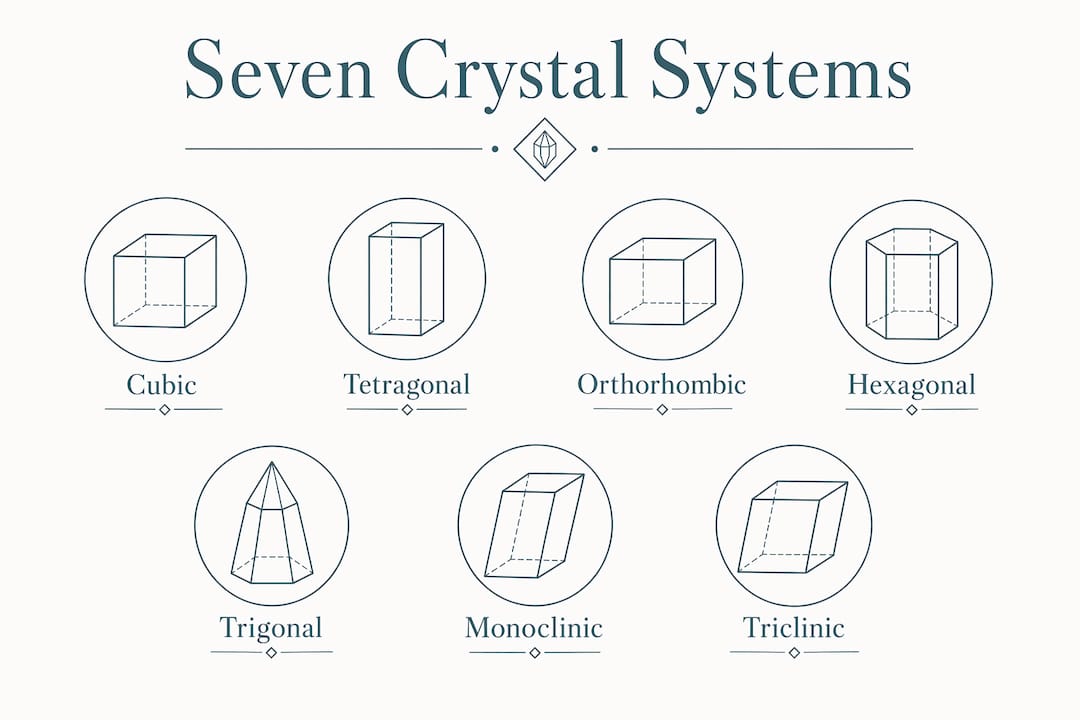
Crystals form different shapes because their internal atomic arrangement follows one of seven primary crystal systems, each defined by a unique set of axes and angles. These systems are: cubic, tetragonal, hexagonal, trigonal, orthorhombic, monoclinic, and triclinic. Each system produces a characteristic geometric symmetry that shows up in the crystal’s external faces, edges, and angles.
Crystal symmetry governs not only external shape but also internal physical attributes including cleavage patterns and optical properties. That means the crystal system a mineral belongs to tells you far more than just what it looks like. It predicts how it breaks, how it transmits light, and how hard it is.
The table below outlines each system with its key properties and a mineral example.
| Crystal system | Axis properties | Symmetry | Example mineral |
|---|---|---|---|
| Cubic | Three equal axes, all at 90° | Highest symmetry | Pyrite, halite |
| Tetragonal | Two equal axes, one different, all at 90° | Four-fold rotation | Zircon, wulfenite |
| Hexagonal | Four axes, three equal at 60°, one vertical | Six-fold rotation | Beryl, apatite |
| Trigonal | Three equal axes at equal angles | Three-fold rotation | Quartz, calcite |
| Orthorhombic | Three unequal axes, all at 90° | Three two-fold axes | Topaz, olivine |
| Monoclinic | Three unequal axes, one oblique angle | One two-fold axis | Gypsum, orthoclase |
| Triclinic | Three unequal axes, no right angles | Lowest symmetry | Kyanite, turquoise |
Understanding crystal systems is practical knowledge for hobbyists, not just academic theory. It explains physical properties beyond shape, including hardness and cleavage, which directly affect how you handle, display, and identify specimens.
Pro Tip: When you pick up an unfamiliar mineral, count its visible flat faces and note their angles. That geometry is your first clue to its crystal system.
Which environmental factors shape a crystal’s external habit?
The internal crystal system sets the rules, but the environment decides how closely those rules are followed. At least five major environmental factors influence the actual habit a crystal develops: available space, temperature, pressure, growth speed, and the presence of trace impurities. Each one can push the final shape away from the textbook ideal.
Most natural crystals are malformed compared to their theoretical form. Habit results from competition between the internal atomic blueprint and the chaotic conditions of real growth environments. A crystal growing freely in an open cavity develops sharp, well-defined faces. The same mineral squeezed between rock layers produces a flattened, irregular mass.
The key environmental influences on crystal habit are:
- Available space. Crystals growing in open vugs or cavities develop full, geometric faces. Crystals growing in tight matrix produce anhedral (shapeless) masses.
- Temperature. High temperatures generally accelerate growth and can favour certain face orientations over others, shifting the habit.
- Pressure. Elevated pressure during formation compresses growth and can flatten or elongate a crystal along specific axes.
- Growth speed. Slow growth produces well-formed, euhedral crystals with sharp faces. Rapid growth creates subhedral or anhedral forms with rounded or incomplete faces.
- Chemical impurities. Trace elements in the growth solution can bond preferentially to certain crystal faces, blocking their development and altering the overall shape.
Mineralogists use three terms to describe how well a crystal’s external form matches its internal symmetry. Euhedral crystals show all expected faces clearly. Subhedral crystals show some faces but not all. Anhedral crystals show no recognisable geometric faces at all.
Pro Tip: Euhedral specimens are rarer and generally more valued by collectors precisely because they require ideal growth conditions. When you see a perfectly terminated quartz point, you are looking at a crystal that had both the right chemistry and the right space to grow without interruption.
How do thermodynamics and surface energy drive crystal shape?
Thermodynamics explains why crystals settle into specific shapes rather than growing as spheres or random blobs. Crystals minimise their total surface free energy during formation, and the equilibrium shape is the one that achieves the lowest possible energy state. This is the same principle that causes soap bubbles to form spheres, but crystals cannot do that because their surface energy is not equal in all directions.
Crystal surface energy is anisotropic, meaning it varies depending on which face of the crystal you measure. Some faces have lower surface energy and grow more slowly. Those slow-growing faces become the largest and most prominent faces on the finished crystal. Fast-growing faces shrink and may disappear entirely. The result is a non-spherical shape that reflects the internal atomic arrangement.
| Growth condition | Energy state | Resulting shape |
|---|---|---|
| Slow, low supersaturation | Near equilibrium | Euhedral, flat-faced crystal |
| Moderate supersaturation | Slightly unstable | Subhedral, rounded faces |
| High supersaturation | Far from equilibrium | Dendritic or skeletal branching |
Dendritic crystal growth occurs under diffusion-controlled, rapid growth conditions. Minor anisotropy at crystal edges becomes amplified under high supersaturation, causing corners and edges to grow faster than flat faces. The result is the branching, snowflake-like patterns seen in native silver and some manganese oxide minerals. These shapes are not intrinsic to the mineral. They are a product of growth kinetics, not crystal system.
What explains shape variation within the same mineral species?
The same mineral can produce completely different external habits depending on where it forms. Local growth conditions override generic crystal system tendencies, which is why sapphires from Montana form stout, tabular habits while corundum from other localities grows in elongate, barrel-shaped crystals. Both are the same mineral, the same crystal system, and the same chemistry. The difference is entirely environmental.
This variation matters for collectors and students for several reasons:
- Locality identification. Experienced collectors can often identify a specimen’s origin from its habit alone, before any chemical testing.
- Variety distinction. Habit identification aids mineral classification and can distinguish varieties that chemical composition alone might not separate.
- Value assessment. Unusual habits from specific localities often carry premium value in the collector market. A crystal specimen’s shape directly affects how it is classified and priced.
- Growth story. Each habit variation tells you something specific about the temperature, chemistry, and space available when that crystal formed.
Quartz is the clearest example of this diversity. It grows as long prismatic points under typical hydrothermal conditions, as flat tabular crystals under certain pressure regimes, and as massive microcrystalline aggregates (chalcedony) when growth is rapid and space is minimal. The internal trigonal symmetry is identical in all three cases.
How to identify and describe crystal shapes and habits
Recognising crystal habit is a practical skill that aids mineral identification beyond what chemistry alone can reveal. The first step is learning the standard habit vocabulary used in mineralogy.
Common crystal habits and what they look like:
- Prismatic. Long, column-like crystals with parallel faces running the length of the crystal. Tourmaline and beryl are classic examples.
- Tabular. Flat, tablet-shaped crystals where one dimension is much shorter than the other two. Wulfenite often shows this form.
- Acicular. Needle-like, very thin and elongated. Natrolite and some rutile crystals grow this way.
- Bladed. Flat and elongated like a knife blade. Kyanite is a well-known bladed mineral.
- Dendritic. Branching, tree-like patterns. Native silver and pyrolusite commonly show dendritic habits.
- Massive. No visible crystal faces; the mineral fills space without geometric form. Turquoise often occurs this way.
- Botryoidal. Rounded, grape-like clusters formed by radial crystal growth. Malachite and hematite frequently show this habit.
When you examine a specimen, start by noting the dominant shape: is it elongated, flat, or equant (equal in all directions)? Then look at the faces. Are they flat and shiny (indicating slow, controlled growth) or curved and rough (indicating faster or interrupted growth)? Crystal morphology connects these observations to the underlying atomic structure.
Growth irregularities are also informative. Phantoms inside quartz crystals record pauses in growth. Etch pits on feldspar faces show where the crystal partially dissolved before re-growing. These features are not flaws. They are a record of the crystal’s history.
Pro Tip: Carry a hand lens (10x loupe) when examining specimens. Many habit features, including striations on pyrite faces and termination details on quartz, are only visible at magnification and are key to accurate identification.
Specimens that show crystal shape diversity
Legacy Crystals and Minerals carries specimens that illustrate the full range of crystal habits discussed here. From cubic pyrite clusters to hexagonal amethyst points, each piece in the collection reflects a specific combination of crystal system and growth environment.

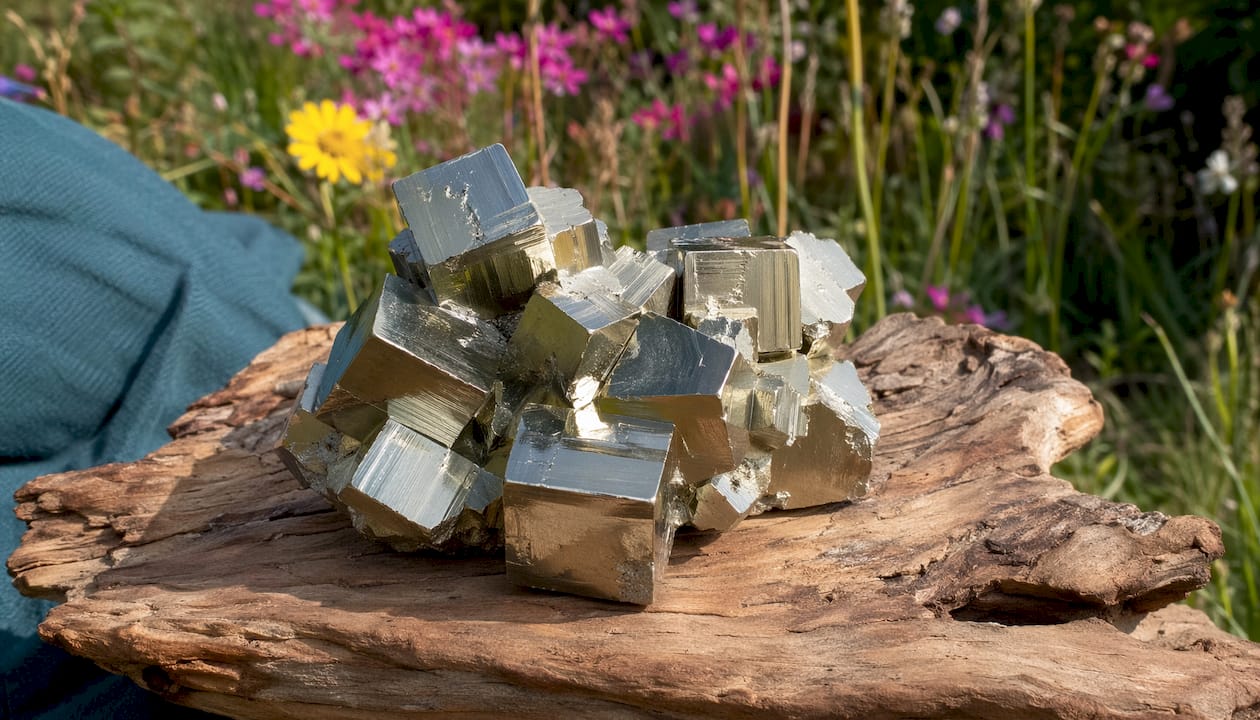
A pyrite cluster from Brazil shows the cubic system at its most geometric: flat, mirror-bright faces meeting at precise right angles. For something that shows environmental influence on habit, the UV-reactive hematite and quartz specimen from Fujian demonstrates how multiple minerals with different crystal systems can co-exist in one growth environment, each expressing its own habit. Legacy Crystals and Minerals also offers polished and carved pieces, including the Coral Jade Bracelet, where the natural crystal structure of jade is preserved in a refined, wearable form.
Key takeaways
Crystal shape is determined by two forces: the internal atomic lattice (crystal system) and the external growth environment (temperature, pressure, space, and impurities).
| Point | Details |
|---|---|
| Seven crystal systems | Every mineral belongs to one of seven systems, each producing a characteristic geometric symmetry. |
| Habit vs. ideal form | Most natural crystals deviate from their ideal shape due to real-world growth constraints. |
| Thermodynamics drives shape | Crystals minimise surface free energy, producing flat-faced forms under slow growth and dendritic forms under rapid growth. |
| Same mineral, different habits | Local conditions override crystal system tendencies, so the same mineral can look very different by locality. |
| Habit aids identification | Recognising crystal habit helps distinguish mineral varieties that share similar chemistry. |
FAQ
What is a crystal habit?
Crystal habit is the characteristic external shape a mineral tends to display, determined by both its internal atomic structure and the conditions present during growth. It is the standard term mineralogists use to describe and classify crystal shapes.
Why do crystals form different shapes if they share the same chemistry?
Local growth conditions, including temperature, pressure, available space, and impurities, override the generic tendencies of the crystal system. Sapphires from Montana and elongate corundum from other localities share identical chemistry but display distinct habits because their growth environments differed.
What is the difference between euhedral, subhedral, and anhedral crystals?
Euhedral crystals display all expected geometric faces clearly. Subhedral crystals show only some faces. Anhedral crystals show no recognisable faces at all, typically because growth space was restricted.
Why do some crystals grow in branching, dendritic patterns?
Dendritic growth occurs under high supersaturation and rapid growth conditions. Crystal edges and corners grow faster than flat faces, producing branching shapes. This is a product of growth kinetics, not the mineral’s crystal system.
How does knowing crystal shape help with mineral identification?
Habit identification is a diagnostic tool that can distinguish mineral varieties with similar chemical compositions. Combined with colour, lustre, and cleavage, habit narrows identification quickly and accurately.
Recommended
- What is crystal morphology: a complete scientific guide – Legacy Crystals and Minerals
- Crystal Growth Explained — From Molecule to Masterpiece – Legacy Crystals and Minerals
- How Crystals Form: Inside the Earth’s Natural Artistry – Legacy Crystals and Minerals
- Understanding Crystal Systems: Cubic, Hexagonal & More – Legacy Crystals and Minerals


