

Signification de l'améthyste : symbolisme, vertus et comment la choisir
L'améthyste symbolise la clarté, la sobriété et la perspicacité spirituelle. C'est la variété de quartz la plus précieuse, associée depuis des siècles à la protection, au calme et à une intuition accrue. En tant que pierre de naissance traditionnelle de février, elle occupe une place dans les registres gemmologiques et les pratiques spirituelles du monde entier.
Faits en bref :
- Formule chimique : SiO2 (dioxyde de silicium) ; quartz violet
- Dureté Mohs : 7
- Cause de la couleur : impuretés de fer combinées à l'irradiation gamma naturelle
- Principaux pays sources : Brésil, Uruguay, Madagascar, Zambie
- Traitement courant à surveiller : le traitement thermique convertit l'améthyste en pierre de couleur citrine
- Pierre de naissance : février
Points clés à retenir
La signification de l'améthyste repose sur une base de science géologique documentée, des siècles de symbolisme culturel et une utilisation active dans la pratique spirituelle contemporaine.
| Point | Détails |
|---|---|
| Signification symbolique principale | L'améthyste représente la clarté, la sobriété, la protection et la perspicacité spirituelle à travers les cultures. |
| Faits gemmologiques | Quartz violet (SiO2), dureté Mohs 7, couleur due au fer et à l'irradiation naturelle, densité spécifique ~2,65. |
| Conseil d'achat | Demandez la localité, la divulgation du traitement et les documents de provenance ; la zonification de couleur signale une origine naturelle. |
| Essentiels d'entretien | Évitez une exposition prolongée au soleil, rangez loin des pierres plus dures, nettoyez avec du savon doux et de l'eau froide. |
| Legacy Crystals and Minerals | Propose des spécimens et des bijoux en améthyste naturelle avec une provenance claire, des grappes aux bracelets portables. |
Table des matières
- Qu'est-ce que l'améthyste, et d'où vient-elle ?
- Comment l'histoire et la mythologie ont façonné le symbolisme de l'améthyste
- Que veulent dire les gens lorsqu'ils interrogent sur la signification spirituelle de l'améthyste ?
- Comment utiliser et entretenir l'améthyste
- Comment choisir une améthyste authentique au Canada
- L'améthyste a-t-elle une signification dans les cultures autochtones canadiennes ?
- Comment l'améthyste se forme-t-elle et combien de temps cela prend-il ?
- Améthyste naturelle vs. synthétique : valeur et différences pratiques
- L'améthyste chez Legacy Crystals and Minerals
- Sources
- FAQ
Qu'est-ce que l'améthyste, et d'où vient-elle ?
L'améthyste est une variété violette de quartz de formule chimique SiO2. Sa couleur varie du lilas pâle au violet foncé, déterminée par la concentration d'impuretés de fer et le degré d'irradiation gamma naturelle que le cristal a absorbé pendant sa formation. Le résultat est un éclat vitreux et une densité spécifique d'environ 2,65.
| Propriété | Valeur |
|---|---|
| Formule chimique | SiO2 |
| Dureté Mohs | 7 |
| Densité spécifique | ~2,65 |
| Éclat | Vitré |
| Cause de la couleur | Fer + irradiation naturelle |
L'améthyste se forme principalement dans les cavités rocheuses volcaniques et sédimentaires, le plus souvent dans les géodes et les veines hydrothermales. Les plus grands gisements se trouvent au Brésil et en Uruguay, où des géodes massives peuvent atteindre plusieurs mètres de hauteur. Le matériau brésilien a tendance à produire des cristaux plus grands avec une saturation modérée ; l'améthyste uruguayenne est généralement plus foncée et plus compacte. Madagascar et la Zambie produisent des cristaux prisés pour leur couleur profonde et riche, souvent préférés par les collectionneurs recherchant des teintes violettes intenses.
Le Canada a sa propre histoire de l'améthyste. La mine d'améthyste Panorama près de Thunder Bay, en Ontario, est l'un des plus grands gisements d'améthyste en Amérique du Nord et a été un site commercial et touristique pendant des décennies. L'améthyste de l'Ontario apparaît souvent en grappes drusy avec une matrice caractéristique brun-rougeâtre.
Notes sur le traitement :
- Le chauffage de l'améthyste naturelle à environ 300–400°C la convertit en une pierre de couleur citrine ; c'est une pratique commerciale courante
- La citrine naturelle est beaucoup plus rare que le matériau traité thermiquement vendu comme citrine
- L'améthyste cultivée en laboratoire est chimiquement identique à l'améthyste naturelle mais manque d'inclusions géologiques et de valeur de provenance
- Une exposition prolongée au soleil peut faire pâlir la couleur de l'améthyste au fil du temps
Comment l'histoire et la mythologie ont façonné le symbolisme de l'améthyste
Le mot améthyste vient directement du grec ancien amethystos, qui signifie « non enivré ». Les Grecs et les Romains taillaient des récipients à boire en améthyste et la portaient comme amulette, croyant qu'elle prévenait l'ivresse et maintenait l'esprit clair. L'écrivain romain Pline l'Ancien a documenté ces croyances, et le médecin Asclépiade a fait référence à l'améthyste dans les premiers écrits médicaux.
La mythologie derrière la pierre implique Dionysos (Bacchus dans la tradition romaine), le dieu du vin. Un récit populaire décrit une jeune femme nommée Améthyste qui fut transformée en cristal pour la protéger de la colère de Dionysos ; le dieu, plein de remords, versa du vin sur la pierre, lui donnant sa couleur violette. L'histoire est une invention de la Renaissance plutôt qu'un texte classique, mais elle a cimenté le lien de la pierre avec la sobriété et la protection divine dans la culture européenne.
Principales étapes historiques :
- Antiquité classique : Utilisation grecque et romaine dans les amulettes, les coupes et les bagues à cachet
- Europe médiévale : Les évêques portaient des anneaux d'améthyste comme symbole de piété et d'autorité spirituelle ; elle était appelée la « pierre de l'évêque »
- Renaissance : L'améthyste était classée au même rang que le rubis et l'émeraude en valeur ; les collections royales européennes la mettaient en évidence
- XIXe siècle : De vastes gisements brésiliens et uruguayens ont inondé le marché, rendant l'améthyste largement accessible et la faisant passer d'une gemme royale rare à une pierre largement disponible
- Égypte ancienne : L'améthyste est apparue dans les bijoux funéraires et les scarabées sculptés
- Bouddhisme et hindouisme : Les perles d'améthyste apparaissent dans les malas de prière bouddhistes tibétains, associées au calme et à la clarté
Les découvertes brésiliennes du XIXe siècle ont marqué un tournant. Avant ces découvertes, l'améthyste atteignait des prix comparables à ceux du saphir. Par la suite, l'approvisionnement s'est considérablement accru, c'est pourquoi l'améthyste bénéficie aujourd'hui à la fois d'un prestige historique royal et d'une accessibilité quotidienne.
Que veulent dire les gens lorsqu'ils interrogent sur la signification spirituelle de l'améthyste ?
Les associations spirituelles les plus courantes pour l'améthyste se concentrent sur trois qualités : le calme, la clarté et la protection. Les traditions de guérison par les cristaux la décrivent comme une pierre qui apaise le bruit mental, soutient la conscience intuitive et crée un champ protecteur autour de l'utilisateur.
Associations métaphysiques courantes :
- Sobriété et clarté : Enracinées dans l'étymologie grecque ; utilisées pour soutenir la pensée claire et la libération des schémas compulsifs
- Intuition : Associée à une perception accrue et à une conscience psychique
- Équilibre émotionnel : Les praticiens l'utilisent pour soulager l'anxiété, le chagrin et le débordement émotionnel
- Protection : Placée aux points d'entrée d'une maison ou portée comme talisman contre l'énergie négative
- Soutien au sommeil : Placé sous un oreiller ou sur une table de chevet pour favoriser un sommeil réparateur
Cartographie des chakras : L'améthyste est le plus souvent liée au chakra du troisième œil (Ajna) et au chakra couronne (Sahasrara), tous deux associés à la perception, à la connexion spirituelle et à une conscience supérieure. Certains praticiens l'utilisent également avec le chakra du cœur pour le travail de guérison émotionnelle.
Selon les sources contemporaines de guérison par les cristaux, l'améthyste soutient la tranquillité, l'intuition et l'équilibre émotionnel, ce qui en fait l'une des pierres les plus largement utilisées en méditation et en travail énergétique.
Comment les praticiens l'utilisent :
- Tenir un morceau pendant la méditation pour approfondir la concentration
- Placer une grappe dans une chambre pour un soutien au sommeil
- La porter en bijoux pour un contact énergétique continu
- L'arranger en grille protectrice autour d'un espace de vie
Conseil de pro : Tenez un morceau d'améthyste dans votre main non dominante pendant deux à trois minutes dans un espace calme. Remarquez si vous ressentez un changement dans votre rythme mental ou votre tension corporelle. Cette vérification simple vous aide à évaluer si une pierre particulière résonne avant l'achat.
Note : Toutes les allégations de guérison et métaphysiques ci-dessus font partie de la tradition spirituelle et populaire. Elles ne sont pas des conseils médicaux et ne doivent pas remplacer les soins de santé professionnels.
Comment utiliser et entretenir l'améthyste
L'améthyste est l'un des cristaux les plus pratiques à utiliser. Sa dureté de 7 la rend résistante aux rayures quotidiennes, et sa grande disponibilité la rend accessible sous de nombreuses formes.
Utilisations courantes :
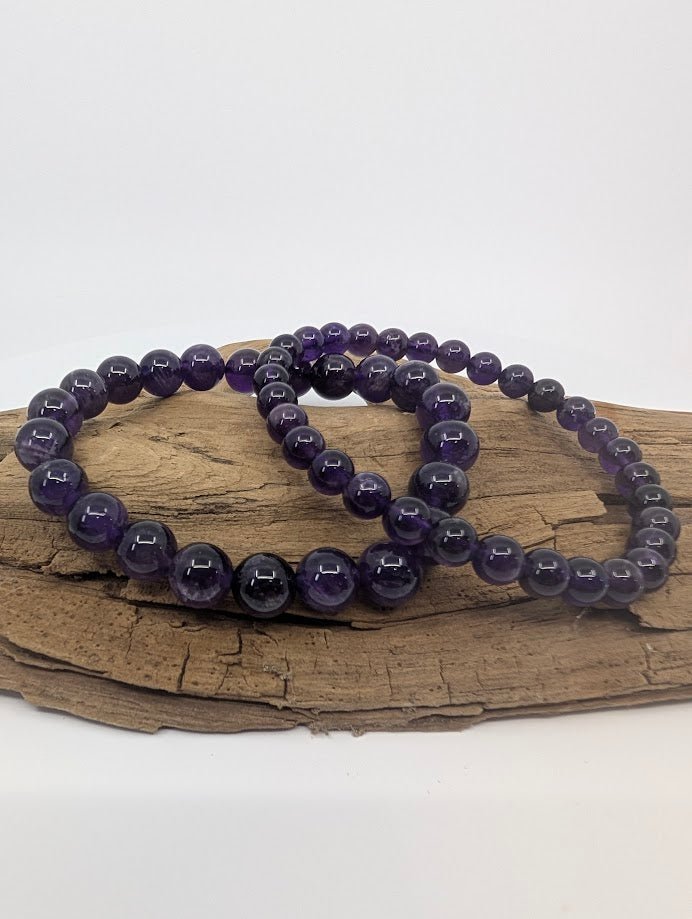
- Bijoux : Portée en bagues, pendentifs ou bracelets pour un contact continu ; un bracelet en améthyste violet foncé avec des perles de 6 mm ou 8 mm est une option populaire et portable
- Pierre de méditation : Tenue en main ou placée sur le front pendant la pratique
- Grappe décorative : Une grappe d'améthyste brésilienne placée sur un bureau ou une étagère à des fins décoratives et énergétiques
- Placement Feng Shui : Positionnée dans le coin de la richesse (loin à gauche de l'entrée) ou le coin du savoir d'une pièce
- Soutien au sommeil : Un petit morceau roulé ou une grappe placée près du lit
Étapes de nettoyage et de rechargement :
- Rincer sous l'eau courante froide pendant 30 secondes (l'améthyste est résistante à l'eau avec une dureté de 7)
- Placer au clair de lune toute la nuit, particulièrement pendant la pleine lune, pour recharger
- Purifier avec de la sauge ou de la fumée de palo santo si désiré
- Définir une intention en tenant la pierre et en énonçant un but clair
Liste de contrôle d'entretien :
- Nettoyer avec un savon doux et de l'eau tiède ; éviter les nettoyeurs à ultrasons pour les spécimens inclus
- Stocker à l'abri de la lumière directe du soleil pour éviter la décoloration
- Garder séparé des pierres plus dures (diamant, corindon) qui peuvent rayer la surface
- Éviter les produits chimiques ménagers, l'eau de Javel et les trempages dans l'eau salée
Note de sécurité : Ne pas ingérer de cristaux ni fabriquer d'élixirs de cristaux en plaçant des pierres directement dans l'eau potable. Si vous fabriquez un élixir de gemmes, utilisez la méthode indirecte (pierre dans un récipient scellé placé à l'intérieur du récipient d'eau). L'améthyste qui a été traitée thermiquement peut se comporter différemment dans les applications sensibles à la couleur ; confirmez toujours l'état du traitement auprès de votre vendeur.
Comment choisir une améthyste authentique au Canada
Acheter de l'améthyste au Canada signifie naviguer dans un mélange de spécimens naturels, de pierres traitées thermiquement et de matériaux cultivés en laboratoire. Savoir quoi demander et quoi rechercher protège à la fois votre investissement et votre utilisation prévue.
Questions à poser à tout vendeur :
- Cette pierre est-elle naturelle, traitée thermiquement ou cultivée en laboratoire ?
- Quel est le pays et la région d'origine ?
- Une amélioration de la couleur a-t-elle été appliquée au-delà de la taille et du polissage ?
- Quelle est la politique de retour si la pierre ne correspond pas à la description ?
- Un certificat d'authenticité ou des documents de provenance sont-ils disponibles ?
Identification de l'améthyste naturelle, traitée ou cultivée en laboratoire :
- Améthyste naturelle : Présente une zonification de couleur inégale, des inclusions naturelles (fantômes, aiguilles de rutile, inclusions fluides) et une variation de saturation à travers le cristal ; la zonification de couleur et les inclusions sont des signaux positifs d'authenticité
- Traitée thermiquement (en citrine) : Couleur jaune à orange ; les vendeurs doivent le divulguer ; la citrine naturelle est rare et généralement jaune pâle à fumée
- Améthyste cultivée en laboratoire : Chimiquement identique à la naturelle ; manque d'inclusions et de provenance ; la couleur est souvent anormalement uniforme et constante
Conseils de provenance :
- Matériau brésilien : grandes géodes, violet modéré à profond, largement disponible ; voir améthyste avec calcite du Brésil pour un exemple typique
- Matériau uruguayen : grappes plus foncées et plus compactes, saturation plus élevée
- Matériau zambien et malgache : couleur profonde, souvent préféré pour les pierres de qualité joaillerie
- Ontario (Thunder Bay) : matrice rougeâtre, grappes drusy, forte provenance locale
Liste de contrôle d'approvisionnement éthique :
- Le vendeur fournit des informations claires sur la localité (pays, région, mine si possible)
- Les photos montrent le spécimen réel, pas des images d'archives
- La divulgation du traitement est explicite, non masquée dans les petits caractères
- Les vendeurs canadiens réputés offriront une fenêtre de retour et répondront directement aux questions de provenance
Notes d'experts : gemmologie et provenance
Les informations gemmologiques crédibles sur l'améthyste proviennent d'une courte liste de sources primaires. L'aperçu de l'améthyste du GIA couvre l'histoire du marché, la classification des couleurs et les normes de divulgation des traitements. Mindat.org fournit des détails sur les données minérales, y compris les styles de formation, le pléochroïsme et les différences liées à la localité. Les deux sont les références standard pour les collectionneurs et les revendeurs.
Les spécimens de qualité musée comportent un niveau de documentation que les listes de vente au détail standard ne contiennent généralement pas. Une pièce de qualité musée comprendra :
- Localité précise (pays, région, mine ou formation géologique)
- Dimensions et poids
- Minéraux associés présents dans le spécimen
- Contexte géologique (type de formation, roche hôte)
Une liste de vente au détail standard peut ne mentionner que « Brésil » ou « améthyste naturelle » sans plus de détails. Cet écart est important pour les collectionneurs et les utilisateurs métaphysiques. Un spécimen de sceptre violet foncé des montagnes Goboboseb, Namibie avec de l'analcime associée est un exemple clair du détail de provenance que les acheteurs sérieux devraient attendre : localité nommée, minéral associé, type de formation et taille précise, tous documentés.
Ce qu'une solide documentation de provenance comprend :
- Mine nommée ou région géologique, pas seulement le pays
- Minéraux associés (par exemple, analcime, calcite, quartz)
- Habitus de formation (sceptre, grappe, géode, drusy)
- Dimensions et poids du spécimen
L'améthyste a-t-elle une signification dans les cultures autochtones canadiennes ?
L'améthyste est présente physiquement au Canada, notamment dans le nord-ouest de l'Ontario, près de Thunder Bay, où l'un des plus grands gisements d'Amérique du Nord est exploité commercialement depuis les années 1950. L'améthyste de l'Ontario est la pierre précieuse minérale officielle de la province.
Les liens spécifiques documentés entre l'améthyste et les traditions spirituelles ou cérémonielles des peuples autochtones canadiens ne sont pas largement publiés dans des sources accessibles, et attribuer des significations sans sources communautaires vérifiées serait inexact. Ce qui est documenté, c'est que de nombreuses traditions des Premières Nations et des Métis accordent une profonde signification à la terre et à ses minéraux en tant que parties vivantes du monde naturel, les pierres étant considérées comme ayant leur propre énergie et leur propre relation au lieu.
Pour obtenir des informations précises sur la manière dont des nations spécifiques comprennent les minéraux et leur signification, la consultation directe avec les gardiens du savoir communautaire ou les ressources culturelles propres à chaque nation est la voie appropriée. La région de Thunder Bay, qui abrite les communautés Anishinaabe et d'autres Premières Nations, est le contexte régional le plus pertinent pour l'améthyste de l'Ontario.
Comment l'améthyste se forme-t-elle et combien de temps cela prend-il ?
La formation de l'améthyste est un processus géologique lent qui se mesure en millions d'années. La séquence suit un schéma clair :
- Activité volcanique : Les coulées de lave créent des cavités (vésicules) lorsque des bulles de gaz sont piégées pendant le refroidissement.
- Mouvement de fluides hydrothermaux : Des eaux souterraines riches en silice, transportant du fer dissous, s'infiltrent dans ces cavités pendant des millions d'années.
- Nucléation des cristaux : La silice commence à cristalliser sur les parois des cavités, formant la couche de base d'une géode.
- Développement de la couleur : Les ions de fer sont incorporés dans le réseau de quartz en croissance ; les radiations gamma naturelles provenant de la roche environnante altèrent ensuite ces centres de fer, produisant la couleur violette.
- Croissance continue : Les cristaux croissent vers l'intérieur, couche par couche, sur des échelles de temps allant de dizaines de millions à des centaines de millions d'années selon les conditions géologiques.
- Érosion et découverte : L'altération expose finalement les géodes à la surface ou près de celle-ci, où elles sont trouvées et exploitées.
La nuance spécifique de violet dépend de la concentration en fer, de la dose de radiation et de la température pendant la formation. Des températures plus élevées pendant la croissance peuvent en fait réduire l'intensité de la couleur, c'est pourquoi un traitement thermique ultérieur inverse ou modifie entièrement la couleur. Les géodes brésiliennes se sont formées dans des coulées de basalte de la province volcanique du Paraná, l'un des plus grands systèmes de basalte de plateau de la Terre, ce qui explique l'échelle énorme des dépôts là-bas.
Améthyste naturelle vs synthétique : valeur et différences pratiques
La distinction entre l'améthyste naturelle et synthétique est importante différemment selon la raison de votre achat.
L'améthyste naturelle se forme sur des échelles de temps géologiques et possède une provenance, des inclusions et un caractère lié à sa localité. Les collectionneurs et les utilisateurs métaphysiques la préfèrent grandement. Le zonage de couleur, les inclusions fantômes et les légères irrégularités de surface sont des caractéristiques, non des défauts. Une tour en grappe d'améthyste naturelle avec des couches de croissance visibles raconte une histoire géologique qu'une pierre synthétique ne peut reproduire.
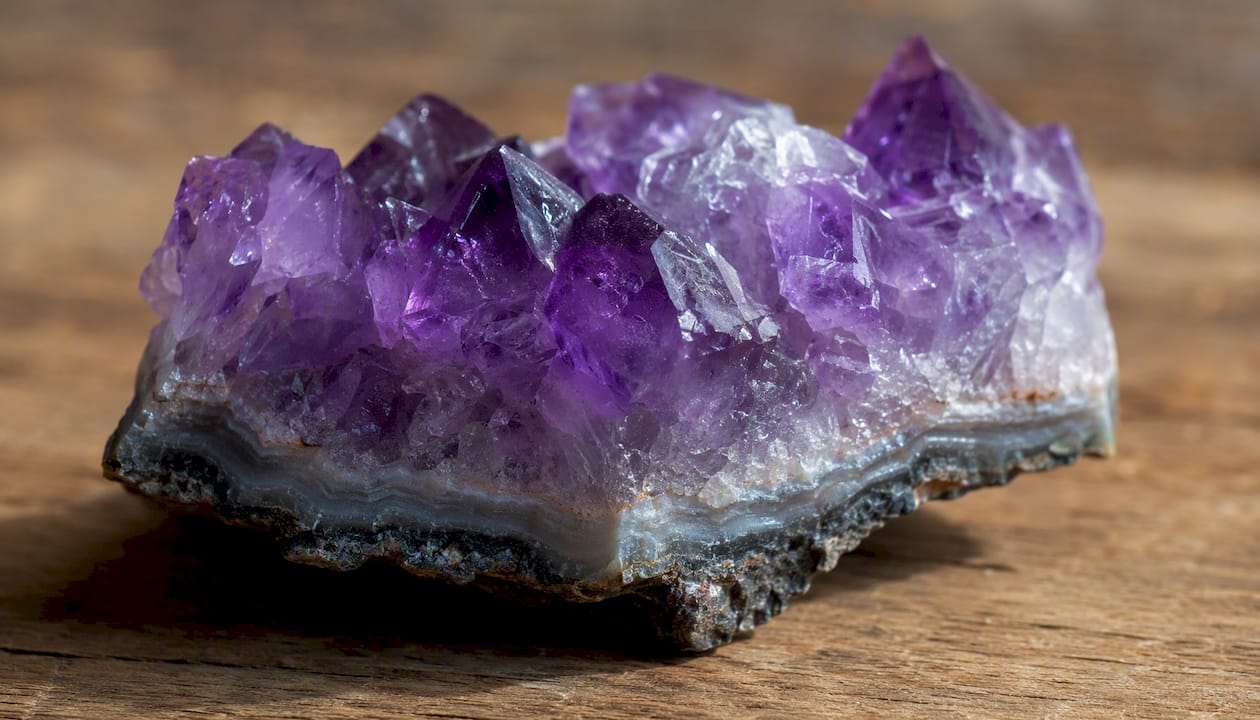
L'améthyste synthétique (cultivée en laboratoire) est produite à l'aide de méthodes hydrothermales qui imitent les conditions naturelles mais compressent le délai à quelques semaines. Le résultat est chimiquement et optiquement identique à l'améthyste naturelle. Elle est principalement utilisée en joaillerie commerciale où la couleur constante et le faible coût importent plus que la provenance. Pour les collectionneurs et les praticiens spirituels, elle présente peu d'attrait précisément parce qu'elle manque d'histoire géologique.
Principales différences pratiques :
- Améthyste naturelle : zonage de couleur variable, inclusions présentes, caractère spécifique à la localité, valeur de collection plus élevée.
- Améthyste synthétique : couleur uniforme, sans inclusions, pas de provenance, coût inférieur, adaptée aux bijoux de masse.
- Améthyste traitée thermiquement (vendue comme citrine) : couleur altérée de manière permanente ; les vendeurs doivent le divulguer ; valorisée différemment de l'améthyste naturelle et de la citrine naturelle.
Pour un usage métaphysique, la plupart des praticiens spécifient un matériau naturel non traité. Le raisonnement est que l'histoire géologique et le caractère énergétique de la pierre sont considérés comme faisant partie de sa valeur. Un bracelet en améthyste lavande fabriqué à partir de pierres roulées naturelles a un attrait différent de celui fait à partir de perles cultivées en laboratoire, même si la couleur semble similaire.
L'améthyste chez Legacy Crystals and Minerals
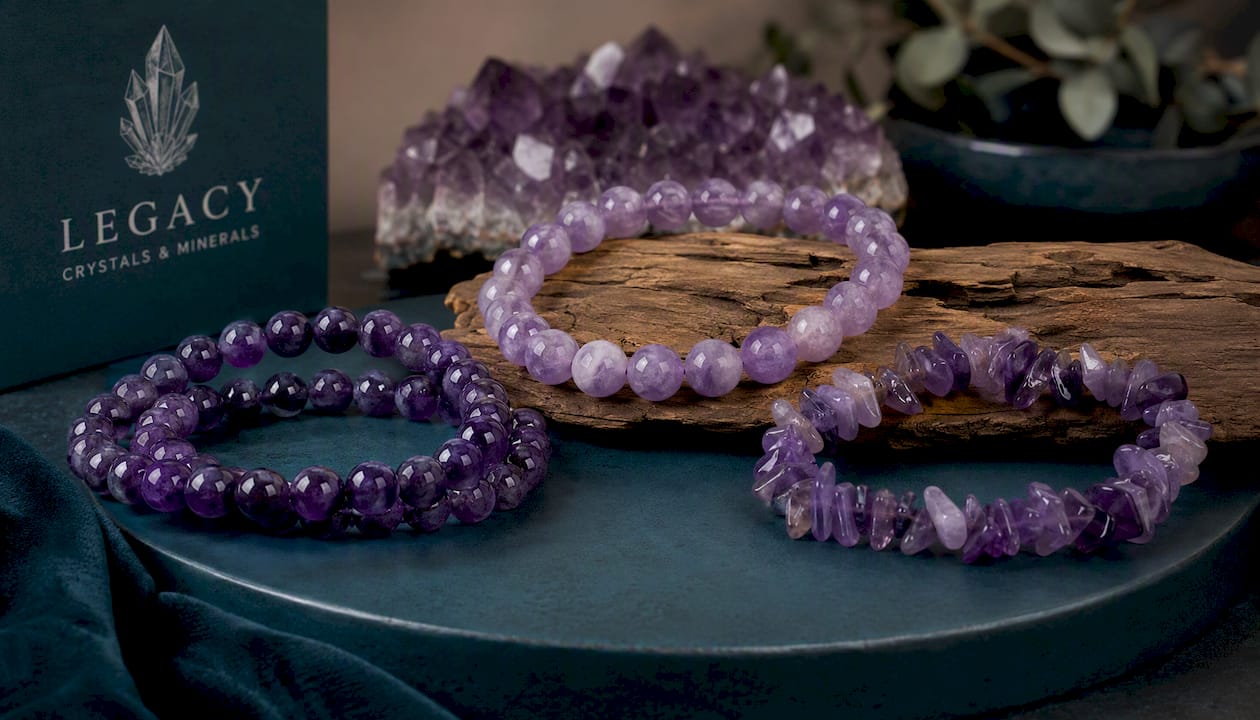
Legacy Crystals and Minerals propose de l'améthyste naturelle sous les formats couverts par cet article : grappes brutes avec provenance brésilienne documentée, micro-spécimens avec métadonnées complètes de la localité, et pièces à porter fabriquées à partir de pierres roulées naturelles. Le bracelet en améthyste violet foncé en perles de 6 mm et 8 mm, le bracelet en améthyste lavande en quatre options de taille, et le bracelet en éclats d'améthyste fabriqué à partir de pierre brésilienne roulée naturelle représentent chacun une gamme de couleurs et un niveau de prix différents. Les listes de spécimens incluent la localité, les minéraux associés et le type de formation, les détails de provenance que cet article identifie comme la norme que les acheteurs sérieux devraient attendre. Parcourez la collection complète d'améthystes chez Legacy Crystals and Minerals pour trouver une pièce qui correspond à votre usage prévu, que ce soit pour l'exposition, la méditation ou le port quotidien.
Sources
- Pierre de naissance de février | GIA
- Mindat
- Améthyste - Wikipédia
- Améthyste : Signification, propriétés et aperçu | CrystalDatabase
FAQ
Quelle est la signification spirituelle de l'améthyste ?
L'améthyste est associée à la clarté, à la sobriété, à l'intuition et à la protection dans les traditions spirituelles et métaphysiques. Les praticiens la lient aux chakras du troisième œil et de la couronne, l'utilisant pour la méditation, le soutien au sommeil et le travail d'équilibre émotionnel.
À quoi sert l'améthyste ?
L'améthyste est utilisée pour la méditation, la réduction du stress, le soutien au sommeil et comme talisman protecteur dans la pratique de la lithothérapie. Sa dureté de 7 sur l'échelle de Mohs la rend également suffisamment durable pour être portée quotidiennement en bijou.
Quelle est la signification de porter de l'améthyste ?
Porter de l'améthyste est traditionnellement associé au maintien de la clarté mentale, du calme émotionnel et à la protection contre les énergies négatives. La croyance grecque selon laquelle elle prévenait l'ivresse est la racine historique de ces associations.
Contre quoi l'améthyste protège-t-elle ?
Dans la tradition métaphysique, l'améthyste est censée protéger contre les énergies négatives, les interférences psychiques et la surcharge émotionnelle. Ce sont des croyances populaires et spirituelles, non des affirmations médicalement vérifiées.
Recommandé
- Comment choisir des cristaux pour la guérison émotionnelle – Legacy Crystals and Minerals
- Améthyste avec Analcime – Montagnes Goboboseb, Namibie – Sceptre violet foncé – Micro spécimen (19mm) - Legacy Crystals and Minerals – Legacy Crystals and Minerals
- Cristaux pour l'alignement des chakras : votre guide 2026 – Legacy Crystals and Minerals


