
Chinese fluorites: collector's buying guide for Canada
Canadian collectors can reliably source Chinese fluorites through reputable online dealers with documented mine provenance, museum-grade listing platforms, and local mineral shows. The single most important check before buying: confirm the chain of custody (mine name, pocket if known) and request high-resolution photos alongside a UV fluorescence response. Without those two items, pass on the listing.
Quick buying checklist:
- Verify the exact mine and pocket designation (e.g., Yaogangxian Mine, Yizhang County, Hunan)
- Request measurements (cm) and weight (grams) in writing
- Confirm a clear return and refund policy before payment
- Ask for shipping insurance and a customs estimate for Canada
- Demand UV fluorescence photos or video, not just a text note
- Check that photos show multiple angles, including crystal edges and matrix contact
Legacy Crystals and Minerals lists Yaogangxian specimens with mine-level provenance, weight, and UV documentation — see the fluorite with pyrite listing as a reference point for what a well-documented entry looks like. Canadian buyers should budget 2–4 weeks for international shipping plus customs processing on top of the stated handling time.
Table of Contents
- What do the major Chinese fluorite localities actually produce?
- How do you grade and authenticate a Chinese fluorite specimen?
- How can Canadian collectors buy Chinese fluorites safely?
- What do Chinese fluorite specimens typically cost?
- How do you care for, display, and UV-test Chinese fluorite?
- What recent pocket finds should collectors know about?
- How do you verify provenance and spot red flags before paying?
- Key takeaways
- Useful sources for buying and verification
- Legacy Crystals and Minerals: documented Chinese fluorite for Canadian collectors
- FAQ
What do the major Chinese fluorite localities actually produce?
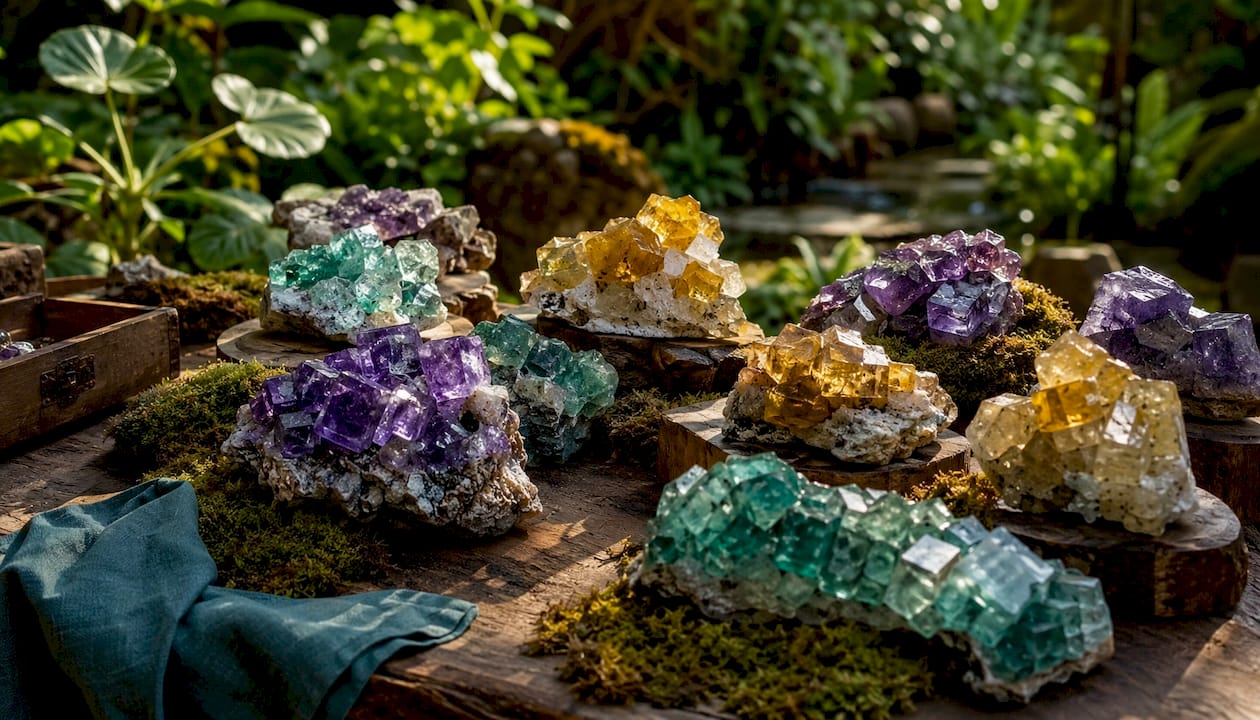
China is the most prolific producer of collector-grade fluorite globally, with significant deposits across Hunan, Zhejiang, Jiangxi, Inner Mongolia, and Fujian. Each locality has a recognisable signature.
| Locality | Typical colours | Crystal habit | Key accessory minerals | Museum-grade potential |
|---|---|---|---|---|
| Yaogangxian (YGX), Hunan | Purple, green, blue, multi-colour | Gemmy cubes, cubic clusters | Pyrite, quartz, chlorite | Very high |
| Xianghualing, Hunan | Yellow-green, pale purple | Cubic, sometimes massive | Calcite, wolframite | Moderate–high |
| Shangbao, Hunan | Green, purple | Cubic, octahedral | Calcite, quartz | Moderate |
| Huanggang, Inner Mongolia | Purple, colourless, blue | Cubic, coarse | Calcite, sphalerite | Moderate–high |
| Fujian Province | Green, purple, colourless | Cubic on quartz matrix | Quartz, chlorite, pyrite | Moderate |
| Beijing region | Yellow, pale green | Massive to cubic | Calcite | Decorative–moderate |
Yaogangxian (YGX), Hunan is the benchmark. Gemmy, multi-coloured cubes with pyrite are the locality’s calling card. Transparent purple-to-green zoning on a single crystal, sometimes with bright golden pyrite on the matrix, places YGX at the top of the Chinese fluorite hierarchy for collectors. UV response is typically vivid.
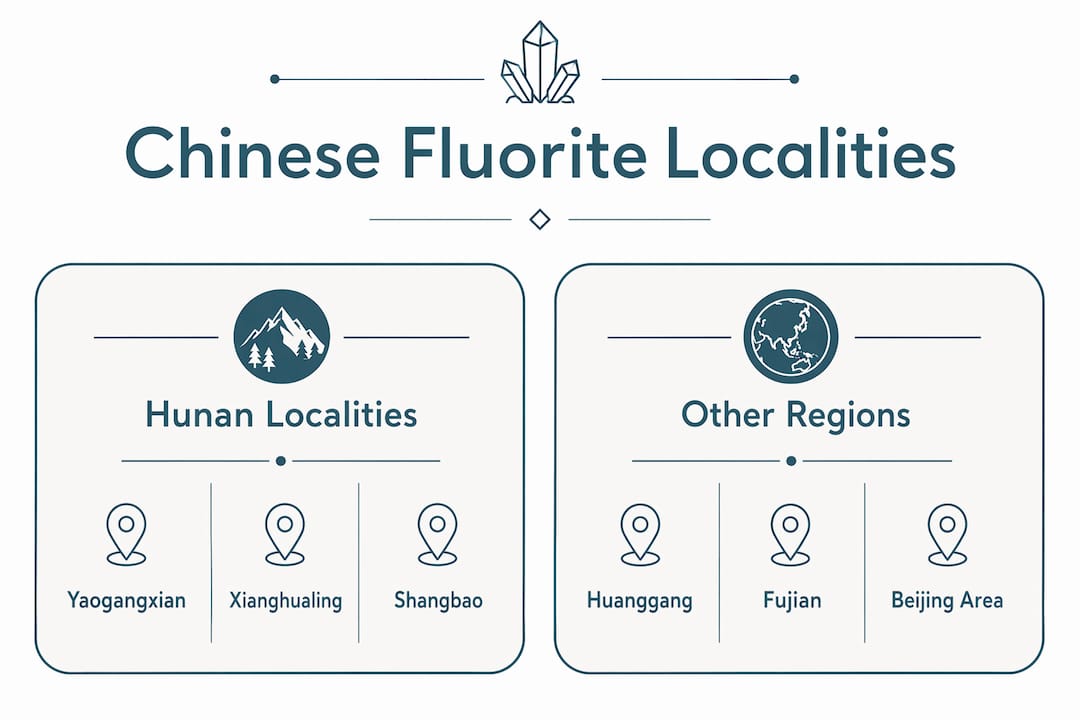
Xianghualing produces yellower-green material, often less gemmy than YGX but still collectible. Wolframite as an accessory mineral is a locality clue not seen at most other Chinese sites.
Shangbao is known for clean green and purple cubes on calcite, generally smaller than YGX pieces. Matrix contact is often clean and well-defined.
Huanggang, Inner Mongolia yields coarser purple and colourless cubic crystals, sometimes on sphalerite-bearing matrix. Recent pocket announcements from this region have attracted collector attention and provenance scrutiny.
Fujian produces green fluorite on quartz with chlorite inclusions — a distinct aesthetic. Legacy Crystals and Minerals carries a Fujian specimen that illustrates the characteristic chlorite-green colouration and quartz matrix association.
Beijing-region material tends toward yellow and pale green massive forms, better suited to display than serious collecting.
How do you grade and authenticate a Chinese fluorite specimen?
Grading comes down to six criteria applied in sequence. Work through them before committing to any purchase.
Grading checklist:
- Colour saturation and zoning: Deep, even saturation or sharp colour-zone boundaries add value. Pale or washed-out colour reduces it.
- Transparency and gemminess: Gem-clear crystals command premiums. Milky or cloudy interiors lower the grade.
- Crystal faces and edge sharpness: Clean, undamaged faces with sharp edges indicate undisturbed growth. Chipped edges or frosted faces signal handling damage or cleaving.
- Crystal habit: Cubes and octahedra are the most common forms. Curved fluorite (rare) and “open window” crystals carry a premium for their unusual geometry.
- Matrix presence and accessory minerals: Pyrite on YGX fluorite is a value driver. Calcite or quartz matrix is common; sphalerite or wolframite is locality-specific and adds interest.
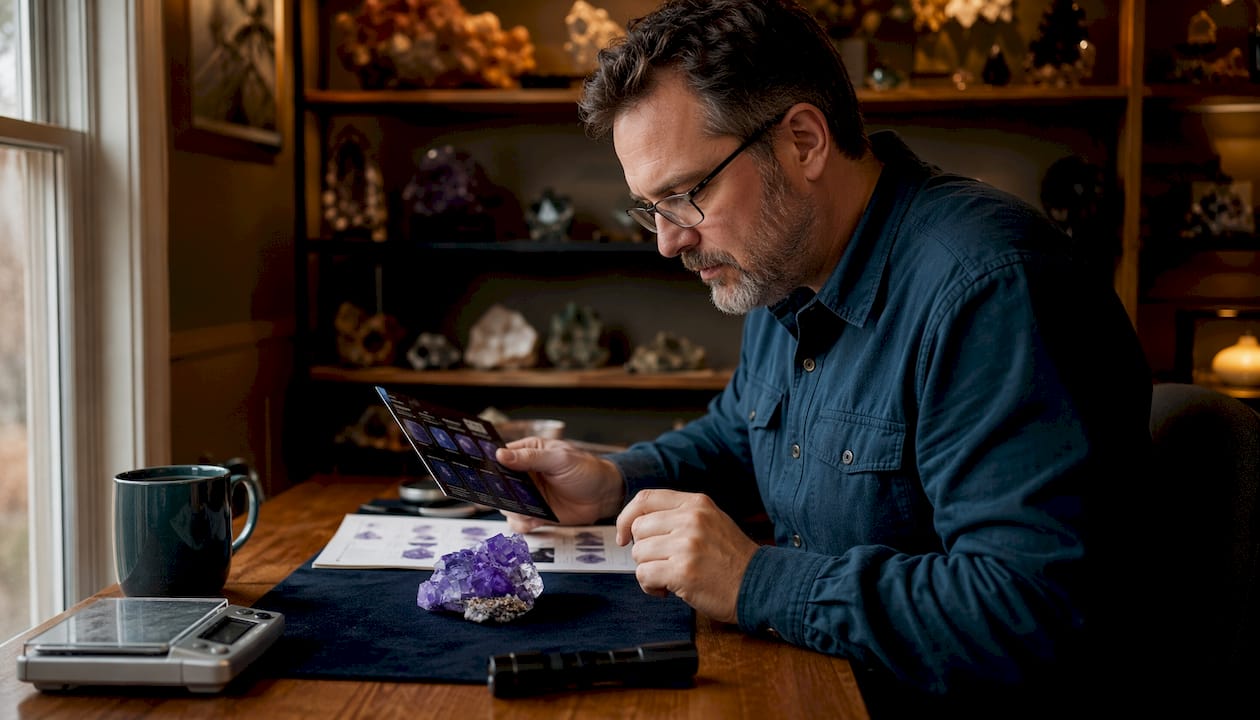
- UV fluorescence: Many Chinese fluorites show vivid blue or cream fluorescence under shortwave or longwave UV. Ask for a UV photo or video — a seller who cannot provide one for a high-value piece is a yellow flag.
Common manipulations and fakes to watch for
Dyeing is the most frequent manipulation. Artificially dyed specimens often show colour concentrated along fractures rather than distributed through the crystal lattice. Under magnification, dye pools at micro-cracks. Glued assemblies are the second concern: crystals glued onto a foreign matrix show inconsistent glue lines visible in raking-light photos. Surface coatings (lacquer or resin) create an unnatural sheen and can mask damage.
Quick photo checks: Ask for a raking-light photo (light from one side at a low angle) to reveal surface coatings or glue lines. A macro photo of crystal edges shows whether chipping has been filled or painted.
Pro Tip: When messaging a seller, paste this exact request: “Please send: (1) raking-light photo of the matrix contact, (2) UV photo under shortwave UV, (3) macro of at least one crystal edge, (4) weight in grams and longest dimension in cm.” Sellers with genuine specimens respond quickly. Sellers who deflect or offer only marketing photos are a red flag.
How can Canadian collectors buy Chinese fluorites safely?
Canadian buyers have several practical routes, each with different risk profiles.
Vendor types:
- Established online dealers with museum-grade listings and documented provenance (the safest route for high-value pieces)
- Specialised collector-dealers who source directly from Chinese mines (good provenance, variable return policies)
- Auction platforms (competitive pricing, but provenance documentation varies widely)
- Local mineral shows and club networks across Canada (hands-on evaluation, no shipping risk)
Canadian mineral clubs and gem-and-mineral shows — including events affiliated with the Gem and Mineral Federation of Canada — offer the advantage of in-person inspection. For Chinese fluorite specifically, show dealers often carry YGX and Fujian material.
Step-by-step safe buying process for Canadian buyers:
- Request provenance documentation (mine name, pocket, acquisition date) in writing before paying.
- Ask for UV fluorescence photos or video and macro photos of crystal edges.
- Confirm weight (grams) and all dimensions (cm) match the listing description.
- Verify the return and refund policy covers international buyers and specifies the return window.
- Request shipping insurance and ask the dealer to declare the correct customs value.
- Budget 2–4 weeks for transit plus Canadian Border Services Agency processing.
Shipping note: International mineral shipments to Canada typically clear customs within a few business days of arrival, but delays occur around holidays. Carriers such as FedEx International and DHL Express offer tracking and insurance options suited to fragile specimens. Always request fragile labelling and double-box packing.
Legacy Crystals and Minerals ships to Canadian buyers and presents provenance, weight, and UV data on its Yaogangxian listings — the fluorite with quartz page is a practical example of how accessory minerals and locality data are presented.
What do Chinese fluorite specimens typically cost?
Locality, size, transparency, colour, and documented provenance are the primary value drivers. A small, pale, undocumented piece and a gemmy, multi-coloured YGX cube with pyrite and UV photos can differ by an order of magnitude in price even at similar physical sizes.
| Grade category | Typical size | Typical price range (CAD) | Key value drivers |
|---|---|---|---|
| Small decorative | Under 5 cm | $10–$50 | Colour, basic locality label |
| Mid-range collector | 5–10 cm | $50–$250 | Gemminess, accessory minerals, mine name |
| High-end collector | 10–cm range | $250 and above | Documented pocket, UV response, sharp faces |
| Museum-grade | 20 cm+ or exceptional clarity | Above $1,000 | Full provenance, gem-clear, rare colour combo |
Primary value drivers:
- Locality and pocket: A named pocket at YGX adds more value than a generic “Hunan, China” label.
- Colour rarity: Purple-green combinations and vivid blue are more sought after than pale or common yellow-green.
- Gemminess: Gem-clear crystals with no internal cloudiness command the highest premiums.
- Accessory minerals: Golden pyrite on YGX fluorite is a consistent price driver.
- Documented provenance: Field photos, dealer acquisition records, and UV test documentation all add verifiable value.
For purchases above $500 CAD, consider requesting a third-party mineral identification report or a written statement of authenticity from the seller. Lab authentication is rarely necessary for mid-range pieces but adds meaningful protection at the high end.
How do you care for, display, and UV-test Chinese fluorite?
Fluorite sits at Mohs hardness 4, which makes it softer than most display surfaces and prone to scratching. Handle specimens with clean, dry hands or cotton gloves.
Cleaning and handling:
- Rinse with room-temperature water and a soft brush only
- Avoid ultrasonic cleaners — vibration fractures internal cleavage planes
- No harsh chemicals, acids, or bleach; fluorite is acid-sensitive
- Keep away from prolonged direct sunlight, which can fade colour in some specimens
- Store in a padded box or on a foam-lined shelf away from harder minerals
Display recommendations: Use acrylic or wooden display stands sized to the specimen’s base. Keep fluorite away from quartz or calcite specimens that could scratch it during handling. Moderate, indirect light shows colour zoning best without accelerating fading.
UV testing protocol:
- Work in a darkened room.
- Wear UV-blocking safety glasses — shortwave UV (254 nm) is harmful to eyes.
- Hold the UV lamp 5–10 cm from the specimen.
- Observe colour and intensity of fluorescence; photograph with a phone camera on manual settings (ISO 800–1600, no flash).
- Compare the response to the seller’s stated UV behaviour.
A mismatch between the seller’s UV claim and your test result is grounds for a return request. Dyed specimens sometimes fluoresce differently from natural colour zones — uneven or absent fluorescence in a supposedly natural colour zone warrants closer inspection.
Safety note: Before testing with any solvent or chemical, test an inconspicuous spot. Acetone can strip surface coatings but may also damage natural lustre on some specimens.
What recent pocket finds should collectors know about?
Two developments have shaped the Chinese fluorite market in the 2024–2026 period.
Purple-green combination pockets at Yaogangxian have drawn strong collector interest. Multi-coloured specimens showing distinct purple and green zones on a single crystal are among the most visually striking pieces from any Chinese locality. When new pockets of this type are announced, prices for comparable existing pieces typically rise in the short term, and provenance scrutiny on similar-looking listings increases.
The Huanggang purple-on-quartz controversy generated significant debate in collector communities. Announcements described purple fluorite crystals on what was labelled “candle quartz” from the Huanggang region of Inner Mongolia. The find prompted calls for lab verification and pocket documentation, with collectors on mineral forums requesting field photos and chain-of-custody records before accepting the locality claim at face value.
Market interest follows pocket announcements closely. A new find that generates social media attention can spike prices for similar-looking pieces within weeks. Collectors who understand the locality signatures described earlier are better positioned to evaluate whether a “new pocket” listing is consistent with the claimed origin.
How do you verify provenance and spot red flags before paying?
Provenance checklist:
- Mine name and province (e.g., Yaogangxian Mine, Yizhang County, Hunan)
- Pocket designation or extraction date if available
- Dealer acquisition history or chain of custody statement
- High-resolution photos from at least three angles, including matrix contact
- UV fluorescence photo or video
- Weight in grams and all dimensions in cm
- Written return and refund policy
For pieces above $500 CAD, a written statement of authenticity or a third-party mineral identification report adds meaningful protection. Established mineral identification services and gemological laboratories can confirm species and detect surface treatments.
Red flags:
- Vague locality (“China” with no province or mine)
- Photos that are low-resolution, heavily filtered, or show only one angle
- Seller refuses to provide measurements or weight
- UV response described only in text with no photo or video
- Payment by wire transfer only, with no refund option
- Listing photos that look inconsistent in lighting or background across the specimen
Pro Tip: Ask the seller directly: “Can you confirm the exact mine and pocket for this specimen, and provide a UV photo under shortwave UV?” A credible seller answers both within 24 hours. If the response is vague or the UV photo never arrives, treat it as a red flag.
Key takeaways
Chinese fluorites from documented localities like Yaogangxian command the highest collector value when listings include mine provenance, UV fluorescence records, and precise measurements.
| Point | Details |
|---|---|
| Provenance is the top priority | Always confirm mine name, pocket, and chain of custody before paying for any specimen. |
| UV and photo verification | Request UV fluorescence photos and raking-light images; mismatches with seller claims justify a return. |
| Price tracks locality and gemminess | Gem-clear YGX cubes with pyrite and documented provenance reach high-end prices above $1,000 CAD. |
| Canadian buyers need extra lead time | Budget 2–4 weeks for international transit plus Canadian customs processing on imported specimens. |
| Legacy Crystals and Minerals | Lists Yaogangxian specimens with mine provenance, UV documentation, and weight — a practical reference for what a trustworthy listing looks like. |
Useful sources for buying and verification
- Mindat.org locality database — the primary reference for mine locations, mineral associations, and specimen photos by locality; use it to cross-check any locality claim a seller makes
- Mindat Yaogangxian locality page — specific locality data, photos, and associated minerals for Yaogangxian
- Fluorite deposits in China — ScienceDirect — peer-reviewed geological survey of Chinese fluorite deposits by province
- Fluorite pricing guidance — value factors and price band reference for collector-grade fluorite
- Controversy surrounding purple fluorite on quartz from China — detailed collector-community analysis of the Huanggang provenance debate
- Minfind — Fluorite China — locality and specimen reference for Chinese fluorite finds
- Legacy Crystals and Minerals product pages for Yaogangxian specimens: fluorite with pyrite (Yizhang County), fluorite with pyrite, and fluorite with quartz — practical examples of provenance-documented listings with UV records and measurements
For hands-on evaluation, the Gem and Mineral Federation of Canada maintains a directory of regional clubs and shows where Chinese fluorite specimens are regularly available for in-person inspection.
Legacy Crystals and Minerals: documented Chinese fluorite for Canadian collectors
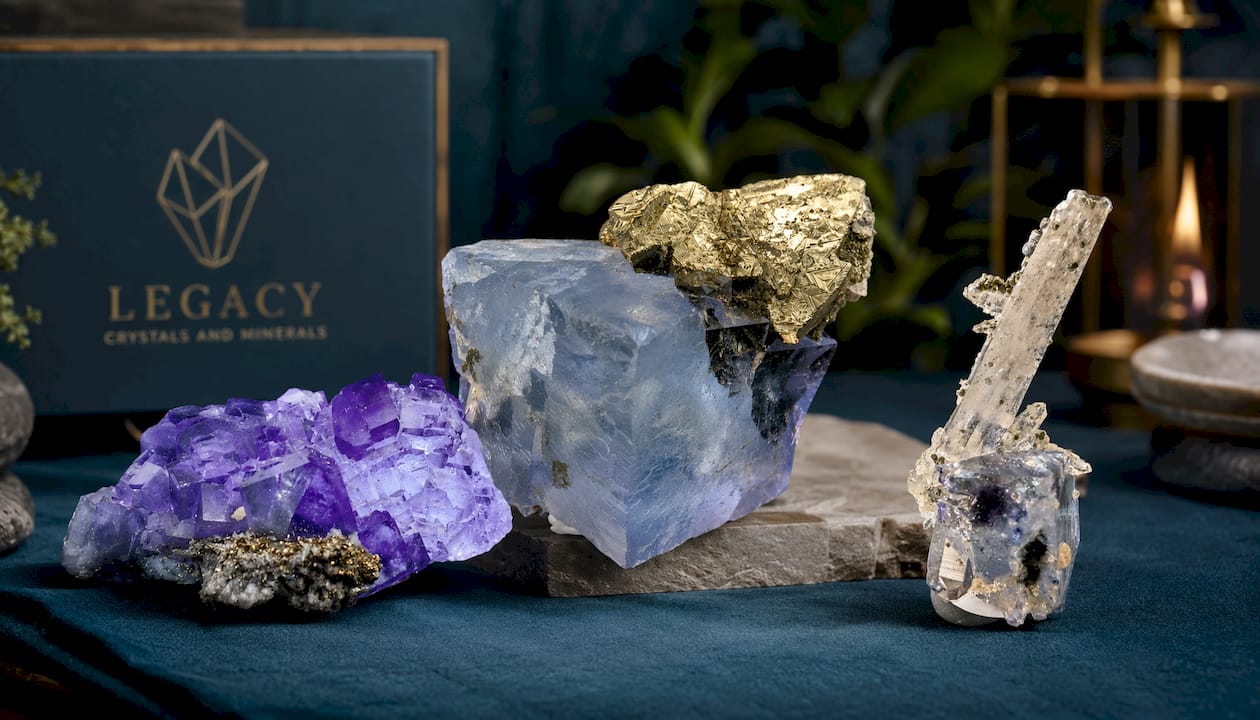
Most online listings for Chinese fluorite offer a locality name and a photo. Legacy Crystals and Minerals goes further: each Yaogangxian listing includes the mine designation, weight in grams, dimensions, and UV fluorescence documentation — the exact combination that separates a verifiable specimen from a generic “China fluorite” entry. The fluorite with pyrite from Yizhang County is a direct example: full locality, accessory mineral identification, and photographic detail. Canadian buyers receive shipping with tracking, and the return policy is stated clearly on each product page. Browse the current Yaogangxian inventory at Legacy Crystals and Minerals to find specimens that meet the provenance and documentation standards this guide outlines.
FAQ
What is the rarest colour of fluorite?
Blue fluorite is among the rarest colours globally, with blue Yaogangxian specimens particularly sought after. Purple-green colour combinations on a single crystal are also considered rare and command collector premiums.
Is fluorite found in China?
Yes. China is the world’s leading producer of collector-grade fluorite, with major deposits in Hunan, Inner Mongolia, Fujian, Zhejiang, and Jiangxi provinces.
How do you tell if fluorite is real or fake?
Check UV fluorescence (natural fluorite typically fluoresces; dyed specimens may show uneven or absent response), examine colour distribution under magnification (dye concentrates in fractures), and request raking-light photos to reveal surface coatings or glue lines.
What colour of fluorite is most valuable?
Gem-clear, deeply saturated purple or blue fluorite with sharp colour zoning commands the highest prices. For Chinese specimens specifically, transparent purple-green combinations from Yaogangxian with associated pyrite are among the most valued by collectors.
Recommended
- Fluorescent minerals: the collector’s complete guide – Legacy Crystals and Minerals
- The Enchanting Beauty of Shangbao Fluorite – Legacy Crystals and Minerals
- Shangbao Fluorite with Quartz – UV Reactive Collector’s Specimen - Legacy Crystals and Minerals – Legacy Crystals and Minerals
- YGX Fluorite with Pyrite – UV Reactive Crystal 198g – Legacy Crystals and Minerals


