

Spécimens de cristaux : guide du collectionneur sur les types et la valeur
Les spécimens de cristaux sont des échantillons minéraux qui présentent une structure cristalline visible formée par l'arrangement ordonné des atomes au sein d'un solide. Les minéralogistes classent toutes les structures cristallines connues dans l'un des six systèmes cristallins primaires : Cubique, Hexagonal, Tétragonal, Orthorhombique, Monoclinique et Triclinique. Ces systèmes sont la base pour identifier et évaluer les spécimens minéraux naturels. Que vous collectionniez par intérêt scientifique, pour leur attrait esthétique ou pour une pratique métaphysique, la compréhension de ces classifications distingue les collectionneurs avertis de ceux qui se fient uniquement à la couleur.
Comment identifier les spécimens de cristaux par type et système
Les six systèmes cristallins définissent la symétrie atomique interne de chaque minéral. Cette symétrie est fixe et ne change pas, peu importe où ou comment un cristal se forme. Ce qui change, c'est l'habitus du cristal, c'est-à-dire sa forme externe telle qu'elle se développe dans un environnement spécifique.
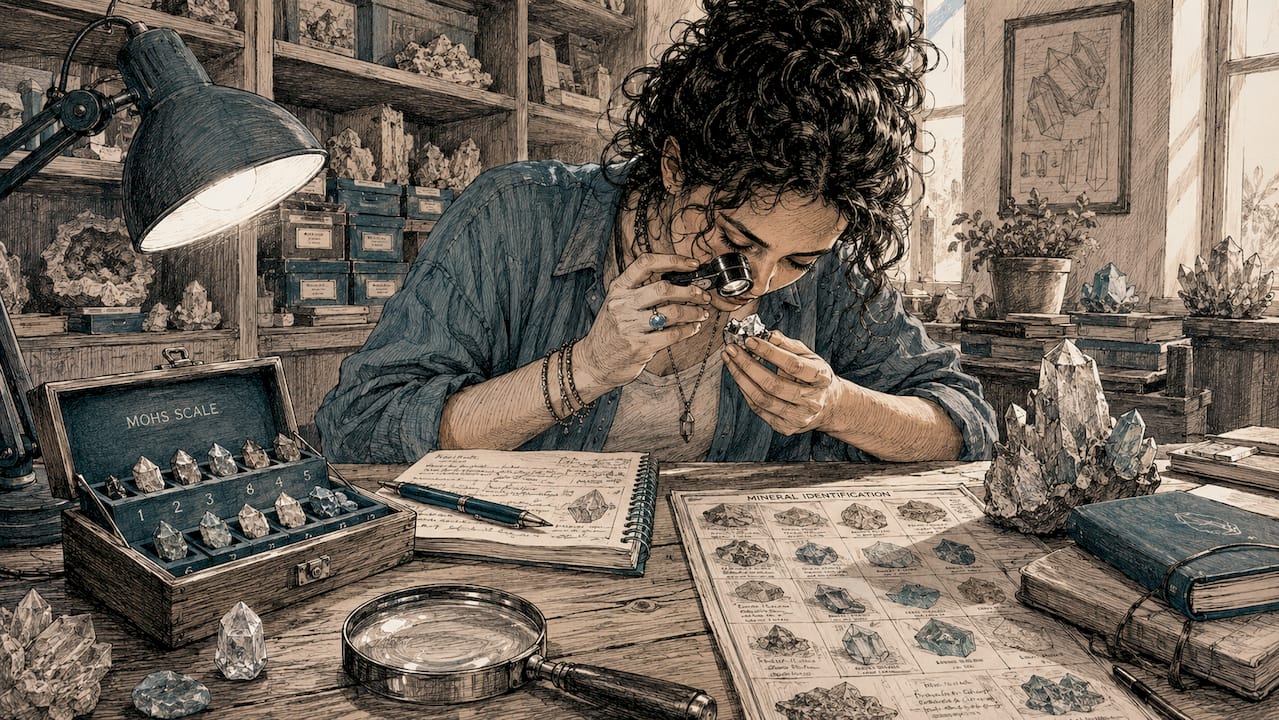
L'habitus cristallin est un bon point de départ pour l'identification, mais il est variable. Une seule espèce minérale peut croître sous forme de colonnes prismatiques, de plaques plates ou de fibres en forme d'aiguille, selon la température, la pression et l'espace disponible. Le système cristallin, en revanche, est constant et déterminé uniquement par la structure atomique.
Les six systèmes cristallins avec des exemples de minéraux :
| Système cristallin | Type de symétrie | Exemples courants |
|---|---|---|
| Cubique | Symétrie la plus élevée, axes égaux | Pyrite, fluorite, galène |
| Hexagonal | Axe de rotation sénaire | Quartz, calcite, apatite |
| Tétragonal | Axe quaternaire, deux axes égaux | Zircon, wulfénite |
| Orthorhombique | Trois axes inégaux, tous à angle droit | Topaze, aragonite, célestite |
| Monoclinique | Trois axes inégaux, un angle oblique | Gypse, orthose, malachite |
| Triclinique | Symétrie la plus faible, pas d'angles droits | Labradorite, cyanite, turquoise |
L'identification pratique va au-delà de la forme. Le test de dureté utilisant l'échelle de Mohs est l'un des moyens les plus rapides de réduire le nombre de candidats. Le quartz, par exemple, a une dureté de 7 et raye proprement le verre. Ce seul test élimine immédiatement des dizaines de minéraux plus tendres. L'éclat, la couleur de la trace sur la porcelaine non émaillée et les angles de clivage ajoutent encore à la précision.
La couleur est la caractéristique d'identification la moins fiable. Les impuretés et la variabilité environnementale font que le même minéral peut apparaître dans des couleurs complètement différentes. L'améthyste et le quartz clair sont tous deux du dioxyde de silicium. La couleur violette de l'améthyste provient d'impuretés de fer et d'irradiation naturelle, et non d'une espèce minérale différente. Se fier uniquement à la couleur conduit à des erreurs d'identification constantes.
Conseil de pro : Lors de l'identification d'un spécimen inconnu, testez la dureté et observez l'éclat avant toute autre chose. La couleur devrait être le dernier facteur que vous considérez, et non le premier.
Quels facteurs déterminent la valeur des spécimens de cristaux rares ?
La valeur d'un spécimen minéral dépend de cinq facteurs principaux : la taille, la qualité du cristal, les dommages, la rareté de la localité et la provenance. Ces facteurs interagissent, et une faiblesse dans l'un d'eux peut réduire considérablement la valeur.
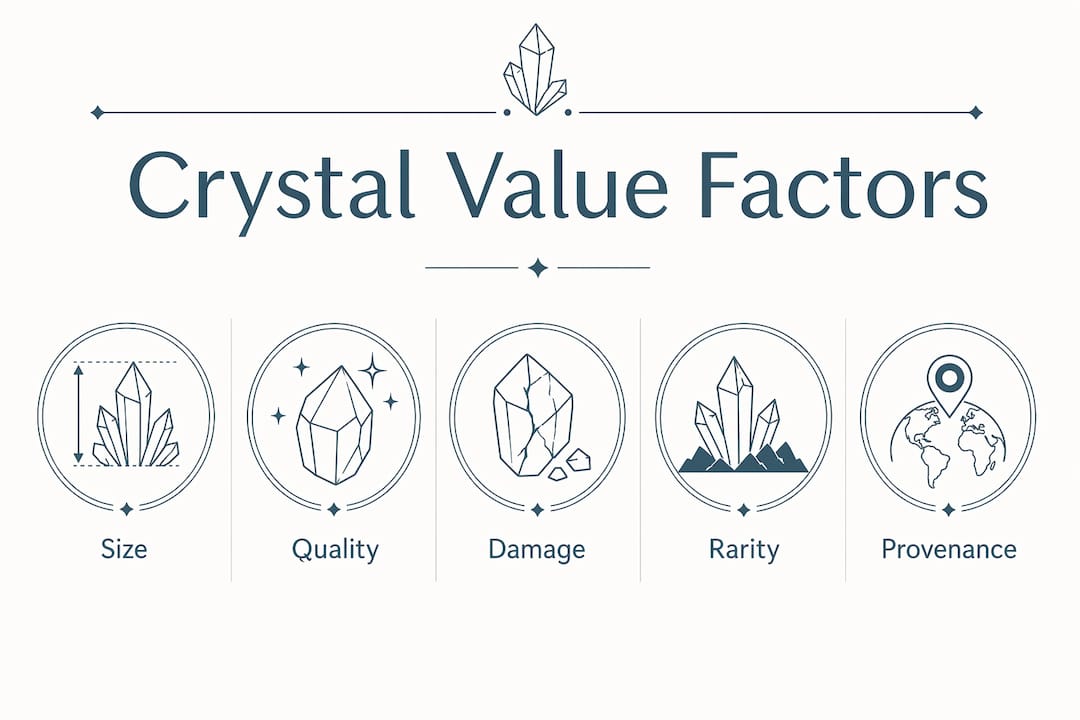
Le prix des spécimens varie de 20 $ pour de petits cristaux bruts à plus de 2 000 $ pour de belles pièces de qualité musée. Cette fourchette reflète l'énorme différence entre une pointe de quartz commune d'un lot en vrac et un agrégat de fluorite parfaitement terminé d'une mine historiquement significative. La taille compte, mais la qualité compte davantage. Un petit spécimen impeccable surpasse toujours un grand spécimen endommagé aux enchères.
Les dommages sont le plus grand facteur de dévalorisation sur le marché des spécimens. Les spécimens sans dommage sont évalués 50 à 80 % plus cher que ceux qui ont été réparés ou dont les terminaisons sont cassées. Un éclat sur une pointe de cristal, une zone de contact réparée ou une terminaison recollée peut réduire de moitié la valeur d'un spécimen, même si sa couleur et sa taille sont exceptionnelles.
L'intégrité d'un spécimen est son attribut le plus important. Un cristal avec une forme parfaite et une taille modeste surpassera toujours une grande pièce réparée dans toute collection sérieuse ou contexte de revente.
La provenance ajoute une couche de valeur qui va au-delà de l'apparence physique. Un spécimen documenté comme provenant d'une mine spécifique, surtout si elle est maintenant fermée ou épuisée, a une signification historique. Des localités comme la mine de Tsumeb en Namibie ou la mine d'Elmwood au Tennessee sont connues pour produire des spécimens aux habitus inhabituels et d'une qualité exceptionnelle. La documentation de l'origine, même une simple étiquette manuscrite d'une collection passée, ajoute de la crédibilité et de l'intérêt pour les collectionneurs.
Conseil de pro : Inspectez toujours les spécimens à l'aide d'une loupe de bijoutier 10x avant d'acheter. Les réparations de colle, les fractures comblées et les surfaces repolies sont invisibles à l'œil nu mais immédiatement évidentes sous grossissement.
Pour les collectionneurs qui souhaitent constituer une collection sérieuse, le guide de curation de cristaux de qualité musée chez Legacy Crystals and Minerals couvre en détail les niveaux de prix et les critères de qualité.
Types de cristaux courants collectés à des fins éducatives et métaphysiques
Les collectionneurs et les chercheurs spirituels recherchent souvent des spécimens différents, mais leurs choix se recoupent plus qu'on ne pourrait s'y attendre. Les collectionneurs scientifiques privilégient la représentation du système cristallin, la documentation de la localité et l'intégrité physique. Les collectionneurs métaphysiques se concentrent sur les associations énergétiques, l'attrait visuel et la résonance personnelle. Cependant, les deux groupes ont tendance à graviter vers les mêmes minéraux de haute qualité.
Les variétés de quartz sont les spécimens les plus largement collectionnés dans les deux communautés. Le quartz clair, l'améthyste, le quartz fumé et la citrine appartiennent tous au système hexagonal et forment des prismes à six côtés avec un éclat vitreux et une fracture conchoïdale. Leur accessibilité, leur variété et leur clarté visuelle en font des points de départ idéaux pour les nouveaux collectionneurs.
Spécimens populaires avec des notes clés :
- Quartz clair : Système hexagonal, éclat vitreux, dureté 7. Associé à la clarté et à l'amplification dans la pratique métaphysique. Largement disponible et facile à authentifier.
- Améthyste : Quartz violet coloré par des impuretés de fer. Se forme en géodes et en pointes individuelles. Associé au calme et à l'intuition. Les formes sceptres de localités comme les montagnes de Goboboseb en Namibie sont très recherchées par les collectionneurs.
- Fluorite : Système cubique, clivage octaédrique parfait, souvent multicolore. Les variétés réactives aux UV brillent sous la lumière ultraviolette à ondes courtes. Associé à la concentration et à la clarté mentale.
- Calcite : Système hexagonal, clivage rhomboédrique, large gamme de couleurs. Se présente sous de nombreux habitus, y compris des formes scalénoédriques et prismatiques. Associé à la purification et à l'amplification.
- Grenat : Système cubique, généralement un habitus dodécaédrique, éclat vitreux. Dureté 6,5-7,5 selon la variété. Associé à l'ancrage et à la vitalité.
Les débutants bénéficient le plus de commencer avec les variétés de quartz. Elles sont abordables, largement disponibles, faciles à identifier et représentent clairement le système hexagonal. Une fois que vous comprenez le quartz, identifier d'autres minéraux hexagonaux comme la calcite et l'apatite devient beaucoup plus simple.
Comment authentifier les spécimens de cristaux naturels et éviter les contrefaçons
Le commerce des cristaux comprend un volume important de matériaux traités, teints et synthétiques. Savoir distinguer le naturel de l'amélioré est une compétence essentielle pour tout collectionneur. La bonne nouvelle est que la plupart des contrefaçons et des traitements se révèlent lors d'une inspection de base.
Les caractéristiques de surface et les inclusions sont les marqueurs d'authenticité les plus fiables. Les cristaux naturels contiennent des zones de croissance, des fractures internes, des inclusions minérales et des textures de surface qui reflètent de véritables processus géologiques. Les pierres synthétiques ou fortement traitées semblent souvent trop parfaites, avec une couleur uniforme, sans inclusions et un éclat artificiel.
Principaux contrôles d'authentification :
- Test à la lumière UV : De nombreux minéraux naturels fluorescent sous la lumière ultraviolette de manière prévisible. La fluorite brille sous les UV à ondes courtes. Les imitations synthétiques ne présentent souvent aucune réaction ou une réaction incohérente.
- Test de température : Le quartz naturel est froid au toucher, même à température ambiante. Les imitations en verre se réchauffent rapidement dans votre main.
- Inspection de surface : Recherchez les marques de moulage, les bulles ou la saturation uniforme de la couleur. Ces éléments indiquent du verre ou de la résine plutôt qu'une croissance minérale naturelle.
- Documentation de provenance : Un vendeur réputé fournit des informations sur la localité, l'historique de la collection ou un certificat d'authenticité pour les pièces importantes.
- Test de teinture : Les pierres teintées montrent souvent une couleur concentrée dans les fissures et les piqûres de surface. Essuyez avec de l'acétone sur un coton-tige. Un transfert de couleur indique une teinture.
Conseil de pro : Achetez auprès de vendeurs qui fournissent des données de localité et qui répondent volontiers aux questions sur leur approvisionnement. Les réponses vagues sur l'origine sont un signe avant-coureur fiable.
Lors d'un achat en ligne, recherchez les vendeurs qui photographient les spécimens sous plusieurs conditions d'éclairage, y compris les UV. Legacy Crystals and Minerals fournit des descriptions détaillées des spécimens et des informations de localité, ce qui facilite les décisions d'achat en toute confiance.
Points clés à retenir
Les spécimens de cristaux authentiques, sans dommage, classés par système cristallin et étayés par une documentation de provenance, ont la plus grande valeur pour les collectionneurs, les éducateurs et les praticiens métaphysiques.
| Point | Détails |
|---|---|
| Le système cristallin est fixe | Tous les minéraux appartiennent à l'un des six systèmes cristallins basés sur la symétrie atomique, qui ne change jamais. |
| La couleur induit en erreur | La couleur varie en raison des impuretés ; utilisez la dureté, l'éclat et l'habitus pour une identification fiable. |
| Les dommages réduisent fortement la valeur | Les spécimens sans dommage sont évalués 50 à 80 % plus cher que les pièces réparées ou ébréchées. |
| La provenance ajoute de la valeur | La localité documentée et l'historique de la collection augmentent à la fois la crédibilité et la valeur de revente. |
| L'authentification nécessite une inspection | Utilisez une loupe 10x, une lumière UV et des contrôles de surface pour confirmer les spécimens naturels et non traités. |
Ce que j'ai appris au fil des ans en manipulant des spécimens de cristaux
La plus grande erreur que je vois faire aux nouveaux collectionneurs est d'acheter par couleur. Une améthyste d'un violet vif ou une fluorite d'un vert éclatant attire l'œil, et l'achat se fait avant toute réelle inspection. La couleur est la chose la plus facile à falsifier et la moins fiable à laquelle se fier.
Ce que je privilégie maintenant, c'est la diversité des systèmes cristallins et l'intégrité physique. Une collection qui représente les six systèmes cristallins raconte une histoire plus complète de la science minérale qu'une étagère remplie de quartz de différentes couleurs. Une seule lame de cyanite triclinique parfaite ou une topaze orthorhombique impeccable vous en apprend plus sur la cristallographie qu'une douzaine de pointes de quartz d'apparence similaire.
La relation entre la compréhension scientifique et l'appréciation métaphysique n'est pas une contradiction. Savoir que l'améthyste tire sa couleur des impuretés de fer et de l'irradiation naturelle ne diminue en rien sa beauté ou sa résonance. Au contraire, comprendre le processus géologique qui a créé un spécimen approfondit l'expérience de travailler avec lui. La science et la pratique spirituelle se renforcent mutuellement.
Mon conseil pratique pour quiconque constitue une collection : achetez la meilleure qualité que vous pouvez vous permettre en petite quantité plutôt que d'accumuler un grand nombre de pièces médiocres. Un spécimen de qualité musée avec une provenance documentée vaut plus, sur le plan éducatif et financier, que vingt pierres en vrac. La patience et la sélectivité sont les véritables compétences dans ce passe-temps.
— Simon
Spécimens authentiques de Legacy Crystals and Minerals
Legacy Crystals and Minerals propose une sélection organisée de spécimens naturels et sans dommage, provenant de localités documentées du monde entier.
La gamme comprend tout, d'un agrégat de quartz clair du Brésil à un agrégat de zéolite d'Inde avec des flocons de cristaux de calcite octogonaux. Chaque pièce est sélectionnée pour son intégrité naturelle, sa qualité visuelle et son intérêt scientifique. Les collectionneurs, les éducateurs et les praticiens métaphysiques trouveront des spécimens qui répondent aux normes de qualité musée sans nécessiter un budget de musée. Les données de localité et les détails des spécimens sont inclus dans chaque annonce.
FAQ
Que sont les spécimens de cristaux ?
Les spécimens de cristaux sont des échantillons minéraux naturels qui présentent une structure cristalline visible formée par un arrangement atomique ordonné. Ils sont collectés pour l'étude scientifique, l'exposition et la pratique métaphysique.
Comment identifier un spécimen de cristal par type ?
Identifiez les spécimens de cristaux en testant leur dureté sur l'échelle de Mohs, en observant leur éclat et leur trace, et en déterminant leur système cristallin à partir de leur habitus externe et de leur symétrie. La couleur seule n'est pas un indicateur fiable.
Qu'est-ce qui rend un spécimen de cristal précieux ?
La valeur dépend de la taille, de l'intégrité physique, de la rareté de la localité et de la documentation de provenance. Les spécimens sans dommage sont évalués 50 à 80 % plus cher que les exemples réparés ou ébréchés.
Comment savoir si un spécimen de cristal est naturel ou traité ?
Recherchez les inclusions, les zones de croissance et les textures de surface naturelles. Utilisez la lumière UV pour tester la fluorescence, et examinez sous une loupe 10x pour déceler un éclat artificiel, de la teinture dans les fissures ou des réparations à la colle.
Quels spécimens de cristaux sont les meilleurs pour les débutants ?
Les variétés de quartz, y compris le quartz clair, l'améthyste et le quartz fumé, sont le meilleur point de départ. Elles sont abordables, faciles à identifier et représentent clairement le système cristallin hexagonal.
Recommandé
- Construire une collection de cristaux de qualité musée : Guide expert – Legacy Crystals and Minerals
- Améthyste avec Analcime – Montagnes de Goboboseb, Namibie – Sceptre violet foncé – Micro-spécimen (19mm) - Legacy Crystals and Minerals – Legacy Crystals and Minerals
- Base de connaissances sur les cristaux : Éducation minérale, collection et signification – Legacy Crystals and Minerals
- Sceptre d'Améthyste – Montagnes de Goboboseb, Namibie – Inclusions fantômes – Micro-spécimen (16mm) - Legacy Crystals and Minerals – Legacy Crystals and Minerals


