

Cristaux pour la protection contre les champs électromagnétiques : choix et placements pratiques
La tourmaline noire, la shungite, l’hématite, la pyrite et le quartz fumé sont les cristaux les plus couramment utilisés pour la protection contre les champs électromagnétiques (CEM). Le point de départ le plus pratique : placez un morceau de shungite près de votre routeur Wi-Fi et portez un bracelet en tourmaline noire quotidiennement. Notez qu’un petit pendentif en shungite ne peut pas vous protéger des CEM à l’échelle d’une pièce – il ne peut bloquer que le rayonnement qui frappe directement l’objet lui-même.
- À quoi s’attendre : Les cristaux offrent des bienfaits psychologiques et énergétiques pour de nombreux utilisateurs. La protection physique contre les CEM ambiants n’est pas scientifiquement établie pour les bijoux ou les petites pierres.
- Avertissement : Les cristaux ne sont pas des dispositifs médicaux et ne sont pas des boucliers CEM prouvés. Pour des préoccupations techniques concernant les CEM, consultez un professionnel qualifié.
Conseil de pro : Commencez avec une pièce de shungite stationnaire et une pièce de tourmaline noire à porter. Cette approche à deux niveaux couvre à la fois le placement de l’appareil et le port personnel sans compliquer la pratique.
Points clés
La shungite est le seul cristal dont les propriétés de blindage matériel sont documentées dans des études en laboratoire ; tous les autres cristaux couramment utilisés contre les CEM fonctionnent par pratique énergétique ou rituelle plutôt que par blindage physique mesurable.
| Point | Détails |
|---|---|
| Meilleurs cristaux à utiliser | La tourmaline noire et la shungite sont la paire la plus pratique pour un usage quotidien et stationnaire. |
| Meilleur placement | Placez une tour de shungite près de votre routeur ou de votre compteur intelligent ; portez de la tourmaline noire en bracelet tout au long de la journée. |
| Preuve de la shungite | Les composites de laboratoire avec une concentration plus élevée de shungite ont montré une transmittance EMR réduite dans la gamme 500 MHz–4 GHz ; les pièces de taille bijou ne sont pas équivalentes. |
| Conseil d’achat | Confirmez l’authenticité de la shungite par un test de conductivité et vérifiez la provenance de Carélie, en Russie, avant d’acheter. |
| Legacy Crystals and Minerals | Propose des tours de shungite polies et des bracelets de shungite provenant de Carélie, adaptés à l’approche de placement en couches décrite dans cet article. |
Table des matières
- Que sont les CEM et pourquoi les gens cherchent-ils à s’en protéger ?
- Cristaux pour la protection contre les CEM : lesquels sont utilisés et pourquoi
- Comment utiliser les cristaux pour la protection à la maison et en déplacement
- Comment choisir et authentifier les cristaux avant d’acheter
- Ce que la science soutient réellement sur les cristaux et les CEM
- Attentes réalistes, notes de sécurité et combinaison responsable des cristaux
- Pièces de shungite et de tourmaline noire de Legacy Crystals and Minerals
- Sources
- FAQ
Que sont les CEM et pourquoi les gens cherchent-ils à s’en protéger ?
Un champ électromagnétique (CEM) est une zone d’énergie produite par des objets électriquement chargés. Les sources domestiques courantes incluent les routeurs Wi-Fi, les smartphones, les ordinateurs portables, les compteurs intelligents et les fours à micro-ondes.
L’OMS note que pour la plupart des expositions quotidiennes à de faibles niveaux de CEM, les preuves actuelles ne confirment pas les risques pour la santé, bien que la recherche se poursuive. L’AIEA considère que le blindage technique est pertinent principalement pour les scénarios professionnels ou de forte exposition, et non pour les environnements domestiques typiques.
Points clés des directives officielles :
- Les CEM non ionisants de faible niveau provenant des appareils ménagers ne sont pas classés comme un risque avéré pour la santé.
- La recherche en cours cible les scénarios d’exposition élevée à long terme.
- L’exposition quotidienne de la plupart des gens est bien inférieure aux seuils professionnels.
Conseil de pro : Un compteur CEM de base (disponible à la location dans certains magasins d’électronique et de sécurité canadiens) ou une application pour smartphone comme ElectroSmart donne un aperçu rapide des niveaux de CEM de votre maison. Si les lectures sont constamment élevées près d’un appareil, un biologiste du bâtiment professionnel peut effectuer une évaluation plus approfondie.
Cristaux pour la protection contre les CEM : lesquels sont utilisés et pourquoi
Les cristaux ci-dessous reflètent le consensus des praticiens à travers les guides et les ressources communautaires. Chaque entrée note la raison matérielle, les formes courantes et la disponibilité approximative au Canada.
1. Shungite Un minéral riche en carbone de Carélie, en Russie. Des études en laboratoire montrent que les plaques et composites de shungite transformés peuvent présenter des propriétés de réflexion et d’absorption des micro-ondes mesurables, bien que l’efficacité dépende de la teneur en carbone, de l’épaisseur et de la préparation. Formes courantes : tours polies, plaques, pierres roulées et bracelets. Largement disponible au Canada chez les détaillants de cristaux spécialisés, généralement entre 15 et 80 CAD selon la taille et la forme.
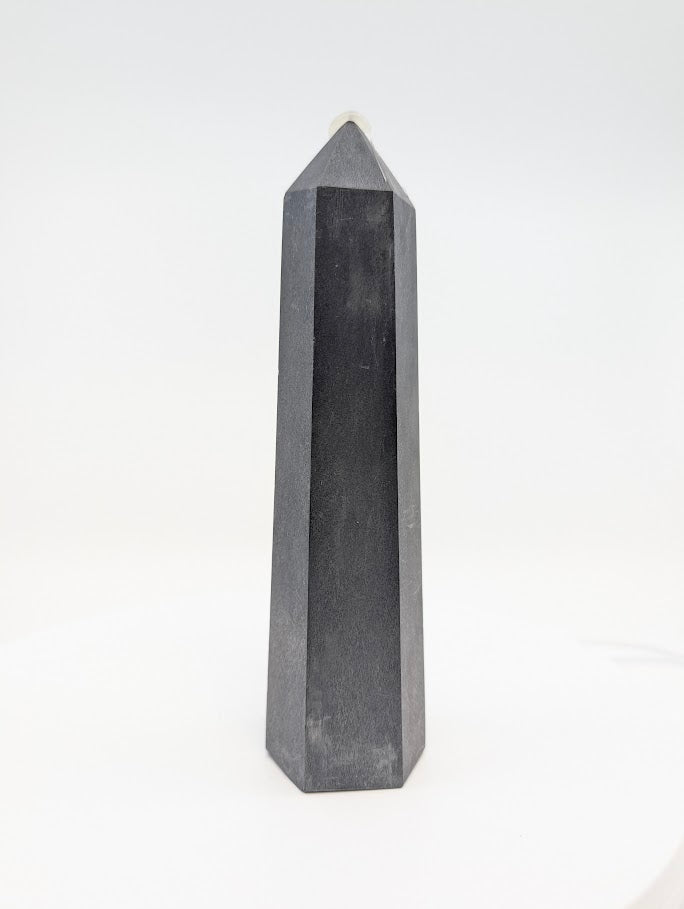
2. Tourmaline noire Choisie pour sa teneur en fer et son utilisation traditionnelle comme pierre d’ancrage et de protection. Aucune donnée de blindage en laboratoire ne soutient son utilisation à l’échelle des bijoux, mais elle reste le choix le plus populaire parmi les praticiens pour les bijoux. Formes : roulée, brute, bracelet, pendentif. Disponible partout au Canada, entre 5 et 40 CAD pour les pièces roulées.
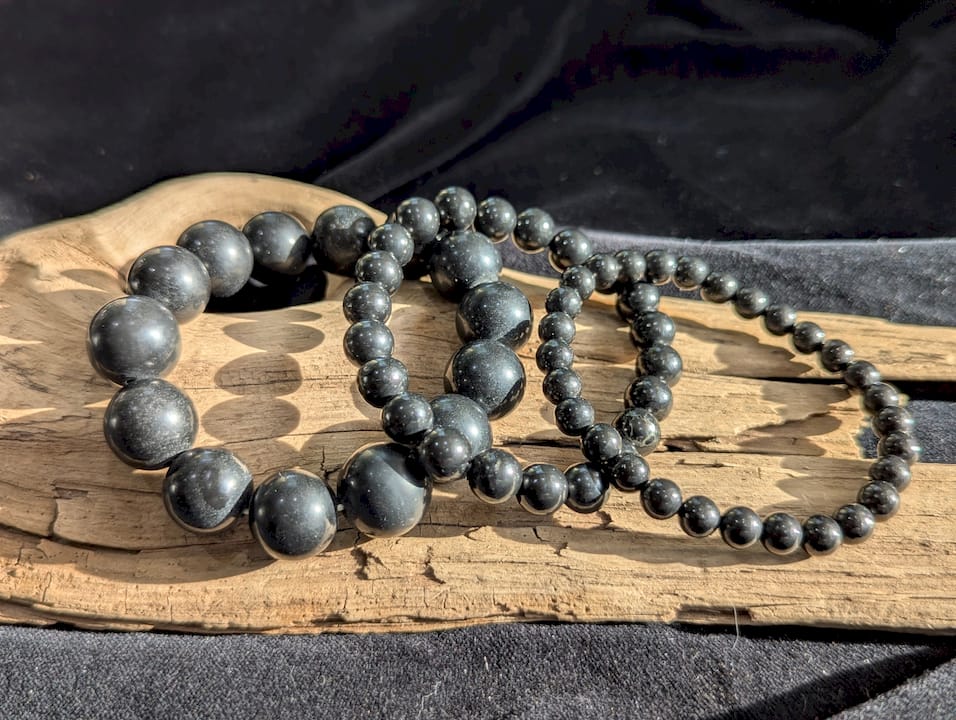
3. Hématite Un minéral d’oxyde de fer. Certains guides citent sa teneur en fer comme pertinente pour les interactions électromagnétiques. L’hématite magnétique est courante dans les bijoux de masse — gardez l’hématite naturelle non magnétique éloignée des disques durs, des cartes de paiement et des dispositifs médicaux. Formes : roulée, disque poli, bracelet.
4. Pyrite Sulphure de fer avec un éclat métallique. Les praticiens l’utilisent pour sa densité énergétique perçue. Comme l’hématite, la pyrite naturelle peut avoir un léger magnétisme — vérifiez avant de la placer près d’appareils électroniques sensibles. Formes : amas brut, roulée, spécimen cubique.
5. Quartz fumé Un cristal de dioxyde de silicium avec des impuretés d’aluminium qui lui donnent sa couleur gris-brun. Les praticiens le privilégient pour l’ancrage et la réduction du stress près des écrans. Aucune propriété de blindage matériel n’est établie. Formes : tour, roulée, pendentif. Facilement disponible au Canada, entre 8 et 50 CAD.
6. Obsidienne Verre volcanique, principalement du dioxyde de silicium. Traditionnellement utilisée pour la protection et l’ancrage. Aucune propriété de blindage électromagnétique n’est documentée. Formes : sphère, roulée, pierre de poche.
7. Fluorite Un minéral de fluorure de calcium. Les praticiens l’associent à la clarté mentale et à la réduction de la fatigue mentale attribuée au temps passé devant les écrans. Formes : tour, roulée, octaèdre. Courante et abordable au Canada.
8. Amazonite Un minéral feldspathique. Certains guides suggèrent de l’utiliser pour réduire le stress perçu dans les environnements riches en CEM. Aucune donnée de blindage matériel. Formes : roulée, pierre de poche, pendentif.
Note sur les minéraux magnétiques : L’hématite et la pyrite peuvent affecter les bandes magnétiques, les disques durs et les dispositifs médicaux implantés. Choisissez des formes non magnétiques ou maintenez une distance par rapport aux appareils électroniques sensibles. Certains guides avertissent également que le quartz simple peut amplifier certains signaux dans les applications radio, de sorte que les praticiens préfèrent souvent les pierres contenant du fer ou du carbone pour une utilisation liée aux CEM.
Conseil de pro : Pour les meilleurs cristaux à utiliser contre les CEM, privilégiez la shungite pour tout placement stationnaire près des appareils. Réservez la tourmaline noire, le quartz fumé ou la fluorite pour un usage portable ou sur un bureau où une pierre non magnétique est plus sûre.
Comment utiliser les cristaux pour la protection à la maison et en déplacement
L’approche la plus pratique est stratifiée : de la shungite stationnaire près des appareils, plus une pierre d’ancrage portable comme la tourmaline noire pour un usage personnel tout au long de la journée.
Liste de contrôle du placement :
- Routeur Wi-Fi : Placez une tour ou une plaque de shungite polie à moins de 30 cm du routeur. La pierre se trouve directement sur le chemin du signal plutôt que de protéger toute la pièce.
- Bureau ou ordinateur portable : Un morceau de shungite roulée ou une petite tour sur la surface du bureau près de l’appareil. Gardez les pierres magnétiques (hématite, pyrite) à au moins 20 cm du disque dur de l’ordinateur portable.
- Table de chevet / chargeur de téléphone : Une pierre roulée de tourmaline noire ou un petit morceau de shungite à côté du téléphone en charge. De nombreux praticiens estiment que ce placement favorise une meilleure qualité de sommeil, bien qu’il s’agisse d’un bénéfice subjectif.
- Compteur intelligent : Placez une plaque de shungite sur le mur intérieur en face du compteur. La couverture est limitée à l’interception directe, pas au blindage de toute la pièce.
Bijoux et utilisation portable :
- Les bracelets sont la forme portable la plus pratique. Un bracelet en shungite ou un bracelet en tourmaline noire porté au poignet non dominant est la recommandation standard des praticiens.
- Les pendentifs sont proches du corps mais ne couvrent que la zone qu’ils touchent directement. Pour un bénéfice perçu plus large, associez un pendentif à une pièce stationnaire.
- Nettoyez les cristaux portables mensuellement : rincez brièvement la shungite sous l’eau froide et séchez-la en tapotant. Évitez un trempage prolongé pour les pièces polies. Pour l’entretien des bijoux en cristal, vérifiez la sensibilité à l’eau de la pierre avant de la nettoyer.
Grille de poste de travail simple à 3 pierres :
Placez une tour de shungite à l’arrière du bureau (entre vous et le routeur), une pierre roulée de tourmaline noire à gauche du clavier et une pointe de quartz fumé à droite. Cet arrangement reflète les dispositions de grille courantes des praticiens pour les espaces de travail à forte utilisation d’écrans.
Notes de sécurité :
- Gardez l’hématite magnétique et la pyrite éloignées des terminaux de paiement, des disques durs et des dispositifs médicaux implantés (stimulateurs cardiaques, implants cochléaires).
- Rangez les petites pierres roulées hors de portée des enfants et des animaux domestiques — risque d’étouffement.
- Évitez les cristaux avec des revêtements de surface ou des teintures en contact direct avec la peau pendant des périodes prolongées si la composition du revêtement est inconnue.
Conseil de pro : Pour voyager, une petite pierre roulée de tourmaline noire dans une poche ou un sac est l’option la plus simple. Elle ne nécessite aucune logique de placement et ne présente aucun risque magnétique pour les équipements de sécurité de l’aéroport.
Comment choisir et authentifier les cristaux avant d’acheter
Acheter la mauvaise pièce – une perle de verre teintée vendue comme de la shungite, ou un anneau en hématite synthétique – est facile à faire en ligne. Ces vérifications réduisent ce risque.
Liste de contrôle d’authenticité :
- Poids et densité : La shungite véritable est notablement lourde pour sa taille. Les pièces légères qui ressemblent à de la shungite sont souvent en plastique ou en résine.
- Test de conductivité (shungite uniquement) : La shungite réelle conduit l’électricité. Touchez les deux sondes d’un testeur de continuité de base à la surface de la pierre. La conductivité confirme la teneur en carbone ; l’absence de conductivité suggère un faux ou une pièce de très faible qualité.
- Texture de surface : La shungite authentique a une surface noire mate à semi-lustrée avec des inclusions minérales visibles. Les pièces noires parfaitement uniformes et brillantes sont suspectes.
- Provenance : Demandez au vendeur l’origine. La shungite véritable provient de Carélie, en Russie. Les vendeurs qui ne peuvent pas nommer l’origine ou qui ne mentionnent que « Russie » sans préciser la Carélie méritent de la prudence.
- Prix : Une shungite dont le prix est inférieur à 5 CAD pour une pièce de la taille d’une paume est un signal d’alarme. Les spécimens de qualité musée ou testés coûtent plus cher et sont accompagnés de documents de provenance plus clairs.
Signaux d’alerte à l’achat :
- Allégations médicales (« prouvé cliniquement pour bloquer les CEM », « élimine les radiations ») sans preuve sourcée.
- Langage « pré-chargé » ou « énergétiquement scellé » utilisé pour justifier un prix élevé sans provenance.
- Allégations d’origine incohérentes ou aucune origine indiquée.
- Pas de politique de retour ou d’option d’échange.
Guide des formes pour différentes utilisations :
- Plaque ou tour de shungite : Idéal pour le placement stationnaire des appareils. Une plus grande surface signifie plus d’interception directe.
- Shungite roulée : Polyvalente pour le bureau, les grilles et les voyages. Plus facile à manipuler et à ranger.
- Bracelet en shungite : Option portable. Confirmez l’authenticité des perles avec le test de conductivité si possible.
- Tourmaline noire roulée ou en bracelet : Non magnétique, sûre près des appareils électroniques, largement disponible au Canada.
Pour les acheteurs canadiens, recherchez des vendeurs qui indiquent l’origine des spécimens, offrent des retours et fournissent des photos de la pièce réelle plutôt que des images de stock. Lire sur comment acheter des cristaux en ligne sans se faire arnaquer avant d’acheter est une première étape pratique.
Ce que la science soutient réellement sur les cristaux et les CEM
Les cristaux ne sont pas des boucliers CEM prouvés pour tout le corps. C’est la base. Ce que la recherche montre est plus spécifique et plus intéressant que la plupart des messages marketing ne le suggèrent.
La shungite est le seul cristal dont les propriétés matérielles pertinentes pour le blindage électromagnétique sont documentées. Des études en laboratoire sur des plaques de shungite ultrafines ont révélé des performances mesurables de réflexion et d’absorption des micro-ondes dans certaines gammes de fréquences, comparables dans certains tests à des composites de carbone synthétiques plus épais. Une étude distincte utilisant de la poudre de shungite comme charge composite a montré qu’une augmentation de la concentration de shungite de 10 % à 50 % dans un liant de paraffine réduisait la transmittance EMR et augmentait l’absorption dans la gamme 500 MHz à 4 GHz. Ce sont des résultats de matériaux conçus, et non des résultats de bijoux.
Conclusion clé : Dans les tests de composites en laboratoire, une concentration plus élevée de shungite a produit une transmittance EMR mesurablement plus faible dans la gamme 500 MHz à 4 GHz — mais ces résultats s’appliquent à des échantillons conçus avec une teneur en carbone et une épaisseur contrôlées, et non à une perle polie sur un bracelet.
Ce que cela signifie pour l’usage domestique :
- Une tour de shungite polie placée près d’un routeur se trouve sur le chemin direct du signal et peut en intercepter une partie. Un pendentif fin ne peut pas protéger le porteur des CEM ambiants à l’échelle d’une pièce.
- La différence entre un composite industriel de shungite et une perle de bracelet de 8 mm est substantielle en termes de densité de carbone, d’épaisseur et de surface.
- La tourmaline noire, l’obsidienne, le quartz fumé et la fluorite n’ont pas de propriétés de blindage électromagnétique documentées dans la littérature scientifique des matériaux.
L’Institut national du cancer déclare que la recherche n’a pas établi de lien clair entre l’exposition typique aux CEM non ionisants et le cancer. L’OMS parvient à une conclusion similaire pour les niveaux d’exposition quotidiens. Ces positions n’invalident pas l’utilisation des cristaux pour l’ancrage, la réduction du stress ou la pratique rituelle — elles clarifient simplement que le mécanisme n’est pas un blindage physique.
Attentes réalistes, notes de sécurité et combinaison responsable des cristaux
Les cristaux ne sont pas des dispositifs médicaux et ne doivent pas remplacer les conseils professionnels ou l’atténuation technique des CEM lorsque l’exposition est une réelle préoccupation.
Liste de contrôle de sécurité :
- Ne placez pas d’hématite ou de pyrite magnétisées près des cartes de paiement, des disques durs ou des dispositifs médicaux implantés.
- Gardez les petites pierres roulées hors de portée des enfants de moins de trois ans — risque d’étouffement.
- Évitez les cristaux avec des traitements de surface ou des colorants inconnus en contact direct avec la peau pendant de longues périodes.
- Si un cristal a été traité avec un revêtement (courant dans les pièces de masse), le revêtement peut libérer de fines particules avec une usure répétée.
Combinaison de cristaux :
La shungite et la tourmaline noire sont l'association la plus courante dans les guides de praticiens. La shungite gère le placement d'appareils fixes ; la tourmaline noire couvre la mise à la terre portable. L'ajout de quartz fumé à un réseau de poste de travail est un troisième élément courant pour une réduction perçue du stress lors de sessions de travail intensives sur écran.
La distinction entre superposition rituelle et superposition fonctionnelle est importante. La superposition rituelle — définir une intention, disposer des pierres en grille, porter un bracelet comme un rappel conscient — a une réelle valeur psychologique pour de nombreuses personnes. La superposition fonctionnelle (s'attendre à ce que les pierres bloquent physiquement les champs électromagnétiques mesurables dans une pièce) n'est pas étayée par les preuves actuelles. Les deux approches peuvent coexister sans contradiction.
Pour les lecteurs ayant des préoccupations spécifiques concernant les champs électromagnétiques, l'OMS et cancer.gov fournissent les résumés les plus clairs des preuves actuelles et des conseils pratiques.
Conseil de pro : Associez une tour de shungite près de votre routeur avec un bracelet en tourmaline noire à porter au quotidien. Cette combinaison couvre à la fois les couches stationnaires et portables sans nécessiter une configuration de grille complexe.
Pièces de shungite et de tourmaline noire de Legacy Crystals and Minerals
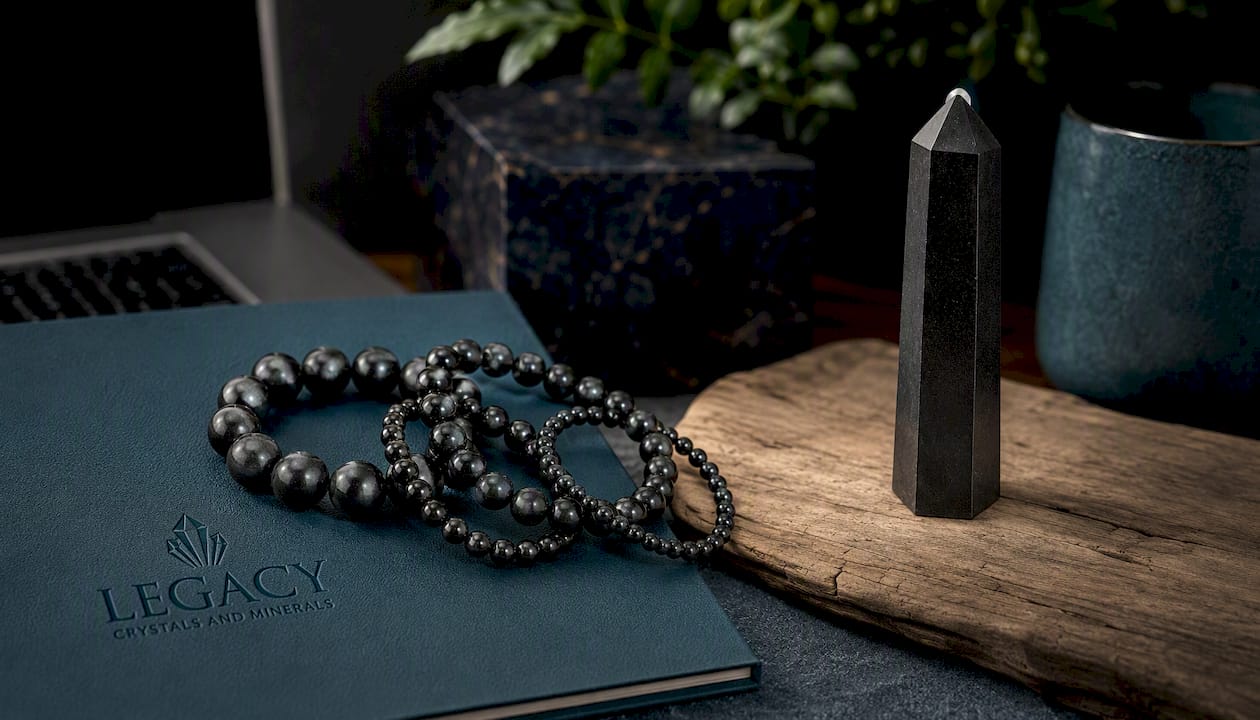
Legacy Crystals and Minerals propose deux des pièces les plus pratiques pour l'approche en couches décrite dans cet article. Les tours de shungite polies provenant de Carélie, en Russie, conviennent pour un placement stationnaire près des routeurs, des compteurs intelligents ou sur un bureau. La provenance de Carélie est clairement indiquée, ce qui est important pour authentifier la shungite. Pour un usage portable, le bracelet en shungite avec des perles rondes polies de 7 mm, 8 mm et 14 mm offre une option quotidienne pratique. La combinaison d'une tour près de votre appareil principal avec un bracelet pour un usage personnel couvre les deux couches de placement sans nécessiter de multiples achats. Parcourez la sélection complète sur Legacy Crystals and Minerals et consultez les pages produits pour les prix canadiens actuels, les détails de la politique de retour et les tailles disponibles.
Sources
- Rayonnements : champs électromagnétiques – Questions et réponses (OMS)
- Champs électromagnétiques et cancer (National Cancer Institute)
- Efficacité de blindage électromagnétique de plaques de shungite ultra-minces légères et flexibles (ScienceDirect)
FAQ
Quel cristal est le plus couramment utilisé pour la protection contre les CEM ?
La shungite et la tourmaline noire sont les cristaux les plus fréquemment recommandés pour la protection contre les CEM. La shungite a des propriétés matérielles documentées dans les études en laboratoire ; la tourmaline noire est le choix portable le plus populaire parmi les praticiens.
La tourmaline noire bloque-t-elle vraiment les CEM ?
Aucune preuve scientifique matérielle ne soutient la tourmaline noire comme bouclier physique contre les CEM. Elle est utilisée pour ses propriétés d'ancrage traditionnelles et comme pierre portable non magnétique, sûre à proximité des appareils électroniques.
Qu'est-ce qui absorbe le rayonnement CEM ?
En laboratoire, les composites de shungite à forte concentration en carbone ont montré une absorption mesurable des rayonnements électromagnétiques dans la gamme de 500 MHz à 4 GHz. Aucun bijou en cristal n'a démontré la capacité d'absorber les CEM ambiants au niveau de la pièce pour le porteur.
Quelle est la pierre qui bloque les CEM ?
La shungite est la pierre la plus souvent citée pour ses propriétés de blocage des CEM. Des études en laboratoire confirment les propriétés de blindage dans les plaques et les composites conçus, mais un petit pendentif ou bracelet ne peut intercepter que le rayonnement qui frappe directement l'objet lui-même, et non protéger le porteur des CEM environnants.
L'orgonite est-elle meilleure que la shungite pour la protection contre les CEM ?
L'orgonite est un composite de résine, pas un minéral naturel. Contrairement à la shungite, elle n'a aucune donnée scientifique matérielle examinée par des pairs confirmant un blindage électromagnétique. La teneur en carbone de la shungite lui confère une base documentée dans des études en laboratoire que l'orgonite n'a pas.
Recommandé
- Les cristaux de protection expliqués : un guide complet pour débutants – Legacy Crystals and Minerals
- Comment fonctionnent les autels de cristal : un guide pratique pour 2026 – Legacy Crystals and Minerals
- Combiner les cristaux pour le travail énergétique : un guide pratique – Legacy Crystals and Minerals
- Cristaux pour les pratiques de méditation : un guide pratique – Legacy Crystals and Minerals


