

Six Garnet Species Collectors Need: Varieties, Value & Provenance
Garnet is not one gemstone but a family of six mineral species, and colour, combined with named trade varieties like tsavorite or rhodolite, drives most of what collectors and buyers pay. The species itself matters less to price than which variety you’re holding, how saturated its colour is, how clean it is, and how it was cut. Rarity swings the numbers hardest: common red garnets stay affordable at almost any size, while green and orange rarities climb fast once you’re past a carat.
TL;DR:
- Rarity significantly impacts garnet prices, with green and orange varieties becoming much more expensive beyond one carat, unlike common red garnets.
- The six main garnet species are split into two series, pyralspite and ugrandite, with trade names like rhodolite and tsavorite describing appearance, not strict chemical purity.
- Quality factors such as color saturation, clarity, cut, and provenance strongly influence a garnet’s value, especially in larger, high-quality specimens like demantoid or tsavorite.
- Avoid vague labeling and unverified sources when purchasing online, and verify species and origin through gemmological tests or reports for significant investments.
- Proper care involves gentle cleaning with soap and water, avoiding harsh chemicals, and choosing protective settings for daily wear, especially for softer or included stones.
Table of Contents
- Garnet species explained: pyralspite vs ugrandite
- Colour and notable varieties worth knowing
- Quality factors: what actually determines a garnet’s value
- How to choose a garnet: a checklist for collectors and jewellery buyers
- Care and wearability: keeping garnet jewellery in good shape
- Why trust this guide
- Garnet pieces worth a closer look
- Sources
- FAQ
Garnet species explained: pyralspite vs ugrandite
Every garnet belongs to one of two chemical series. Pyrope, almandine, and spessartine make up the pyralspite series, built around aluminum. Grossular, andradite, and uvarovite form the ugrandite series, built around calcium. That split is the backbone of garnet identification, and it’s the first thing a gemmologist checks before naming a stone.
Almandine is the most abundant of the six, showing up in metamorphic rock worldwide as deep red to brownish red crystals. Pyrope runs a purer red, often with a hint of orange. Spessartine swings toward orange and mandarin tones. On the ugrandite side, uvarovite is a vivid green but almost never found in sizes large enough to facet, grossular ranges from colourless to the prized green tsavorite, and andradite includes demantoid, the green variety with the highest dispersion of any garnet.
Here’s where it gets interesting for buyers: most red garnets on the market aren’t pure pyrope or pure almandine. They’re solid-solution blends, meaning the crystal structure mixes both chemistries in varying ratios. Gem-A’s own species breakdown explains why trade names exist at all: rhodolite (a pyrope-almandine blend with a raspberry-purple tone) and malaya (a pyrope-spessartine blend in peachy orange-pink) describe appearance and market position, not strict chemical purity.
For collectors chasing locality specimens, a few things matter beyond colour:
- Crystal habit (dodecahedral or trapezohedral faces are classic garnet forms)
- Matrix attachment, since garnet embedded in its host rock often commands a premium over a loose stone
- Documented provenance, which affects both scientific and resale value
- Consistency of colour across the crystal, since zoning can signal a lower-grade piece
Colour and notable varieties worth knowing
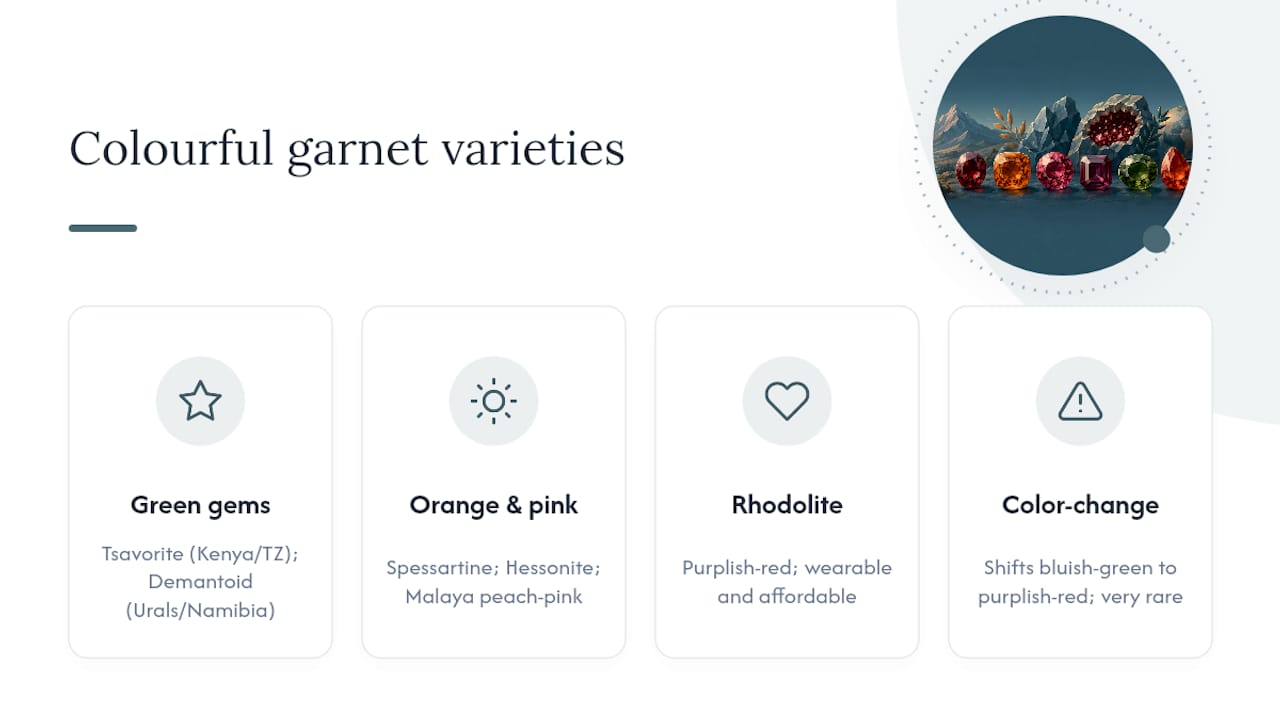
Garnet appears in nearly every colour except blue, which is exceptionally rare and mostly limited to a handful of Madagascar and East African finds. Green garnets carry the most prestige in this family. Tsavorite, a green grossular first identified in Kenya and Tanzania in the 1960s, gets its colour from vanadium and chromium. Demantoid, a green andradite from Russia’s Ural Mountains and later Namibia, is prized for a fire that can outshine diamond in the right cut.
Orange and pink varieties round out the palette with more accessible price points. Spessartine delivers bright mandarin orange. Hessonite, a brownish orange to cinnamon grossular variety, has been carved and worn for centuries in South Asian jewellery traditions. Malaya splits the difference with a warm peachy pink that photographs beautifully in mixed-metal settings.
Rhodolite deserves its own mention for sheer wearability: its purplish red sits between garnet’s classic deep red and something closer to amethyst, and it’s one of the more affordable named varieties for everyday jewellery.
Quick colour fact: color-change garnets, which shift from bluish green in daylight to purplish red under incandescent light, are among the rarest stones in the entire gem trade, rarer by most collector accounts than fine emerald in equivalent sizes.
Quality factors: what actually determines a garnet’s value
Judging a garnet takes more than eyeballing colour. Here’s the practical order collectors and appraisers work through:
- Colour first, always. Hue, tone, and saturation get evaluated against the expectations for that specific variety. GIA’s buyer’s guidance treats colour as the single most influential factor in garnet pricing.
- Clarity, with different standards by species. Almandine and pyrope are typically eye-clean. Spessartine and hessonite commonly carry visible inclusions, and in hessonite those swirling inclusions (sometimes called a “scotch in water” effect) are diagnostic, not a flaw, so don’t penalize a stone for something that’s actually confirming its identity.
- Cut and proportion. Garnet cutters often sacrifice some weight retention to maximize brilliance, particularly with demantoid, where dispersion is the whole point.
- Carat weight and rarity interaction. This is where the market gets uneven. A three-carat almandine is unremarkable. A three-carat fine demantoid or tsavorite can be exponentially more valuable than a one-carat stone of the same quality, because clean material that size is genuinely scarce.
- Hardness and durability. Most gem-quality garnets sit at 6.5 to 7.5 on the Mohs scale, which puts them solidly in daily-wear territory. Check our Mohs hardness scale guide if you’re comparing garnet against other stones you’re considering for a ring.
Pro Tip: If a seller can’t tell you which garnet variety you’re looking at beyond “garnet,” ask for a refractive index reading. It’s a five-minute test that separates almandine from pyrope from rhodolite far more reliably than eyeballing colour under a store light.
How to choose a garnet: a checklist for collectors and jewellery buyers
Start by deciding what you actually want. A display specimen for a shelf has different priorities than a ring you’ll wear daily, and a budget piece for casual collecting doesn’t need the same scrutiny as an investment-grade demantoid.
Once you know your goal, work through this checklist before you buy:
- Confirm the exact variety, not just “garnet” (ask for species and, if relevant, locality)
- Ask directly whether the stone has been treated or enhanced in any way
- Request weight, measurements, and, for specimens, matrix composition
- Ask for a gemmological report on anything above a modest budget threshold
- Confirm the return policy before paying, especially for online purchases
Watch for a few warning signs. Vague labeling like “genuine garnet” with no species named is a red flag. So is a listing with only stock photography and no actual images of the specimen in hand. Evasive answers about where a stone was mined, particularly for supposedly rare varieties like tsavorite or demantoid, should make you walk away.
When comparing listings online, consistent lighting across photos matters more than people assume, since garnet’s colour can shift dramatically under different bulbs. Ask for a photo with a scale reference, and request a short video if the price justifies it. Anyone building a collection should also read through our collector’s guide to specimen types and value before making a first specimen purchase.
Care and wearability: keeping garnet jewellery in good shape
Warm soapy water and a soft brush clean most garnet varieties safely. Skip harsh chemicals entirely. Ultrasonic and steam cleaners are fine for eye-clean, stable varieties like almandine and pyrope, but skip them for heavily included stones such as hessonite, where trapped fluid inclusions can react badly to heat or vibration.
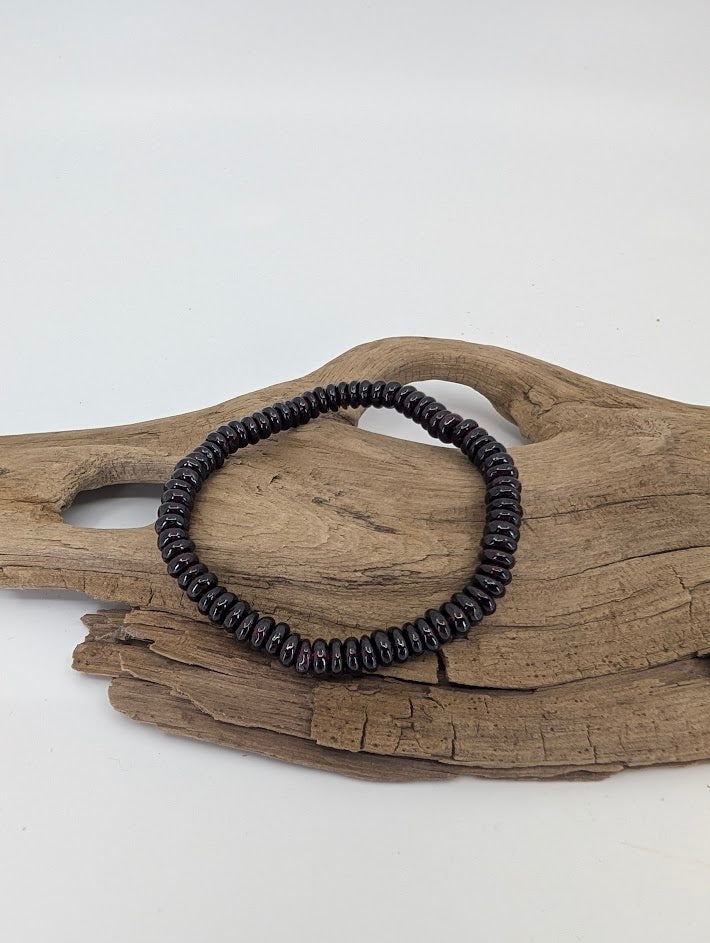
For rings, choose a protective setting like a bezel if the stone sees daily wear. Pendants and earrings face less abrasion risk, so a simpler prong setting works well. A garnet bracelet in bead form is generally forgiving, provided you take it off before heavy manual work.
Why trust this guide
This guide was written by Simon at Legacy Crystals and Minerals, drawing on gemmological references from GIA and Gem-A alongside hands-on specimen sourcing. Legacy Crystals and Minerals stocks museum-grade material, including a documented almandine garnet specimen from River Valley, Ontario, the kind of provenance detail that separates a serious mineral dealer from a generic reseller.
Garnet pieces worth a closer look
If today’s reading has you eyeing an actual specimen or a piece to wear, There are various garnet specimen and jewelry options available that reflect the qualities and varieties discussed earlier.
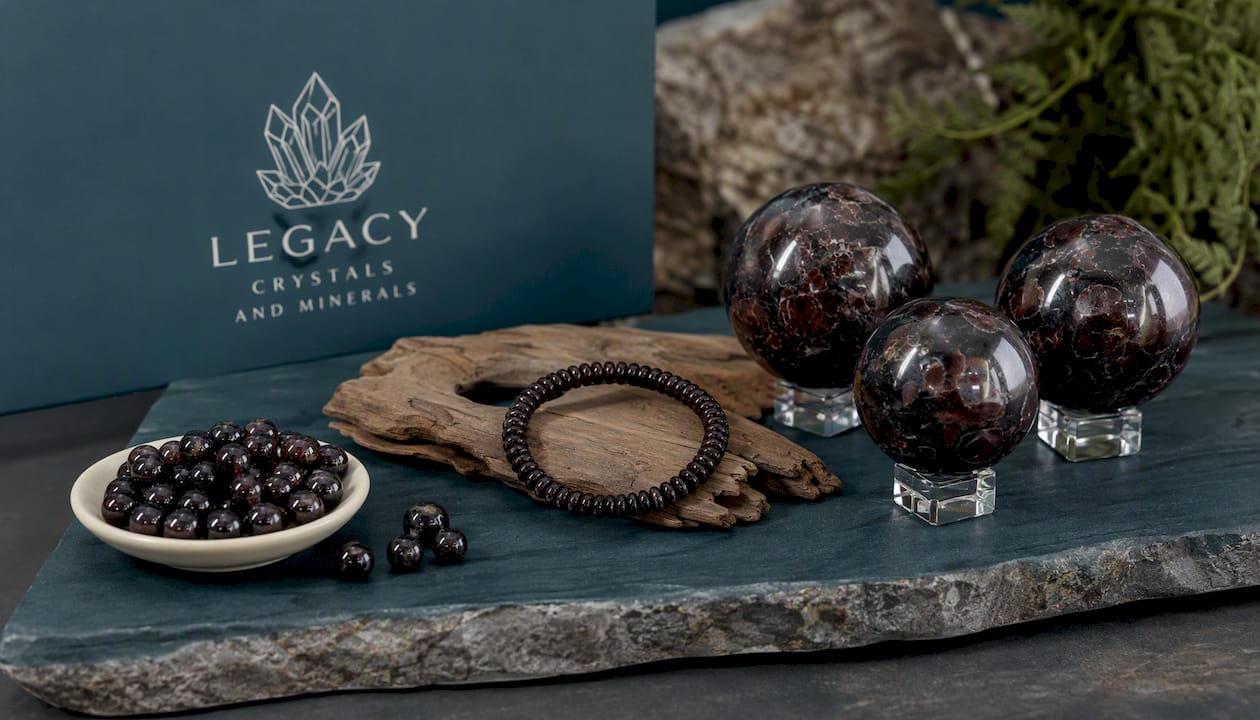
The Garnet Mini Spheres, available in small, medium, and large, suit anyone who wants a clean, display-ready piece of garnet without committing to a full raw specimen. For daily wear, the Garnet Rondelle Bracelet in 5.5 mm Heishi cut, deep almandine, delivers the classic almandine red in a wearable format that holds up to the hardness expectations covered in the quality section above. Collectors after something with genuine mineralogical interest should look at the Almandine Garnet in Biotite Matrix Spheres, where the garnet crystals sit visibly within their natural host rock rather than being cut free of it.
Every listing states species and origin plainly. If you’re building out a broader collection, the raw minerals and crystals collection and the museum quality minerals and crystals selection are worth browsing alongside garnet-specific pieces, and the bracelets and jewelry collections cover wearable options beyond the single bracelet featured here. Check current pricing directly on each product page.
Sources
- Garnet | GIA
- Buying guide: What are the different types of garnet? | Gem‑A
- GIA — Garnet care & cleaning
FAQ
What are the six main types of garnet?
The six primary gem species are pyrope, almandine, spessartine, grossular, andradite, and uvarovite, split into the pyralspite and ugrandite series. Trade names like rhodolite and tsavorite describe specific colour varieties within those species rather than separate minerals.
Which type of garnet is most valuable?
Demantoid and tsavorite, both green varieties, typically command the highest prices, and their value rises sharply with size because large, clean stones are genuinely scarce. Common red almandine and pyrope stay affordable even at larger carat weights.
What is the rarest colour of garnet?
True blue garnet is the rarest colour, found in only a few known localities and almost never in gem quality large enough to facet. Colour-change garnets, which shift hue under different lighting, are also among the scarcest varieties collectors encounter.
Who cannot wear red garnet?
There’s no medical or gemmological reason someone can’t wear red garnet; at a Mohs hardness of 6.5 to 7.5, it holds up fine for most people in daily jewellery. Anyone with a specific sensitivity to metal settings, rather than the stone itself, should check the mount material instead.


