

Tarifs 2026 des spécimens de grandidierite : Ce que les collectionneurs doivent demander
La grandidierite est l'une des gemmes bleu-vert les plus rares de la planète, et les collectionneurs la prisent car les pièces transparentes et fortement pléochroïques sont presque introuvables. Les spécimens se présentent sous forme de morceaux de minéraux bruts, de pièces de collection de qualité cabinet, de cabochons et, rarement, de gemmes facettées. Avant de dépenser un euro, la transparence et la provenance vérifiée importent plus que la taille ou la saturation de la couleur à elles seules.
TL;DR:
- La transparence et la provenance influencent considérablement le prix, les belles pierres transparentes atteignant des milliers de dollars par carat, tandis que le matériau opaque reste abordable.
- Les spécimens authentiques présentent un pléochroïsme distinct, passant du bleu-vert au vert et au quasi-incolore lorsqu'ils sont tournés sous la lumière. L'absence de ce trait indique une éventuelle fausse représentation.
- La plupart des pièces transparentes de grande valeur sont taillées en cabochons ou en gemmes facettées ne dépassant pas 5 carats en raison de leur fragilité et de la présence de plans de clivage.
- Les acheteurs doivent vérifier l'authenticité à l'aide de rapports de laboratoire, de la localité d'origine, de photos haute résolution et de résultats de tests indépendants avant l'achat.
- Un entretien approprié implique un nettoyage délicat, un montage soigné pour éviter la pression sur les plans de clivage, et le stockage des spécimens dans des environnements rembourrés et à faible humidité.
Table des matières
- Qu'est-ce que la grandidierite et d'où vient-elle ?
- Comment identifier et évaluer un spécimen de grandidierite ?
- Quels types de spécimens trouverez-vous en vente ?
- Qu'est-ce qui détermine la valeur et le prix de la grandidierite ?
- Où acheter et que demander en premier ?
- Comment prendre soin et exposer la grandidierite ?
- Où trouver de la grandidierite authentifiée et d'autres spécimens rares ?
- Sources
- FAQ
Qu'est-ce que la grandidierite et d'où vient-elle ?
La grandidierite est un borosilicate de magnésium, de fer et d'aluminium qui se forme dans les roches métamorphiques, ce qui explique pourquoi on la trouve aux côtés d'autres minéraux de bore dans quelques endroits géologiquement spécifiques du monde. Son trait distinctif est le pléochroïsme trichroïque : inclinez un morceau sous la lumière et vous le verrez passer du bleu-vert au vert et aux tons presque incolores selon l'angle d'observation.
Chiffres clés à connaître avant d'acheter :
- Dureté Mohs d'environ 7,5, suffisamment résistante pour une manipulation soigneuse mais pas à l'abri des éclats.
- L'indice de réfraction et la densité se situent dans les plages typiques des minéraux de borosilicate, des détails qu'un rapport de laboratoire confirmera.
- Les principales sources sont les districts de Tranomaro et Andrahomana à Madagascar et le Sri Lanka, Mindat répertoriant une courte liste d'occurrences mondiales mineures.
Comprendre ce qui rend tout spécimen rare aide à contextualiser le statut de la grandidierite. Legacy Crystals and Minerals couvre les mécanismes plus larges de ce qui rend un minéral rare pour les collectionneurs qui envisagent leur prochaine acquisition.
Comment identifier et évaluer un spécimen de grandidierite ?
L'évaluation de la grandidierite repose sur trois éléments : ce que vous pouvez voir, ce qu'un laboratoire confirme et les documents que le vendeur peut produire. Voici la séquence suivie par les acheteurs expérimentés.
- Vérifier le pléochroïsme. Faites pivoter la pierre sous une source de lumière forte. La grandidierite véritable change visiblement entre le bleu-vert, le vert et l'incolore. Une pierre qui semble de la même couleur sous tous les angles est un signal d'alarme.
- Évaluer la clarté et le fenêtrage. Recherchez une « fenêtre » (une zone transparente au centre) dans les cabochons, car cela indique souvent un matériau mince taillé pour maximiser la taille apparente plutôt que la qualité.
- Vérifier attentivement la dureté et l'indice de réfraction. Un bijoutier ou un gemmologue peut confirmer que l'IR se situe dans la plage connue de la grandidierite sans endommager la pierre, car les tests de rayure risquent d'endommager les plans de clivage du matériau.
- Demander la documentation. Demandez un rapport de laboratoire gemmologique, la localité déclarée et des photos haute résolution prises à côté d'une règle ou d'une pièce de monnaie pour l'échelle.
Legacy Crystals and Minerals recommande de consulter les principes fondamentaux plus larges de l'évaluation dans son guide d'évaluation des spécimens minéraux avant de comparer les annonces individuelles.
Conseil de pro : Photographiez vous-même le spécimen à la lumière naturelle du jour et à nouveau sous un éclairage intérieur chaud. Si le changement de couleur correspond à ce que montrent les photos du vendeur, vous regardez un matériau cohérent et honnêtement représenté.
Les recherches sur le terrain du GIA ont documenté la première vague moderne de grandidierite facettable du gisement de Tranomaro à Madagascar en 2015, et cette seule découverte reste une référence quant à la rareté du matériau brut transparent, même aujourd'hui.
Quels types de spécimens trouverez-vous en vente ?
Les annonces se répartissent généralement en quatre catégories, et savoir laquelle vous examinez modifie ce que vous devez vous attendre à payer et la manière dont vous l'exposerez ou le porterez.
- Spécimens bruts : morceaux de cristal non polis, appréciés principalement pour leur intérêt minéralogique, leur zonage de couleur et leur attachement à la matrice.
- Spécimens de cabinet : pièces taillées ou taillées, montées ou exposées pour leur forme cristalline et leur couleur, courantes dans les collections minérales sérieuses.
- Cabochons : coupes polies et bombées faites à partir de matériaux translucides à opaques, généralement de 1 à 10 carats.
- Gemmes facettées : réservées au matériau transparent rare, généralement finies à moins de 5 carats, car le brut transparent plus grand n'est presque jamais trouvé intact.
La grandidierite facettée est suffisamment fragile pour que la plupart des gemmologues déconseillent les montages pour un usage quotidien. Les plans de clivage signifient qu'un coup dur contre un comptoir ou une portière de voiture peut ébrécher une pierre finie, donc les montures d'exposition ou les bijoux pour des occasions spéciales ont plus de sens qu'une bague de tous les jours.
Qu'est-ce qui détermine la valeur et le prix de la grandidierite ?
La transparence est le facteur le plus important du prix, point final. Une pierre qui laisse passer la lumière proprement commande un prix considérablement plus élevé qu'une pièce opaque de taille identique, et cet écart se creuse à mesure que la clarté s'améliore.
Les indications de prix approximatives pour 2026 se divisent en grandes catégories :
- Matériau commercial opaque : prix modestes par carat, adaptés aux spécimens d'exposition ou d'étude plutôt qu'aux bijoux.
- Cabochon translucide de qualité : un cran au-dessus, dont le prix est basé sur la saturation de la couleur et la qualité de la taille.
- Pierres facettées incluses : encore plus chères, bien que les inclusions visibles réduisent toujours le prix par rapport au matériau propre.
- Fines gemmes transparentes : le summum, où les prix peuvent atteindre plusieurs milliers de dollars par carat pour une couleur et une clarté exceptionnelles.
Après la transparence, la qualité de la taille, le poids en carats et la provenance documentée déterminent le reste du prix. Une pierre avec un rapport de laboratoire correspondant et une localité déclarée se vendra toujours mieux qu'une pièce d'apparence identique sans documentation. Pour tout achat supérieur à quelques centaines de dollars, demandez si une vérification en laboratoire indépendant est disponible, et envisagez de faire une évaluation pour l'assurance une fois que vous la possédez. Les spécimens transparents de grande valeur méritent d'être protégés de la même manière que vous assureriez toute belle gemme.
Où acheter et que demander en premier ?
La rareté de la grandidierite attire à la fois des spécialistes légitimes et des vendeurs qui étirent la vérité sur la localité ou la clarté. Tenez-vous-en aux canaux ayant une bonne réputation : marchands de minéraux spécialisés, maisons de vente aux enchères établies avec des processus d'examen gemmologique, et détaillants sélectionnés qui étayent leurs affirmations avec des documents de laboratoire.
Avant de vous engager dans un achat, demandez ce qui suit :
- Localité déclarée, idéalement recoupée avec des gisements connus comme Tranomaro ou le Sri Lanka.
- Un rapport de laboratoire gemmologique pour toute pierre transparente ou facettée de grande valeur.
- Photos haute résolution avec une référence d'échelle visible (règle, pièce de monnaie ou carte calibrée).
- Résultats de tests indépendants confirmant l'IR et la dureté lorsque le prix le justifie.
- Une politique de retour clairement énoncée au cas où le spécimen ne correspondrait pas à sa description à l'arrivée.
Méfiez-vous de ces signaux d'alarme :
- Aucune localité indiquée, ou une revendication de localité qui ne correspond pas aux occurrences documentées.
- Refus de fournir des tests de laboratoire sur une pierre transparente coûteuse.
- Photos sans référence d'échelle, rendant la taille et la proportion impossibles à juger.
- Prix bien inférieurs aux niveaux du marché pour la qualité indiquée, ce qui signifie généralement un matériau mal identifié ou surestimé.
Un vendeur qui répond à ces questions facilement, sans hésitation ni détournement vague, vaut votre confiance. Celui qui les esquive ne l'est pas.
Comment prendre soin et exposer la grandidierite ?
Le clivage de la grandidierite est sa plus grande vulnérabilité, une manipulation douce est donc plus importante qu'avec des gemmes plus résistantes. Nettoyez les spécimens avec une brosse douce, un détergent doux et de l'eau tiède uniquement. Évitez complètement les nettoyeurs à ultrasons et à vapeur ; les vibrations et la chaleur peuvent ouvrir des microfissures le long des plans de clivage que vous ne verrez pas avant qu'il ne soit trop tard.
- Orientez l'éclairage de l'écran pour capter le changement pléochroïque ; une seule source de lumière fixe masque l'effet qui fait que la grandidierite vaut la peine d'être collectionnée.
- Montez les cabochons et les pierres facettées de manière à ce qu'aucun fermoir ou sertissage n'exerce de pression directement le long d'un plan de clivage.
- Rangez les spécimens en vrac dans des boîtes rembourrées et à faible humidité, et conservez la documentation avec la pièce.
Conseil de pro : Photographiez votre spécimen sur un fond uni le jour même où vous le recevez. Si vous devez un jour déposer une demande d'indemnisation, des photos datées avec des détails visibles sur l'état simplifieront considérablement le processus.
Pour des détails plus approfondis sur le stockage et le nettoyage de l'ensemble de votre collection, Legacy Crystals and Minerals propose un guide dédié sur l'entretien de vos spécimens.
Où trouver de la grandidierite authentifiée et d'autres spécimens rares ?
L'approvisionnement en un spécimen authentique de grandidierite implique de faire confiance à la parole du vendeur concernant la localité, la clarté et les tests, car si peu de pièces existent qu'une seule pierre mal représentée peut vous coûter des centaines de dollars. Legacy Crystals and Minerals propose des minéraux de qualité musée et des spécimens rares avec des notes d'état, des documents de provenance et des photographies à l'échelle inclus dans chaque annonce, afin que vous ne soyez pas laissé à deviner ce que vous achetez réellement.
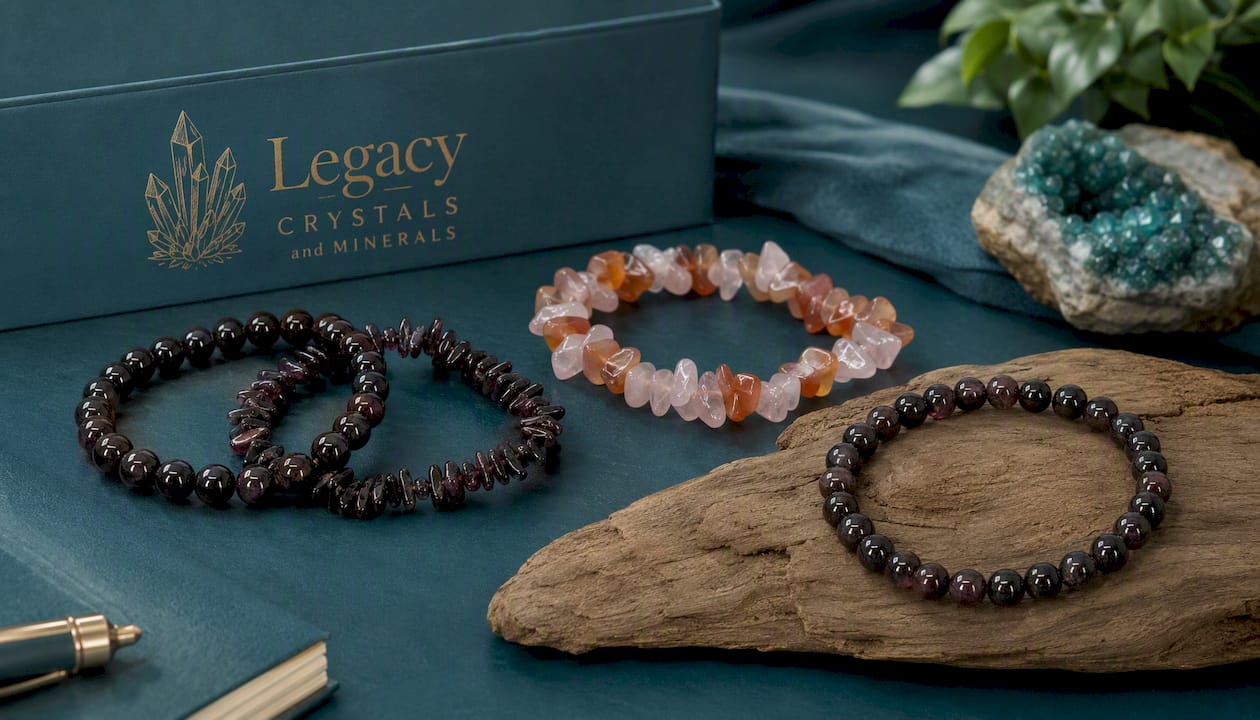
Bien que la grandidierite elle-même soit une demande spécialisée à traiter par contact direct avec notre équipe, le catalogue plus large de Legacy Crystals and Minerals reflète le même standard : pièces authentifiées, rapports d'état honnêtes et un véritable support client si une question sur un rapport de laboratoire survient après l'achat. Parcourez nos pièces minérales portables comme le Bracelet en grenat et astrophyllite en mélanges de 6 mm et 8 mm, le Bracelet en chips de quartz rose et cornaline, ou le Bracelet en grenat disponible en styles ronds ou chips de 3 mm, 6 mm, 7 mm et 8 mm. Si vous recherchez un spécimen rare spécifique comme la grandidierite, contactez directement le service client. Nous vous expliquerons la documentation à attendre et vous aiderons à éviter les erreurs d'approvisionnement qui piègent les acheteurs novices.
Sources
- Grandidierite de Madagascar | Gemmes et Gemmologie
- Informations sur les bijoux et les pierres précieuses de grandidierite - Gem Society
- Guide des prix de la grandidierite : Valeur et coût en 2026 - GemsLore
- Mindat
FAQ
La grandidierite est-elle précieuse ?
Oui. Le matériau commercial opaque se vend à des prix modestes par carat, tandis que les belles pierres facettées transparentes peuvent atteindre plusieurs milliers de dollars par carat, faisant de la transparence le facteur le plus important de la valeur globale.
Comment savoir si la grandidierite est vraie ?
Recherchez le pléochroïsme trichroïque (un changement entre le bleu-vert, le vert et l'incolore sous différents angles), confirmez une dureté d'environ 7,5 et demandez un rapport de laboratoire gemmologique vérifiant l'indice de réfraction pour toute pièce de grande valeur.
Quelle est la signification spirituelle de la grandidierite ?
Certains collectionneurs associent la grandidierite à la clarté de la communication et à la perspicacité sereine, en lien avec sa douce teinte bleu-vert, bien qu'il s'agisse d'une interprétation personnelle et métaphysique plutôt que d'une affirmation scientifique.
Où peut-on trouver de la grandidierite ?
Les principales sources sont les districts de Tranomaro et Andrahomana à Madagascar et le Sri Lanka, les occurrences documentées ailleurs restant mineures et rares en comparaison.


