

Comment repérer les faux cristaux en ligne : un guide pratique
Les faux cristaux sont définis comme des pierres vendues comme des minéraux naturels qui sont soit entièrement synthétiques, fabriquées à partir de verre ou de résine, soit des minéraux réels tellement traités que les vendeurs les présentent de manière trompeuse. La chose la plus importante à comprendre avant d'acheter de véritables cristaux en ligne est que les contrefaçons pures sont moins courantes que les pierres traitées. La plupart des "faux" cristaux sont en fait des minéraux réels altérés par la teinture, la chaleur ou la stabilisation. Connaître cette distinction change votre façon de faire des achats. L'échelle de Mohs, les tests de conductivité thermique et l'inspection par grossissement sont les trois méthodes les plus fiables pour identifier les vrais cristaux des faux à la maison, et chacune est plus facile à appliquer que la plupart des acheteurs ne l'imaginent.
Comment repérer les faux cristaux en ligne avant qu'ils n'arrivent
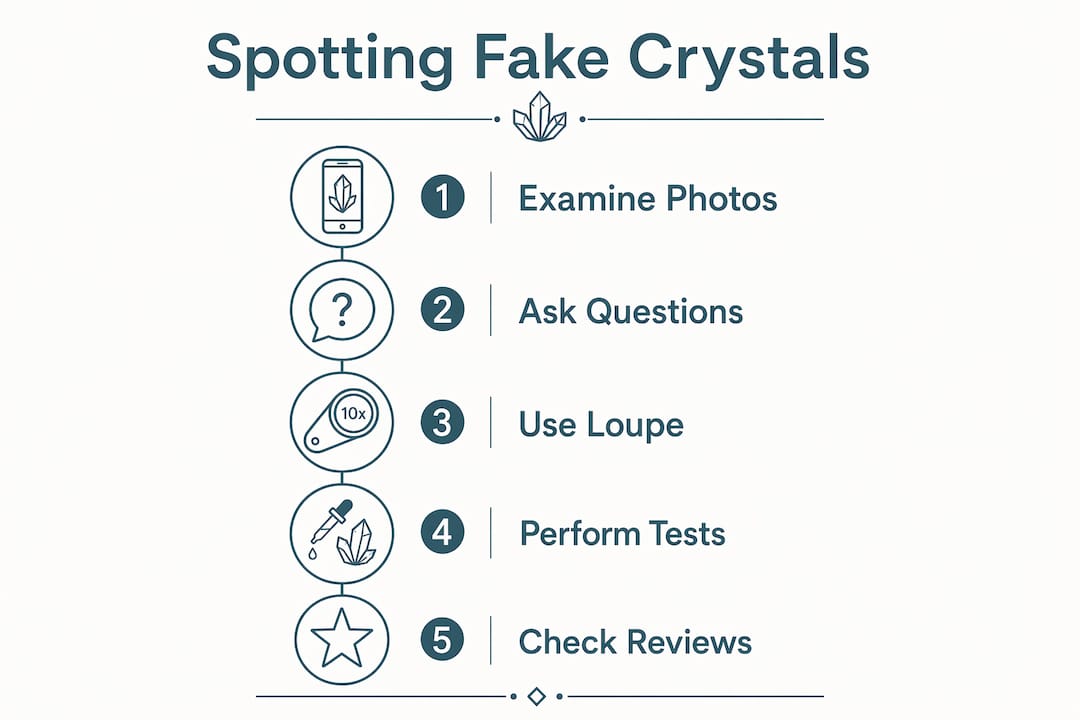
La première ligne de défense est ce que vous voyez sur la page de l'annonce, avant de dépenser un centime. Les vidéos de listes sous lumière naturelle donnent des indices d'authenticité plus solides que les photos statiques. Les images fortement éditées avec des couleurs saturées et aucune inclusion visible sont un signe d'avertissement, pas un argument de vente.
Posez trois questions au vendeur avant d'acheter : Où a-t-il été extrait ? A-t-il été traité ? Avez-vous une politique de retour ? Un vendeur qui ne peut pas répondre clairement à ces trois questions est à éviter. Les détaillants légitimes documentent l'origine et le traitement car la transparence protège leur réputation.
Vérifiez la description de l'annonce pour des mots comme « amélioré », « couleur stabilisée » ou « créé en laboratoire ». Ces termes ne sont pas automatiquement mauvais, mais leur absence quand ils devraient être présents est un signal d'alarme. Un vendeur proposant une turquoise bleu vif à bas prix sans mention de stabilisation omet presque certainement des informations critiques.
Quels outils avez-vous besoin pour vérifier les cristaux à la maison ?
Une fois votre commande arrivée, un petit ensemble d'outils vous permet d'effectuer des vérifications fiables sans aucun équipement de laboratoire. Chaque outil cible une propriété différente de la pierre.
- Loupe de bijoutier 10x : Révèle les caractéristiques internes. Les bulles d'air sphériques à l'intérieur d'une pierre confirment le verre ou la résine. Les pierres naturelles ne contiennent jamais de bulles parfaitement rondes.
- Lampe de poche LED : Illumine la structure interne, le zonage de couleur et les fractures. Tenez-la derrière la pierre dans une pièce sombre.
- Lime à ongles en acier (dureté 6,5) : Utilisée pour les tests de rayure selon l'échelle de Mohs.
- Acétone et coton-tige : Détecte le colorant de surface. Frottez une zone cachée ; le transfert de couleur sur le coton-tige signifie une coloration artificielle.
- Balance de cuisine : Un poids anormalement léger pour la taille d'une pierre suggère une construction creuse, un remplissage en résine ou du plastique.
| Outil | Ce qu'il détecte | Coût |
|---|---|---|
| Loupe de bijoutier 10x | Bulles d'air, inclusions, texture | Faible |
| Lampe de poche LED | Zonage de couleur, fractures, clarté | Faible |
| Lime à ongles en acier | Dureté, test de rayure Mohs | Faible |
| Acétone + coton-tige | Colorant de surface, coloration artificielle | Très faible |
| Balance de cuisine | Densité, remplissage de résine, plastique | Faible |
Astuce de pro : Testez d'abord l'acétone sur une petite surface cachée. Certaines pierres naturelles ont des traitements de surface acceptables et divulgués ; le test vous indique si la couleur est dans la pierre ou sur celle-ci.
Avant d'effectuer tout test, photographiez la pierre sous plusieurs angles. Cela vous protège si vous devez contester, et cela entraîne votre œil au fil du temps à reconnaître plus rapidement les caractéristiques naturelles.
Quels tests rapides identifient de manière fiable les vrais cristaux des faux ?
Cinq tests couvrent la grande majorité des questions d'authenticité pour les cristaux achetés en ligne. Exécutez-les dans l'ordre du moins invasif au plus invasif.
-
Test de température. Tenez la pierre dans votre paume pendant 30 secondes. Les cristaux naturels absorbent la chaleur de votre peau plus rapidement que le verre ou le plastique. Une pierre qui se réchauffe immédiatement est probablement du verre ou de la résine. Le quartz véritable reste frais nettement plus longtemps.
-
Inspection par grossissement. Utilisez votre loupe 10x sous une lumière vive. Les cristaux naturels présentent des fractures irrégulières, des inclusions et des voiles. Les spécimens plus grands parfaitement clairs et sans défaut sont suspects. Les bulles sphériques confirment immédiatement le verre ou la résine.
-
Test de rayure de Mohs. Le quartz se situe à 7 sur l'échelle de dureté de Mohs. Le verre se situe à 5,5 et une lime en acier à 6,5. Si une lime en acier raye votre quartz, la pierre n'est presque certainement pas du quartz véritable. Passez la lime sur un bord caché et vérifiez s'il y a une rainure.
-
Test de teinture à l'acétone. La howlite teintée est fréquemment vendue comme de la turquoise. Frottez de l'acétone sur une zone cachée. Le transfert de couleur signifie que la pierre a été artificiellement teintée. La turquoise véritable et la howlite véritable sont toutes deux des minéraux légitimes ; le problème est de les étiqueter l'une pour l'autre.
-
Vérification du poids et de la densité. La résine et le plastique pèsent nettement moins que les équivalents minéraux de même taille. Si un « cristal » semble creux ou comme un jouet dans votre main, cette impression physique est une donnée fiable.
Astuce de pro : Pour la moldavite spécifiquement, recherchez une texture givrée et mate avec des piqûres irrégulières. La fausse moldavite a un aspect brillant et uniforme. La vraie moldavite a des caractéristiques de sculpture nettes que les imitations en verre ne peuvent pas reproduire.
Pierres traitées vs contrefaçons pures : quelle est la vraie différence ?
Comprendre cette distinction est la chose la plus utile que vous puissiez apprendre sur l'approvisionnement authentique en cristaux. Les pierres traitées sont des minéraux réels. Les contrefaçons pures ne le sont pas.
Jusqu'à 90 % de la turquoise vendue sur le marché américain est stabilisée avec de la résine pour améliorer sa dureté et sa couleur. Ce chiffre signifie que la plupart des turquoises que vous rencontrez en ligne ont été traitées. La turquoise stabilisée est toujours de la vraie turquoise. Le problème survient lorsque les vendeurs la présentent comme une pierre naturelle non traitée et la facturent en conséquence.
Le traitement thermique est l'une des pratiques les plus répandues dans le commerce des cristaux. L'améthyste, par exemple, devient jaune ou orange lorsqu'elle est chauffée, puis est vendue comme citrine. La pierre est du vrai quartz. La couleur n'est pas naturelle. Un traitement thermique non divulgué présenté comme une pierre de couleur naturelle trompe les acheteurs et gonfle les prix. La divulgation est la norme ; son absence est le problème.
Les catégories de préoccupation se décomposent comme suit :
- Pierres stabilisées : Minéraux réels durcis ou colorés avec de la résine (turquoise, malachite). Acceptable si divulgué.
- Pierres traitées thermiquement : Minéraux réels avec une couleur altérée (améthyste vendue comme citrine, topaze pâle approfondie en bleu). Acceptable si divulgué.
- Pierres teintes : Minéraux réels avec une couleur artificielle de surface ou en profondeur (howlite teinte pour imiter la turquoise ou le lapis-lazuli). Acceptable si divulgué.
- Cristaux de laboratoire : Compositions chimiques authentiques cultivées dans des conditions contrôlées. Pas des faux, mais pas naturels. Doit être divulgué.
- Imitations en verre et résine : Pas du tout des minéraux. Vendues comme cristaux sans divulgation. Ce sont de pures contrefaçons.
La vraie turquoise a un éclat cireux à porcelaine avec une matrice irrégulière. La howlite teintée a des veines plus uniformes et un éclat vitreux. Cette différence visuelle est détectable avec une loupe et un bon éclairage, même pour un débutant.
La base de connaissances sur les cristaux de Legacy Crystals and Minerals couvre en détail les divulgations de traitement et l'éducation minérale, ce qui est utile lorsque vous essayez d'interpréter la description de produit d'un vendeur.
Quels signaux d'alarme indiquent une annonce de cristal en ligne suspecte ?
Certains schémas d'annonces apparaissent constamment dans les ventes de cristaux frauduleuses ou trompeuses. Les reconnaître permet d'économiser du temps et de l'argent.
- Chaque pièce du catalogue d'un vendeur semble identique en taille, couleur et forme. Les spécimens naturels varient.
- Les photos sont fortement filtrées, prises uniquement sur des fonds noirs, ou ne montrent aucune inclusion.
- L'annonce utilise des mots comme « rare » et « puissant » pour chaque article sans contexte géologique.
- Aucune politique de retour ou d'échange n'est répertoriée sur le site.
- Le prix d'une pierre rare nommée (moldavite, larimar de haute qualité, tanzanite de qualité gemme) est considérablement inférieur au prix du marché.
| Caractéristique de l'annonce | Vendeur fiable | Annonce suspecte |
|---|---|---|
| Photos | Multi-angles, lumière naturelle, inclusions visibles | Image unique éditée, pas d'inclusions |
| Vidéo | Disponible sur demande ou listée | Non disponible |
| Divulgation du traitement | Clairement indiquée | Absente ou vague |
| Informations sur l'origine | Mine ou région nommée | « Cristal naturel » uniquement |
| Politique de retour | Clairement indiquée | Manquante |
| Prix | Conforme au marché | Anormalement bas pour les pierres rares nommées |
La vidéo sous lumière naturelle non éditée est le signal d'authenticité le plus fort disponible pour les acheteurs en ligne. Demandez-la si elle n'est pas déjà dans l'annonce. Un vendeur avec un stock authentique n'hésitera pas.
Vérifiez les avis des vendeurs sur des plateformes indépendantes plutôt que de vous fier uniquement aux témoignages sur le site. Recherchez spécifiquement les avis qui mentionnent la réception de pierres correspondant aux photos, un dimensionnement précis et une divulgation honnête du traitement. Pour les collectionneurs qui construisent une collection sérieuse, le guide de collection de cristaux de qualité musée chez Legacy Crystals and Minerals décrit ce qu'il faut rechercher pour un approvisionnement réputé.
Points clés à retenir
Repérer les faux cristaux en ligne nécessite de connaître la différence entre les vraies pierres traitées et les imitations pures, puis d'appliquer de simples tests physiques après l'achat.
| Point | Détails |
|---|---|
| Traité vs faux | La plupart des problèmes de marché concernent des pierres réelles traitées, et non des imitations en verre ou en plastique. |
| Inspection à la loupe | Une loupe de bijoutier 10x révèle des bulles d'air sphériques qui confirment les contrefaçons en verre ou en résine. |
| Test de rayure Mohs | Le quartz véritable (dureté 7) résiste à une lime en acier (dureté 6,5) ; une rayure confirme une contrefaçon. |
| Signaux d'alarme de l'annonce | L'absence de divulgation de traitement, les spécimens identiques et l'absence de politique de retour signalent un vendeur suspect. |
| Vidéo plutôt que photos | Demandez une vidéo sous lumière naturelle ; elle fournit des indices d'authenticité plus solides que les images statiques éditées. |
Ce que j'ai appris au cours de mes années d'approvisionnement en cristaux
Le conseil que je donne le plus souvent est le suivant : cessez d'attendre la perfection comme preuve de qualité. Les nouveaux collectionneurs rejettent fréquemment des spécimens authentiques parce qu'ils présentent des fractures, une couleur inégale ou de petits éclats. Ces caractéristiques sont des preuves d'authenticité, et non des défauts. Les cristaux naturels présentent des fractures irrégulières, des inclusions et des voiles. Un spécimen grand, impeccable et parfaitement symétrique devrait susciter votre suspicion, pas votre enthousiasme.
La deuxième chose que j'ai apprise est que la patience avant l'achat vaut plus que n'importe quel kit de test après coup. Passez du temps dans les forums de collectionneurs, lisez attentivement les divulgations de traitement et posez des questions directes aux vendeurs. Un vendeur qui répond rapidement et spécifiquement est presque toujours plus digne de confiance que celui qui répond avec un langage marketing.
Les erreurs arrivent. J'ai acheté des pierres teintes que j'ai ensuite correctement identifiées. La réponse utile est de documenter ce que vous avez reçu, de le comparer avec vos photos à la loupe et d'utiliser cette expérience pour affûter votre œil. Chaque pierre mal identifiée vous apprend quelque chose qu'un achat parfait ne peut pas vous apprendre.
La communauté autour de la collection de minéraux est vraiment bien informée et généreuse en informations. Les ressources du Gemological Institute of America (GIA), les forums de collectionneurs et les plateformes éducatives offrent tous des conseils gratuits. Utilisez-les avant de dépenser pour quoi que ce soit d'important.
— Simon
Cristaux authentiques de Legacy Crystals and Minerals
Legacy Crystals and Minerals source et répertorie des spécimens avec des informations d'origine claires, des divulgations de traitement et une photographie détaillée afin que les acheteurs sachent exactement ce qu'ils reçoivent.
Le catalogue comprend des spécimens naturels vérifiés, adaptés aux nouveaux collectionneurs comme aux amateurs expérimentés. Le groupe de cristaux de quartz clair du Brésil est un excellent point de départ pour quiconque souhaite un spécimen authentique et bien documenté avec des inclusions naturelles visibles. Pour quelque chose de plus inhabituel, le groupe de zéolite d'Inde offre une formation avec des flocons de cristaux de calcite octogonaux et des détails de provenance complets. Chaque fiche produit inclut les informations que vous savez maintenant rechercher : origine, état de traitement et photographie précise.
FAQ
Quelle est la méthode la plus simple pour identifier les faux cristaux à la maison ?
Le test de température est le point de départ le plus rapide. Les cristaux naturels restent frais plus longtemps que le verre ou le plastique lorsqu'ils sont tenus dans la paume de votre main. Suivez-le par une inspection à la loupe 10x pour des bulles d'air sphériques, qui confirment immédiatement le verre ou la résine.
La turquoise stabilisée est-elle un faux cristal ?
La turquoise stabilisée est de la vraie turquoise traitée avec de la résine pour améliorer sa dureté et sa couleur. Ce n'est pas une contrefaçon. Le problème survient lorsque les vendeurs présentent la turquoise stabilisée comme une pierre naturelle non traitée sans en faire la divulgation.
Comment savoir si un vendeur de cristaux est digne de confiance en ligne ?
Les vendeurs fiables fournissent des informations sur l'origine, des divulgations de traitement, une politique de retour et des vidéos ou des photos multi-angles sous lumière naturelle. Les vendeurs qui ne peuvent pas répondre directement aux questions sur le traitement ou l'origine de la mine sont à éviter.
Les cristaux cultivés en laboratoire peuvent-ils être vendus comme naturels ?
Les cristaux cultivés en laboratoire ont la même composition chimique que les pierres naturelles, mais sont cultivés dans des conditions contrôlées. Les vendre comme naturels sans divulgation est trompeur. Les vendeurs réputés étiquettent toujours clairement le matériau cultivé en laboratoire.
Que nous apprend l'échelle de dureté de Mohs sur un cristal ?
L'échelle de Mohs classe la dureté des minéraux de 1 à 10. Une pierre cotée 7 (comme le quartz) devrait résister aux rayures d'une lime en acier cotée 6,5. Si la lime laisse une rainure, la pierre est plus molle que ce qui est annoncé et probablement pas du quartz véritable.
Recommandé
- Construire une collection de cristaux de qualité musée : guide d'expert – Legacy Crystals and Minerals
- Top 3 des alternatives de cristaux uniques pour earthinspiredgifts.com.au 2026 – Legacy Crystals and Minerals
- Bracelet en quartz clair craquelé — Perles de 6 mm et 8 mm - Legacy Crystals and Minerals – Legacy Crystals and Minerals
- Cristaux pour l'alignement des chakras : votre guide 2026 – Legacy Crystals and Minerals


