

Signification de la labradorite : un guide pour les chercheurs spirituels
La labradorite est la pierre de la transformation. Les praticiens l'utilisent pour affiner l'intuition, protéger l'aura et soutenir le changement personnel. Scientifiquement, c'est un feldspath plagioclase riche en calcium avec une dureté Mohs adaptée à la bijouterie mais nécessitant une manipulation soigneuse, identifiée par son éclair iridescent caractéristique appelé labradoréscence.
Trois utilisations métaphysiques principales :
- Intuition : favorise une connaissance intérieure plus claire et une sensibilité psychique
- Protection : utilisée pour protéger l'aura des énergies externes
- Transformation : liée au changement personnel, à la résilience et à la révélation du potentiel caché
Points clés à retenir
La signification spirituelle de la labradorite est ancrée dans son comportement optique : l'éclair caché qui n'apparaît que lorsque l'angle change est la source directe de son symbolisme de transformation et d'intuition.
| Point | Détails |
|---|---|
| Pierre de transformation | La labradorite est utilisée pour l'intuition, la protection et le changement personnel dans la pratique métaphysique. |
| La labradoréscence est interne | L'éclair provient de surfaces jumelles à l'intérieur de la pierre, et non de la surface ; l'état du poli l'affecte directement. |
| Le spectrolite est un nom commercial | Le spectrolite désigne la labradorite finlandaise vive, et non une espèce minérale distincte ; vérifiez la provenance avant d'acheter. |
| Les allégations métaphysiques ne sont pas cliniques | Les utilisations de la lithothérapie sont des traditions rapportées par les praticiens, et non des traitements validés cliniquement. |
| Legacy Crystals and Minerals | Propose des pierres roulées de qualité AA, des bracelets de perles et des bracelets de copeaux pour la méditation, le port et le transport. |
Table des matières
- Qu'est-ce que la labradorite et qu'est-ce qui la rend unique ?
- Quelle est la signification spirituelle de la labradorite ?
- Allégations de guérison de la labradorite : ce que rapportent les praticiens
- Comment utiliser la labradorite dans la pratique quotidienne ?
- Comment choisir et entretenir la labradorite ?
- Faits minéralogiques et référence d'identification rapide
- Histoire, légendes et associations culturelles
- Labradorite de Legacy Crystals and Minerals
- Sources
- FAQ
Qu'est-ce que la labradorite et qu'est-ce qui la rend unique ?
La labradorite appartient au groupe des feldspaths plagioclases. Sa composition se situe dans une gamme spécifique de teneur en anorthite, et ce rapport spécifique, combiné à un refroidissement lent pendant la formation, est ce qui permet à la labradoréscence de se développer. Tous les plagioclases présentant un effet schiller ne sont pas qualifiés de labradorite ; la bytownite et d'autres feldspaths apparentés peuvent présenter une séparation lamellaire similaire dans les bonnes conditions, ce qu'il est bon de savoir lors de l'évaluation d'un spécimen.
L'effet optique lui-même, la labradoréscence, est produit lorsque la lumière pénètre dans la pierre et se réfléchit sur des surfaces de maclage internes microscopiques. L'épaisseur et l'espacement de ces couches déterminent les couleurs qui apparaissent, généralement bleu, vert, or et violet sur une base gris foncé à presque noir. Geology note que l'effet est entièrement interne, et non un éclat de surface, c'est pourquoi l'état du poli est si important pour la performance visuelle.
Certains spécimens ne présentent aucun éclair. Cela ne les rend pas moins de qualité en tant que labradorite au sens minéralogique, mais cela affecte leur valeur sur les marchés des gemmes et métaphysiques.
Variétés courantes :
- Labradorite standard : corps foncé, éclair bleu ou vert ; la forme la plus largement disponible
- Spectrolite : un nom commercial lié à une localité pour le matériau finlandais vif avec une gamme de couleurs plus large et un corps plus foncé ; ce n'est pas une espèce minérale distincte
- Pierre de lune arc-en-ciel : une variété de labradorite blanche avec une adularescence bleue ; souvent mal étiquetée ou confondue avec la labradorite standard
Conseil de pro : Faites pivoter tout spécimen sous une seule source de lumière directionnelle, telle qu'une lampe de bureau, plutôt qu'un éclairage diffus en hauteur. La gamme complète de l'éclair ne devient visible que lorsque l'angle change.
Quelle est la signification spirituelle de la labradorite ?
La signification fondamentale de la labradorite dans la pratique métaphysique est axée sur la transformation. L'éclair caché de la pierre, invisible jusqu'à ce que l'angle change, alimente une métaphore constante : un potentiel déjà présent mais pas encore révélé. Les praticiens travaillent directement avec cette image, utilisant la pierre comme point focal pour les intentions de changement, de croissance et de découverte de ce qui a été obscurci.
Mindbodygreen décrit la labradorite comme un support pour le travail intérieur, la présentant comme un outil qui aide la lumière intérieure de l'utilisateur à briller plutôt que de faire le travail à sa place. Ce cadre est utile pour fixer des attentes réalistes dans la pratique rituelle.
Thèmes métaphysiques primaires :
- Transformation : soutient le changement aux niveaux personnel, émotionnel et spirituel
- Intuition et ouverture psychique : utilisée pour accroître la sensibilité à la guidance intérieure et à la perception subtile
- Protection et bouclier aurique : couramment placée au bord extérieur des champs énergétiques pour dévier les influences indésirables
- Clarté : liée à l'élimination du doute de soi et des croyances limitantes
Associations avec les chakras : La labradorite est le plus souvent associée au chakra du troisième œil (Ajna), qui régit l'intuition et la vision intérieure. Certains praticiens l'utilisent également au chakra de la gorge pour une communication claire et au chakra couronne pour une connexion spirituelle plus large.
Associations zodiacales : Scorpion, Sagittaire et Lion sont les signes les plus couramment liés à la labradorite dans la littérature métaphysique moderne, bien que ces associations varient selon les traditions.
Invite rituelle courte : Tenez la pierre au niveau du troisième œil ou du cœur. Fixez une intention claire liée à un changement que vous souhaitez réaliser. Observez l'éclair comme un ancrage visuel pour cette intention.
Conseil de pro : Écrivez votre intention sur papier avant une séance. Placer la pierre sur l'intention écrite pendant la méditation donne à la pratique un point focal concret et facilite son suivi dans le temps.
La labradorite est largement décrite comme une pierre qui soutient le travail intérieur de l'individu plutôt que d'agir comme une force externe, ce qui la rend bien adaptée aux pratiques réflexives et méditatives.
Allégations de guérison de la labradorite : ce que rapportent les praticiens
Les traditions de guérison par les cristaux attribuent une gamme de bienfaits émotionnels, mentaux et physiques à la labradorite. Ce sont des utilisations rapportées par les praticiens, et non des découvertes cliniques. La labradorite ne remplace pas les soins médicaux, et aucune allégation métaphysique concernant la pierre n'a été évaluée lors d'essais cliniques.
Utilisations émotionnelles et mentales les plus fréquemment rapportées :
- Diminution du doute de soi et renforcement de la résilience pendant les périodes de changement
- Soutien à la clarté mentale lorsque la prise de décision semble confuse
- Réduction de l'anxiété liée aux transitions ou à l'incertitude
- Encouragement de la pensée créative et de la résolution de problèmes
Allégations physiques ou somatiques dans les traditions de guérison par les cristaux :
- Liée à la santé des yeux et du cerveau dans certaines traditions
- Associée au soutien du système respiratoire et du métabolisme
- Utilisée par certains praticiens pendant la convalescence comme soutien complémentaire
Ces attributions physiques font partie d'une longue tradition populaire et ne sont pas étayées par des preuves évaluées par des pairs. Utilisez la labradorite comme un complément, et non un substitut, aux conseils médicaux professionnels.
Affirmations prêtes à la pratique :
- « Je fais confiance au processus de changement. »
- « Mon intuition me guide clairement. »
- « Je suis protégé et ancré à mesure que je grandis. »
Conseil de pro : Associez une affirmation à une couleur spécifique de l'éclair de la pierre. Si vous travaillez sur la clarté, concentrez-vous sur l'éclair bleu ou blanc. Pour les intentions de croissance ou d'abondance, les tons or ou vert servent d'ancrage visuel.
Comment utiliser la labradorite dans la pratique quotidienne ?
Porter de la labradorite
Le placement affecte la façon dont les praticiens souhaitent que la pierre agisse. Un bracelet de labradorite porté au poignet gauche est traditionnellement associé à la réception d'énergie, ce qui en fait un choix courant pour le travail de protection et d'intuition. Le poignet droit est lié à la projection d'énergie vers l'extérieur, ce qui convient aux intentions de communication ou de production créative.
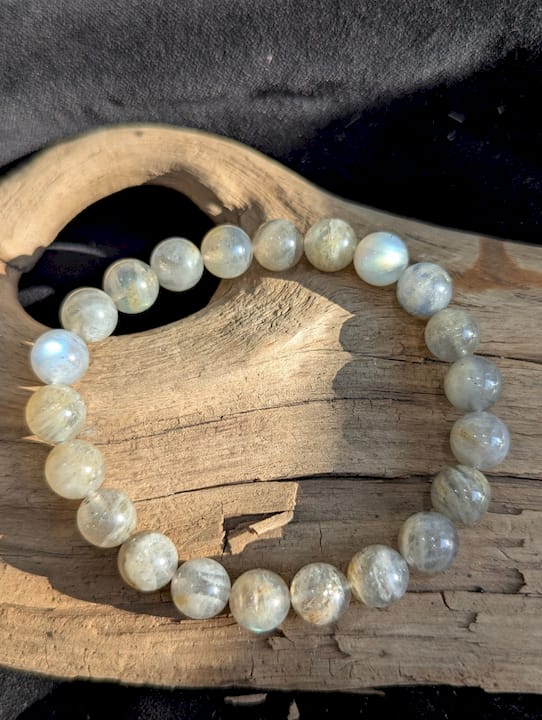
Un collier positionne la pierre près du chakra de la gorge ou du cœur, selon la longueur de la chaîne, ce qui convient aux praticiens travaillant sur l'expression ou la clarté émotionnelle.
Méditation et divination
- Trouvez un endroit calme et tenez la pierre dans les deux mains ou placez-la au niveau du troisième œil.
- Passez 1 à 3 minutes à simplement observer l'éclair sous une lumière douce. Laissez les couleurs changeantes calmer l'esprit.
- Énoncez ou visualisez clairement votre intention.
- Pour une séance plus longue de 15 à 20 minutes, placez la pierre sur le corps au point de chakra pertinent et utilisez des exercices de respiration ou une visualisation guidée pour approfondir la pratique.
- Terminez en posant la pierre intentionnellement et en notant toutes les impressions dans un journal.
Port, grilles et utilisation sur l'autel
- Portez une pierre de labradorite roulée dans une poche ou une pochette pour une protection continue tout au long de la journée.
- Dans les grilles de cristal, la labradorite fonctionne bien aux points extérieurs d'un agencement protecteur, avec une pierre d'ancrage telle que la tourmaline noire au centre.
- Sur un autel, placez-la de manière à ce qu'elle capte la lumière naturelle ou la lumière des bougies pour que la labradoréscence reste visible et active comme point focal.
Élixirs et utilisations à base d'eau
La labradorite contient des composés de silicate d'aluminium. Les élixirs à contact direct (placer la pierre dans l'eau potable) ne sont pas recommandés. Utilisez plutôt une méthode indirecte : placez la pierre dans un récipient en verre scellé, puis submergez ce récipient dans l'eau. L'intention énergétique est transférée sans que la pierre ne contacte le liquide.
Évitez :
- L'ingestion crue de tout matériau en pierre
- L'exposition prolongée au sel, qui peut piquer la surface
- La chaleur prolongée, qui peut ternir le poli et réduire la visibilité de la labradoréscence
Conseil de pro : Pour un rafraîchissement quotidien rapide, tenez la pierre sous l'eau courante froide pendant 30 secondes, puis séchez-la en tapotant avec un chiffon doux. Cela élimine la poussière de surface sans les risques de sel ou de trempage prolongé.
Comment choisir et entretenir la labradorite ?
Indicateurs de qualité
Une forte labradoréscence dépend de la structure de la couche interne, c'est pourquoi l'éclair est le principal indicateur de qualité. Lors de l'évaluation d'un spécimen :
- Intensité de l'éclair : recherchez une couleur vive et saturée qui remplit la majeure partie de la face visible
- Gamme de couleurs : un éclair multicolore (bleu, vert, or, violet) dans une seule pierre a une valeur plus élevée
- Couleur de base : un corps gris foncé à presque noir offre le meilleur contraste pour l'éclair
- Poli : une surface lisse et uniforme permet à la lumière de pénétrer proprement ; les rayures dispersent la lumière et réduisent l'effet
- Lignes de clivage : un clivage visible est normal dans le feldspath mais affecte la durabilité ; évitez les pièces présentant des fissures profondes près des bords
Spectrolite vs labradorite : signification des noms
La spectrolite est un nom commercial, pas une espèce minérale distincte. Il fait référence à un matériau de labradorite vive traditionnellement associé à la Finlande, présentant généralement un corps plus foncé et une gamme de couleurs plus large que le matériau standard. Les listes en ligne utilisent le nom de manière lâche. Lorsque la provenance n'est pas documentée, la description exacte est « labradorite avec éclair multicolore » plutôt que spectrolite.
Authentifier la labradorite naturelle
La labradorite synthétique existe, et les pierres traitées sont courantes dans la gamme de prix inférieure. Vérifications de base :
- L'éclair doit changer lorsque la pierre tourne, et non rester statique sous tous les angles (une couleur statique suggère une teinture ou un revêtement)
- La labradorite naturelle est froide au toucher et présente une structure interne visible sous grossissement
- Une couleur uniforme, parfaitement répartie et sans variation dans la base est un signal d'alarme
Pour les pièces de grande valeur, demandez un rapport de laboratoire gemmologique. Le guide d'identification des cristaux naturels vs synthétiques chez Legacy Crystals and Minerals couvre les tests visuels et tactiles en détail. Pour les achats en ligne, la liste de contrôle de protection de l'acheteur est un point de départ pratique.
Entretien et maintenance
L'usure de surface réduit la labradoréscence en obscurcissant le poli qui permet à la lumière de pénétrer proprement dans la pierre. Rangez la labradorite séparément des pierres plus dures (quartz, topaze) qui peuvent la rayer. Nettoyez avec un chiffon doux et humide. Évitez les nettoyeurs à ultrasons, la vapeur et les solutions chimiques agressives.
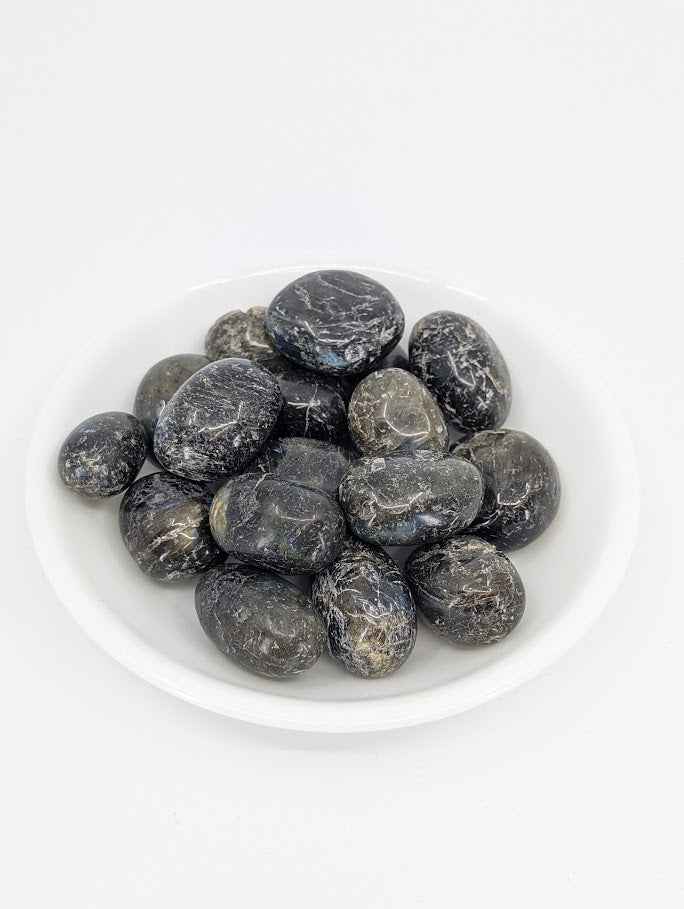
Conseil de pro : Un bracelet perlé de labradorite de 10 mm montre l'éclair sur plusieurs perles simultanément, ce qui facilite l'observation de la gamme complète de couleurs lors du port par rapport à un seul cabochon.
Faits minéralogiques et référence d'identification rapide
La labradoréscence de la labradorite se forme par maclage interne et séparation lamellaire au sein de la structure du plagioclase. Les couches agissent comme des surfaces d'interférence en film mince ; leur épaisseur et leur espacement déterminent la couleur de la lumière réfléchie. C'est pourquoi l'effet est interne et pourquoi les dommages de surface le réduisent.
Conseils d'identification :
- La strie est blanche ; utile pour exclure les minéraux sombres d'apparence similaire
- Les roches hôtes typiques sont le basalte, le gabbro et l'anorthosite, qui se forment lorsque les roches ignées mafiques se refroidissent lentement
- La labradoréscence est absente dans certains spécimens ; utilisez l'indice de réfraction et la densité pour confirmer l'identité lorsque l'effet optique n'est pas visible
- La dureté de 6 à 6,5 signifie qu'une lime en acier la rayera ; le quartz (dureté 7) la rayera également
L'identification technique utilise l'indice de réfraction et les mesures de densité pour distinguer la labradorite des feldspaths plagioclases apparentés lorsque la labradoréscence est absente, selon l'entrée minéralogique de Wikipédia.
Histoire, légendes et associations culturelles
- 1770 : Des missionnaires moraves documentent la labradorite sur la péninsule du Labrador (aujourd'hui le Canada), donnant au minéral son nom
- Légende inuite : l'Aurore Boréale aurait été piégée à l'intérieur des roches côtières ; un guerrier a frappé les roches avec sa lance pour libérer la plupart des lumières, mais certaines sont restées à l'intérieur de la pierre, qui est devenue la labradorite
- Fin du XVIIIe siècle : la pierre parvient aux collectionneurs européens et devient à la mode en France et en Angleterre.
- 1940 : la spectrolite finlandaise est découverte lors de fouilles de guerre près d'Ylämaa ; le matériau vif est nommé spectrolite et devient une pierre précieuse nationale finlandaise.
- XXe-XXIe siècle : la communauté métaphysique adopte directement l'imagerie des aurores boréales, liant l'éclat caché de la pierre aux concepts de lumière intérieure, de transformation et de potentiel révélé.
Le Crystal Almanac note que la couleur sombre du corps et l'éclat interne sont constamment utilisés dans les descriptions commerciales et métaphysiques pour soutenir les métaphores de protection et de potentiel caché, un modèle qui s'étend de la littérature des premiers collectionneurs aux guides des praticiens actuels.
Le langage métaphysique moderne a largement adapté l'imagerie inuite plutôt que d'inventer un nouveau symbolisme. Le comportement visuel de la pierre, la lumière apparaissant de l'intérieur de l'obscurité, a rendu la traduction simple.
Labradorite de Legacy Crystals and Minerals

Legacy Crystals and Minerals s'approvisionne et classe la labradorite spécifiquement en fonction de l'intensité de l'éclat, de l'état de surface et de la précision de la provenance. La collection comprend trois formats adaptés à différentes pratiques : la pierre roulée de qualité AA pour la méditation et le transport, le bracelet perlé de 10 mm pour un usage quotidien et le placement au poignet, et le bracelet rond et en éclats de 8 mm pour une option portable plus légère. Chaque pièce est sélectionnée pour sa labradorescence visible plutôt que d'être simplement listée par son nom. Parcourez la collection de labradorite de Legacy Crystals and Minerals pour trouver un spécimen ou un bijou qui correspond à votre pratique.
Sources
- Labradorite - Wikipédia
- Géologie
- mindbodygreen — Labradorite
- Labradorite - La pierre de la transformation | Crystal Almanac
- Velvetmatter
FAQ
Que fait la labradorite spirituellement ?
La labradorite est utilisée dans la pratique métaphysique pour soutenir l'intuition, protéger l'aura des énergies indésirables et faciliter la transformation personnelle. Les praticiens l'utilisent au niveau du chakra du troisième œil pour approfondir la perception intérieure et la clarté.
Quelle est la signification spirituelle de la labradorite ?
La signification principale de la labradorite est la transformation : l'éclat interne caché de la pierre symbolise un potentiel déjà présent mais pas encore visible. Elle est également associée à la protection et à l'ouverture psychique dans la plupart des traditions métaphysiques.
Quels sont les avantages de porter une pierre de labradorite ?
Porter de la labradorite maintient la pierre en contact étroit avec le champ énergétique du corps tout au long de la journée. Les praticiens signalent des avantages tels qu'une réduction du doute de soi, une plus grande clarté mentale et un sentiment de protection durable, en particulier lorsqu'elle est portée au poignet gauche.
Contre quoi la labradorite protège-t-elle ?
La labradorite est traditionnellement utilisée pour protéger l'aura des énergies négatives externes, des interférences psychiques et des effets épuisants des états émotionnels d'autres personnes. C'est l'une des pierres les plus couramment recommandées pour le travail de délimitation énergétique dans les traditions de guérison par les cristaux.


