

Signification du lapis-lazuli : symbolisme, propriétés et guide d'achat
Le lapis-lazuli signifie « pierre du ciel » — le nom combine le latin lapis (pierre) et le persan lāzaward (ciel), et cette étymologie a donné à l'anglais le mot « azure ». À travers les cultures et les siècles, la pierre a porté un ensemble cohérent d'associations symboliques :
- Vérité et sagesse — lié à une communication honnête et à une pensée claire
- Vision intérieure — associé au troisième œil et à une perspicacité accrue
- Communication et clarté — connecté au chakra de la gorge et à l'expression de soi
- Protection — utilisé comme talisman à travers la Mésopotamie, l'Égypte et au-delà
- Royauté et prestige — réservé historiquement aux souverains, aux prêtres et à l'art sacré
Physiquement, le lapis-lazuli est une roche métamorphique, pas un minéral unique. Le GIA le classe comme un agrégat composé principalement de lazurite, avec de la calcite et de la pyrite comme compagnons courants. Il enregistre 5–5,5 sur l'échelle de Mohs. Le matériau le plus fin provient toujours des mines de Sar-e-Sang dans la province de Badakhshan en Afghanistan, la même source qui a approvisionné l'Égypte ancienne et la Mésopotamie.
Points clés à retenir
Le lapis-lazuli est une roche métamorphique multi-minérale dont la signification s'étend de l'étymologie littérale (pierre du ciel) à plusieurs milliers d'années de symbolisme culturel, et à la pratique métaphysique moderne centrée sur la vérité, la perspicacité et la communication.
| Point | Détails |
|---|---|
| Signification principale | Le lapis-lazuli symbolise la vérité, la vision intérieure et la communication dans la plupart des traditions culturelles. |
| Identité physique | C'est une roche (lazurite + calcite + pyrite) avec une dureté Mohs de 5–5,5; la dureté varie selon l'échantillon. |
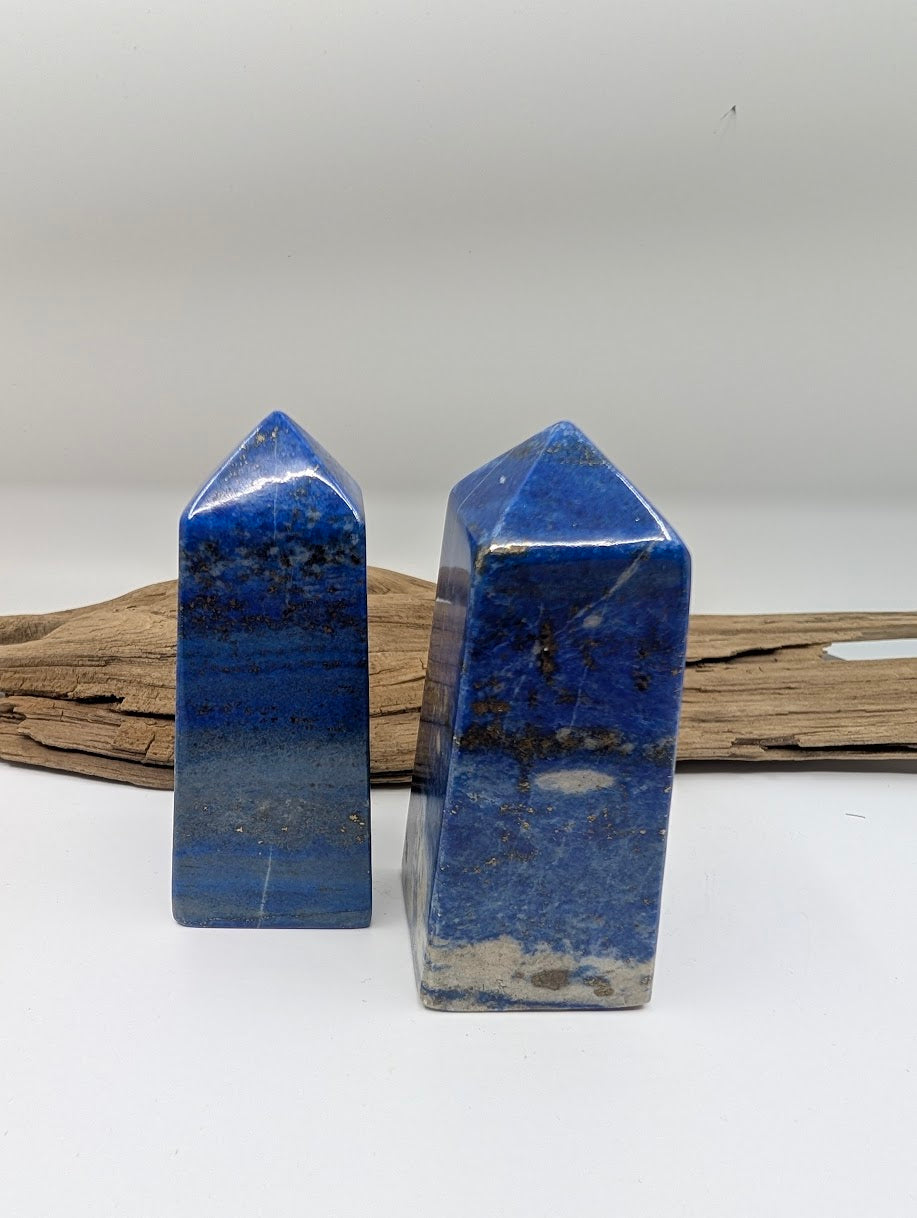
| Marqueurs de qualité supérieure | Un bleu uniforme profond, une calcite minimale et de petites mouchetures de pyrite uniformes indiquent un matériau de qualité collectionneur. |
| Allégations métaphysiques | Les associations avec le troisième œil et le chakra de la gorge sont des croyances culturelles, et non des traitements médicalement prouvés. |
| Legacy Crystals and Minerals | Propose du lapis en tours polies, bracelets et cœurs avec livraison au Canada et photographie de produit claire. |
Table des matières
- Quelles sont les principales propriétés physiques du lapis-lazuli ?
- Comment le lapis-lazuli a-t-il façonné l'histoire et la culture ?
- Que signifie le lapis-lazuli dans la pratique métaphysique ?
- Comment identifier le vrai lapis-lazuli et repérer les faux ?
- Comment nettoyer et ranger le lapis-lazuli ?
- Qu'est-ce qui rend une pièce de lapis-lazuli plus précieuse qu'une autre ?
- Où les acheteurs canadiens peuvent-ils trouver du lapis-lazuli de qualité ?
- Comment le symbolisme du lapis-lazuli varie-t-il selon les cultures ?
- Comment le lapis-lazuli est-il utilisé dans les pratiques métaphysiques modernes ?
- Legacy Crystals and Minerals : lapis-lazuli pour les collectionneurs canadiens
- Sources
- FAQ
Quelles sont les principales propriétés physiques du lapis-lazuli ?
Le lapis-lazuli est une roche, pas une gemme au sens minéralogique strict. Sa couleur, sa durabilité et sa valeur dépendent toutes du rapport de ses minéraux constitutifs.
Principaux composants minéraux :
- Lazurite — le feldspathoïde bleu contenant du soufre qui donne au lapis sa couleur
- Calcite — minéral blanc qui apparaît sous forme de veines ou de taches ; une teneur plus faible en calcite signifie une qualité supérieure
- Pyrite — des mouchetures de métalte de couleur or ; de petites mouchetures uniformément réparties sont considérées comme attrayantes
- Minéraux accessoires — le diopside, l'haüyne et la sodalite peuvent également être présents en plus petites quantités
Selon le GIA, une roche doit présenter une couleur nettement bleue avec une proportion significative de lazurite pour être qualifiée de lapis-lazuli. Le tableau ci-dessous résume les principales mesures physiques.
| Propriété | Valeur / Description |
|---|---|
| Groupe minéral | Roche agrégée (lazurite + calcite + pyrite) |
| Dureté Mohs | 5–5,5 |
| Densité spécifique | 2,7–2,9 |
| Diaphanéité | Opaque à semi-translucide |
| Lustre | Cireux à terne (polissage brillant) |
| Couleur | Bleu roi profond ; peut présenter de la calcite blanche et de la pyrite dorée |
| Sources principales | Sar-e-Sang (Afghanistan), Chili, Russie, Myanmar |
Le gisement de Sar-e-Sang en Afghanistan fournit du lapis depuis plus de 6 000 ans et reste la référence pour le matériau de qualité supérieure. Le lapis chilien tend vers un bleu plus clair et plus verdâtre et contient souvent plus de calcite. Le matériau russe de la région du Baïkal est généralement d'un bleu moyen. Le Myanmar produit de plus petites quantités de qualité variable.
Parce que la dureté varie d'un échantillon à l'autre selon la teneur en calcite, Geology conseille des montures protectrices pour les bijoux de tous les jours — une note pratique importante lors du choix entre une bague et un pendentif.
Comment le lapis-lazuli a-t-il façonné l'histoire et la culture ?
Peu de pierres ont une histoire documentée plus longue. Les routes commerciales du lapis-lazuli reliaient l'Afghanistan à la vallée de l'Indus, à la Mésopotamie et à l'Égypte dès la période néolithique, ce qui en fait l'une des premières marchandises commercialisées sur de longues distances.
Utilisations marquantes à travers le temps :
- env. 7000 av. J.-C. — Les perles néolithiques trouvées à Mehrgarh (aujourd'hui au Pakistan) représentent certains des premiers lapis travaillés
- env. 3000–1000 av. J.-C. — Les souverains sumériens et babyloniens utilisaient le lapis pour les sceaux-cylindres, les bijoux et les objets votifs ; l'Épopée de Gilgamesh décrit des temples ornés de lapis
- env. 1323 av. J.-C. — Le masque funéraire de Toutankhamon incorporait du lapis-lazuli aux côtés de l'or et de la cornaline, cimentant son association avec la royauté divine en Égypte
- Moyen Âge européen — le lapis broyé produisait l'outremer, le pigment bleu le plus cher disponible pour les peintres
- Renaissance, XIVe–XVIIe siècle — l'outremer de lapis était réservé aux sujets les plus prestigieux ; les robes de la Vierge Marie dans les retables étaient presque universellement peintes avec, signalant à la fois l'importance spirituelle et la richesse du mécène
- Époque moderne — le lapis reste une pierre de collection, un matériau de joaillerie et un objet de pratique métaphysique dans le monde entier
La connexion avec le pigment mérite une pause. Pendant la Renaissance, l'outremer fabriqué à partir de lapis-lazuli coûtait plus cher l'once que l'or à certains moments. Les artistes le recevaient comme une ligne distincte dans les contrats, et les mécènes en spécifiaient l'utilisation pour des figures particulières. Cette réalité économique a façonné des siècles d'iconographie — le bleu du ciel dans la peinture religieuse occidentale est, littéralement, du lapis-lazuli broyé.
Que signifie le lapis-lazuli dans la pratique métaphysique ?
Les associations métaphysiques principales sont la vérité, la perspicacité et la communication. Celles-ci correspondent à deux chakras les plus couramment cités dans la pratique des cristaux : le troisième œil (Ajna), lié à l'intuition et à la vision intérieure, et le chakra de la gorge (Vishuddha), associé à l'expression honnête et à la clarté.
Associations symboliques et spirituelles courantes :
- Stimuler une auto-réflexion honnête et réduire l'auto-illusion
- Soutenir une communication verbale et écrite claire
- Encourager la méditation profonde et l'accès à la connaissance intérieure
- Offrir une énergie protectrice, en particulier contre les interférences psychiques
- Lié au Sagittaire et à la Balance dans les traditions astrologiques occidentales ; également associé aux Poissons dans certains systèmes
Utilisations pratiques dans la pratique spirituelle :
- Placer une pointe de lapis ou une pierre roulée sur la gorge ou le front pendant la méditation
- Tenir un morceau pendant l'écriture d'un journal pour favoriser une auto-évaluation honnête
- Porter un bracelet en lapis-lazuli au poignet gauche pendant le travail créatif ou communicatif
- Utiliser un cœur de lapis-lazuli comme objet focal dans un autel de méditation ou un rituel de don
Ces associations sont des croyances culturelles de longue date, et non des traitements médicalement validés. Comme le note HowStuffWorks, les attributions métaphysiques telles que les connexions du troisième œil et du chakra de la gorge représentent une pratique culturelle plutôt qu'une preuve clinique. Traitez-les comme un cadre pour la fixation d'intentions, et non comme un substitut aux soins médicaux.
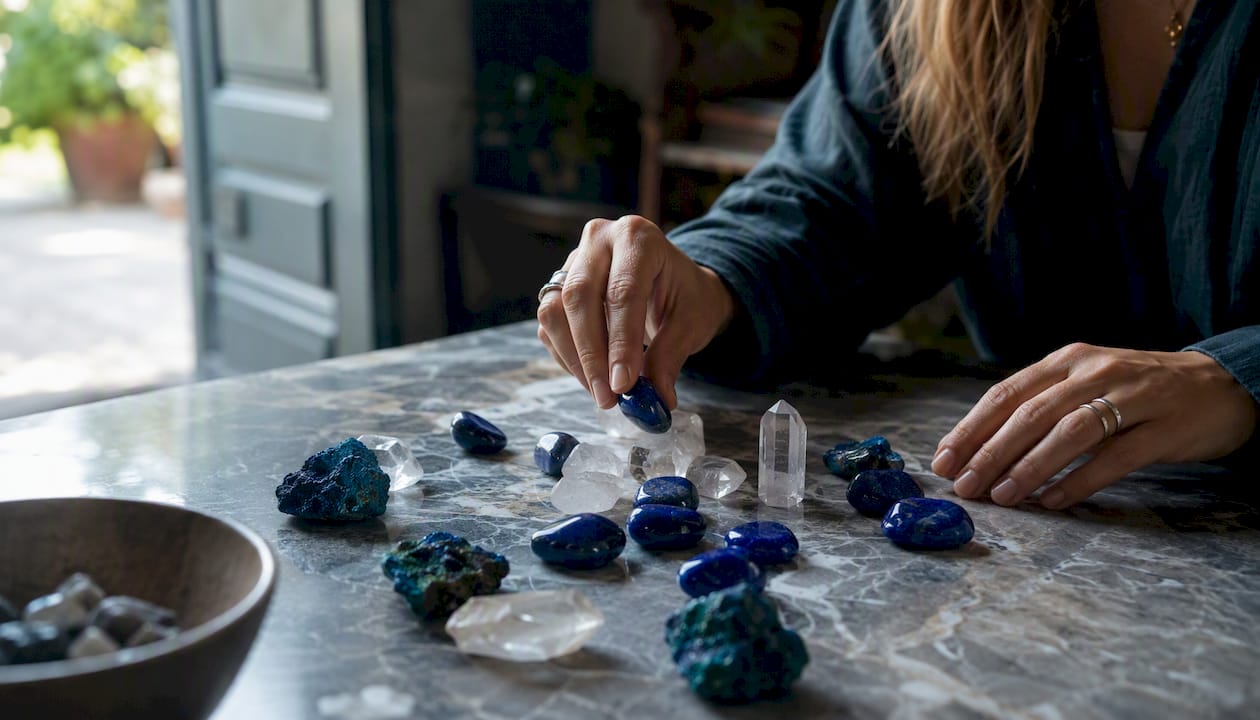
Conseil de pro : Associez le lapis-lazuli à du quartz clair pour amplifier ses associations de clarté, ou à de l'azurite pour un jumelage bleu profond complémentaire axé sur l'intuition. Ces deux combinaisons sont courantes dans les agencements de guérison par les cristaux.
Comment identifier le vrai lapis-lazuli et repérer les faux ?
Le lapis est l'une des pierres les plus imitées sur le marché. Les principaux substituts sont la sodalite, l'howlite teintée, l'agate teintée et les imitations synthétiques ou en verre.
Indices visuels du lapis authentique :
- Bleu roi profond et saturé — pas pâle, pas verdâtre, pas artificiellement uniforme
- Mouchetures de pyrite dorée visibles (bien que tous les spécimens ne les montrent pas de manière proéminente)
- Veines ou taches de calcite blanche — leur présence est normale ; leur absence dans une pièce très uniforme peut être un signal d'alarme
- Surface légèrement cireuse ou terne avant le polissage ; brillante après
Liste de contrôle rapide pour l'identification :
- Recherchez de la pyrite — le lapis présente souvent des mouchetures de pyrite dorée alors que la sodalite n'en a généralement pas
- Vérifiez le bleu — la sodalite tend vers un bleu plus gris ou plus violet ; le lapis est un bleu roi plus chaud et plus profond
- Examinez la calcite — les veines blanches sont courantes dans le lapis authentique ; une pièce sans blanc et d'une couleur parfaitement uniforme peut être teintée
- Testez le poids — le lapis a une densité spécifique de 2,7–2,9 et est sensiblement dense pour sa taille
- Lumière UV — la sodalite fluoresce souvent en orange sous UV court ; le lapis ne le fait généralement pas
HowStuffWorks clarifie la distinction fondamentale : la sodalite est un minéral unique, tandis que le lapis-lazuli est une roche multi-minérale. Cette différence de composition explique pourquoi les inclusions de pyrite sont un séparateur si fiable — la sodalite ne contient tout simplement pas de pyrite.
Avertissement à l'acheteur : L'howlite teintée est l'imitation de lapis la plus courante sur le marché bas de gamme. Elle imite la couleur bleue mais manque de pyrite, présente une matrice blanche crayeuse plutôt que des veines de calcite, et dégorgera souvent sa couleur sur un chiffon humide. Si un prix semble trop bas pour la qualité annoncée, considérez cela comme un signal pour demander des documents de provenance et des photographies détaillées sous une lumière neutre.
Pour un guide plus large sur la vérification des pierres avant l'achat, la ressource comment repérer les faux cristaux de Legacy Crystals and Minerals couvre les étapes d'authentification applicables au lapis et à d'autres pierres.
Conseil de pro : Demandez à tout vendeur en ligne une photographie prise à la lumière naturelle du jour, et non sous un éclairage de studio. Un éclairage artificiel teinté de bleu peut masquer le contenu en calcite et faire paraître les pierres teintes plus saturées qu'elles ne le sont.
Comment nettoyer et ranger le lapis-lazuli ?
Le lapis-lazuli est poreux et sensible aux acides, aux abrasifs et à une exposition prolongée à l'eau. Sa teneur en calcite le rend réactif aux nettoyants ménagers qui seraient sans danger pour les pierres plus dures.
Conseils d'entretien :
- Nettoyer avec un chiffon doux et humide et un savon doux uniquement — pas de nettoyeurs à ultrasons, pas de vapeur
- Sécher immédiatement après tout contact avec l'eau ; ne pas faire tremper
- Stocker séparément des pierres plus dures (quartz, topaze, saphir) qui peuvent rayer la surface
- Tenir à l'abri de la lumière directe du soleil pendant de longues périodes, car une exposition prolongée aux UV peut altérer la couleur bleue
- Pour les bijoux, les sertissages clos sont plus sûrs que les sertissages à griffes car ils protègent les bords de la pierre des chocs
Pour le nettoyage rituel, le fumage à la sauge ou au palo santo est largement utilisé et sûr. Les plaques de chargement en sélénite sont une autre option courante. Le nettoyage à l'eau est généralement déconseillé compte tenu de la porosité du lapis — un rinçage rapide est acceptable, mais laisser le lapis immergé ne l'est pas.
Note d'entretien : Étant donné que la dureté du lapis varie d'un échantillon à l'autre en fonction de la teneur en calcite, geology.com recommande des montures protectrices pour les bagues et les pièces de tous les jours. Un pendentif ou un bracelet subit moins d'impact direct qu'une bague, ce qui rend ces formats plus adaptés à une utilisation régulière.
Qu'est-ce qui rend une pièce de lapis-lazuli plus précieuse qu'une autre ?
La couleur est le principal facteur. Un bleu royal profond et uniforme avec un minimum de calcite blanche et de petites mouchetures de pyrite uniformément réparties représente le haut du marché. Le GIA confirme qu'un bleu profond uniformément réparti avec un minimum de calcite augmente la valeur, tandis que des mouchetures de pyrite bien réparties sont généralement considérées comme améliorant l'attrait d'un spécimen.
Facteurs de valeur, classés :
- Saturation et uniformité de la couleur — plus elle est profonde et uniforme, plus la qualité est élevée
- Teneur en calcite — moins il y en a, mieux c'est ; de fortes veines blanches réduisent la valeur
- Distribution de la pyrite — de petites mouchetures uniformes ajoutent un intérêt visuel ; de gros amas ou l'absence de pyrite réduisent tous deux l'attrait
- Provenance — le matériau de Sar-e-Sang (Afghanistan) commande une prime ; le matériau chilien et russe se négocie à un prix inférieur
- Taille et coupe — les grands cabochons propres et les tours bien formées sont plus rares et leur prix est en conséquence
- Finition — un polissage élevé sur une pièce dense et à faible teneur en calcite indique un travail de qualité
Catégories de qualité (descriptions générales du marché) :
- Qualité d'entrée de gamme — bleu plus clair, calcite visible, peut présenter des irrégularités de surface ; convient aux pierres roulées et aux pièces d'introduction
- Qualité collectionneur — bleu profond, calcite modérée, pyrite attrayante ; convient aux spécimens d'exposition et aux bijoux de qualité
- Qualité musée — bleu uniforme intense, calcite minimale, fine distribution de pyrite, provenance documentée ; convient aux collections sérieuses et aux pièces de qualité d'investissement
Pour un cadre plus large sur l'évaluation des spécimens minéraux, le guide du collectionneur sur les types et la valeur de Legacy Crystals and Minerals s'applique directement aux décisions de classement du lapis.
Où les acheteurs canadiens peuvent-ils trouver du lapis-lazuli de qualité ?
Les acheteurs canadiens ont plusieurs voies fiables : les magasins de minéraux spécialisés dans les grandes villes, les détaillants en ligne réputés, et les salons des minéraux et des gemmes organisés annuellement à travers le pays (le circuit des salons des gemmes et minéraux organise des événements à Toronto, Vancouver, Calgary et dans d'autres centres).
Questions clés à poser à tout vendeur :
- Quel est le pays d'origine ? (L'Afghanistan/Sar-e-Sang est prisé)
- La pierre a-t-elle été teinte ou traitée de quelque manière que ce soit ?
- Quelle est la politique de retour si l'article n'est pas tel que décrit ?
- Pouvez-vous fournir des photographies détaillées sous lumière naturelle ?
- Un certificat ou un rapport de laboratoire est-il disponible ?
Contexte des prix (gammes approximatives en dollars canadiens par type) :
| Type | Gamme de prix typique (CAD) | Notes |
|---|---|---|
| Pierres roulées (petites) | 3 $ l'unité | Qualité d'entrée ; la couleur varie |
| Bracelets de perles chips ou rondes | 15 $ | La qualité dépend de l'uniformité des perles |
| Cabochons polis (qualité collectionneur) | 20 $ | La couleur et la teneur en calcite déterminent le prix |
| Tours / pointes polies | 25 $ | La taille et la provenance sont des facteurs clés |
| Spécimens de qualité musée | 100 $ | Origine documentée ; bleu intense, peu de calcite |
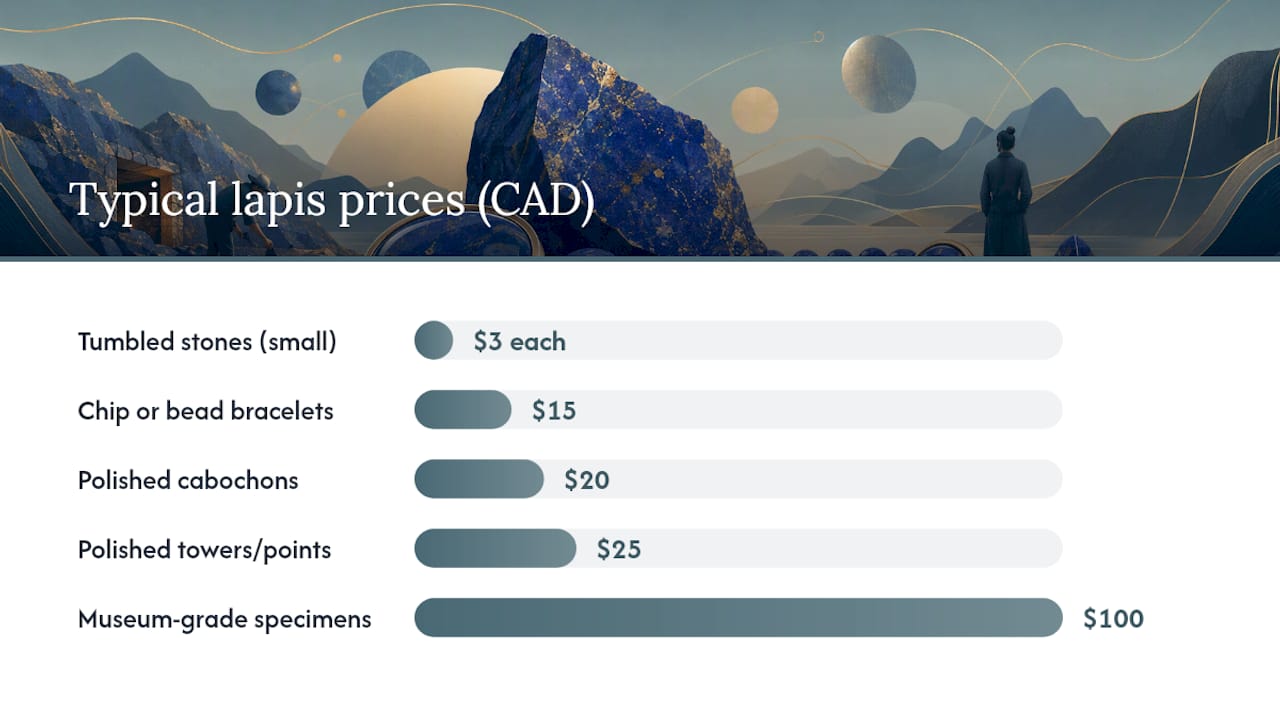
Les gammes reflètent les prix de détail typiques ; les prix varient selon le vendeur, la provenance et les conditions du marché.
Liste de vérification pour les acheteurs canadiens :
- Confirmer que la TVH/TPS est incluse ou détaillée dans le prix affiché
- Vérifier l'origine de l'expédition — l'expédition canadienne domestique évite les retards douaniers
- Demander des documents de provenance, surtout pour les pièces plus chères
- Vérifier la politique de retour/échange avant l'achat
- Comparer l'apparence de la pierre avec la liste de vérification d'identification ci-dessus
Legacy Crystals and Minerals expédie au Canada et propose du lapis sous plusieurs formats. La tour polie en lapis-lazuli est un bon exemple de spécimen de qualité d'exposition avec des photographies de produits claires, et le bracelet en lapis-lazuli en perles chips, de 6 mm et de 8 mm couvre la gamme des articles à porter. Comprendre pourquoi l'origine de la mine est importante est un contexte utile avant de s'engager pour une pièce plus chère.
Comment le symbolisme du lapis-lazuli varie-t-il selon les cultures ?
La portée symbolique de la pierre varie notablement selon les traditions.
L'Égypte considérait le lapis comme un lien matériel direct avec les cieux. Son bleu profond reflétait le ciel nocturne, et il était réduit en poudre pour le fard à paupières, utilisé dans les amulettes funéraires et incrusté dans les bijoux royaux. L'association était avec la protection divine, la renaissance et l'au-delà — le masque funéraire de Toutankhamon en est l'exemple le plus cité.
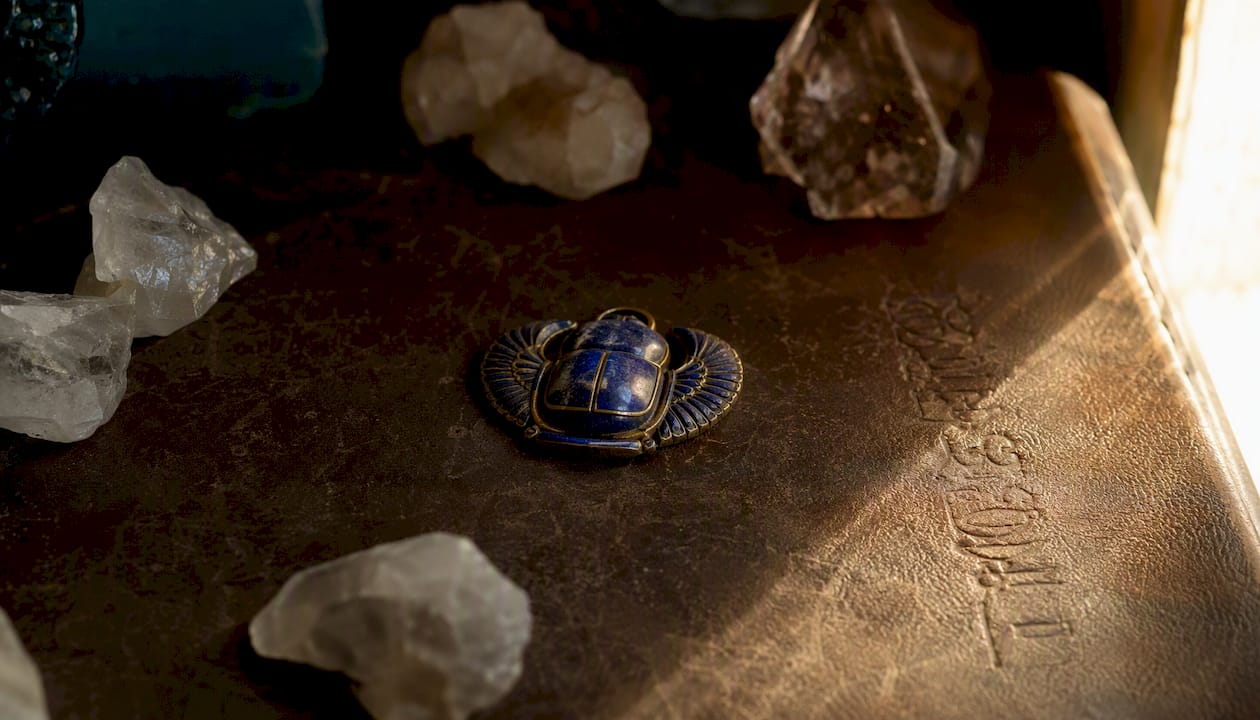
La Mésopotamie (Sumer, Babylone, Assyrie) valorisait le lapis comme un marqueur de l'autorité cosmique et politique. Les sceaux cylindriques, les figurines votives et les décorations de temples utilisaient le lapis pour signaler la proximité des dieux. Le poème sumérien « La Descente d'Inanna aux Enfers » énumère spécifiquement les bijoux en lapis-lazuli parmi les attributs divins portés par Inanna.
La tradition occidentale/européenne a hérité du prestige de la pierre par le commerce et l'art. L'Europe médiévale et de la Renaissance associait le lapis aux cieux principalement sous sa forme de pigment — l'outremer. La couleur bleue elle-même est devenue codée comme sacrée et royale, une signification qui a persisté longtemps après que l'outremer synthétique ait remplacé la pierre broyée au XIXe siècle.
Les traditions orientales varient plus largement. Dans le bouddhisme tibétain, le lapis est associé au Bouddha de la Médecine (Sangye Menla), dont le corps est représenté en bleu lapis. La pierre apparaît également dans les contextes de la médecine ayurvédique et de la médecine traditionnelle chinoise, bien que les attributions spécifiques diffèrent selon les écoles et les régions.
La pratique moderne des cristaux en Occident synthétise ces fils, en mettant l'accent sur la vérité, la communication et l'activation du troisième œil — un mélange de symbolisme protecteur égyptien, de prestige de la Renaissance et de cadres de chakras contemporains.
Comment le lapis-lazuli est-il utilisé dans les pratiques métaphysiques modernes ?
La pratique moderne des cristaux a développé des techniques spécifiques pour travailler avec le lapis-lazuli qui s'appuient sur ses associations historiques.
Techniques de méditation :
- Placement sur le troisième œil — allongez-vous et placez une pointe ou une pierre roulée de lapis au centre du front. Maintenez pendant 10 à 20 minutes en vous concentrant sur la respiration. C'est la technique la plus courante pour les praticiens travaillant sur l'intuition ou la clarté décisionnelle.
- Activation de la gorge — tenez un morceau au niveau de la gorge ou portez un pendentif en lapis pendant une pratique vocale, la préparation à une prise de parole en public, ou des conversations difficiles.
- Travail d'autel — placez un cœur ou une tour de lapis au centre d'un espace de méditation comme point d'ancrage pour les séances de définition d'intentions.
Applications de rituels de guérison :
- Le lapis est couramment utilisé dans les grilles de cristaux avec le quartz clair (amplification) et l'améthyste (intuition). La combinaison vise la clarté mentale et la communication honnête.
- Certains praticiens utilisent le lapis dans le travail onirique, plaçant un morceau près de l'oreiller ou sous le lit pour favoriser des rêves vifs ou instructifs.
- Tenir un journal avec du lapis à proximité est un point d'entrée facile — la pierre sert de rappel physique de l'intention d'écrire honnêtement.
Ces pratiques sont de nature culturelle et personnelle. Elles n'ont aucune validation clinique, et toute personne gérant un problème de santé devrait se fier à des soins médicaux qualifiés plutôt qu'au seul travail avec les cristaux.
Legacy Crystals and Minerals : lapis-lazuli pour les collectionneurs canadiens
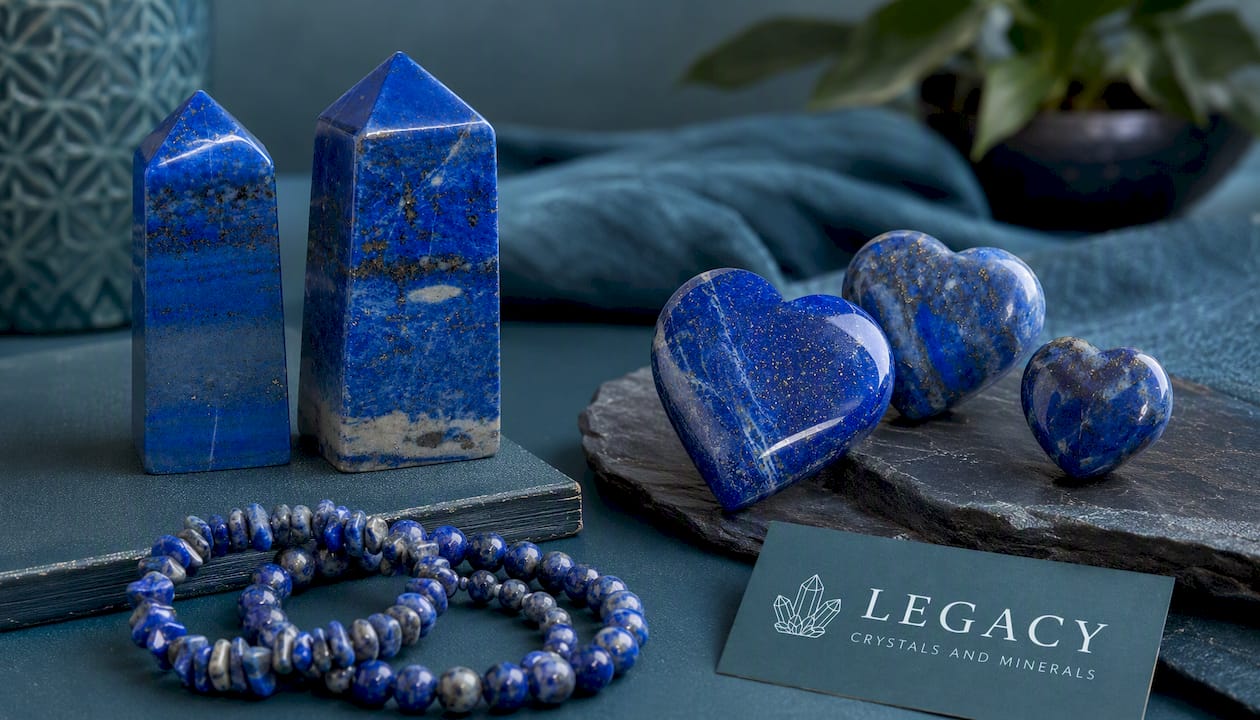
Legacy Crystals and Minerals sélectionne le lapis-lazuli pour la profondeur de sa couleur, le caractère de sa pyrite et sa provenance — et pas seulement son prix. La gamme couvre trois formats adaptés à différents besoins : la tour polie de lapis pour l'exposition et la méditation, le bracelet de lapis en perles chips, rondes de 6 mm et 8 mm pour un usage quotidien, et le cœur de lapis pour offrir ou pour le travail d'autel. Chaque article comprend des photographies détaillées du produit afin que les acheteurs puissent évaluer la couleur et le contenu en calcite avant de commander. L'expédition est domestique au Canada, sans retards douaniers sur les commandes standard. Parcourez la sélection actuelle de lapis sur Legacy Crystals and Minerals pour trouver une pièce qui correspond à vos critères de qualité.
Sources
- Pierre gemme de lapis-lazuli | Pierre de lapis-lazuli – GIA
- Géologie
- Lapis-lazuli - Wikipédia
- Sodalite : une alternative abordable au lapis-lazuli | HowStuffWorks
- Sodalite vs Lapis-Lazuli - Comment les distinguer (avec photos)
FAQ
Quels sont les bienfaits du port du lapis-lazuli ?
Le lapis-lazuli est associé dans la pratique des cristaux à une communication plus claire, une expression de soi honnête et une concentration mentale. Ce sont des associations culturelles et métaphysiques, et non des bienfaits pour la santé cliniquement prouvés.
Quel est un autre nom pour le lapis-lazuli ?
Le lapis-lazuli n'a pas de nom scientifique alternatif unique, mais il est souvent abrégé en « lapis » dans le commerce. Historiquement, le pigment obtenu par broyage était appelé outremer.
Que représente le lapis-lazuli dans la Bible ?
Le lapis-lazuli est largement identifié comme l'une des pierres du pectoral du Grand Prêtre décrit dans l'Exode, bien que les traductions varient. Il est également associé aux fondations de la cité céleste dans l'Apocalypse, où il apparaît comme un saphir dans certaines versions et comme du lapis dans d'autres.
Quels signes du zodiaque sont associés au lapis-lazuli ?
Le lapis-lazuli est le plus souvent lié au Sagittaire et à la Balance dans l'astrologie occidentale. Certaines traditions l'associent également aux Poissons. Ces liens sont basés sur la tradition métaphysique plutôt que sur une classification gemmologique formelle.
Comment distinguer le lapis-lazuli de la sodalite ?
Cherchez des paillettes de pyrite dorée — le lapis en a généralement, la sodalite non. La sodalite tend également vers un bleu plus gris ou plus violet, tandis que le vrai lapis présente un bleu royal plus profond et plus chaud avec des veines de calcite blanche.


