
Rhodochrosite Meaning: Heart Healing, Mohs 3.5–4.5 and How to Buy
Rhodochrosite is primarily a heart-centred stone of self-compassion and emotional healing, prized for its rose-red to pink banding. Mineralogically, it’s manganese carbonate (MnCO3), soft enough (Mohs 3.5 to 4.5) that it needs gentle handling. Wear it, place it in a meditation space, or keep a raw piece nearby, but skip the ultrasonic cleaner and acidic jewellery dips.
TL;DR:
- Crystal-quality rhodochrosite with vivid, high-contrast banding and larger size commands premium prices, especially if sourced from historic deposits like the Sweet Home Mine.
- Its soft Mohs hardness of 3.5 to 4.5 means it requires gentle cleaning and protected settings in jewelry to prevent damage from daily wear.
- Provenance and detailed locality information significantly influence the stone’s value, making documented origin crucial when purchasing.
- Rhodochrosite typically reacts to dilute acid as a carbonate, which can aid in identification but should be used cautiously.
- The mineral is intended for emotional support practices rather than clinical treatment, reinforcing the importance of professional care for serious mental health concerns.
Table of Contents
- What does rhodochrosite symbolize spiritually?
- Using rhodochrosite for emotional and mental healing
- Mineralogy and origin: what rhodochrosite actually is
- Rhodochrosite vs rhodonite: how to tell them apart
- How to use rhodochrosite safely, including in jewellery
- Care instructions and what drives specimen value
- Why provenance and precise sourcing matter
- Bring rhodochrosite’s meaning into your daily practice
- Where these facts come from
- Sources
- FAQ
What does rhodochrosite symbolize spiritually?
Rhodochrosite’s spiritual reputation centres on four recurring themes: self-love, compassion, forgiveness, and a return to inner joy after emotional hardship. Crystal-healing communities consistently frame it as a stone for people who give care to others but forget to direct that same warmth inward. It’s popularly tied to heart-centred healing and attracting love, a theme that shows up across most crystal guides and practice communities, even though this association is cultural rather than scientific.
The visual character of a piece can shift how people read its energy. A pale pink specimen with soft, thin banding is often described as gentler and better suited to quiet reflection or bedtime use. A deep rose or maroon piece with bold, contrasting bands reads as more intense, associated with confronting buried grief or old resentment rather than easing into it slowly. Neither reading is a mineralogical fact. It’s a working framework many practitioners use to choose a specimen that fits their mood.
Common ways people incorporate rhodochrosite into spiritual practice include:
- Holding a tumbled piece during morning reflection to set an intention around self-acceptance.
- Placing a specimen on the heart during meditation to focus attention on that region.
- Carrying a small stone in a pocket or bag as a daily reminder to soften self-criticism.
- Using rhodochrosite in a crystal grid alongside other pink or green stones associated with the heart.
None of these practices require a large investment. A rough or tumbled piece serves the purpose just as well as a polished pendant, which matters if you’re building a collection slowly rather than buying one showpiece.
Using rhodochrosite for emotional and mental healing
People reach for rhodochrosite most often during three kinds of emotional work: processing grief, learning to prioritize self-care without guilt, and calming an overreactive response to criticism or conflict. The stone doesn’t erase these experiences. It functions as a focal point that some people find useful while doing the harder work of actually sitting with difficult feelings.
A few simple, low-pressure ways to work with it:
- Five-minute grounding meditation. Hold the stone in your left hand, breathe slowly, and silently repeat a short self-compassion phrase for the length of five breaths.
- Journalling prompt. Keep the stone beside your notebook and write for ten minutes on the question, “What would I say to a friend feeling what I feel right now?”
- Thirty-minute wear ritual. Wear a rhodochrosite bracelet for half an hour before a stressful conversation or task, treating the time as a deliberate pause rather than a guarantee of calm.
Pro Tip: Keep a small notebook near your rhodochrosite piece and jot down one word describing your mood before and after each session. Patterns show up faster than memory alone will catch them.
None of this replaces professional care. Crystal work is a complementary practice, not a treatment for depression, anxiety disorders, or grief that isn’t easing over time. If emotional pain is interfering with daily life, a doctor or licensed therapist is the right first call, not a mineral.
Mineralogy and origin: what rhodochrosite actually is
Rhodochrosite is manganese carbonate, MnCO3, crystallizing in the trigonal system. In its purest form it’s rose-red, though specimens range from pale pink to a brownish hue depending on trace impurities, and the mineral typically forms in hydrothermal veins and metamorphic deposits, often alongside calcite and other manganese minerals.
Hardness is the detail buyers most need to remember: a moderate hardness on the Mohs scale typical for soft minerals in the soft range, softer than quartz and closer to a fingernail-plus-knife-blade range in practical terms. Specific gravity runs roughly 3.45 to 3.6. Most commercial material shows up as botryoidal (grape-like) crusts or banded slabs; gem-quality rhombohedral crystals are far rarer and command a real premium among collectors.
| Property | Detail |
|---|---|
| Chemical formula | MnCO3 (manganese carbonate) |
| Crystal system | Trigonal |
| Mohs hardness | 3.5 to 4.5 |
| Specific gravity | 3.45 to 3.6 |
| Common forms | Botryoidal, banded slabs, rare rhombohedral crystals |
| Notable localities | Argentina, Peru, Colorado (Sweet Home Mine, historically), Romania, South Africa |
Locality drives a large part of a piece’s value. The Sweet Home Mine in Colorado, now closed, produced some of the finest rhombohedral rhodochrosite crystals ever documented, and specimens traced to that mine still carry premium pricing decades later. Argentine material tends to show the classic stalactite-slice banding most people picture when they hear “rhodochrosite,” while Peruvian and South African deposits contribute additional colour variation. The Handbook of Mineralogy documents these occurrences in detail for anyone comparing specimens against known reference data.
Rhodochrosite vs rhodonite: how to tell them apart
Rhodochrosite and rhodonite get confused constantly, which is a real problem if you’re paying collector prices for one and receiving the other. The core distinction is chemical: rhodochrosite is a carbonate (MnCO3), while rhodonite is a manganese silicate with a different crystal structure entirely.
That chemical gap shows up in physical properties you can actually check:
- Hardness. Rhodochrosite sits at 3.5 to 4.5; rhodonite is noticeably harder and more durable, which you can feel when scratching against a steel blade.
- Pattern. Rhodochrosite usually shows concentric or wavy banding; rhodonite tends toward more uniform pink to reddish colour, sometimes with black manganese oxide veining.
- Acid reaction. As a carbonate, rhodochrosite reacts to dilute acid; rhodonite, a silicate, does not. This test should only be done with proper lab materials, never with household chemicals on a piece you value.
When buying online, favour listings with clear locality information, high-resolution photos that actually show banding or crystal edges up close, and sellers willing to share weight and measurements on request. If a listing is vague on all three, treat it as a red flag rather than a bargain.
How to use rhodochrosite safely, including in jewellery
For meditation, most people place rhodochrosite directly on the chest over the heart, or set it at the centre of a crystal grid surrounded by supporting stones. Sessions of ten to twenty minutes are typical. Longer isn’t inherently better here; consistency across several short sessions tends to matter more than one marathon sitting.
Jewellery is where rhodochrosite’s softness actually matters. Follow these guidelines:
- Choose pendants and earrings over rings. Protected settings away from constant friction suit the stone’s Mohs hardness far better than a ring that knocks against countertops all day.
- Clean with a soft cloth only. Skip ultrasonic and steam cleaners entirely. Both can crack or dull a stone this soft.
Care instructions and what drives specimen value
Clean rhodochrosite with a soft, slightly damp cloth and mild water, nothing acidic and no chemical jewellery dips. Authoritative mineral references specifically warn against harsh chemical cleaning, since the mineral is chemically sensitive and can react to acidic solutions. Store pieces separately from harder stones to avoid surface scratches, and keep them out of direct sunlight if colour retention matters to you.
Value climbs with a short list of factors:
- Crystal-grade rhombohedral form rather than tumbled or botryoidal material.
- Vivid, high-contrast banding rather than muted or washed-out colour.
- Larger specimen size with minimal damage or repair.
- Documented locality, particularly historic Sweet Home Mine material or well-sourced Argentine stalactite slices.
Why provenance and precise sourcing matter
Simon, the mineral specialist behind much of Legacy Crystals and Minerals’ product content, focuses on documenting locality, weight, and measurements for every listing rather than relying on vague descriptions. That level of detail matters because rhodochrosite pricing swings heavily on origin and crystal quality. Before buying, ask any seller for locality, close-up photos of banding, and exact dimensions. A blue calcite sphere from Argentina on the Legacy Crystals and Minerals site shows the kind of provenance detail worth expecting from any credible listing.
Bring rhodochrosite’s meaning into your daily practice
Reading about rhodochrosite’s meaning is one thing. Wearing a piece that actually holds up to daily life is another. Legacy Crystals and Minerals sources its rhodochrosite pieces with documented locality and precise measurements rather than vague “natural stone” descriptions, so you know exactly what you’re buying before it arrives.
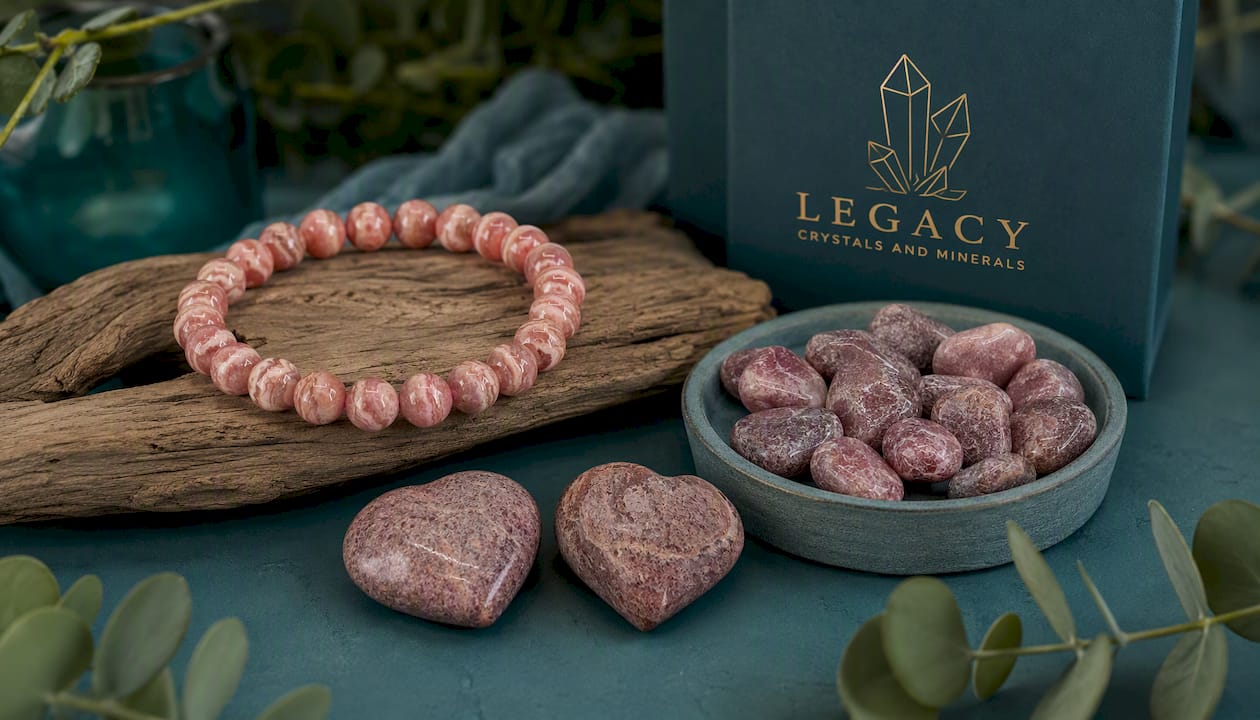
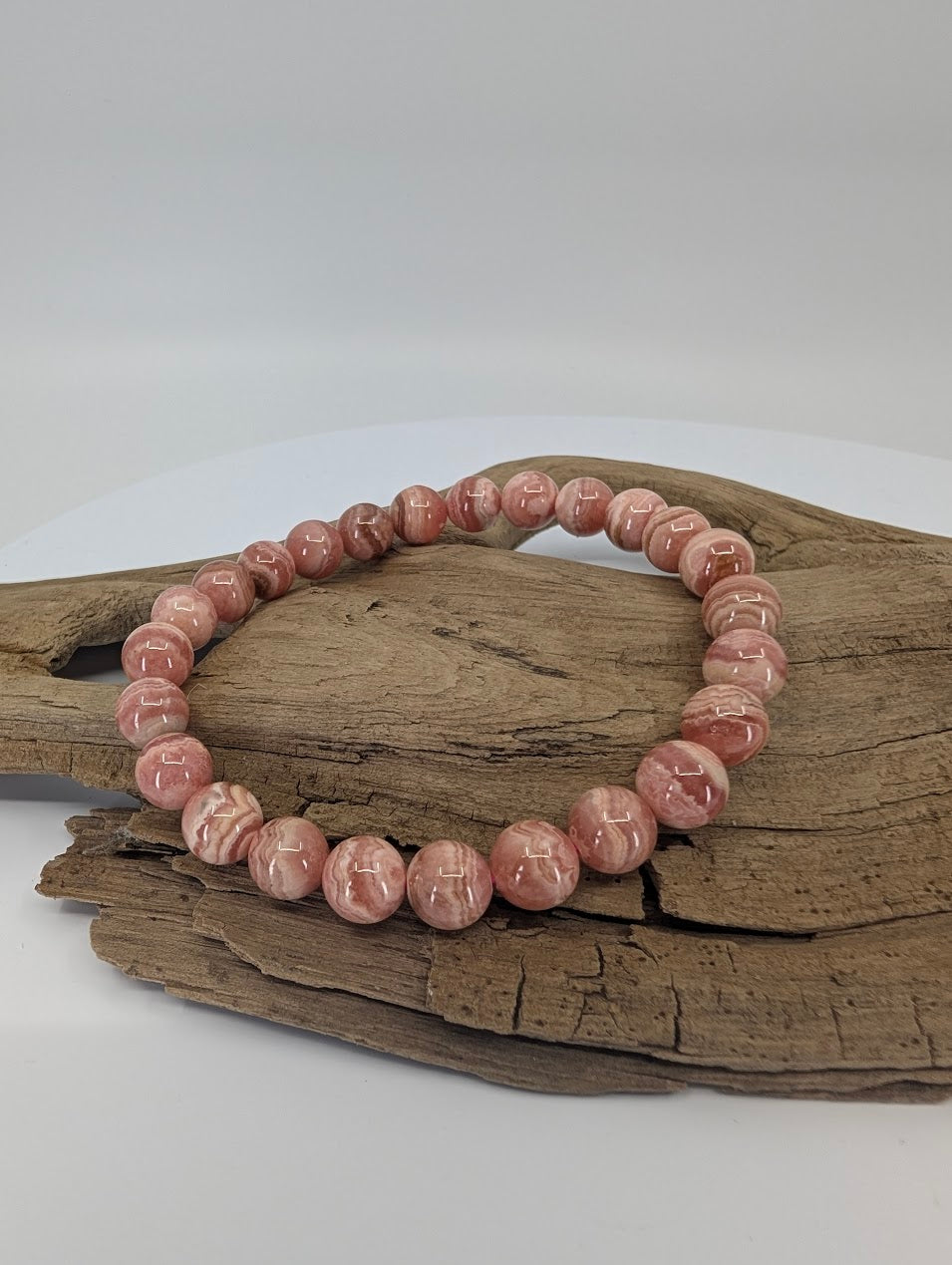
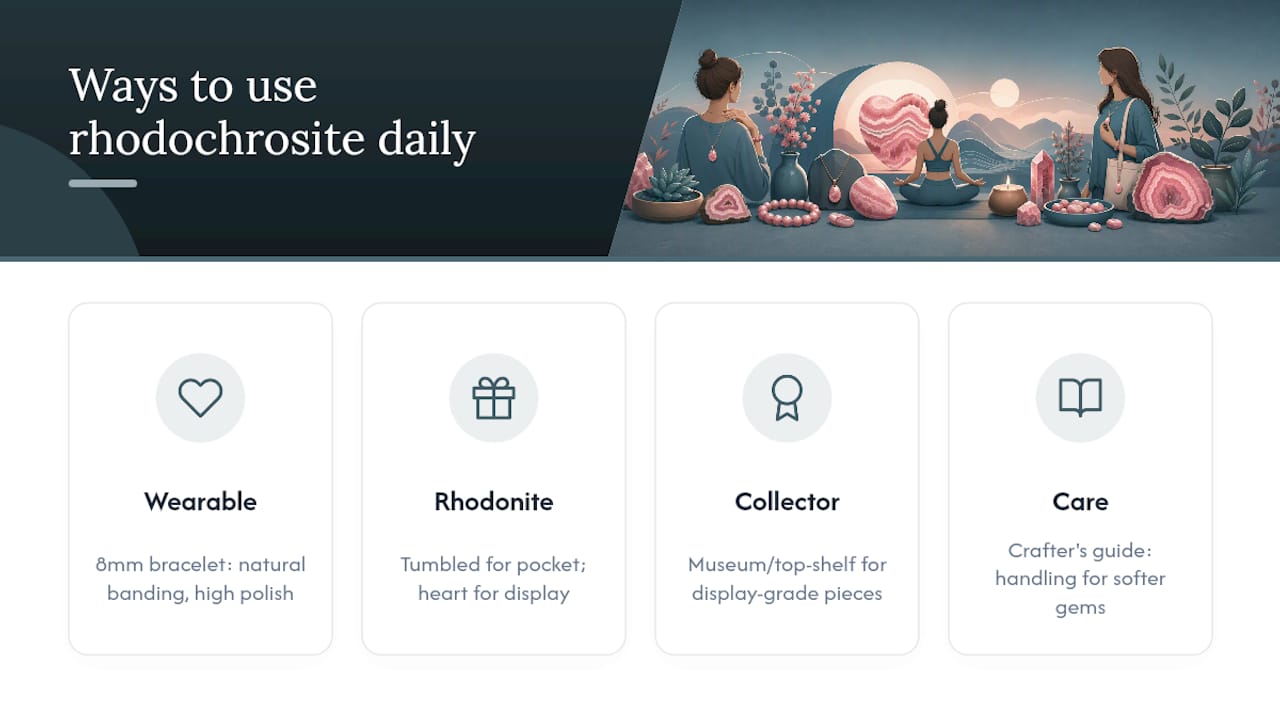
The 8mm HQ Rhodochrosite Bracelet is built around natural pink banding and a high polish finish, a solid option if you’re ready to wear the self-compassion work described above rather than just read about it. If you’re drawn to rhodonite instead, or want a complementary piece for a gift, the Rhodonite Tumbled Stone offers an A+ grade option for pocket carry, while the Rhodonite Heart suits anyone who wants a display piece specifically tied to compassion work. For jewellery care fundamentals that apply to softer gemstones generally, this crafter’s guide covers handling practices worth knowing before your first wear.
Beyond these two stones, the full jewelry collection and bracelets category cover a wider range of heart-centred and grounding stones, while the museum quality minerals and top shelf collector minerals collections are worth browsing if you’re building toward a display-grade rhodochrosite specimen rather than a wearable piece. Collectors who prefer untouched material can start with raw minerals and crystals or polished specimens, and anyone drawn to sculptural pieces should look at the carvings collection. Feeling adventurous? The mystery items selection is a low-pressure way to add an unexpected specimen to your collection. Browse the bracelet page today and check current availability before your next meditation or gifting occasion.
Where these facts come from
Mineralogical claims in this guide draw on Wikipedia’s rhodochrosite entry for composition and hardness data, Britannica for occurrence and care guidance, and the Handbook of Mineralogy for locality and crystallographic detail. Identification comparisons reference Gemslore’s rhodochrosite versus rhodonite breakdown. Each source is a standard reference point for gemmologists and collectors verifying specimen authenticity.
Sources
- Rhodochrosite — Wikipedia
- Rhodochrosite | Definition, Location, Properties, & Facts | Britannica
- Rhodochrosite — Handbook of Mineralogy (PDF)
- Rhodochrosite vs Rhodonite: Differences, Tests and Identification — Gemslore
FAQ
What does rhodochrosite do spiritually?
Rhodochrosite is associated with heart-centred healing, self-compassion, and forgiveness in crystal-healing traditions. Practitioners commonly use it during meditation or grief processing to soften self-criticism, though this is a cultural and spiritual framework rather than a clinically proven effect.
What are the benefits of wearing rhodochrosite?
Wearers often describe rhodochrosite jewellery, like a bracelet with natural pink banding, as a daily physical reminder to practise self-care and emotional balance. Because the stone sits at a moderate hardness on the Mohs scale typical for soft minerals in the soft range, protected settings like pendants tend to hold up better long-term than rings.
Why is rhodochrosite so expensive?
High prices trace back to rarity: crystal-grade rhombohedral specimens, intense banding, and documented locality all drive value up sharply. Material tied to historic sources like the Sweet Home Mine in Colorado commands especially strong collector interest because that deposit is no longer active.
Which is better, rhodonite or rhodochrosite?
Neither is objectively better. They serve different purposes: rhodochrosite is a softer carbonate associated with self-love and emotional healing, while rhodonite is a harder silicate linked to compassion and grounding, and better suited to everyday jewellery like the Rhodonite Heart. Choose based on whether you prioritize the specific spiritual theme or day-to-day durability.


