

What are phantom crystals: how to identify, use and care for them
Phantom crystals are quartz specimens (SiO2) that contain a visible outline of an earlier growth stage preserved inside the host crystal. That internal outline, called a phantom, follows the hexagonal crystal habit of quartz and looks like a smaller ghost crystal frozen within the larger one. On the Mohs hardness scale, quartz sits at approximately 7, making phantom quartz durable enough for both display and handling. To identify one quickly, look for a geometric interior outline that mirrors the crystal’s own shape. For spiritual practice, the phantom is most commonly used as a focal point in meditation, symbolising preserved layers of time and personal growth.
Table of Contents
- What are phantom crystals, exactly? A mineralogical definition
- How do phantom crystals form?
- How to identify genuine phantom quartz
- What colours and types of phantom quartz exist?
- Physical and chemical properties at a glance
- Where is phantom quartz found, and how can Canadian buyers source it?
- How do practitioners use phantom crystals?
- Are phantom crystals valuable? Collector criteria
- How to clean and store phantom quartz safely
- Phantom quartz vs Garden/Lodolite quartz: key differences
- How to spot fake or synthetic phantom crystals
- Cultural and historical significance of phantom crystals
- Key takeaways
- Further reading and reputable sources
- Phantom quartz specimens and jewellery at Legacy Crystals and Minerals
- FAQ
What are phantom crystals, exactly? A mineralogical definition
Mineralogical definitions describe a phantom as a ghost-like inclusion that preserves a former growth stage within quartz. The term “phantom” refers specifically to that preserved interior outline, not to any random inclusion or surface coating.
A few terms collectors use regularly:
- Phantom: the visible internal outline of an earlier crystal termination.
- Nested or multi-phantom: a specimen showing two or more successive phantom outlines, each representing a separate growth pause.
- Scepter: a form where a second generation of quartz grew over the tip of an earlier crystal, often with a phantom visible at the junction.
- Host crystal: the outer, later-formed quartz that encases the phantom.
- Termination outline: the pointed end of the earlier growth stage, preserved as a silhouette inside the host.
Phantom quartz shares the same chemical formula (SiO2) and hexagonal/trigonal crystal habit as ordinary quartz. What sets it apart is the recorded interruption, not the chemistry.
How do phantom crystals form?
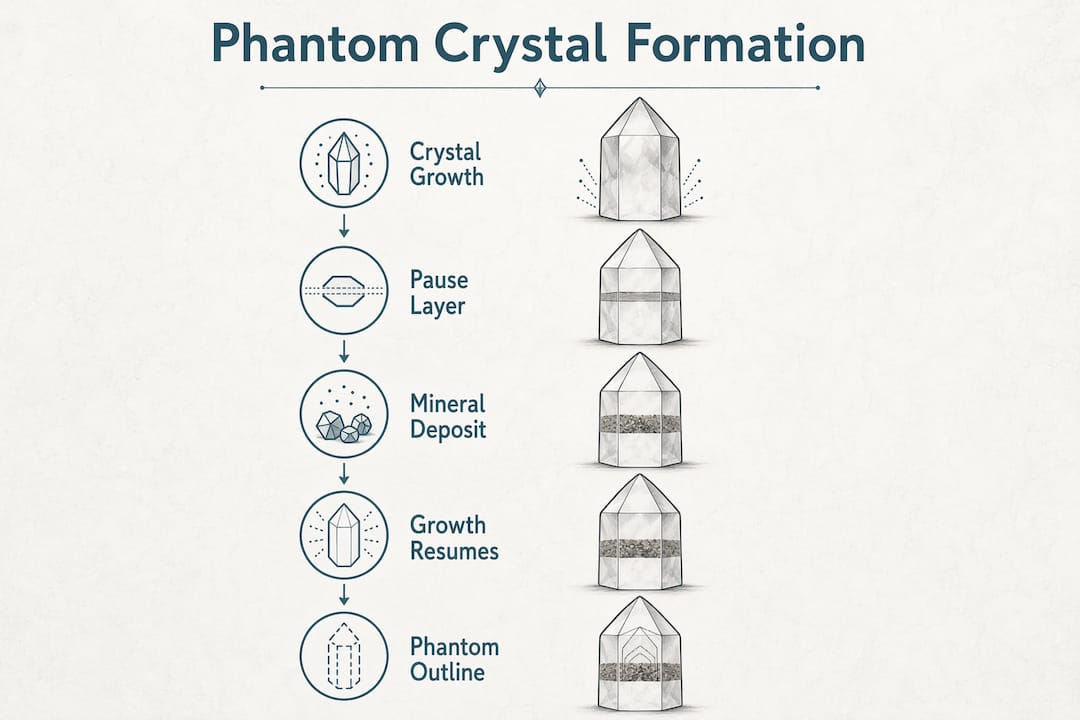
Formation happens in stages over geological time, each stage separated by a pause in crystal growth.
- Initial growth: quartz begins crystallising from silica-rich hydrothermal fluids in a rock cavity.
- Growth pause: a change in fluid chemistry, temperature, or pressure halts crystal growth. The pause can last thousands to millions of years.
- Mineral deposition: during the pause, a thin layer of a secondary mineral coats the exposed crystal surface. Common coating minerals include chlorite, hematite and other iron oxides, clay minerals such as kaolinite, and sericite (a fine-grained muscovite mica).
- Resumed growth: conditions shift again, quartz growth restarts, and the new quartz encases the mineral coating entirely.
- Phantom preserved: the coating layer is now locked inside the host crystal as a permanent outline of the earlier termination.
Phantom quartz forms when quartz growth pauses, a thin layer of mineral deposits on the crystal surface, then growth resumes and the earlier surface becomes encased as a phantom outline. When this cycle repeats, each successive pause leaves another outline, producing nested phantoms. The “time-capsule” description used in metaphysical contexts is a direct reference to this layered geological record.
How to identify genuine phantom quartz
Distinguishing a true phantom from other included quartz or treated specimens comes down to a short checklist.
- Geometric interior outline: the phantom silhouette follows the hexagonal crystal habit of the host, not a random or cloud-like shape.
- Internal, not surface: the outline sits inside the crystal, fully encased by later-grown quartz. Surface coatings or staining do not qualify.
- Sharp transition or contrast: a clear boundary between the inclusion layer and the surrounding quartz is a strong indicator of a genuine growth pause.
- Identifiable inclusion mineral: chlorite (green), hematite (red/orange), clay (white), or sericite (orange/gold) are the most common. The colour should be consistent with one of these minerals.
- Multiple nested outlines: multi-phantom specimens show two or more concentric silhouettes, each following the same hexagonal form.
Comparison with Garden/Lodolite quartz: Garden quartz (also called Lodolite) contains dense, irregular inclusions of multiple minerals that create a landscape-like interior. The inclusions do not follow the crystal’s geometric outline. Under magnification, phantom quartz shows a defined layer at a specific depth; Garden quartz shows scattered, three-dimensional inclusions throughout.
Comparison with artificial treatments: some sellers sell dyed or coated quartz as “phantom.” A surface coating will not show a fully encased outline under a loupe. Artificially coloured specimens often show colour concentrated at surface cracks or along the exterior rather than at an interior geometric layer.
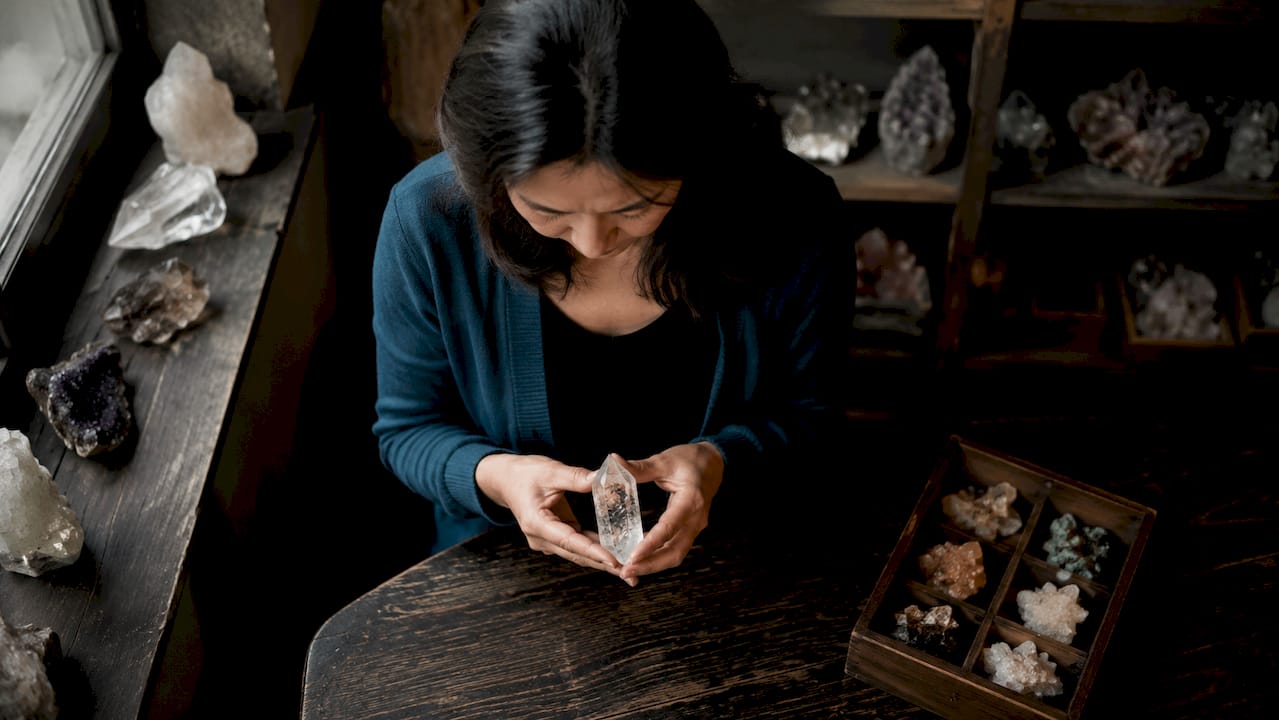
Pro Tip: Hold the specimen under a directional light source (a single LED torch works well) and rotate it slowly. A genuine phantom will show a consistent geometric outline at a fixed depth inside the crystal. Under a 10x loupe, the boundary between the inclusion layer and the surrounding quartz should be sharp and follow the crystal’s own facets.
What colours and types of phantom quartz exist?
Colour in phantom quartz is determined by the mineral that coated the crystal during the growth pause.
-
Green phantoms: caused by chlorite inclusions. Among the most recognisable and widely collected.
-
Red and orange phantoms: result from hematite or other iron oxides. The Red Phantom Quartz with Hematite Inclusions (19mm high-clarity specimen) is a clear example of this type, with the iron oxide layer visible as a defined red silhouette inside a transparent host.
-
White phantoms: clay minerals such as kaolinite or feldspar produce a pale, milky outline.
-
Orange/gold phantoms: sericite creates a warm orange tone, as seen in the Orange Sericite Phantom Quartz Bracelet with polished 9.5mm beads.
-
Smoky, amethyst, or citrine hosts: the host crystal itself can be any quartz variety. An amethyst host with a clear or chlorite phantom is particularly striking. The Amethyst Scepter from the Goboboseb Mountains, Namibia (16mm micro specimen) shows phantom inclusions within a scepter form.
Multi-phantom specimens, where two or more successive outlines are visible, are less common than single-phantom examples. Sericite phantoms are among the rarer colour varieties.
Pro Tip: When photographing or cataloguing phantom quartz, note both the host crystal type (clear, smoky, amethyst, citrine) and the inclusion mineral that produces the phantom colour. That two-part label gives the most accurate description of the specimen.
Physical and chemical properties at a glance
| Property | Details |
|---|---|
| Chemical formula | SiO2 (silicon dioxide) |
| Crystal system | Trigonal (hexagonal habit) |
| Hardness (Mohs) | ~7 |
| Cleavage | None; conchoidal fracture |
| Transparency | Transparent to translucent |
| Typical forms | Single-terminated crystals, scepters, clusters |
| Durability | Good; avoid sharp impacts and thermal shock |
Museum-grade phantom specimens are typically single-terminated crystals with high host transparency and a well-defined phantom layer. Scepter forms with phantom inclusions, such as those from Namibia, are particularly sought after by collectors.
Where is phantom quartz found, and how can Canadian buyers source it?
Phantom quartz occurs in hydrothermal quartz deposits worldwide. Well-known source regions include:
- Brazil: one of the largest global sources, producing clear and smoky phantoms in a range of sizes.
- Madagascar: known for high-clarity specimens with well-defined chlorite and other inclusion phantoms.
- Namibia: the Goboboseb Mountains region produces notable amethyst scepters with phantom inclusions.
- Democratic Republic of Congo: a source for green chlorite phantoms.
- United States: various localities, including Arkansas, produce phantom quartz specimens.
This list is illustrative. Phantom quartz occurs in many other regions, and provenance labelling varies by seller.
For Canadian buyers, a few practical points apply. Ask sellers for specific locality information, not just a country of origin. Request clear, magnified photos that show the phantom outline from multiple angles. Confirm the seller’s return policy before purchasing, particularly for higher-value specimens. Buying crystals online without adequate photos or provenance documentation is the most common source of disappointment. High-clarity multi-phantom specimens are typically available through specialised mineral dealers rather than general gift shops.
How do practitioners use phantom crystals?
Metaphysical meaning
Phantom quartz is interpreted in spiritual contexts as a “time capsule” or “ghost crystal” used for self-reflection and working through past experiences. The phantom outline is understood as a symbol of preserved growth layers, making it a common tool for practitioners working on personal transformation, trauma integration, and timeline reflection.
Step-by-step focal meditation method
- Prepare the space. Sit in a quiet, comfortable position. Dim lighting helps reduce visual distraction.
- Ground yourself. Take three slow, deliberate breaths. Place both feet flat on the floor.
- Hold the crystal. Hold the phantom quartz in both hands or place it at eye level where the phantom is visible.
- Focus on the phantom outline. Fix your gaze on the internal silhouette. Practitioners report that the internal “ghost” provides a stable focal point that supports deeper, quieter attention.
- Set an intention. Silently name one layer of experience you want to reflect on, whether a past event, a pattern, or a period of growth.
- Sit for 5–15 minutes. Let thoughts arise and pass without forcing analysis.
- Journal afterward. Write down any images, words, or feelings that surfaced. This integration step is where most practitioners find the session’s value.
Typical intentions include personal growth reflection, working through recurring patterns, and exploring how past experiences shaped present behaviour. If this practice surfaces strong emotional material, consider working with a qualified mental health professional alongside any spiritual practice.
Are phantom crystals valuable? Collector criteria
Collectors prize specimens where the phantom contrast is sharp and host clarity is high. Multi-phantom or nested specimens are rarer and command higher collector interest.
The main value drivers, in order of importance:
- Host clarity: a transparent host lets the phantom outline show clearly. Cloudy or heavily fractured hosts reduce visual impact and value.
- Phantom contrast: a sharply defined, high-contrast outline is more desirable than a faint or diffuse one.
- Number of nested phantoms: single phantoms are common; two or more nested outlines are significantly rarer.
- Inclusion mineral: green chlorite phantoms are popular, but multi-nested specimens with excellent host transparency are the rarest and most collectible.
- Specimen size and form: larger, well-formed single-terminated crystals and scepters typically attract more collector interest than small or irregular pieces.
- Provenance documentation: a known locality adds credibility and, for museum-grade pieces, measurable value.
Phantom quartz is generally not valued like precious gems, but high-quality multi-phantom specimens are sought after by serious collectors for their rarity and visual appeal. When shopping, request provenance information, magnified images, and a clear return policy. Red flags include vague origin descriptions (“Brazil/China/unknown”), photos taken only in strong overhead light that obscures the phantom, and no return option on specimens above a modest price point. A collector’s guide to specimen value can help set realistic expectations before purchasing.
How to clean and store phantom quartz safely
Safe cleaning methods
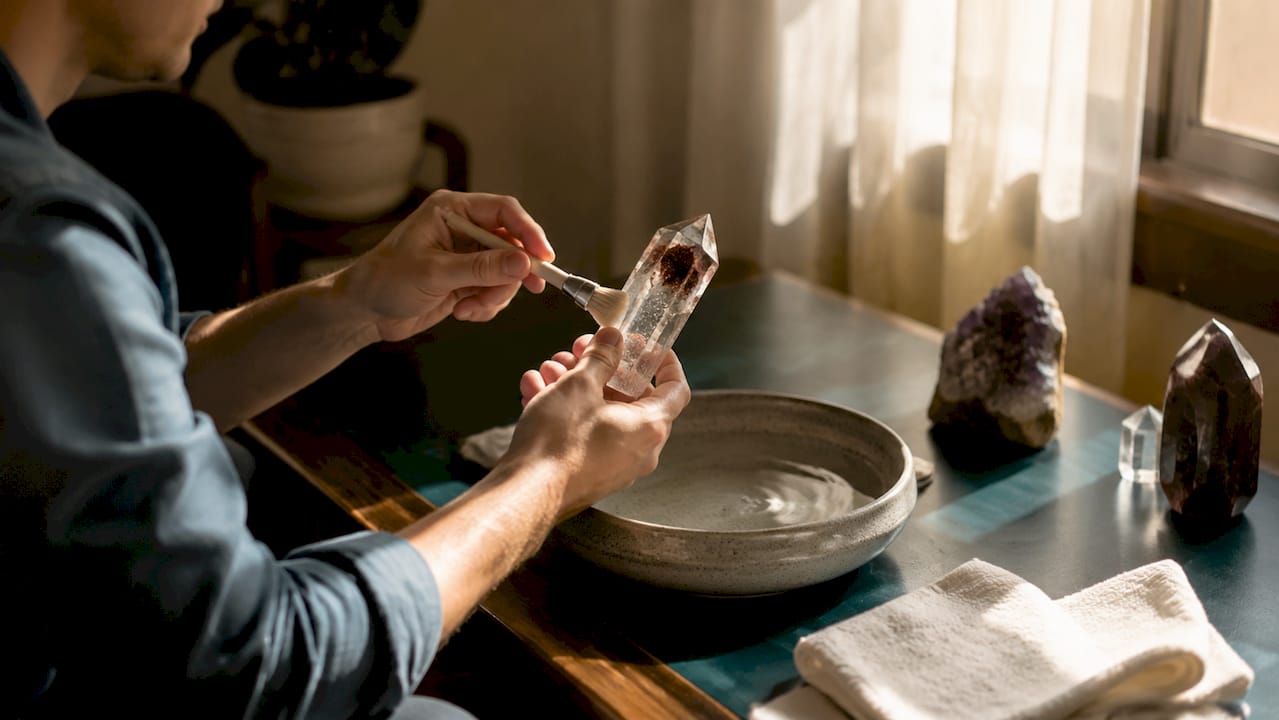
- Rinse with lukewarm water and a soft brush (a soft toothbrush works well).
- Use a small amount of mild, unscented soap if needed. Rinse thoroughly.
- Pat dry with a soft cloth. Allow to air dry fully before storing.
- Avoid ultrasonic cleaners unless the specimen has been verified free of internal fractures or unstable inclusions.
What to avoid
- Harsh acids or chemical cleaners. These can etch the quartz surface and dissolve certain inclusion minerals.
- Prolonged soaking in saltwater. Salt can work into micro-fractures and cause long-term damage.
- Sudden temperature changes. Moving a cold specimen into hot water (or vice versa) risks thermal shock and cracking.
- Direct, prolonged sunlight. Some inclusion minerals, particularly iron oxides, can fade with extended UV exposure.
For specimens with visible cracks or unstable inclusions, dry cleaning with a soft brush is the safest option. Store phantom quartz away from harder minerals that could scratch the surface, and keep pieces wrapped individually in soft cloth or placed in padded trays.
For practitioners who cleanse crystals energetically, common methods include placing the specimen on a selenite slab, using sound (a singing bowl or tuning fork), or leaving it in indirect moonlight. These methods carry no physical risk to the specimen.
Phantom quartz vs Garden/Lodolite quartz: key differences
Practitioners report that phantom quartz is uniquely suited to meditation because the internal phantom provides a stable, geometric focal point. Garden quartz, by contrast, offers a complex visual field that some practitioners use differently, for open-awareness or visualisation work rather than single-point focus.
| Feature | Phantom quartz | Garden/Lodolite quartz |
|---|---|---|
| Inclusion pattern | Geometric, follows hexagonal crystal habit | Irregular, dense, multi-mineral |
| Inclusion depth | Fixed layer at a specific growth stage | Scattered throughout the crystal |
| Under magnification | Sharp boundary at inclusion layer | Three-dimensional, landscape-like |
| Common inclusion minerals | Chlorite, hematite, clay, sericite | Chlorite, feldspar, epidote, multiple mixed minerals |
| Metaphysical use | Single-point focus, past-layer work | Visualisation, inner landscape exploration |
| Collector ID criterion | Geometric silhouette matching crystal habit | Dense, varied interior scene |
Genuine phantoms show a geometric silhouette that follows the hexagonal habit of the host crystal, which is the single clearest diagnostic feature separating them from Garden/Lodolite quartz with irregular inclusions.
How to spot fake or synthetic phantom crystals
Synthetic and treated phantom crystals do appear in the market. Knowing the common types helps avoid costly mistakes.
Artificially coated specimens: some sellers apply a coloured coating to the exterior of a quartz crystal, then overgrow a thin layer of synthetic quartz on top to simulate an encased phantom. Under a loupe, the “phantom” layer often shows uniform thickness inconsistent with natural mineral deposition, and the boundary may look too clean or too regular.
Dyed quartz: quartz with surface cracks or internal fractures can be dyed to produce coloured zones that resemble phantoms. The colour concentrates along fracture lines rather than following the crystal’s hexagonal outline.
Glass or synthetic quartz: manufactured glass or lab-grown quartz can be shaped to include a visible internal layer. Glass typically shows gas bubbles under magnification; lab-grown quartz may show curved growth lines rather than the angular, facet-following lines of natural phantom quartz.
What to look for: a natural phantom outline follows the exact geometry of the host crystal’s facets and termination. The inclusion layer has variable thickness and texture consistent with natural mineral deposition. Identifying natural vs synthetic crystals requires a loupe, directional lighting, and, for high-value purchases, a certificate from a recognised gemological laboratory. Checking a seller’s red flags for fake crystals before purchasing online is a practical first step.
Cultural and historical significance of phantom crystals
Phantom quartz does not carry a single well-documented cultural tradition the way some gemstones do, but its significance appears across several contexts.
In Japanese mineralogical and collector culture, phantom quartz (known in Japanese as ファントムクォーツ) has been appreciated as a specimen of geological interest since at least the modern mineral collecting era. Japanese collectors have historically placed high value on clarity and internal structure in quartz, and phantom specimens fit naturally into that tradition.
In Western esoteric traditions, the “ghost crystal” framing became prominent in the late 20th century alongside the broader crystal healing movement. Authors and practitioners drew on the visible growth record inside the crystal to develop the time-capsule symbolism now widely associated with phantom quartz in metaphysical contexts.
Among mineral collectors more broadly, phantom quartz has long been valued as a geological curiosity, a tangible record of interrupted and resumed crystal growth. Before the metaphysical framing became common, phantom specimens were collected primarily for their scientific interest and visual appeal, appearing in natural history museum collections as examples of complex quartz growth.
The overlap between scientific interest and spiritual use is not unusual for quartz varieties. The science and spirit of quartz have attracted collectors, scientists, and practitioners for centuries, and phantom quartz sits at that intersection more visibly than most varieties.
Key takeaways
Phantom quartz is a durable SiO2 mineral with a geometric internal outline formed by mineral inclusions during a growth pause, making it identifiable by its hexagonal silhouette, collectible for its clarity and contrast, and usable in focal meditation practice.
| Point | Details |
|---|---|
| Core definition | Phantom quartz contains a preserved interior outline (phantom) formed by mineral inclusions during a growth pause. |
| Identification signal | Look for a geometric silhouette inside the crystal that follows the hexagonal habit; use a loupe and directional light. |
| Formation recap | Growth pauses, a mineral layer deposits, growth resumes and encases the layer; repeated pauses produce nested phantoms. |
| Collecting value | Host clarity and phantom contrast drive value most; multi-nested specimens with sharp outlines are the rarest. |
| Legacy Crystals and Minerals | Offers museum-grade phantom specimens and phantom quartz jewellery with provenance details and clear specimen photography. |
Further reading and reputable sources
For deeper study, the following sources cover phantom quartz from mineralogical and collector perspectives:
- Mindat.org — authoritative mineralogical glossary definitions, including the phantom crystal entry.
- Wikipedia (Phantom quartz) — chemical and physical property overview with references.
- Geology In (geologyin.com) — detailed coverage of phantom quartz types, colours, and collector criteria.
- Crystal Almanac (crystalalmanac.com) — practitioner-oriented overview of metaphysical uses and meditation applications.
- Anahana (anahana.com) — buyer guidance and provenance advice for phantom quartz.
- Legacy Crystals and Minerals — museum-grade specimens, phantom quartz jewellery, and educational articles on quartz varieties and collector guidance.
Canadian buyers should confirm shipping terms and import rules with any international seller before purchasing. Request magnified photos showing the phantom outline from multiple angles, and ask for specific locality information rather than a country name alone.
Phantom quartz specimens and jewellery at Legacy Crystals and Minerals
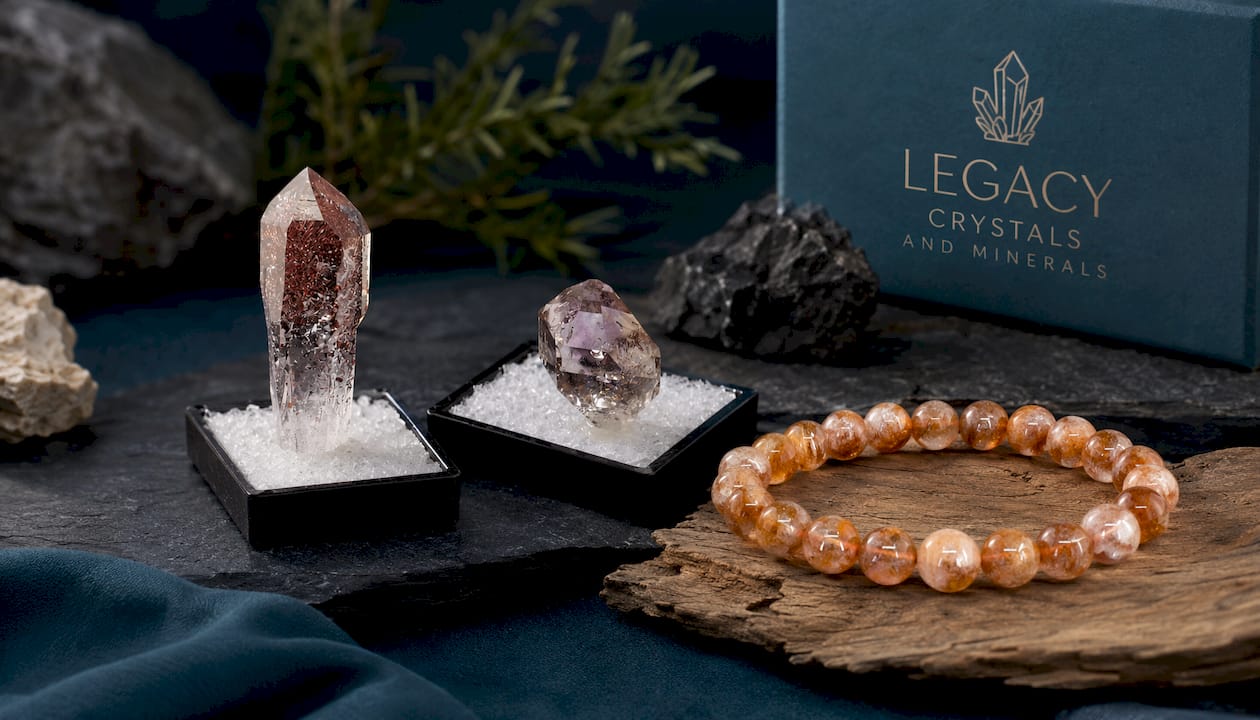
Legacy Crystals and Minerals carries a curated selection of phantom quartz specimens and phantom quartz jewellery, each listed with provenance details and clear specimen photography. For collectors, the inventory includes high-clarity raw specimens such as the Red Phantom Quartz with Hematite Inclusions (19mm) and the Amethyst Scepter from the Goboboseb Mountains, Namibia (16mm micro specimen). For practitioners and those interested in wearable pieces, the Orange Sericite Phantom Quartz Bracelet (polished 9.5mm beads) offers a wearable option with the same mineral authenticity. Browse the full selection at Legacy Crystals and Minerals to find a specimen or piece that fits your collecting or practice goals.
FAQ
Is phantom quartz valuable?
Phantom quartz is generally not priced like precious gems, but high-quality multi-phantom specimens with sharp contrast and excellent host clarity are sought after by serious collectors and can command significant prices relative to ordinary quartz.
Are phantom quartz and Garden quartz the same thing?
No. Phantom quartz has a geometric interior outline that follows the crystal’s hexagonal habit, formed by a specific mineral layer during a growth pause. Garden quartz (Lodolite) contains dense, irregular, multi-mineral inclusions scattered throughout the crystal with no defined geometric outline.
How do you identify phantom quartz?
Look for a geometric silhouette inside the crystal that mirrors the host crystal’s own hexagonal shape. The outline should be fully encased within the quartz, not on the surface, and should show a clear contrast boundary. A 10x loupe and directional light make identification straightforward.
How do you use phantom quartz in practice?
Hold or place the crystal at eye level, focus on the internal phantom outline as a meditation focal point, set a specific intention related to past growth or reflection, and sit for 5–15 minutes. Journalling after the session helps integrate whatever surfaces.
Recommended
- How to Identify Natural vs Synthetic Crystals – Legacy Crystals and Minerals
- How to spot fake crystals online: a practical guide – Legacy Crystals and Minerals
- What are record keeper crystals: meaning and identification – Legacy Crystals and Minerals
- How to Care for and Clean Your Crystals – Legacy Crystals and Minerals


