
Legacy Crystals and Minerals
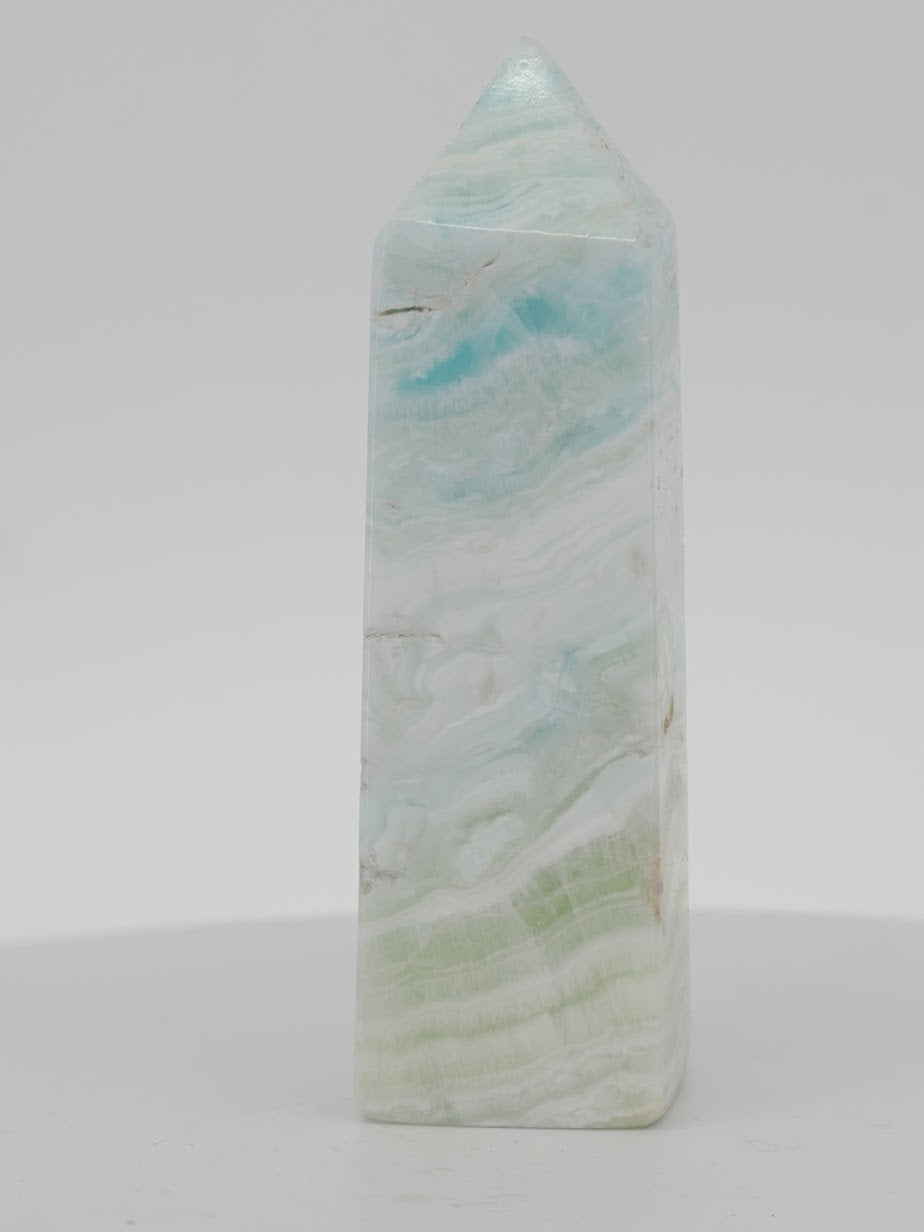
Caribbean Blue Calcite Tower – Balochistan, Pakistan | Intuitive Selection
Caribbean Blue Calcite Tower – Balochistan, Pakistan | Intuitive Selection
Couldn't load pickup availability
Share
Geological Overview
Discovered in 2019 along the border of Pakistan and Afghanistan, Caribbean Blue Calcite is a rare and striking combination of sky-blue Calcite and sandy-brown to white Aragonite ($CaCO_3$). These polymorphic minerals grow in a symbiotic pattern that mimics the aerial view of a tropical shoreline. Its unique structure often includes tiny, sparkling druzy cavities and natural "vugs" that highlight its authentic hydrothermal origins.
Aesthetic Appeal
Each tower is a natural work of art, featuring undulating "waves" of translucent aqua blue crashing against layers of creamy, earthy aragonite. The high-gloss polish emphasizes the waxy luster of the calcite while preserving the raw textures of the aragonite bands. No two pieces are alike, offering a unique "coastline" for every collector.
Metaphysical Properties
Associated with the Crown and Third Eye Chakras, Caribbean Blue Calcite is the ultimate stone for serenity and spiritual expansion. Its gentle energy is said to soothe the mind, making it a favorite for those seeking to alleviate anxiety or enhance their meditation practice. It is believed to act as a bridge to higher consciousness, promoting lucid dreaming and intuitive clarity.
Rarity & Collectibility
Graded AA (Premium Collector Grade), these towers are hand-selected for their superior color saturation and balanced banding. As a relatively new and localized discovery, Caribbean Blue Calcite is a high-demand specimen for both aesthetic decorators and serious mineral collectors.
Collector’s & Display Notes
- Measurements: Approximately 3" to 4" tall (8–10 cm).
- Selection: One tower will be intuitively selected for you.
- Origin: Balochistan Province, Pakistan.
- Care: Calcite is a soft mineral (Mohs 3). Keep away from acidic cleaners and prolonged direct sunlight to maintain its vibrant blue hue.
Condition & Authenticity
Transparency Matters: This is an all-natural mineral specimen with no dyes or heat treatments. Caribbean Blue Calcite is naturally prone to internal fractures and surface crevices; these are not defects but a testament to the stone's genuine formation in the Pakistani wilderness.