
Crystal Shape Meanings: 3 Quick Practices, Care & Buying Notes
Crystal shapes direct how a stone’s energy is expressed: points focus, spheres radiate, pyramids and clusters amplify, and grounding forms like tumbled stones or cubes anchor. The mineral supplies the intrinsic vibration, whether that’s amethyst’s calm or citrine’s brightness, and the shape supplies its posture, giving that vibration a direction to travel. Points and towers project outward, spheres send energy evenly in every direction, and hearts or palm stones hold it close for personal, emotional work.
TL;DR:
- The shape of a crystal influences how its energy is directed, with points focusing, spheres radiating, and clusters amplifying energy based on their form.
- Natural points display growth lines and irregular bases, while carved shapes feature symmetry and smooth finishes, affecting their display and handling.
- For focused intention or manifestation, choose towers or generators, whereas spheres and clusters are better for ambient energy and room filling.
- Handle delicate shapes like points or wands with dry methods and avoid water or sunlight for porous or sensitive minerals to prevent damage.
- Size does not determine strength; a well-terminated small point can outperform a large carved tower in directing intent due to its geometry.
Table of Contents
- Common crystal shapes and their traditional meanings
- How to use shapes: meditation, grids, and daily carry
- Natural formations versus carved shapes: what changes and what doesn’t
- How to choose a shape for your intention
- Do shapes really change a crystal’s energy?
- The history behind common crystal shapes
- Care and cleansing methods by shape
- Featured pieces that match these shapes to practice.
- Sources
- FAQ
Common crystal shapes and their traditional meanings
Every shape on a crystal shelf tells you something about how to use it before you even check the mineral name. Here’s a quick reference for the forms you’ll see most often, whether you’re shopping raw specimens or polished pieces.
- Double-terminated points. Bidirectional. Symbolic meaning: balance, exchange. Used to link two energies or two people, and placed between a giver and receiver in healing layouts. These are singled out in grid practice for balanced exchange work rather than one-way projection.
- Spheres. Radiating. Symbolic meaning: wholeness, harmony. Used for meditation and scrying, and for filling a room with even, ambient energy rather than pointing it anywhere. Spheres lack a single axis, which is why they’re recommended for even, non-directional focus during meditation practices. Read more on crystal sphere meaning if this shape appeals to you.
- Pyramids. Amplifying. Symbolic meaning: manifestation, structure. Used as a grid centrepiece and for stabilizing scattered energy into one clear intention.
- Clusters and geodes. Radiating, multi-point. Symbolic meaning: community, abundance. Used to energize a shared space and to cleanse smaller stones placed nearby, since many terminations radiating in different directions are traditionally treated as filling a room rather than aiming at a single target.
- Hearts. Emotional focus. Symbolic meaning: love, self-compassion. Used for grief work, self-soothing rituals, and gifting. Best kept close to the body or on a nightstand rather than in a busy, high-traffic room.
- Wands. Directional, extended. Symbolic meaning: precision, channelling. Used for targeted energy work along the body or in space, often with a defined tip and a rounded handle end.
- Palm and tumbled stones. Grounding, portable. Symbolic meaning: stability, comfort. Used for daily carry and quick grounding during stressful moments. These are the most economical entry point into a shape collection.
- Eggs. Concentrated, gentle. Symbolic meaning: fertility, new beginnings. Used for gentle energy work and, in some traditions, yoni eggs for pelvic floor practice (always confirm the mineral is non porous and body safe first).
- Cubes. Grounding, structured. Symbolic meaning: order, foundation. Used at the base of grids or on a desk to steady scattered focus during work.
- Merkaba and freeform shapes. Complex, multidirectional. Symbolic meaning: transformation, individuality. Used in advanced grid work or simply displayed for their unusual geometry.
Pro Tip: Don’t assume a bigger point is automatically stronger. A small, well terminated natural point with clean growth faces often outperforms a large carved tower for focused work, because the geometry, not the size, is doing the directing.
How to use shapes: meditation, grids, and daily carry
Shape meaning only matters once you put a stone to work. Here are three simple routines that use directionality on purpose rather than by accident.
- A two-minute sphere meditation. Hold a sphere or palm stone in both palms, cupped loosely at your lap. Close your eyes and let your attention rest on the stone’s weight rather than its edges. Because a sphere has no single axis, it won’t pull your focus toward any one point. Use this for grounding before sleep or after a stressful call.
- A five-stone manifesting grid. Place a generator or pyramid at the centre. Surround it with four points, tips facing outward, to project the intention beyond the grid itself. Anchor the four corners with tumbled stones, which hold the layout steady and ground the outer edge. This layout mirrors the standard approach used for manifestation rituals.
- Choosing a daily carry stone. Pick a tumbled or small palm stone over a raw point for pocket carry. Raw points chip easily against keys and coins, and a chipped tip changes how the stone sits in the hand.
For grid work specifically, tip direction matters: point inward when you want to concentrate energy on a central object or person, and point outward when the goal is projection into a room or beyond. Favour polished shapes for anything handled often, since raw edges wear down unevenly and can flake. Watch for two care issues before you build any routine: some minerals are water soluble and will pit or dissolve if rinsed, and others fade in direct sunlight, so check a stone’s sensitivity before cleansing or displaying it on a sunny windowsill.
Natural formations versus carved shapes: what changes and what doesn’t
A natural formation, such as a cluster, geode, or single terminated point, grew that way underground with no human shaping. A carved or polished shape, like a sphere, heart, or tower, started as rough material that a lapidary cut and finished by hand or machine. The two categories look and feel different, and they’re priced differently too, but the mineral inside hasn’t changed at all.
Polishing doesn’t alter a stone’s intrinsic vibration. What it does change is posture: a rough point becomes a symmetrical tower, a jagged chunk becomes a smooth sphere, and that new geometry changes how the piece is handled, displayed, and used in practice, even though the underlying mineral identity stays identical.
A few identifiers help when you’re deciding what you’re actually buying:
- Natural points show growth striations, an irregular or matrix-attached base, and small natural etchings.
- Carved points show perfect symmetry, a uniform polish, and a flat, sawn base.
- Clusters and geodes with visible matrix rock are almost always natural, since that texture is difficult and unrewarding to fake.
Collectors tend to invest in natural formations for the geological story and display value, since no two are alike. Practitioners more often reach for polished shapes because they’re portable, predictable, and easier to hold during a ritual. Our guide on raw versus polished crystals walks through this trade off in more depth, including why crystals form different shapes underground in the first place.
How to choose a shape for your intention
Skip the guesswork by running through five quick questions before you buy.
- What’s the intention? Manifestation or focused goal work points you toward towers, generators, and single-terminated points. Ambient balance in a room points you toward spheres and clusters. Emotional processing points you toward hearts and palm stones. Daily grounding points you toward tumbled stones.
- Where will it live? A desk or altar can hold something delicate; a bag or pocket cannot.
- How much handling will it get? Frequent touching favours polished, rounded shapes over sharp natural points.
- How much breakage can you tolerate? If you’re clumsy or have curious pets or kids nearby, skip fragile natural terminations and thin wands.
- What’s your budget and aesthetic preference? Spheres cost more per weight because carving one wastes a large share of the rough material; tumbled stones are the most economical way to build a varied set.
Match the intention to the shape category directly: manifestation and goal setting to points and generators, ambient household balance to spheres and clusters, emotional support to hearts and palm stones, and portable grounding to tumbled stones.
Watch for three red flags at checkout: a “natural” point with a perfectly flat, sawn base (likely carved and mislabelled), a tower or obelisk with a base too narrow to stand securely on its own, and any water sensitive mineral, like selenite or halite, sold without a care warning.
Pro Tip: If you’re torn between two shapes for the same intention, buy the one you keep picking up in your hand. Physical resonance is a genuinely useful tiebreaker, and it costs nothing to test in store or while scrolling product photos.
Do shapes really change a crystal’s energy?
The most common myth is that a pointed crystal literally emits a measurable beam of energy, the way a flashlight emits light. Physics doesn’t support that claim, and no controlled test has ever detected such a beam. The more grounded, and more useful, version of the idea is that shape changes how a practitioner directs attention and intention, not that the stone is broadcasting anything on its own.
Shapes work best as tools for mindfulness and ritual focus, not as scientifically proven emitters of energy. The mineral sets the underlying quality; the shape shapes how a person interacts with it.
Treat shape meaning as a practical metaphor rather than a physical law. Choose what you feel drawn to, keep sharp points away from children and pets, and let the ritual, not the marketing claim, do the work.
The history behind common crystal shapes
Carved crystal points and spheres are far from a modern wellness trend. Ancient Mesoamerican cultures shaped quartz and obsidian into skulls and mirrors for divination centuries before the term “crystal healing” existed, and Qing dynasty lapidaries in China turned rock crystal and jade into spheres and carved figures as both scholarly objects and symbols of status. Egyptian burial sites have produced carved amulets in geometric forms, including small pyramids and beads, reflecting a belief that shape carried protective or symbolic weight alongside the stone itself.
Points and obelisks carry their own long history: obelisk shaped monuments in ancient Egypt were carved from single blocks of stone and associated with the sun god Ra, a link that later folk traditions echoed by treating pointed crystal towers as conduits for solar, outward-facing energy. Clusters and geodes, meanwhile, entered European mineral cabinets during the 18th and 19th centuries as prized natural curiosities before any metaphysical framing attached to them, valued first for the raw wonder of their formation.
None of this history proves a scientific mechanism behind shape meaning. It does show that pairing form with symbolism is a consistent human habit across very different cultures and centuries, which is part of why the practice has endured into contemporary spiritual and wellness use rather than fading as a passing fad.
Care and cleansing methods by shape
Cleansing method needs to match the shape you’re holding, not just the mineral. Delicate points and wands with thin tips are easy to chip during a rinse, so a dry method like sage smoke, sound (a singing bowl or bell), or simply resting on a selenite charging plate is safer than running water. Spheres and tumbled stones tolerate a quick rinse under cool water far better, since there’s no fragile edge to knock, though you should still confirm the mineral itself isn’t water soluble before doing this.
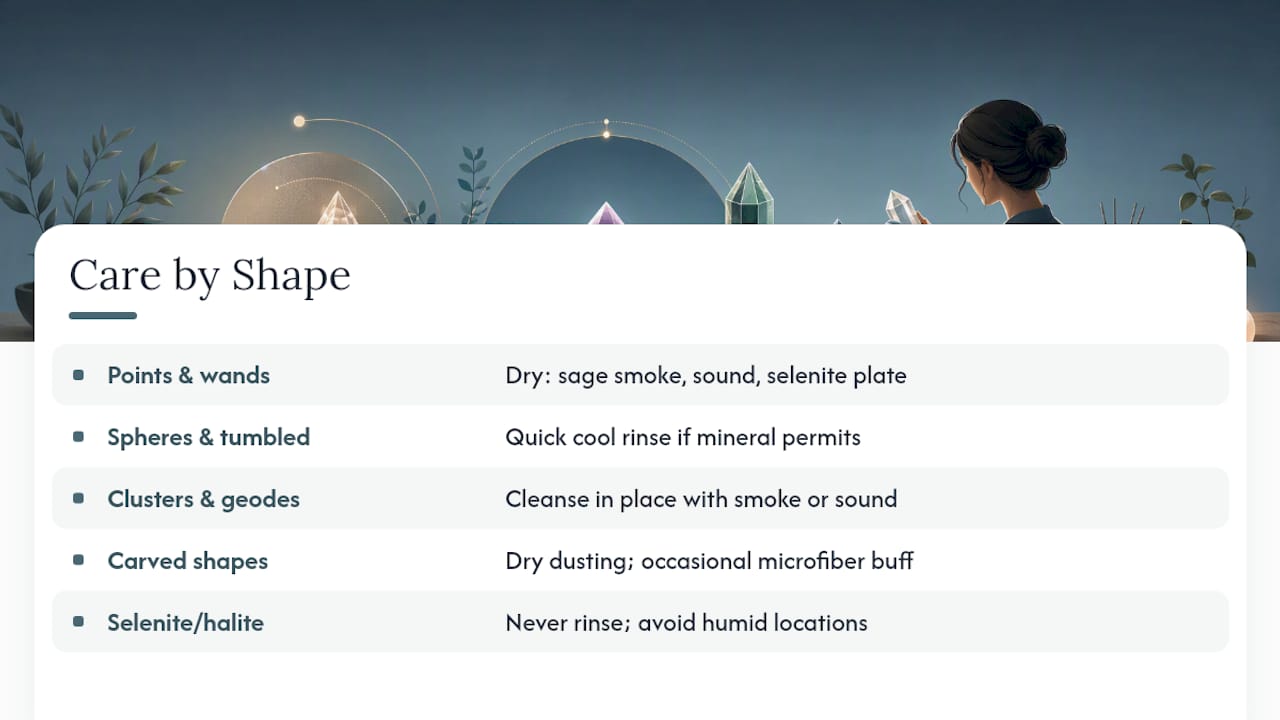
Clusters and geodes with a matrix base are best cleansed in place, using smoke or sound rather than moving them, since repeated handling wears down delicate terminations over time. Carved shapes like hearts and figurines can generally handle light dusting with a soft, dry cloth, and an occasional buff with a microfibre cloth keeps the polish looking fresh without introducing moisture.
Sunlight is the second variable to track. Amethyst, rose quartz, and citrine (when it’s dyed rather than natural) can fade with prolonged sun exposure, so display these on a shelf out of direct light rather than a sunny windowsill, regardless of shape. Selenite and halite towers are the clearest water soluble risk category. Never rinse them, and keep them away from humid bathrooms.
Store fragile natural points separately from tumbled stones in a drawer or box, since tumbled stones will scuff soft natural faces during transport. A soft pouch or lined tray solves this for most home collections.
Featured pieces that match these shapes to practice.
If the point and generator entry above caught your attention, the Mystery Crystal Tower (Generator Obelisk) Blind Grab gives you a directional, six-faced generator suited to grid centrepieces and focused meditation work, exactly the projection role described in the manifesting grid above. Keep it upright on a stable surface and away from edges, since a narrow tip base is the one fragility point to watch on any tower.

For emotional and ritual focal work, the Guardian Angel Spirit carving at roughly 2.6 inches functions the way the heart and figurine entries do: a carved shape meant to sit close by on an altar or nightstand rather than travel in a pocket. Dust it dry rather than rinsing, particularly if the mineral is one of the softer, more porous varieties.
The Crystal Coffin Carvings, a small 3 by 1.5 inch carved form available in obsidian, jasper, sodalite, or rhodonite, work well as a keepsake or a compact ritual object for grid corners or a small altar arrangement, echoing the grounding role tumbled and cube shapes play elsewhere in this guide.
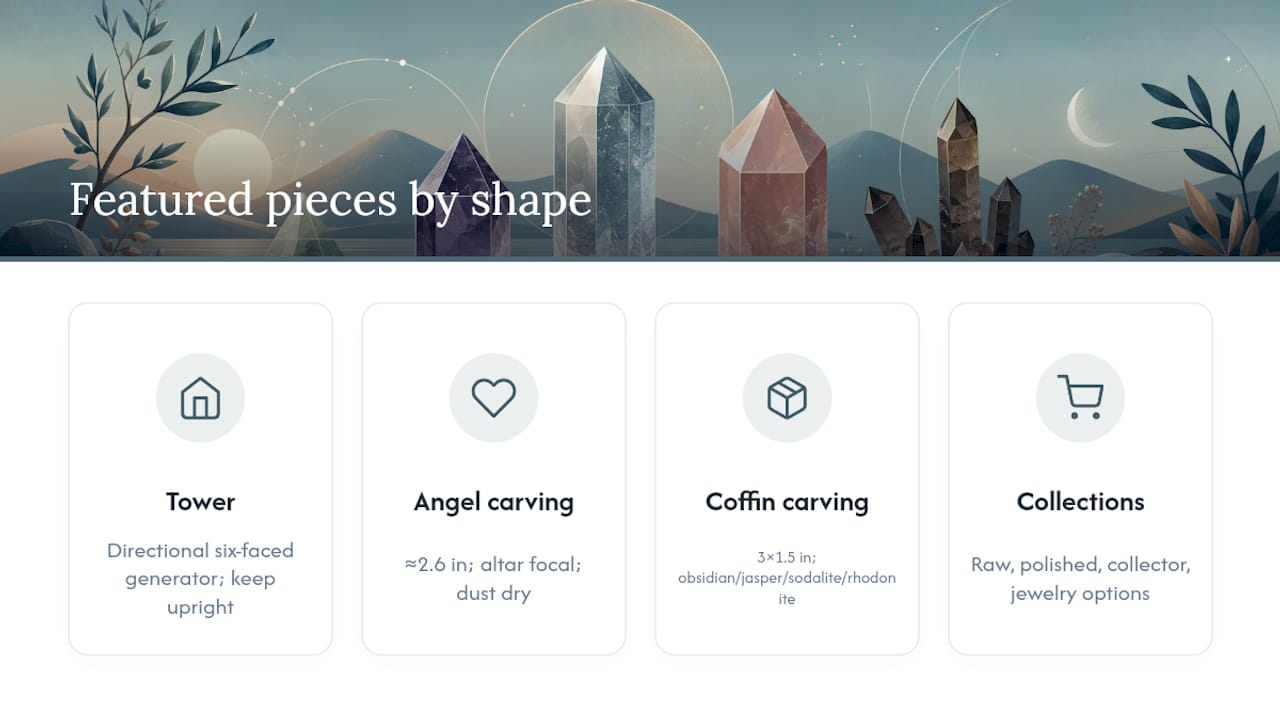
If you’d rather build toward a natural display piece, browse raw minerals and crystals for growth striated points and matrix clusters, or the polished collection for spheres, towers, and other lapidary shapes ready for daily practice. Collectors chasing rarer specimens can look through museum quality minerals and crystals or the top shelf collector minerals selection, while anyone building a wearable, portable set should check the jewelry and bracelets collections, or browse carvings for more heart and figurine options. These are sourced as museum grade, curated specimens with documented provenance, so what you choose reflects the shape meaning you actually want to practise with, not just what happened to be on the shelf.
Sources
- Crystal shapes explained: Points, clusters, spheres & more | Crystal Almanac
- Crystal shapes and formations: a visual guide | Kerykeion
- Crystal shapes & meanings: points, spheres, pyramids, wands | Crystals Alchemy
FAQ
What are the 7 basic crystal shapes?
Most guides count points, spheres, pyramids, clusters, hearts, tumbled stones, and wands as the core seven, though cubes, eggs, and freeform or merkaba shapes are commonly added as a broader set. Each carries a distinct directional role, from the outward focus of a point to the even radiation of a sphere.
What is the most powerful crystal shape?
There’s no single “most powerful” shape, since power depends on what you’re trying to do. A point or generator suits focused manifestation work, while a sphere or cluster suits ambient, room-filling balance, so the right choice is the one that matches your intention.
Which crystals should not be put together?
This question is usually about mineral pairing rather than shape, and it comes down to individual sensitivities like water solubility or sunlight fading rather than a fixed incompatibility list. Store fragile natural points separately from tumbled stones to prevent scuffing, and keep water soluble minerals like selenite away from any damp storage.
What are the six basic crystal shapes?
A common shorter version of the shape list includes points, spheres, pyramids, clusters, hearts, and tumbled stones, dropping wands and eggs as more specialized forms. All of these plus generators, cubes, and freeforms are covered in the shape reference above, since the six-shape list is really a simplified starting point rather than an exhaustive one.
Is a bigger crystal point stronger than a small one?
Size doesn’t determine how well a point directs intention. A small, cleanly terminated natural point with intact growth faces often works as well as a large carved tower, because the geometry of the tip is doing the directing, not the mass of the stone.


