
Crystal Skulls From 4cm to 1.02 kg: Meaning vs Age and How to Buy
Crystal skulls carry a two-part symbolism: the skull represents consciousness, mortality, and ancestral memory, while the crystal represents amplification, clarity, and stored energy. Together, the two meanings form a single object that practitioners use for meditation, intention setting, and reflection on mortality. This symbolic reading stands apart from questions about a skull’s age or origin, which we’ll cover separately.
TL;DR:
- Most famous crystal skulls were made in the 19th century, with tool marks and mineral sourcing confirming modern manufacturing rather than ancient origins.
- The symbolic meaning of skulls and crystal is constructed through contemporary metaphysical practices and varies depending on individual intention and cultural context.
- Common uses include meditation, intention setting, altar display, and group ceremonies, with no formal training required to incorporate them into personal routines.
- Carving quality, size, material rarity, and documented sourcing are the primary factors determining a crystal skull’s value, not its claimed age or mystical powers.
- Scientific research shows no evidence supporting paranormal powers or ancient provenance, making their spiritual use based on personal belief rather than verified history.
Table of Contents
- What do crystal skulls represent?
- How do people use crystal skulls today?
- What does the scientific record say about crystal skull origins?
- How do you assess authenticity and value before buying a crystal skull?
- Why Legacy Crystals and Minerals is a trustworthy source for crystal skulls
- What role do crystal skulls play across different cultures?
- Are crystal skulls’ spiritual powers real or just belief?
- Find your crystal skull at Legacy Crystals and Minerals
- Sources
- FAQ
What do crystal skulls represent?
The meaning of crystal skulls comes from combining two very different symbols into one object. A skull, on its own, has meant mortality and transformation across countless cultures. Crystal, on its own, has long stood for clarity, memory, and energetic amplification in mineral folklore and modern metaphysical practice alike. Carve one into the shape of the other, and you get an object designed to hold both ideas at once: a mind (the skull) housed inside something that concentrates and reflects energy (the crystal).
That pairing is why crystal skull symbolism reads differently depending on who’s interpreting it. A meditation teacher might describe a skull as a mirror for the practitioner’s own consciousness. A collector focused on ancestor work might see it as a vessel for connecting with those who’ve passed. A person drawn to memento mori traditions, the old European practice of keeping a symbol of death nearby as a reminder to live well, might use a skull carving as exactly that: a quiet, physical prompt to stay present.
Several themes recur across how people describe crystal skull metaphysical meaning:
- Amplified consciousness. The clear or translucent structure of quartz is associated with mental clarity, and shaping it into a skull is often read as concentrating that clarity around the idea of “mind.”
- Ancestor and lineage work. Skulls are used as symbolic touchpoints in practices built around honouring those who came before, echoing older traditions of skull veneration found in numerous cultures.
- Transformation. Death imagery paired with crystal (a material formed under pressure over long stretches of time) is often read as a symbol of change and renewal rather than an ending.
- Memento mori. A visible reminder of mortality, used the way a 17th-century vanitas painting used a skull: to focus attention on the present.
- Protection and grounding. Some practitioners place skulls on altars or in workspaces as a stabilizing, watchful presence.
It’s worth being direct about something the wider crystal skull conversation often blurs: this symbolism is a contemporary framework. It doesn’t depend on a skull being ancient, and it doesn’t require a specific archaeological pedigree to be meaningful. The Smithsonian’s own research into famous specimens focused on manufacturing dates, not on disproving symbolic value, because those are separate questions entirely. A skull carved last year in a workshop can carry exactly as much intention and meaning as one presented as centuries old. What changes is the honesty of the claim being made about it.
Museum context matters here too. When institutions like the British Museum study crystal skulls in their collections, they’re answering “when and how was this made,” not “does this object matter to the person who owns it.” Those two questions get conflated constantly in casual conversation about crystal skulls, and separating them is the first step to understanding what these objects actually offer a modern practitioner.
Cultural variation adds another layer. Interpretations shift depending on the tradition a person draws from, whether that’s Western New Age practice, indigenous skull symbolism (treated with its own distinct history and covered later), or simply personal, non-religious reflection on mortality and clarity. None of these readings cancels the others out. A crystal skull’s meaning is built collaboratively, by the person holding it and the intention they bring to it.
How do people use crystal skulls today?
Most contemporary use of crystal skulls falls into a handful of practical categories: meditation anchors, intention-setting tools, ceremonial focal points, and display pieces meant to hold space in a room. None of these require special training, though a bit of structure helps, especially for readers trying this for the first time.
Meditation anchor. Holding or gazing at a skull gives the mind something concrete to return to when attention wanders. This is the same principle behind a mala or a candle flame: a fixed point that interrupts distraction.
Intention setting. Some practitioners hold a skull while stating or writing an intention, treating the crystal’s clarity as symbolic reinforcement of mental focus.
Group ceremony. Circles or gatherings sometimes pass a skull hand to hand, or place one at the centre of a shared space, as a unifying object during collective ritual.
Altar display. A skull kept on a home altar or shelf functions as an ongoing, ambient symbol rather than something actively handled each day.
Contemplative gazing. Simply sitting with a skull and observing its facets, inclusions, and light play can function as a slow, meditative practice on its own.
If you want a simple starting structure, try this short sequence:
- Sit somewhere quiet and hold the skull in both hands, or place it at eye level in front of you.
- Take five slow breaths, letting your gaze soften as you look at the crystal’s surface.
- Silently name one thing you want clarity on, whether that’s a decision, an emotion, or a memory.
- Sit with the object for two to three minutes without trying to force an answer.
- Close by setting the skull down deliberately, treating the placement itself as the end of the practice.
This isn’t a prescribed ritual with fixed rules. Treat it as a starting template, and adjust the pacing, wording, or setting to whatever feels respectful and useful for you.
Mineral choice shapes the experience too. Clear quartz is the most common material and is associated with mental clarity and general amplification. Smoky quartz carries a grounding, calming association, often chosen by people who want a heavier, steadier feel. Amethyst, with its purple tone, is more often linked to emotional or intuitive work. None of these associations are governed by any regulatory or scientific standard. They’re conventions built over decades of metaphysical practice, and picking a mineral often comes down to what a person’s intention calls for. For a longer walk through building a full practice, Legacy Crystals and Minerals’s guide to crystals for meditation practices covers technique in more depth.
Pro Tip: Handle a new skull gently for the first few sessions before deciding how it fits your practice. A heavier piece, like a 1 kg carving, feels completely different in meditation than a small 4 cm skull, and that physical weight often changes how a person relates to it.
What does the scientific record say about crystal skull origins?
The scientific consensus is clear on one point: the most famous crystal skulls in public collections were very likely made in the 19th century, not by any ancient civilization. This isn’t a fringe theory. It’s the conclusion reached independently by researchers at two of the world’s most respected natural history institutions.
The Smithsonian’s National Museum of Natural History examined a skull donated anonymously and used electron microscopy to study its surface at a scale invisible to the naked eye. What they found were tool marks consistent with rotary equipment, the kind of jewellery and lapidary tools that became common in the 19th century, not the hand-worked stone tools available to pre-Columbian carvers.
Electron microscope analysis revealed tool marks on the crystal’s surface consistent with modern rotary cutting equipment rather than hand tools available in pre-Columbian Mesoamerica, supporting a 19th-century or later manufacturing date.
British Museum researchers reached similar conclusions studying skulls in their own holdings, and the pattern extends further into the material itself. Mineral inclusions of chlorite found in several well-known skulls point to quartz sourced from Brazil and Madagascar, regions with no documented connection to the Mesoamerican cultures these skulls were often marketed as belonging to.
Key finding: No crystal skull held in a major public collection has a documented excavation record. Every provenance chain traced by researchers leads back to a purchase history, typically through 19th-century antiquities dealers, rather than an archaeological dig.
Historical research adds a specific likely source. Investigations tracing the best-known skulls back through auction and collection records point toward European lapidary workshops, particularly around Idar-Oberstein in Germany, a region famous for centuries of gemstone cutting expertise. That fits the physical evidence: skilled European carvers with rotary tools and access to Brazilian quartz, producing objects that dealers then sold into a market hungry for exotic “ancient” artifacts.
The myths that grew up around these objects, pre-Columbian sacred origins, connections to Atlantis, claims of extraterrestrial creation, are compelling stories, but no reproducible scientific evidence supports any of them. Archaeologists remain skeptical for a simple reason: the physical evidence (tool marks, mineral sourcing, absence of excavation records) points consistently in one direction, and that direction isn’t ancient Mesoamerica.
None of this erases the symbolic and spiritual value covered earlier. It just means that value stands on its own, separate from any claim about age.
How do you assess authenticity and value before buying a crystal skull?
Buying a crystal skull as a collector or practitioner means separating what actually affects value from what a seller might claim to boost a price. A handful of objective checks go a long way.
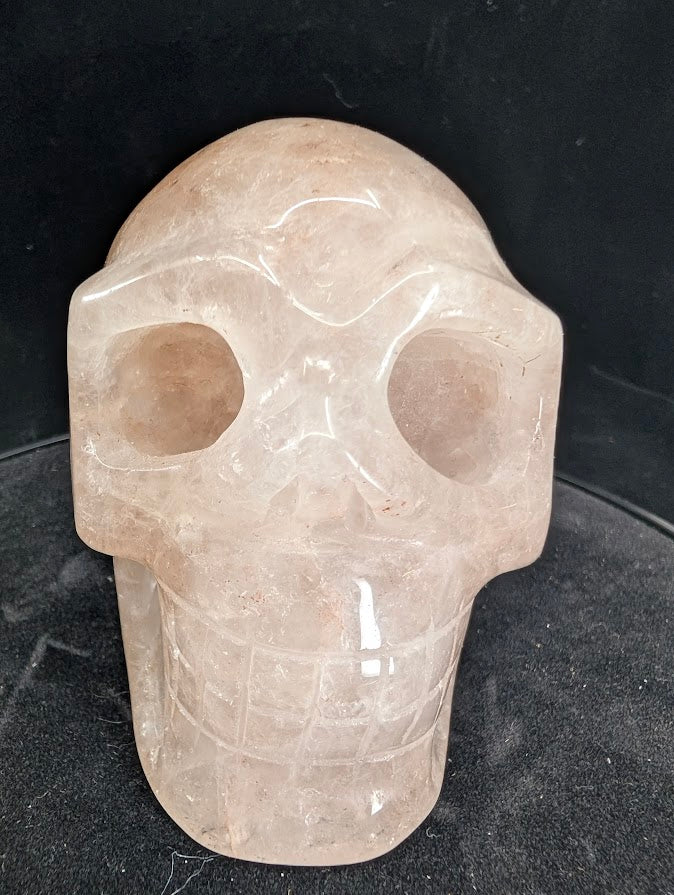
Start with the material itself. Crystal type (clear quartz, amethyst, smoky quartz, or something rarer like hematoid quartz) is the single biggest driver of both price and visual character. Visible inclusions, tiny mineral impurities trapped inside the stone during formation, aren’t flaws to hide; they’re often proof of natural origin and can add character or even value depending on how they’re positioned in the finished carving. Polish quality matters too: a well-finished skull should have even, consistent shine across facets without cloudy patches or uneven grinding marks.
Tool marks are worth a close look, and not just for archaeological interest. Fine, even rotary marks under magnification generally indicate careful modern carving. Rough, inconsistent marks can signal rushed mass production rather than a fault in the material.
Here’s what actually drives price on a legitimate crystal skull:
- Size and weight. Larger carvings require more raw material and far more carving time, which pushes price up substantially.
- Material rarity. Common clear quartz costs less than rarer varieties like hematoid or fire quartz, which carry natural red and orange inclusions that most quartz doesn’t have.
- Carving detail. Fine facial features, defined teeth, and precise cranial proportions take more skilled labour than a simplified, rounded shape.
- Documented sourcing. Sellers who can speak to where the raw material came from and how the piece was carved add real credibility, even without claiming ancient origin.
- Market demand. Certain mineral variants become harder to source, which affects price independent of carving quality.
Watch for red flags, too. Be cautious of any seller claiming verified pre-Columbian or ancient origin, given what museum research has established. Be skeptical of pricing that seems dramatically below market for the claimed size and material. And be wary of listings with only distant or heavily filtered photos that make it hard to inspect the surface, inclusions, or polish up close.
If you’re weighing a serious purchase, ask the seller directly about the mineral’s origin and how the piece was carved. For large, high-value pieces, a gemmological report or lab imaging can settle disputed provenance, though that expense rarely makes sense for a smaller decorative piece. Legacy Crystals and Minerals’s guide to carving quality walks through how to evaluate tool marks and finishing in more technical detail, and it’s worth reading before any purchase over a few hundred dollars.
Why Legacy Crystals and Minerals is a trustworthy source for crystal skulls
Legacy Crystals and Minerals built its catalogue around a straightforward standard: authenticity of material, honesty about origin, and carving quality that holds up under close inspection. That standard matters more in the crystal skull category than almost anywhere else, given how much misinformation circulates about ancient origins.
Author Simon, who covers mineral provenance and carving assessment for Legacy Crystals and Minerals, applies the same evaluation criteria museum researchers use: checking inclusions, tool marks, and material sourcing before writing about or listing any piece.
Three current pieces illustrate the range available to different kinds of buyers:
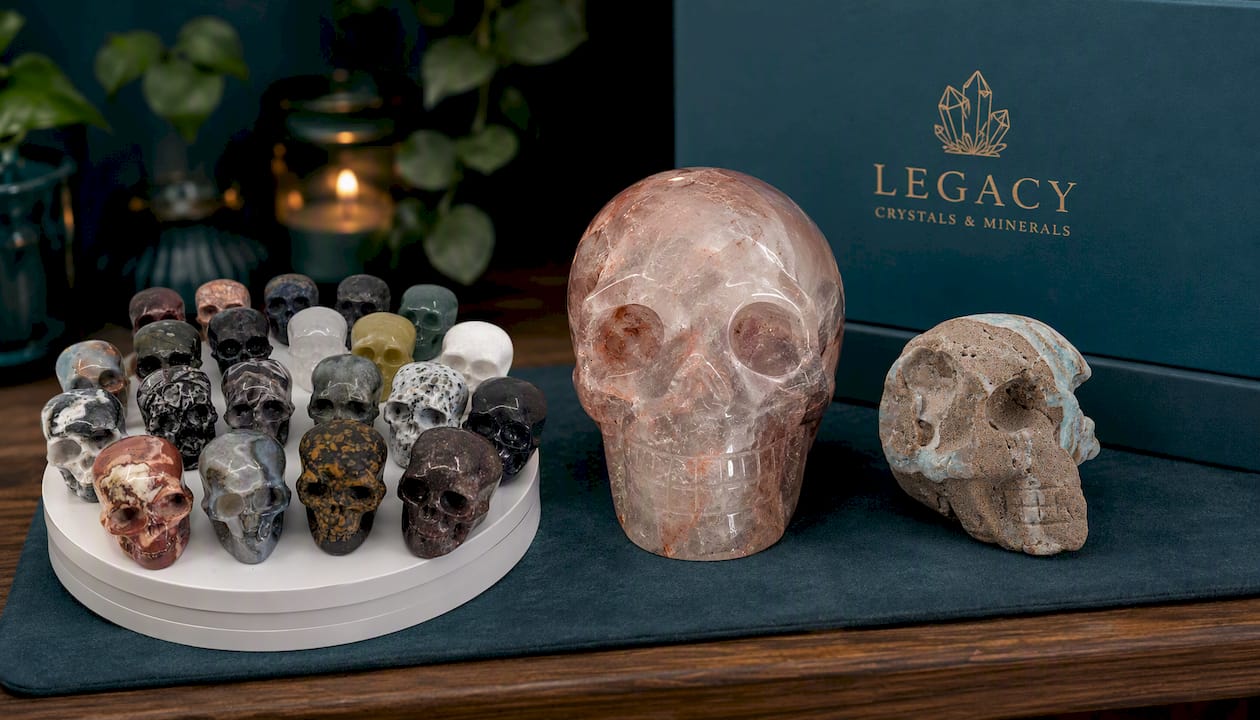
- Crystal Skull Collection – 2in. / 4cm Hand-Carved Crystal Skulls: a compact, affordable entry point suited to meditation practice or a first purchase for someone testing whether a skull fits their routine.
- Crystal Skull Collection – 500g Hand-Carved Skulls (10 Mineral Variants): a mid-sized option spanning ten mineral types, good for collectors who want to compare how different stones carry the same symbolism.
- Fire Quartz Skull – 1.02 kg Hematoid Quartz Carving: a substantial display piece with the reddish inclusions typical of hematoid quartz, built for a collector who wants a statement carving.
| Piece | Weight | Best suited to |
|---|---|---|
| 2in. / 4cm Crystal Skulls | Small | Meditation, first-time buyers |
| 500g Hand-Carved Collection (10 variants) | Mid-sized | Collectors comparing materials |
| Fire Quartz Skull | 1.02 kg | Display, statement collecting |
Legacy Crystals and Minerals documents sourcing on its listings and offers a standard return policy for buyers who want to inspect a piece in hand before committing. For care, keep skulls out of direct sunlight for extended periods (some minerals fade), dust with a soft cloth, and store larger pieces on a stable, padded surface to avoid chipping the delicate facial detail.
What role do crystal skulls play across different cultures?
Skull imagery itself has deep roots that predate any crystal carving controversy. Mesoamerican cultures, including the Aztec and Maya, used skull imagery extensively in religious and ceremonial art, most famously in the tzompantli skull racks and in Day of the Dead traditions that continue today across Mexico. That imagery was carved in stone, painted, and moulded, but the crystal skulls now sold commercially aren’t part of that documented tradition, a distinction worth holding onto given how often the two get merged in marketing.
Tibetan Buddhist practice uses skull imagery differently, through kapala ritual bowls traditionally made from human skulls (and modern replicas in other materials), symbolizing the impermanence of the body and the transformation of ego. European memento mori traditions, meanwhile, used painted or carved skulls in art and jewellery from the medieval period onward as reminders of mortality meant to sharpen focus on how one lives.
Indigenous perspectives on skull symbolism vary enormously by nation and tradition, and generalizing across them flattens real differences in belief and protocol. What’s consistent is that skull imagery, across nearly every culture that has used it, points toward mortality, transformation, and honouring those who came before rather than toward death as an endpoint. Modern crystal skull practice draws loosely on that shared thread, even without a direct historical lineage to any single tradition.
Are crystal skulls’ spiritual powers real or just belief?
This is where honesty matters most. Metaphysical claims about crystal skulls, that they store ancient knowledge, transmit energy, or hold prophetic power, are widespread in New Age literature and popular culture, from novels to feature films built around the idea of skulls with mystical abilities. Scientific investigation has found no reproducible evidence supporting any of these specific claims.
That doesn’t mean the practice is worthless, and it doesn’t mean skepticism and spiritual use are incompatible. Plenty of practitioners hold both positions at once: they understand a skull was carved recently by a skilled artisan, and they still find real value in using it as a meditation focus or a symbol for reflection. The meaning comes from the practice and the intention brought to it, not from an unverifiable claim about ancient power.
Where skepticism is warranted is specific claims: assertions of healing specific illnesses, verified psychic transmission, or documented ancient origin without evidence. Where spiritual use holds up fine is symbolic and contemplative practice, the kind that doesn’t require an extraordinary factual claim to be meaningful. Treating those as two separate questions, rather than one package deal, is the clearest way through the noise around this topic.
Find your crystal skull at Legacy Crystals and Minerals
Reading about crystal skull symbolism only goes so far. At some point, the meaning built into these pieces, consciousness, clarity, transformation, memento mori, becomes something you want to hold rather than just read about. Legacy Crystals and Minerals sources its skulls with documented material origin and visible carving quality, so you’re buying a piece you can actually verify, not just a story attached to a price tag.
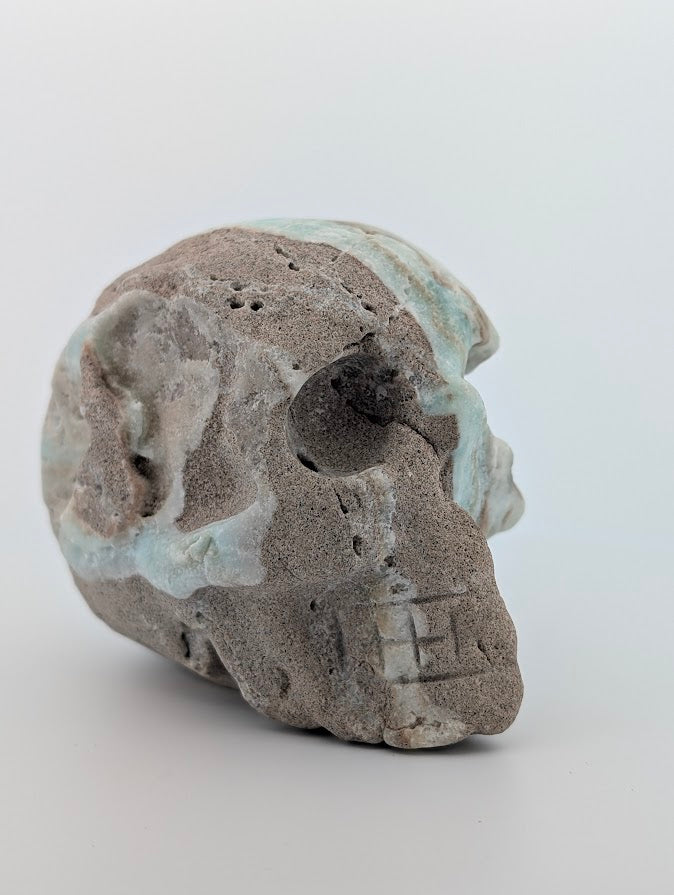
If you’re starting small or building a meditation practice, the 2in. / 4cm hand-carved skulls are an easy, low-cost way to bring the practice covered in this guide into your own routine. Collectors wanting to compare how different minerals carry the same form should look at the 500g collection spanning ten mineral variants, and anyone after a genuine display centrepiece will find the 1.02 kg Fire Quartz Skull hard to match for presence. For more on why carved crystal pieces hold value as decorative art beyond their metaphysical use, Legacy Crystals and Minerals’s partner resource on crystals as art pieces is worth a read.
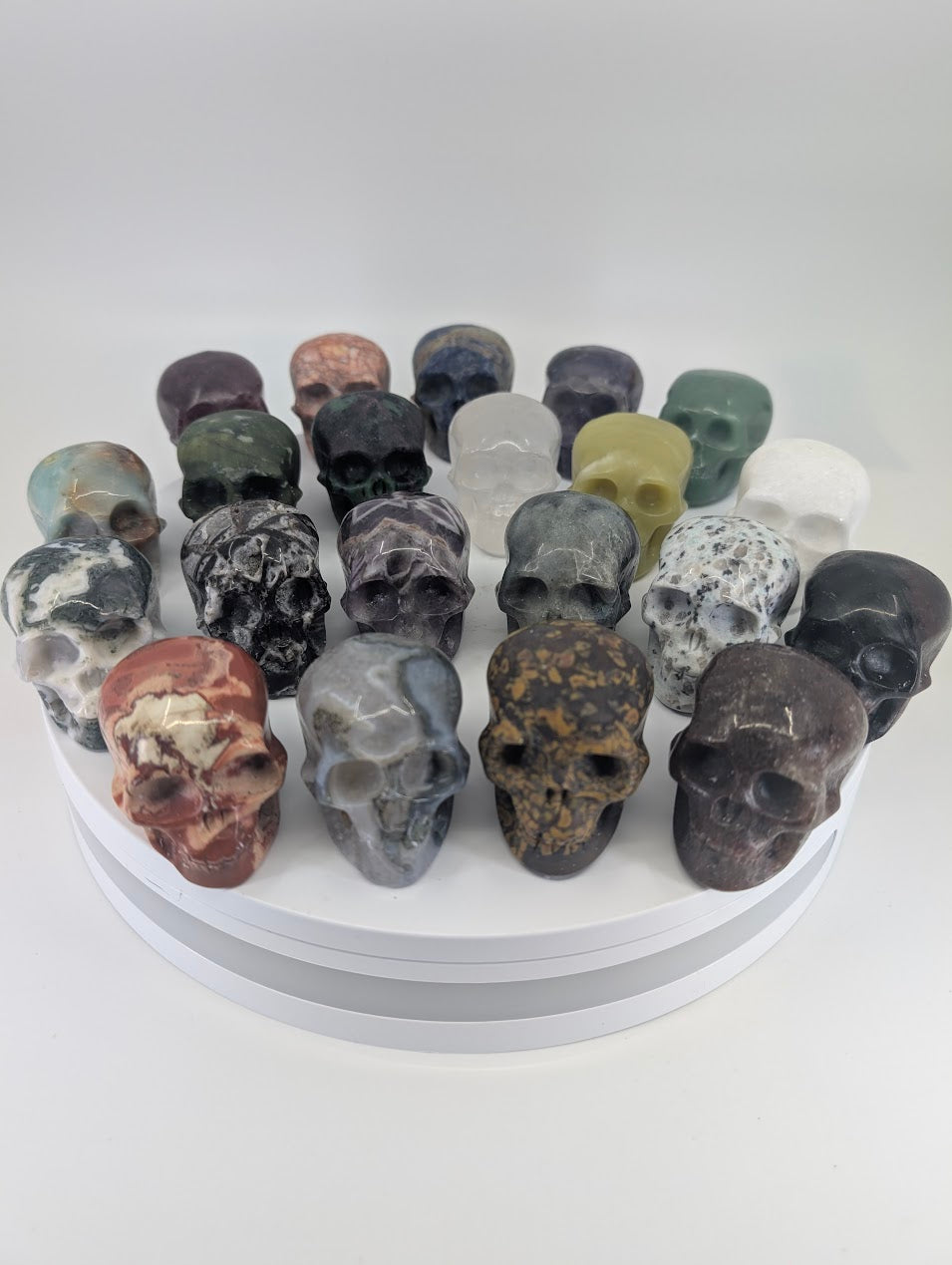
Browse the current skull catalogue, check the sourcing notes on the listing that catches your eye, and pick the piece whose weight and material actually suit how you plan to use it.
Sources
- Crystal skulls information, National Geographic
- Smithsonian press release: mysterious crystal skull exhibit
- What are the crystal skulls?, History
- Crystal skulls: myths and facts, HowStuffWorks
FAQ
What do crystal skulls symbolize?
Crystal skulls symbolize the union of consciousness (the skull) with clarity and amplification (the crystal), and are used for meditation, ancestor reflection, and reminders of mortality.
Are crystal skulls real or fake?
The crystal material itself is genuine quartz or another mineral, but claims of ancient or pre-Columbian origin are not supported. Smithsonian and British Museum research points to 19th-century manufacture for the most famous examples.
What is the purpose of crystal skulls?
Today, crystal skulls serve as meditation anchors, intention-setting tools, altar pieces, and display objects for reflecting on transformation and mortality, without requiring any claim about ancient origin.
What is the value of crystal skulls?
Value comes from material rarity, size, carving detail, and documented sourcing rather than claimed age. A small quartz skull can cost far less than a large, detailed hematoid quartz carving with rarer inclusions.
Are crystal skulls’ claimed healing powers scientifically proven?
No reproducible scientific evidence supports specific healing or paranormal claims tied to crystal skulls, though many people still find real value in using them as symbolic and meditative tools.


