

Moon ritual crystal examples: 8 stones and 3 templates
The five most-used moon ritual crystals, each with a single purpose:
- Selenite — cleansing and purification
- Moonstone — lunar connection and intuition
- Clear Quartz — amplifying intentions
- Amethyst — emotional healing and calm
- Black Tourmaline — grounding and protection
Labradorite, rose quartz, and citrine are commonly chosen as supporting stones depending on intention and phase, but practitioners consistently recommend starting with the core five for all moon-phase rituals.
Selenite, moonstone, and clear quartz are the three most frequently recommended for full-moon work; amethyst and labradorite follow closely as supporting stones. The practitioner’s intuitive pull toward a stone often matters more than any assigned label.
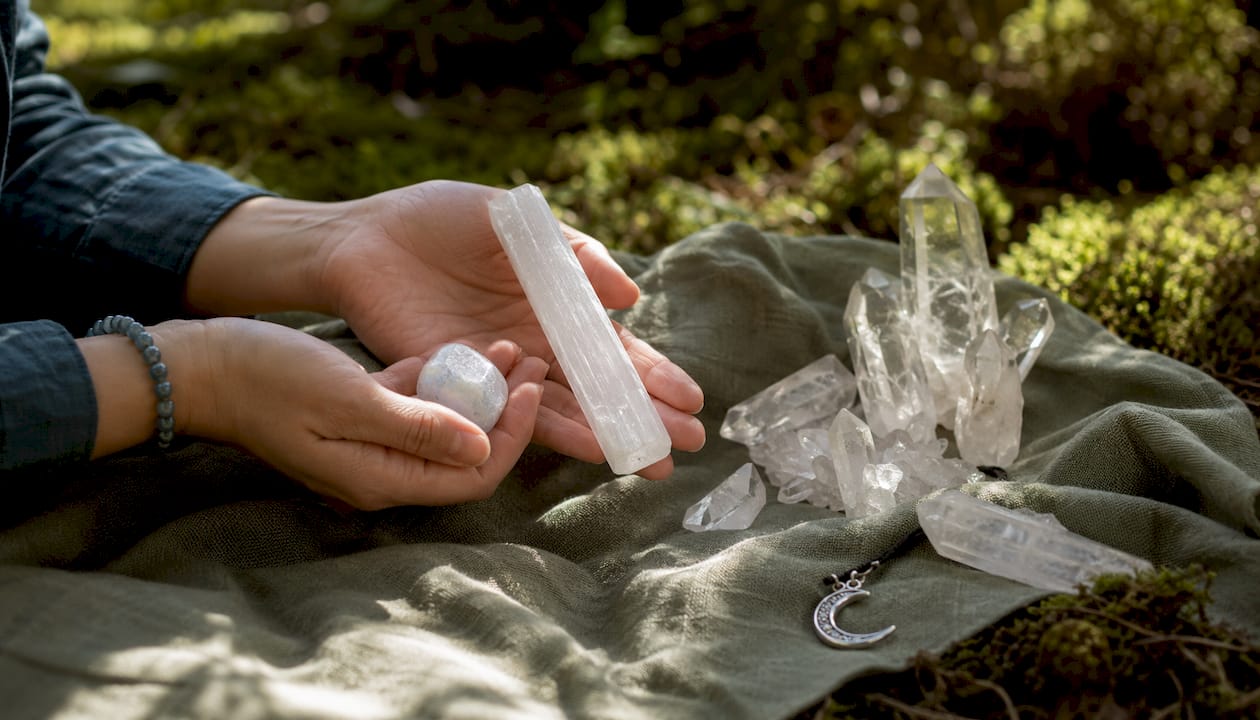
Pro Tip: Pick the stone you feel drawn to first. The ritual works through your intention, not the crystal’s category.
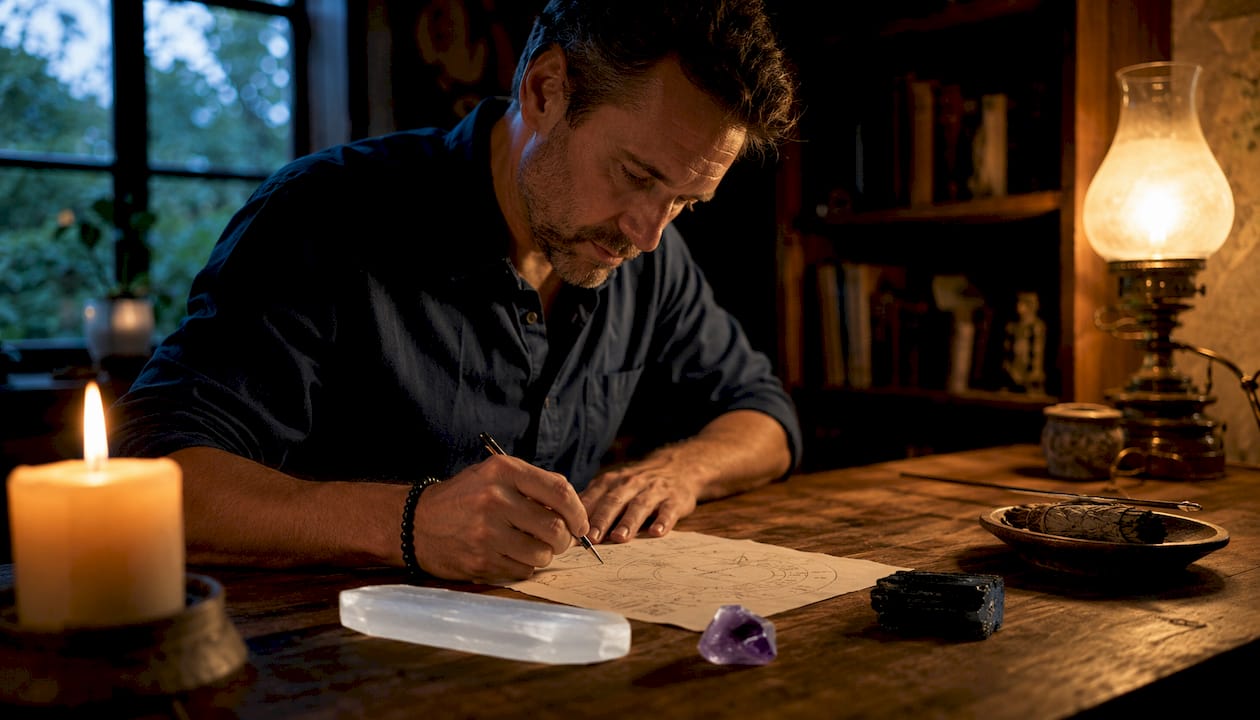
Table of Contents
- Three ready-to-use moon ritual templates you can try tonight
- Crystal properties, phases, and care at a glance
- How to choose the right crystal for your ritual
- Charging, cleansing, and safety: what to do and what to avoid
- What to remember and one thing to try tonight
- Legacy Crystals and Minerals: ritual-ready lunar pieces
- Further reading and source notes
- FAQ
- Key takeaways
Three ready-to-use moon ritual templates you can try tonight
Full-moon release ritual (10–15 minutes)
Recommended crystals: selenite, amethyst, black tourmaline.
- Find a quiet spot — windowsill, balcony, or a table near a window.
- Place your crystals in front of you. Hold the amethyst or black tourmaline in your hands.
- Write one to three things you want to release on a slip of paper.
- Read each item aloud, then fold the paper away from you.
- Set the paper under your selenite or beside your black tourmaline.
- Sit quietly for five minutes. Breathe. Let the intention settle.
- Tear or safely burn the paper when you are ready. Return crystals to their spot.
A full-moon ritual functions well as a short monthly pause — a short period of time is enough. No ceremony required.
Equipment: selenite wand or plate, amethyst tumble, black tourmaline piece, pen and paper.
Indoor variation: A north-facing windowsill works fine. Moonlight through glass still sets the mood; the ritual is about your intention.
New-moon intention ritual (10 minutes)
Recommended crystals: clear quartz, moonstone, citrine.
- Cleanse your space — open a window or light incense.
- Write one clear intention on paper. Keep it specific.
- Place your clear quartz point on top of the paper.
- Hold the moonstone in your non-dominant hand. Close your eyes and visualise the intention as already real.
- Set the citrine beside the paper to anchor the energy of growth.
- Leave the setup overnight on your windowsill or altar.
Equipment: clear quartz point, moonstone tumble, citrine piece, pen and paper.
Indoor variation: A small tray on a desk works as well as an outdoor altar. Consistency matters more than location.
Simple moon-charging method
This is the lowest-effort option and a good starting point for new practitioners.
- Place crystals on a windowsill or safe outdoor surface before bed on the full or new moon.
- Leave them out for one night (four to eight hours is sufficient).
- Bring them in before morning dew forms if they are outdoors.
- Do not place selenite, malachite, or raw pyrite outside — moisture will damage them. Use a dry indoor windowsill for these stones.
- For moon water: fill a glass jar with water, set it on the windowsill overnight, and use the water for cleansing your space or crystals the next day. Keep water-sensitive stones away from the jar.
For readers who want to expand a single-stone practice into a full layout, the crystal altar guide at Legacy Crystals and Minerals covers simple arrangement and maintenance.
Crystal properties, phases, and care at a glance
Each crystal below suits specific moon phases and ritual goals. Pairing suggestions are kept to two stones per entry to keep the practice simple.
| Crystal | Primary purpose | Best phase | Pairs well with | Care sensitivity |
|---|---|---|---|---|
| Selenite | Cleansing, purification | Full moon | Clear quartz | Dry only — water damages |
| Moonstone | Intuition, emotional balance | New moon, full moon | Labradorite | Gentle handling |
| Clear Quartz | Amplification, clarity | Both | Any stone | Low — very durable |
| Amethyst | Emotional healing, calm | Full moon | Selenite | Low — avoid prolonged sun |
| Labradorite | Transformation, inner listening | New moon | Moonstone | Low — avoid harsh chemicals |
| Rose Quartz | Heart work, self-compassion | Both | Amethyst | Low — avoid direct sun |
| Black Tourmaline | Protection, grounding | Full moon, eclipses | Selenite | Low — very durable |
| Citrine | Abundance, momentum | New moon, waxing | Clear quartz | Low — fades in strong sun |
Moonstone is consistently linked to intuition and emotional balancing, making it a natural fit for new-moon intention work with natural stone bead bracelets. Multiple practitioner guides place clear quartz, selenite, labradorite, amethyst, and black tourmaline in the same core list for lunar rituals.
Quick shopping tips for ritual-ready specimens
- Size: A tumble or small carved piece (roughly 2–5 cm) is practical for pocket, altar, or travel use.
- Raw vs. carved: Raw and carved forms each have ritual uses — raw for natural energy, carved for focused intention work.
- Translucence: In selenite and clear quartz, a glassy or milky translucence indicates quality. Avoid pieces with heavy surface crazing.
- Colour consistency: Amethyst should show even violet saturation; patchy or very pale pieces may be dyed or low-grade.
- Heft: A stone that feels lighter than expected for its size may be hollow, cracked, or resin-filled.
How to choose the right crystal for your ritual
A short checklist before buying or selecting a stone:
- Do you feel drawn to it? Personal resonance is the most reliable guide. If a stone catches your attention, that connection supports the ritual.
- What is the intended phase? Full-moon work calls for cleansing and releasing stones (selenite, amethyst, black tourmaline). New-moon work calls for amplifying and intention stones (clear quartz, moonstone, citrine).
- Is it water-sensitive? Selenite, malachite, and raw pyrite should never be submerged or left where dew collects.
- Does the size fit the use? A pocket stone needs to be small and smooth. An altar centrepiece can be larger and more sculptural.
- Is it treated or dyed? Ask the seller. Dyed stones are not harmful, but knowing the treatment helps set realistic expectations.
- Is it damaged? Check for cracks, chips, or surface repairs before buying.
At point of sale, test the heft, check the surface under light, and ask about origin when possible. Provenance matters for authenticity.
Pro Tip: Start with a small core set — moonstone, clear quartz, selenite, amethyst, and black tourmaline. These five cover both moon phases and most ritual intentions without creating decision fatigue.
For readers who want to pair moon-phase crystals with chakra work, the chakra alignment guide at Legacy Crystals and Minerals maps each stone to its corresponding energy centre.
Charging, cleansing, and safety: what to do and what to avoid
Dos
- Place crystals on a dry windowsill overnight on the full or new moon.
- Bring outdoor stones in before dawn to avoid dew exposure.
- Use a selenite plate to cleanse other crystals — selenite is self-cleansing and does not need to go outside.
- Cleanse crystals between rituals using sound (a singing bowl), smoke (incense), or dry moonlight.
Don’ts
- Do not leave selenite, malachite, or raw pyrite outdoors where moisture can collect. Selenite (a gypsum variety) will degrade if dew forms on its surface.
- Do not submerge any stone in moon water without confirming it is water-safe first.
- Do not leave citrine, amethyst, or rose quartz in direct sunlight for extended periods — prolonged UV exposure fades colour.
Stones to keep dry
- Selenite: dissolves slowly in water; keep completely dry.
- Malachite: copper-based; water can leach toxic residue.
- Raw pyrite: oxidises and can rust when wet.
- Calcite: soft and porous; water weakens the surface.
Moon charging is a symbolic and psychological practice. There is no known physical mechanism by which moonlight transfers energy to a crystal. The value of the ritual lies in the intention, the pause, and the consistency of the practice — not in a literal energy transfer. Treat it as a monthly moment of reflection, and the ritual will serve you well regardless of the stone you choose.
For readers combining moon rituals with meditation practices, the same safety notes apply: keep water-sensitive stones away from humidifiers or steam.
What to remember and one thing to try tonight
- Top crystals for moon rituals: selenite, moonstone, clear quartz, amethyst, and black tourmaline are the core recommended set. Labradorite, rose quartz, and citrine are supporting stones for particular intentions or phases.
- Simplest ritual to try tonight: place a clear quartz or moonstone on your windowsill, write one intention on paper, and leave both out overnight.
- Core safety note: keep selenite, malachite, and raw pyrite dry at all times — never leave them where dew or rain can reach them.
- Phase matching: full moon suits releasing and cleansing; new moon suits setting intentions and starting fresh.
- Personal resonance first: the stone you feel drawn to is usually the right one for your ritual, regardless of its assigned category.
Legacy Crystals and Minerals: ritual-ready lunar pieces
Moon rituals work best with stones you can actually hold, place, and return to each month. Legacy Crystals and Minerals carries pieces sized and shaped for exactly that.
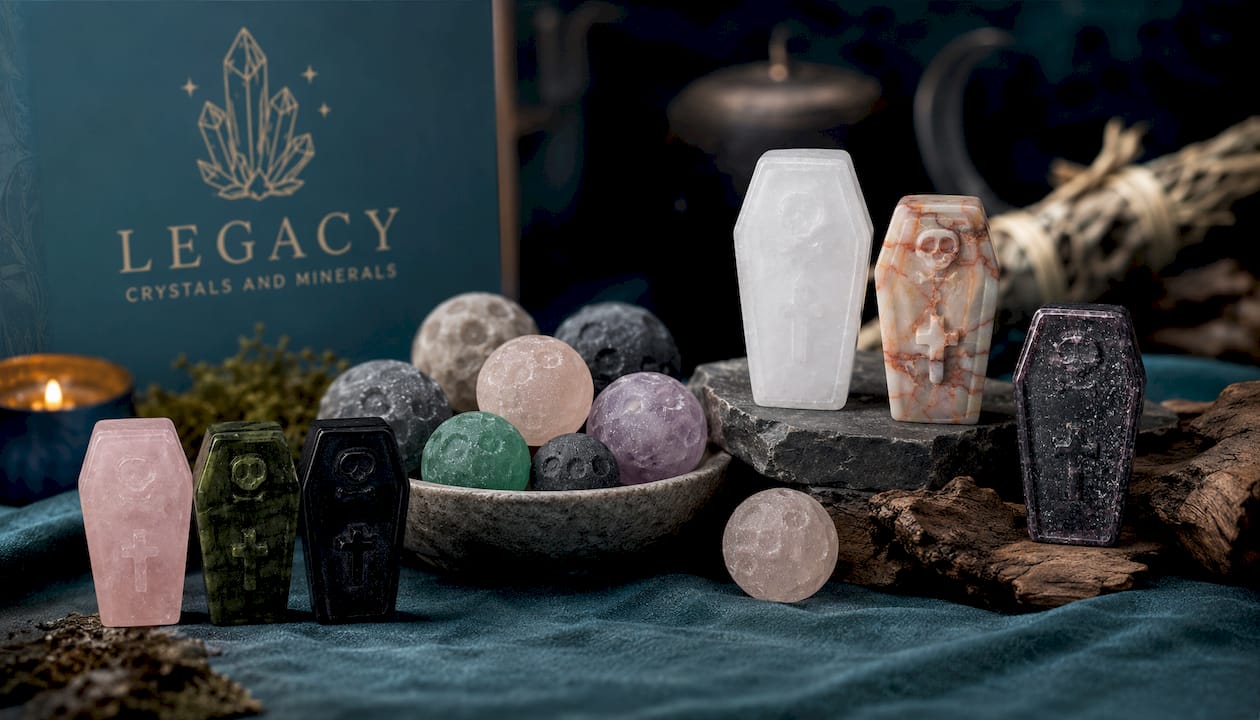
The Lunar Collection mini moon carvings (~33g each) are carved into crescent and full-moon shapes from natural minerals. They sit cleanly on an altar, hold their shape under repeated handling, and are sized for a windowsill setup without taking up space. For a portable ritual option, the small crystal coffin carvings (2" x 1") fit in a pocket or travel pouch and come in a range of minerals so you can match the stone to the phase. The medium coffin carvings (3" x 1.5") work as altar centrepieces or as a weight to anchor an intention paper overnight.
Every piece at Legacy Crystals and Minerals is sourced for authenticity, with specimen descriptions that confirm mineral type and origin. Browse the lunar collection and carved pieces to find a stone that fits your practice.
Further reading and source notes
- Moon phases and crystal rituals — Crystal Meanings: Phase-by-phase crystal recommendations; useful reference for matching stones to the full lunar cycle.
- Full moon ritual guide — AU Crystals: Practical ritual steps and safety notes on water-sensitive stones; one of the clearer practitioner guides available.
- Full moon crystals — Be Nothing Like: Emphasises intuitive stone selection over strict taxonomy; good counterpoint to prescriptive lists.
- Best crystals for a full moon — Spiritual Ark: Corroborates the core five-stone list across multiple practitioner sources.
- New moon and full moon crystal uses — Mooncat Crystals: Detailed moonstone and new-moon ritual guidance.
- Crystals for manifestation rituals — Legacy Crystals and Minerals: Curated starter-set guidance and shopping advice for ritual beginners.
- How crystal altars work — Legacy Crystals and Minerals: Practical altar layout and maintenance for moon ritual setups.
FAQ
What crystals are good for full-moon rituals?
Selenite, amethyst, and black tourmaline are the most commonly recommended for full-moon work. Selenite cleanses, amethyst supports emotional processing, and black tourmaline grounds and protects during high-energy phases.
What are some simple moon rituals to try?
The simplest options are a full-moon release ritual (write what you want to let go, place a crystal on the paper, sit quietly for 10–15 minutes) and a new-moon intention ritual (write one goal, place clear quartz on top, leave overnight on a windowsill).
What crystals are most associated with the moon?
Moonstone and selenite have the strongest traditional lunar associations. Moonstone is linked to the lunar cycle, intuition, and emotional balance; selenite takes its name from Selene, the Greek goddess of the moon.
Which crystals should not be charged in moon water or left outside overnight?
Selenite, malachite, raw pyrite, and calcite should be kept dry at all times. Selenite degrades on contact with moisture; malachite can leach harmful residue when wet. Use a dry indoor windowsill for these stones instead of placing them outside.
Where can you find carved crystals suited to moon rituals?
Legacy Crystals and Minerals carries moon-shaped mineral carvings and small carved pieces in a range of minerals, all with provenance descriptions, sized for altar or pocket use.
Key takeaways
Selenite, moonstone, and clear quartz are the three most reliable moon ritual crystals, covering cleansing, lunar connection, and intention amplification across both the full and new moon.
| Point | Details |
|---|---|
| Core crystal set | Selenite, moonstone, clear quartz, amethyst, and black tourmaline are the core set covering both moon phases and most ritual intentions. |
| Full moon focus | Use selenite, amethyst, and black tourmaline for releasing, cleansing, and protection work. |
| New moon focus | Use clear quartz, moonstone, and citrine as the supporting stones for setting intentions and building momentum. |
| Water safety | Keep selenite, malachite, raw pyrite, and calcite dry; never leave them where dew or rain can reach them. |
| Legacy Crystals and Minerals | Carries moon-shaped mineral carvings and small carved pieces sized for altar or pocket ritual use, with provenance descriptions. |
Recommended
- How crystal altars work: a practical guide for 2026 – Legacy Crystals and Minerals
- Crystals for meditation practices: a practical guide – Legacy Crystals and Minerals
- Crystals for manifestation rituals: your 2026 guide – Legacy Crystals and Minerals
- Crystals for creativity and inspiration: 2026 guide – Legacy Crystals and Minerals


