

Window crystals explained for crystal enthusiasts
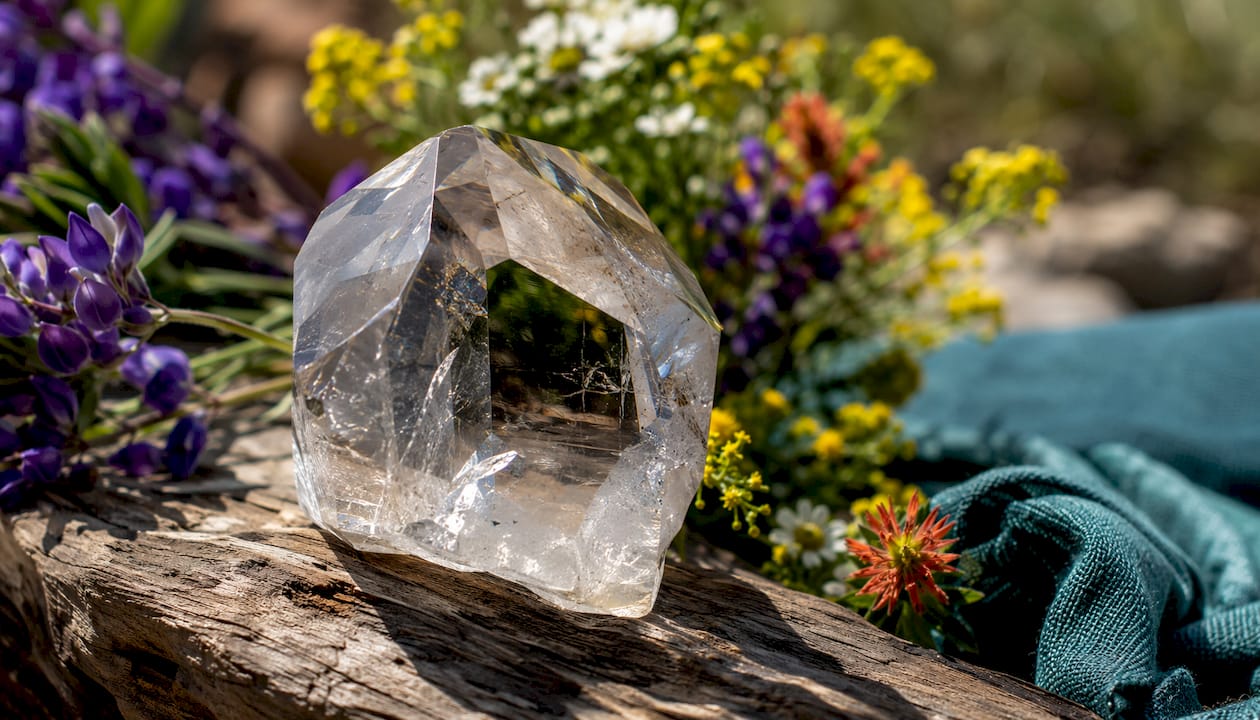
A Window quartz is a clear quartz point with an extra diamond- or rhomboid-shaped facet, distinct from the six standard prism faces, that practitioners use as a reflective portal for scrying, meditation, and self-inspection. This seventh face is the defining feature of window quartz crystals, and it sets them apart from every other quartz formation in a collector’s toolkit.
Table of Contents
- What creates a window face in quartz?
- How to identify a true Window quartz
- Windows, time links, and doorways: what are the differences?
- What do Window quartz crystals mean metaphysically?
- How to use a Window quartz in a basic practice
- Three exercises for deeper Window quartz work
- How to care for Window quartz and what to look for when buying in Canada
- Are Window quartz crystals rare?
- Key takeaways
- Window quartz from a verified source
- Further reading and authoritative sources
- FAQ
What creates a window face in quartz?
Quartz grows in a hexagonal system, producing six prism faces and six termination faces in a standard point. A window forms when growth conditions shift unevenly, allowing an additional rhomboid or diamond-shaped plane to develop between the normal facets. This extra face is not a flaw. It is a product of interrupted or asymmetric crystal growth, sometimes accelerated by post-growth etching.
The geological term fenster (German for “window”) describes a related but distinct process: selective chemical dissolution that etches recessed depressions into prism faces. Fenster quartz forms through dissolution, not addition. The metaphysical Window, by contrast, is a positive extra facet, not a pit or recess. Knowing this distinction matters when you are evaluating a specimen.
Natural window faces show sharp, clean geometry and smooth interior surfaces. The edges meet neighbouring facets flush, without the jagged or conchoidal texture of a chip. Under a 10x loupe, you can often see growth steps or secondary regrowth patterns inside the facet, confirming natural formation rather than surface damage. For more on quartz physical properties, the mineralogy context helps ground what you are looking at.
Pro Tip: Hold the specimen under a single-point light source and rotate it slowly. A natural window face will catch and redirect light in a geometrically consistent way across its entire surface. A chip scatters light irregularly.

How to identify a true Window quartz
The window face is physically obvious when genuine. It reflects light differently from neighbouring facets and sits centred on or near the termination. Here is a practical checklist for identification:
- Clear extra facet: A distinct diamond or rhomboid plane visible without magnification, centred on the termination zone.
- Geometric symmetry: The facet has straight, even edges. It is not lopsided or irregular.
- Flush edges: The window meets adjacent faces cleanly, with no raised lip or rough border.
- Optical behaviour: Held to light, the window transmits or reflects differently from surrounding faces, often appearing slightly frosted, clearer, or with a distinct internal depth.
- No fracture lines: Chips show conchoidal fracture patterns. A genuine window has none.
- Loupe inspection: Under 10x magnification, natural windows show internal growth lines or regrowth steps. Glued-on panes show adhesive residue at the edges.
- Heft and feel: The facet surface should feel smooth and continuous with the rest of the crystal, not applied or recessed unevenly.
For buyers purchasing remotely, the guide on spotting fake crystals online covers seller-vetting steps that apply directly to window quartz purchases.
Pro Tip: A genuine window announces itself. If you are debating whether a facet qualifies, it probably does not. True windows are immediately visually prominent.
Windows, time links, and doorways: what are the differences?
Not all window-type formations are the same. Orientation, depth, and placement each carry different identification markers and, for practitioners, different metaphysical emphases.
Window orientation is the key variable. A window slanted forward toward the crystal tip is called a Future Time Link. A window slanted back toward the base is a Past Time Link. A straight, centred window is simply a Window. Specimens carrying both a forward and a backward window on the same point are uncommon and are considered high-value tools by experienced practitioners.
| Formation | Visual marker | Metaphysical emphasis |
|---|---|---|
| Straight Window | Diamond facet centred on termination, parallel to crystal axis | Neutral self-reflection, present-moment insight |
| Future Time Link | Facet tilted toward the tip | Forward-looking awareness, upcoming potentials |
| Past Time Link | Facet tilted toward the base | Past pattern recognition, ancestral or prior-life work |
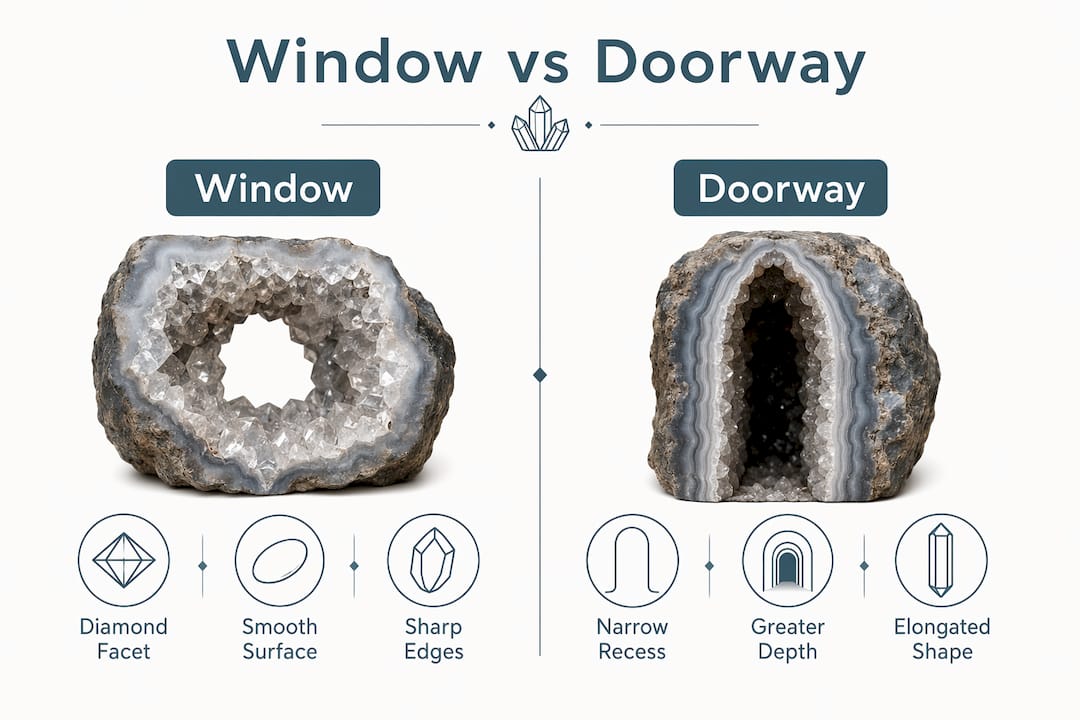
| Doorway | Deeper, portal-like recessed feature, often taller than wide | Access to deeper states, threshold work |
| Fenster / Skeletal | Etched pits and recesses across prism faces from dissolution | Geological feature; not a metaphysical Window |
Doorways differ from windows in depth and proportion. They tend to appear as taller, narrower recesses that feel visually like an opening rather than a reflective plane. Fenster formations, as noted above, are geological etch pits and are not classified as Windows in practitioner traditions, though they are sometimes confused with them by newer collectors.
What do Window quartz crystals mean metaphysically?
Window crystals are described by practitioners as neutral mirrors: they reflect the user’s own inner field rather than storing impressions or transmitting external messages. This framing makes them tools for radical self-honesty rather than oracles. The window does not tell you what to think. It shows you what is already present.
Core metaphysical attributions include:
- Introspection: Gazing into the window is said to surface subconscious patterns, beliefs, and emotional states.
- Scrying and clairvoyance: Window crystals are prized by scryers and clairvoyants because their geometry is said to create a direct energetic line of sight to higher awareness, helping bypass the intellect.
- Third-eye alignment: Practitioners position the window toward the brow during meditation to support intuitive perception.
- Time-link work: Past and future time-link windows are used in practices aimed at examining prior patterns or sensing forward possibilities.
The use of reflective surfaces for scrying has roots across many cultures, from polished obsidian mirrors in Mesoamerican traditions to crystal balls in European divination. Window quartz entered formal crystal lore primarily through the late-twentieth-century metaphysical movement, where practitioners began cataloguing specific quartz formations and assigning them distinct functions. The window’s extra facet made it a natural candidate for practices centred on inner vision and self-examination. For broader context on crystal energy work, the principles underlying window practice follow the same framework used across quartz-based healing traditions.
How to use a Window quartz in a basic practice
Preparation matters. Cleanse the crystal before use (see care section below), set a clear intention, and choose a quiet space with soft, indirect lighting. Sitting upright in a chair or cross-legged on the floor both work. Avoid overhead fluorescent light, which creates distracting reflections on the facet.
Basic gazing session, step by step:
- Hold the crystal at eye level or rest it on a surface at a comfortable viewing angle, window face toward you.
- Soften your gaze. Look at the window without staring hard. Let your eyes relax as if looking through the facet rather than at it.
- Sit for 10–15 minutes. Allow impressions, images, colours, or sensations to arise without forcing them.
- When the session ends, set the crystal down, take three slow breaths, and press your palms briefly to the floor or a solid surface to ground.
- Record impressions immediately in a journal. Write without editing or judging what appeared.
For reading others with a window crystal, obtain clear consent first. Treat impressions as prompts for conversation, not conclusions. The crystals for meditation guide covers complementary setups for quartz-based meditation work.
Pro Tip: Expectation-free practice produces better results. Set your intention, then release it. Treat the window as a prompt for observation, not a source of answers.
Three exercises for deeper Window quartz work
Exercise 1: Timed neutral-gaze scrying
Sit with the window crystal at eye level. Set a timer for 10–15 minutes. For the first three minutes, simply observe the facet without any agenda. From minute four onward, allow your attention to settle on whatever draws it inside the window. At the timer, note three words or images that arose. Do not interpret them immediately. Return to the notes after 24 hours and look for patterns.
Exercise 2: Third-eye alignment visualisation
Lie down and place the crystal on a flat surface above your head, window facing toward your brow. Close your eyes. Visualise a soft light moving from the window facet toward the centre of your forehead. Hold that image for 10 minutes. Notice any colours, geometric shapes, or sensations. This exercise is used by practitioners to support intuitive perception and is most effective after the basic gazing session has become comfortable.
Exercise 3: Paired-window comparative reading
If your specimen carries two windows (one forward, one back), this exercise uses both. Begin with the future time-link window for five minutes, noting impressions. Then shift attention to the past time-link window for five minutes. In your journal, compare the two sets of impressions side by side. Practitioners use this to identify how past patterns may be shaping forward possibilities. Specimens with both orientations are uncommon, which is part of why they are valued.
Journal prompts: What appeared without being invited? What did you expect to see that did not appear? Where did the impression feel like memory versus something new?
How to care for Window quartz and what to look for when buying in Canada
Buyer checklist
- Request close-up photos of the window facet from multiple angles, with a scale reference (a coin or ruler).
- Ask for the specimen’s provenance: country of origin, mine or region if known.
- Confirm the seller’s return policy before purchasing.
- Check for signs of glue at facet edges under magnification or in high-resolution photos.
- Prefer natural, unpolished points for window work. Polished points may have had facets altered.
- For remote purchases in Canada, use sellers who provide detailed photography and written provenance. The guide on identifying natural vs synthetic crystals covers additional authentication steps.
Value factors for Window quartz are qualitative rather than fixed. Clarity, size, rarity of the window configuration, and documented provenance all push price upward. A specimen with both a future and past time-link window commands a premium over a single straight window of comparable size.
Care checklist
- Clean with a soft brush and lukewarm water. Avoid harsh chemicals and ultrasonic cleaners.
- Store individually wrapped in a soft cloth to protect the window facet from contact chips.
- Keep away from prolonged direct sunlight, which can fade some quartz varieties over time.
- Handle by the body of the crystal rather than gripping the termination zone where the window sits.
| Authenticity check | What to look for | What it confirms |
|---|---|---|
| Visual inspection | Clear diamond/rhomboid facet, flush edges, geometric symmetry | Natural window formation |
| 10x loupe | Growth steps, regrowth patterns inside facet | Natural vs. surface damage |
| Light behaviour | Consistent reflection/transmission across the whole facet | Genuine facet, not a chip |
| Edge feel | Smooth, continuous surface with no raised lip or adhesive | No glued-on modification |
| Fracture check | No conchoidal fracture lines at facet boundary | Confirms natural growth |
Are Window quartz crystals rare?
True Window configurations are uncommon compared with plain clear quartz points, but rarity exists on a spectrum. Most quartz points on the market do not carry a genuine window facet. When one is present, its rarity and value depend on several factors:
- Number of windows: A single window is uncommon; two or more on one specimen is significantly rarer.
- Orientation complexity: Specimens carrying both a forward (future) and backward (past) time-link window on the same point are considered exceptionally rare by collectors.
- Clarity: A window in a high-clarity, inclusion-free point is more sought after than one in a heavily included or cloudy specimen.
- Size: Larger windows on large points are harder to find and command higher interest from collectors.
- Provenance: Documented origin from a known locality adds value and authenticity confidence.
Window quartz is not among the rarest minerals on earth, but a well-formed, clearly defined window on a quality clear quartz point is a genuine find. Most collectors encounter far more plain points than true windows in any given lot. For context on how Window quartz fits among quartz varieties, the formation is specific to clear quartz points and does not appear in the same way across other quartz types.
Key takeaways
A Window quartz is defined by a genuine extra diamond-shaped facet that functions as a neutral reflective portal for scrying, self-inspection, and time-link practices.
| Point | Details |
|---|---|
| Visual definition | A true window is a distinct diamond or rhomboid facet, flush with adjacent faces, centred near the termination. |
| Window vs. chip vs. fenster | Chips show conchoidal fracture; fenster quartz has etched pits from dissolution; a window is a smooth, geometrically clean extra facet. |
| Primary metaphysical uses | Scrying, self-reflection, third-eye alignment, and past/future time-link work. |
| Ethics and safety | Obtain consent before reading others; record impressions without judgment; ground after each session. |
| Buying guidance | Request provenance, close-up photos with scale, and a clear return policy before purchasing. |
| Legacy Crystals and Minerals | Offers museum-grade specimens with documented provenance for collectors and practitioners seeking verified Window quartz. |
Window quartz from a verified source
Collectors and practitioners looking for authenticated Window quartz specimens have one practical priority: provenance. Legacy Crystals and Minerals carries museum-grade crystals and mineral specimens with documented origin, detailed photography, and a clear return policy. Each listing is selected for authenticity and quality, not volume.

For those new to window quartz, the Shangbao Fluorite with Quartz specimen shows the standard of provenance documentation and close-up photography that Legacy Crystals and Minerals applies across its collection. Buyers can request additional photos or video of any specimen before purchase. Browse the full collection at Legacy Crystals and Minerals and contact the team directly with questions about specific window configurations or provenance details.
Further reading and authoritative sources
- Windows, Time Links, and Doorways in Quartz Crystals — Sacred Ground: Detailed practitioner guide covering identification, orientation meanings, and historical context. One of the most thorough practitioner-level references available.
- Window Formations — Aurora Gems: Covers visual identification cues and mindset guidance for working with window crystals.
- Window Quartz Properties and Meaning — Crystal Information: Concise reference on time-link orientation and metaphysical classification.
- Fenster Quartz — Crystal Almanac: Authoritative source for distinguishing geological fenster formations from metaphysical windows; useful for authenticity checks.
- Master Crystal: Window Crystal — Moospace: Practitioner-focused explanation of the neutral-mirror principle and expectation-free practice approach.
When evaluating any seller page, prefer listings that publish provenance details, include photos with a scale reference, and state a clear return policy.
FAQ
What is a Window quartz crystal?
A Window quartz is a clear quartz point with an extra diamond-shaped facet that forms as a seventh face distinct from the six standard prism faces. Practitioners use it as a reflective portal for scrying, self-inspection, and meditation.
Why do people hang crystals in their windows?
Hanging crystals in windows is a separate practice from Window quartz work. Clear quartz or faceted crystal prisms are placed in windows to refract sunlight and distribute light energy through a space, often for decorative or energetic purposes.
Is Window quartz rare?
True Window configurations are uncommon in the general quartz market. Specimens with both a future and past time-link window on the same point are considered exceptionally rare by collectors and command a premium.
How do you tell a genuine window from a chip or damage?
A genuine window has clean geometric edges, a smooth surface, and consistent light behaviour across the entire facet. Chips show conchoidal fracture lines, and under a 10x loupe, natural windows display internal growth steps rather than irregular breaks or adhesive residue.
What crystals are best avoided in the bedroom?
This depends on individual sensitivity. Some practitioners avoid high-energy stimulating stones such as clear quartz points near the bed, preferring calming varieties. Window quartz specifically is a reflective tool best used in active practice sessions rather than passive overnight placement.
Recommended
- Understanding Crystal Systems: Cubic, Hexagonal & More – Legacy Crystals and Minerals
- Why crystals crack or cleave: the science explained – Legacy Crystals and Minerals
- Crystal Growth Explained — From Molecule to Masterpiece – Legacy Crystals and Minerals
- How Crystal Grids Work (and How to Make One) – Legacy Crystals and Minerals


