

Cristaux qui pâlissent au soleil : quelles pierres sont à risque
L'améthyste, la kunzite, le quartz rose, la fluorine, le quartz fumé et la célestine sont les cristaux les plus susceptibles de se décolorer à la lumière du soleil, et cette décoloration est généralement permanente. L'opale, la turquoise et l'ambre font face à une menace différente : la chaleur et la déshydratation plutôt que la perte de couleur, mais les dommages sont tout aussi durables. Si l'une de ces pierres se trouve actuellement sur un rebord de fenêtre, placez-la à l'ombre dès aujourd'hui.
Le mécanisme à l'origine de la plupart de ces décolorations est le rayonnement UV qui attaque les centres colorés instables au sein du réseau cristallin. Une fois que ces centres colorés se décomposent, aucun remède maison ne permet de retrouver la saturation initiale. C'est pourquoi la prévention est plus importante que n'importe quelle solution que vous trouverez après coup.
Trois choses à faire dès maintenant :
- Retirez les pierres à risque des rebords de fenêtre et des étagères exposées au soleil direct, même quelques heures par jour.
- Déplacez-les sur une étagère ombragée, dans un tiroir ou une vitrine loin des fenêtres orientées sud ou ouest.
- Ajoutez du verre filtrant les UV, de l'acrylique ou un film pour fenêtre si une pièce doit rester exposée près d'une source de lumière naturelle.
Un fait rapide à retenir : la kunzite, l'une des pierres qui se décolore le plus rapidement sur cette liste, peut perdre visiblement sa couleur en quelques jours ou semaines d'exposition directe au soleil, plus rapidement que presque tout autre minéral de collection.
Points clés
Les cristaux à centres colorés comme l'améthyste, la kunzite, le quartz rose, la fluorine, le quartz fumé et la célestine se décolorent de manière permanente sous la lumière du soleil, tandis que les pierres à base de chromophores comme la pierre de soleil et le rubis restent stables.
| Point | Détails |
|---|---|
| Risque de décoloration le plus élevé | L'améthyste, la kunzite, le quartz rose, la fluorine, le quartz fumé et la célestine perdent leur couleur le plus rapidement sous une exposition directe aux UV. |
| La décoloration est généralement permanente | La décomposition des centres colorés due aux UV ne peut pas être inversée de manière fiable à la maison une fois qu'elle s'est produite. |
| La chaleur menace séparément les matières organiques | L'opale, la turquoise et l'ambre se fissurent ou se déshydratent à cause de la chaleur et de la perte d'humidité, pas seulement à cause des UV. |
| Exposition à l'ombre avec filtres UV | Utilisez du verre filtrant les UV, un film pour fenêtre et des LED à faible émission d'UV pour protéger les spécimens sensibles exposés. |
| Choisissez des pierres stables pour le port quotidien | Les bracelets en pierre de soleil de Legacy Crystals and Minerals utilisent une coloration par chromophore qui résiste à la décoloration en extérieur. |
Table des matières
- Cristaux courants qui se décolorent à la lumière du soleil (et à quelle vitesse)
- Pourquoi les cristaux se décolorent : centres colorés, chromophores et transfert de charge
- Cristaux qui tolèrent généralement la lumière du soleil (avec des réserves)
- Comment exposer vos cristaux sans risquer des dommages causés par le soleil
- Chaleur, déshydratation et matières organiques fragiles : opale, ambre et turquoise
- Conseils du conservateur de Legacy Crystals and Minerals sur l'entretien à l'abri du soleil
- Quelle quantité de soleil faut-il réellement pour décolorer un cristal ?
- Pouvez-vous tester le risque de décoloration d'un cristal avant de l'acheter ?
- Lumière naturelle du soleil versus lumière artificielle : qu'est-ce qui décolore les cristaux plus vite ?
- Entretien des cristaux après une décoloration
- Bijoux résistants au soleil recommandés par Legacy Crystals and Minerals
- Sources
- FAQ
Cristaux courants qui se décolorent à la lumière du soleil (et à quelle vitesse)
Toutes les pierres violettes ou roses ne se décolorent pas au même rythme, et connaître les délais approximatifs vous aide à trier une collection au lieu de paniquer devant chaque spécimen. Voici à quoi s'attendre de la part des cristaux qui apparaissent le plus souvent dans les plaintes concernant la décoloration.
1. Améthyste
L'améthyste doit sa couleur violette à des impuretés de fer qui ont été transformées en un centre coloré photosensible à l'intérieur du quartz. Le soleil direct peut visiblement ternir un spécimen d'un violet profond en quelques semaines, et les pièces d'un lavande pâle le montrent encore plus vite car elles ont moins de profondeur de couleur à perdre. Éloignez les groupes et les pointes d'améthyste de toute fenêtre recevant le soleil de l'après-midi, et considérez les vitrines avec des dessus en verre comme un signal d'avertissement, et non comme une zone de sécurité, car le verre bloque peu les UV.
2. Kunzite
La kunzite est sans doute la pierre la plus fragile de toute cette liste. Sa couleur rose à lilas provient de centres de manganèse notoirement instables sous les UV, et les rapports des collectionneurs décrivent une décoloration visible en quelques jours ou semaines d'exposition directe. Si vous possédez une pièce en kunzite, traitez l'exposition à la lumière du soleil comme vous traiteriez celle de vieilles photographies : des coups d'œil brefs sont acceptables, mais la lumière du jour prolongée est un effacement lent.
3. Quartz rose
Le quartz rose se décolore plus lentement que la kunzite mais suit la même chimie fondamentale. La teinte rose dépend d'oligo-éléments et d'inclusions que la lumière UV décompose progressivement ; ainsi, une sphère de quartz rose sur un bureau ensoleillé peut notablement pâlir avec le temps. Les pièces sculptées et les sphères sont particulièrement vulnérables car leurs surfaces polies et incurvées concentrent parfois la lumière de manière différente des spécimens plats.
4. Fluorine
Les violets, verts et bleus de la fluorine proviennent d'un mélange d'éléments de terres rares et de centres colorés induits par irradiation ; les variétés violettes et bleues sont les plus susceptibles de s'effacer sous un soleil soutenu. Comme la fluorine est également un minéral tendre sujet au clivage, l'exposition au soleil n'est qu'un élément de plus sur une longue liste de menaces. Gardez la fluorine facettée ou polie dans des vitrines plutôt que sur des étagères ouvertes.
5. Quartz fumé
Le quartz fumé tire sa couleur brune à grise de l'irradiation naturelle ou artificielle du quartz, et cette couleur est bel et bien un effet de centre coloré, ce qui signifie qu'elle est tout aussi vulnérable au blanchiment par les UV que l'améthyste. La décoloration a tendance à être plus lente, prenant souvent plusieurs mois d'exposition constante, mais une pointe de quartz fumé laissée sur un rebord de fenêtre lumineux pendant une période prolongée peut devenir sensiblement plus claire et plus grise.
6. Célestine
La coloration bleu pâle de la célestine est délicate à la base, et une exposition prolongée au soleil peut donner aux spécimens déjà subtils un aspect délavé ou crayeux. Comme les cristaux de célestine sont également fragiles et sujets à l'effritement lors d'une manipulation brutale, les dommages causés par la lumière du soleil s'ajoutent souvent à la dégradation physique plutôt que d'agir seuls. Rangez les géodes de célestine dans des vitrines peu éclairées, pas sur des étagères ouvertes.
7. Citrine (type traité)
C'est ici que la provenance compte. La plupart des citrines vendues dans le commerce sont en réalité de l'améthyste traitée thermiquement, et cet historique de traitement signifie qu'elles peuvent se comporter comme l'améthyste sous une exposition aux UV plutôt que comme la citrine naturelle, qui est nettement plus stable. Si vous n'êtes pas sûr qu'une pièce de citrine soit naturelle ou traitée thermiquement, le plus sûr est de la traiter comme étant photosensible jusqu'à preuve du contraire.
Conseil de pro : Les violets et les roses profonds et saturés sont généralement le premier indice visuel qu'une pierre repose sur un centre coloré fragile. Si un spécimen montre également des signes d'irradiation en laboratoire (une couleur intense, suspectement uniforme, sans zonage naturel), supposez qu'il se décolore plus rapidement qu'un équivalent coloré naturellement.
Pourquoi les cristaux se décolorent : centres colorés, chromophores et transfert de charge
La couleur des cristaux provient de l'un des trois mécanismes fondamentaux, et seul l'un d'entre eux est réellement fragile sous la lumière du soleil. Comprendre quel mécanisme produit la couleur d'une pierre vous indique presque tout sur son niveau de risque, même pour les cristaux qui n'ont jamais figuré sur une liste de décoloration.
Les centres colorés sont les coupables derrière la plupart des décolorations. Ils se forment lorsque le rayonnement, naturel ou induit en laboratoire, déloge un électron dans le réseau cristallin, créant un défaut piégé qui absorbe certaines longueurs d'onde de la lumière visible et produit de la couleur. Le problème est que le rayonnement UV transporte suffisamment d'énergie pour inverser ce même processus, libérant l'électron piégé et effaçant la couleur. L'améthyste, la kunzite, le quartz fumé et le quartz rose reposent tous sur des centres colorés, ce qui explique exactement pourquoi ils dominent toutes les listes de décoloration.
Les ions chromophores, en revanche, sont généralement stables. Ce sont des éléments produisant de la couleur comme le chrome (responsable du rouge du rubis et du vert de l'émeraude) ou le fer dans ses états d'oxydation stables, situés directement dans la structure chimique du cristal plutôt que sous forme de défaut induit par irradiation. La lumière du soleil n'a pas assez d'énergie pour rompre ces liaisons dans des conditions normales.
Les couleurs par transfert de charge, où la couleur provient d'électrons se déplaçant entre deux ions différents, ont également tendance à être stables, bien qu'il existe des exceptions qui méritent d'être connues.
L'hackmanite et la tugtupite sont des exceptions intéressantes : elles présentent la ténébrescence, un changement de couleur réversible où les UV créent ou approfondissent réellement la couleur, qui s'estompe ensuite avec le temps sans exposition au soleil. C'est le schéma opposé au blanchiment qui inquiète la plupart des collectionneurs.
Certains cristaux subissent des effets qui dépassent la simple couleur. Des recherches publiées sur les cristaux organiques ont documenté des cas où les UV et la lumière visible déclenchent de véritables réponses mécaniques, notamment des fissures et des courbures, pas seulement une décoloration chimique. D'autres travaux sur le comportement photomécanique des cristaux confirment que l'exposition à la lumière peut exercer un travail physique sur certaines structures cristallines, rappelant que la « décoloration » n'est en fait que le symptôme le plus visible d'un spectre plus large de sensibilité à la lumière.
Quelques indices visuels peuvent vous aider à deviner le niveau de risque d'une pierre avant de trouver un guide de référence :
- Les violets et roses profonds avec une légère nuance grise ou brunâtre signalent souvent une origine par centre coloré.
- Une couleur suspectement uniforme et saturée sans zonage naturel peut indiquer une irradiation en laboratoire, qui a tendance à se décolorer plus rapidement que la couleur acquise naturellement.
- Les pierres connues pour leur coloration chimique stable (chrome, cobalt, la plupart des composés de fer stables) sont des paris plus sûrs pour une exposition ensoleillée.
Cristaux qui tolèrent généralement la lumière du soleil (avec des réserves)
Le rubis, le saphir, le diamant, le jaspe, l'agate, l'œil de tigre et l'obsidienne doivent tous leur couleur à des chromophores stables ou à des effets structurels plutôt qu'à des centres colorés fragiles, de sorte que le soleil direct les décolore rarement de manière notable. De nombreux jaspes et agates entrent dans cette même catégorie stable, ce qui explique en partie pourquoi ils sont populaires pour les décorations de jardin en extérieur et les rebords de fenêtres ensoleillés.
Cela dit, « tolérant au soleil » ne signifie pas « à l'épreuve du soleil » une fois que l'on prend en compte la forme, les revêtements et la chaleur.
- Les sphères polies et les cabochons peuvent concentrer la lumière du soleil comme une lentille, générant parfois assez de chaleur localisée pour endommager les matériaux voisins même si la pierre elle-même ne craint rien.
- Les agates et jaspes teints peuvent se décolorer bien que le minéral sous-jacent soit stable, car le colorant lui-même est souvent sensible aux UV.
- Les adhésifs utilisés dans les montures de bijoux ou les pièces composites peuvent ramollir ou jaunir sous une chaleur soutenue, bien avant que la pierre ne montre le moindre signe d'usure.
- La chaleur du soleil direct, et non les UV eux-mêmes, peut encore stresser les pierres présentant des fractures internes ou des inclusions fluides, indépendamment de la stabilité de la couleur.
L'hypothèse la plus sûre pour toute pierre dont l'historique de traitement ou la provenance est inconnu consiste à la traiter comme si elle pouvait se comporter différemment des manuels. Un bracelet « œil de tigre » avec une couche de teinture synthétique ne suit pas les mêmes règles qu'un spécimen naturel, et il est rarement possible de le savoir juste en le regardant.
Comment exposer vos cristaux sans risquer des dommages causés par le soleil
Protéger une collection ne signifie pas renoncer complètement à la lumière naturelle. Cela nécessite de gérer l'intensité, la durée et la filtration, comme le ferait un conservateur de musée.
- Audit de vos emplacements d'exposition actuels. Parcourez votre maison à midi et notez quelles étagères, rebords de fenêtre et vitrines reçoivent le soleil direct pendant plus d'une heure.
- Déplacez d'abord les pierres à centres colorés. L'améthyste, la kunzite, le quartz rose, la fluorine, le quartz fumé et la célestine doivent être placés sur des étagères ombragées, dans des pièces intérieures ou des vitrines fermées.
- Installez du verre ou de l'acrylique filtrant les UV sur toute vitrine contenant des spécimens précieux ou photosensibles, en particulier si la vitrine se trouve près d'une fenêtre.
- Appliquez un film anti-UV sur les fenêtres derrière les zones d'exposition que vous ne pouvez pas facilement réorganiser ; cela réduit la transmission des UV sans assombrir notablement la pièce.
- Passez à un éclairage LED à faible émission d'UV pour tout éclairage intérieur de vitrine, car certains types d'ampoules plus anciens émettent des UV significatifs à courte distance.
- Faites tourner les spécimens périodiquement si vous aimez montrer des pièces dans des pièces plus lumineuses, limitant ainsi l'exposition cumulée de chaque pierre.
- Contrôlez l'humidité des pierres poreuses ou organiques conservées près des fenêtres, car les variations de chaleur dues à l'exposition au soleil entraînent souvent des variations d'humidité.
La pratique des musées et de la conservation privilégie systématiquement le placement filtré ou intérieur plutôt que la lumière directe du soleil pour tout ce qui est photosensible, et ce même principe s'adapte parfaitement à une étagère ou une vitrine domestique. Le guide de Legacy Crystals and Minerals sur l'exposition des cristaux à la maison détaille le choix des vitrines et le placement, et le guide d'entretien et de stockage des spécimens couvre les routines de nettoyage qui ne stresseront pas davantage les pierres déjà décolorées.
Conseil de pro : Si vous investissez dans une vitrine appropriée pour des spécimens de qualité muséale, traitez-la comme vous traiteriez le rangement de bijoux fins. Les conseils pratiques de rangement des bijoux fins pour éviter la chaleur, les variations d'humidité et la lumière directe s'appliquent presque identiquement aux spécimens minéraux.
Si vous remarquez qu'une décoloration a déjà commencé sur une pièce à laquelle vous tenez :
- Retirez-la immédiatement de l'exposition à la lumière, même si les dommages semblent mineurs.
- Rangez-la dans un tiroir ou une boîte sombre plutôt que dans une vitrine éclairée, car une exposition supplémentaire ne fait qu'aggraver la perte.
- Consultez un restaurateur ou un revendeur expérimenté avant de tenter tout traitement à la maison, en particulier pour les spécimens rares ou de grande valeur.
Chaleur, déshydratation et matières organiques fragiles : opale, ambre et turquoise
L'opale, l'ambre et la turquoise font face à une menace différente du blanchiment des centres colorés. Il s'agit principalement de problèmes de chaleur et d'humidité, qui peuvent survenir même dans une lumière indirecte si la température monte trop haut.
L'opale contient un pourcentage significatif d'eau au sein de sa structure de silice, et l'exposition à la chaleur, en particulier celle que l'on subit dans une voiture garée au soleil ou une vitrine fermée en plein soleil, peut évacuer cette humidité. Le résultat est le craquelage : de fines fissures qui se propagent à la surface à mesure que la pierre se rétracte de manière inégale. La turquoise, une pierre poreuse souvent stabilisée à la résine, peut se dessécher et se décolorer dans les mêmes conditions, virant parfois vers un vert plus terne avec le temps. L'ambre, étant une résine organique, peut ramollir, se craqueler ou développer des fissures de surface lors de cycles de chaleur répétés.
Quelques habitudes de rangement sont très utiles :
- Gardez l'opale, l'ambre et la turquoise à l'abri du soleil direct et des sources de chaleur, pas seulement des UV.
- Stockez-les à une température et une humidité ambiantes stables plutôt que de les laisser alterner entre des points chauds et froids.
- Évitez les vitrines fermées en plein soleil, car la chaleur piégée peut monter bien au-dessus de la température ambiante de la pièce.
Une fois que le craquelage ou les fissures apparaissent, les options de restauration sont limitées et doivent être laissées à un spécialiste. Le guide de Legacy Crystals and Minerals sur l'opale et l'opalite détaille quels matériaux de la famille des opales sont plus tolérants et lesquels nécessitent une précaution supplémentaire.
Conseils du conservateur de Legacy Crystals and Minerals sur l'entretien à l'abri du soleil
[brand_signal]
Un approvisionnement de qualité muséale signifie que chaque spécimen du catalogue Legacy Crystals and Minerals est accompagné d'une provenance documentée. Cela est important car la provenance est exactement ce qui vous indique si une pierre a été irradiée, teinte ou traitée thermiquement de manière à affecter sa sensibilité au soleil. C'est aussi pourquoi la collection de bijoux portables s'appuie fortement sur des pierres à base de chromophores comme la pierre de soleil, qui conservent leur couleur sous une exposition quotidienne à la lumière bien mieux que les pierres à centres colorés ne le feront jamais.
Quelques habitudes à intégrer dans votre routine :
- Vérifiez les notes de provenance avant de supposer qu’une pierre violette ou rose est résistante au soleil.
- Privilégiez les pierres de joaillerie basées sur des chromophores pour les bijoux portés régulièrement à l'extérieur.
- Utilisez le guide de constitution d’une collection de qualité muséale comme référence pour les normes d'exposition visant à protéger la valeur à long terme.
Combien de soleil faut-il réellement pour faire pâlir un cristal ?
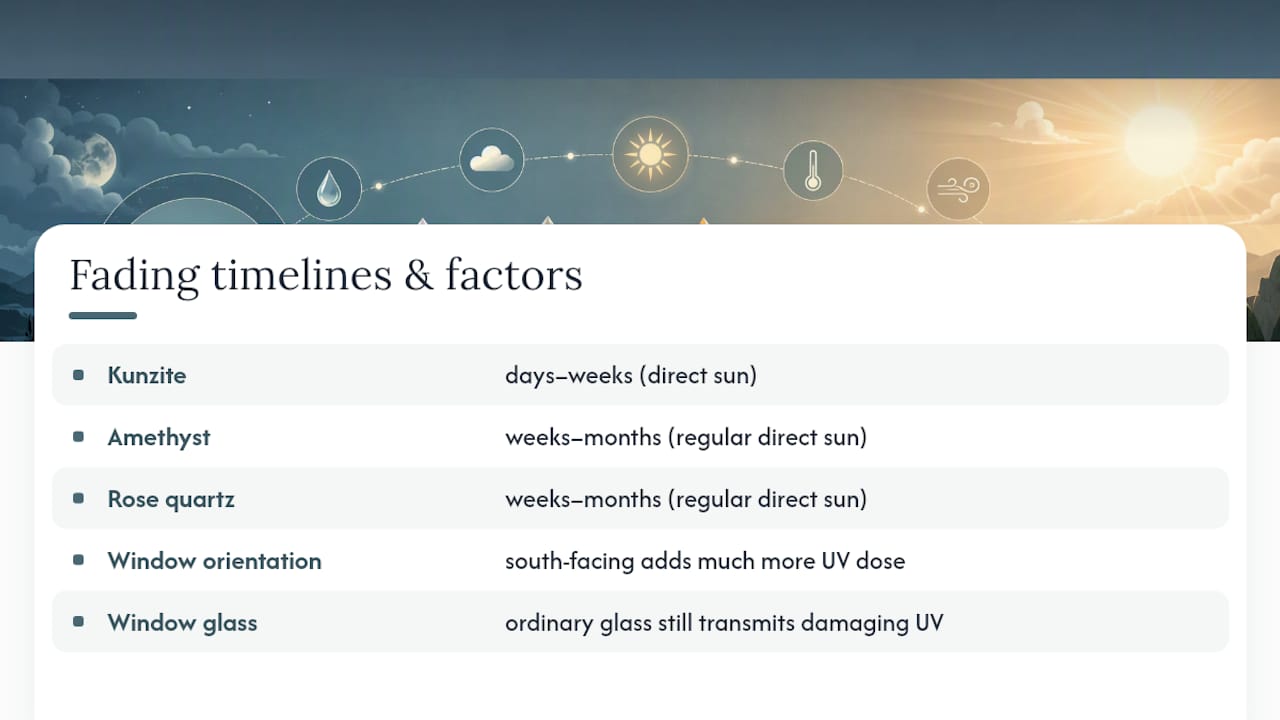
Il n'existe pas de seuil universel unique, car la décoloration dépend de l'interaction entre l'intensité des UV, la durée d'exposition et la stabilité initiale du centre coloré d'une pierre donnée. La kunzite se situe à l'extrémité extrême, avec un pâlissement visible rapporté en quelques jours à quelques semaines sous un soleil direct et non filtré. L'améthyste et le quartz rose mettent généralement plus de temps, souvent de plusieurs semaines à plusieurs mois d'exposition directe régulière avant qu'un changement notable n'apparaisse, bien qu'un spécimen profondément saturé puisse masquer un début de décoloration plus longtemps qu'un spécimen pâle.
L'intensité compte autant que la durée. Une pierre placée sur un rebord de fenêtre orienté au sud pendant les après-midis d'été accumule une dose d'UV quotidienne bien plus importante que la même pierre dans une pièce orientée au nord, même si les deux reçoivent techniquement « un peu de soleil ». Le verre ne bloque pas beaucoup les UV par lui-même ; ainsi, un rebord de fenêtre ensoleillé derrière un vitrage ordinaire laisse passer la plupart des longueurs d'onde nocives. L'altitude et la géographie jouent également un rôle. Les climats à fort indice UV et les altitudes élevées accélèrent les délais de décoloration de manière générale.
La conclusion pratique est simple : considérez toute exposition quotidienne au soleil direct comme cumulative, et non comme un événement isolé. Quelques minutes de lumière matinale ne changeront pas visiblement un spécimen, mais ces mêmes minutes répétées quotidiennement pendant un an constituent une dose réelle.
Peut-on tester le risque de décoloration d’un cristal avant de l'acheter ?
À défaut d'une spectroscopie de laboratoire complète, dont la plupart des collectionneurs n'ont jamais besoin, il existe quelques vérifications pratiques qui aident à prédire le risque de décoloration. Demandez directement au vendeur si une pierre a été irradiée ou traitée thermiquement, car les revendeurs réputés le savent généralement et le divulguent, et c'est le facteur prédictif le plus important d'instabilité. Observez l'uniformité de la couleur : les pierres naturellement colorées présentent généralement un zonage ou des variations, tandis que la couleur améliorée en laboratoire semble souvent anormalement uniforme et saturée.
Un test à domicile simple et sans risque utilisé par certains collectionneurs consiste à placer une petite chute ou une pierre roulée du même matériau, moins précieuse, dans un endroit ensoleillé pendant une période contrôlée et à vérifier chaque semaine s'il y a un changement ; ne faites jamais cela avec un spécimen précieux ou unique. Comparer un spécimen avec une photo de référence prise au moment de l'achat vous donne également une base objective pour vérifier le résultat quelques mois plus tard, car la décoloration est souvent suffisamment progressive pour être imperceptible au jour le jour. Pour tout ce qui est vraiment rare ou de grande valeur, un minéralogiste ou un laboratoire de gemmologie peut identifier définitivement l'historique des traitements et la composition des centres colorés.
Lumière naturelle versus lumière artificielle : qu'est-ce qui fait pâlir les cristaux le plus vite ?
La lumière directe et non filtrée du soleil est presque toujours la source lumineuse la plus rapide et la plus nocive, simplement parce qu'elle transporte un spectre de longueurs d'onde UV plus large et plus intense que la plupart des éclairages intérieurs. Les ampoules à incandescence ordinaires et la plupart des ampoules LED modernes émettent des UV négligeables par comparaison, ce qui explique en partie pourquoi les musées préfèrent souvent l'éclairage LED pour les pièces sensibles.
Cela dit, toute lumière artificielle n'est pas inoffensive. Les anciens tubes fluorescents et certaines ampoules halogènes émettent des UV significatifs à courte distance, et un spécimen placé à quelques centimètres de ce type d'appareil pendant des heures chaque jour peut subir une décoloration graduelle sur une période suffisamment longue. Pour les vitrines avec éclairage intégré, il vaut la peine de vérifier spécifiquement le type d'ampoule, et pas seulement si la vitrine est placée près d'une fenêtre.
La hiérarchie pratique, du plus risqué au moins risqué, est la suivante : soleil extérieur direct, soleil à travers un vitrage non traité, anciens éclairages fluorescents ou halogènes, puis éclairage LED standard ou à incandescence. Si vous choisissez l'éclairage d'une vitrine, des LED à faible émission d'UV associées à un verre filtrant les UV vous offrent ce qui se rapproche le plus d'une installation sans souci.
Prendre soin des cristaux une fois qu’ils ont déjà pâli
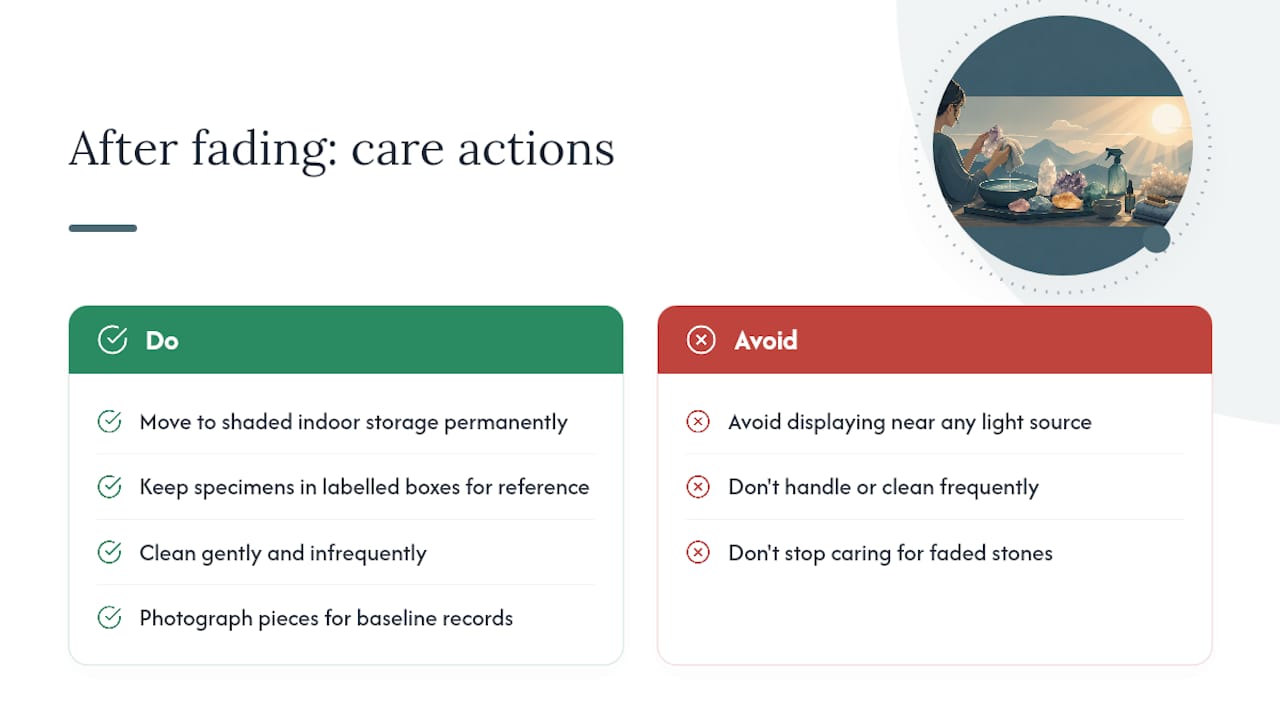
Une fois qu'un cristal a pâli, la réponse honnête est que l'intensité de la couleur d'origine est perdue à jamais dans presque tous les cas, car la dégradation des centres colorés n'est pas réversible par des méthodes domestiques. Cela ne signifie pas pour autant que la pierre est sans valeur ou que l'entretien n'a plus d'importance. Cela signifie que l'objectif passe de la prévention au ralentissement de toute perte supplémentaire et à la protection de la couleur restante.
Déplacez définitivement une pièce ayant pâli dans un espace de stockage ombragé et intérieur plutôt que de continuer à l'exposer près d'une source lumineuse. Certains collectionneurs conservent les spécimens décolorés dans des boîtes étiquetées comme faisant partie d'une collection de référence « avant et après », ce qui est un moyen très utile d'apprendre quelles pierres de votre collection sont les plus vulnérables. Les pierres décolorées conservent généralement leur importance métaphysique et personnelle pour les propriétaires qui y sont attachés, même si leur valeur marchande en tant que spécimen diminue généralement par rapport à un équivalent non décoloré de même taille et de même clarté.
Nettoyez les pièces décolorées doucement et rarement, car la manipulation et le nettoyage répétés ajoutent leur propre usure lente par-dessus les dommages déjà causés par la lumière. Si la pierre faisait partie d'une collection plus vaste, envisagez de la photographier dès maintenant pour vos propres archives, afin que les comparaisons futures disposent d'une base de référence précise.
Bijoux résistants au soleil recommandés par Legacy Crystals and Minerals
Si vous souhaitez des bijoux que vous pouvez porter à l'extérieur sans vous soucier de la décoloration, la pierre de soleil est l'un des choix les plus tolérants sur le marché. Son éclat chaleureux provient d'inclusions de cuivre ou d'hématite qui captent la lumière, un effet structurel stable plutôt qu'un centre coloré fragile, de sorte que l'exposition quotidienne au soleil n'érode pas sa couleur comme elle le ferait pour l'améthyste ou la kunzite.
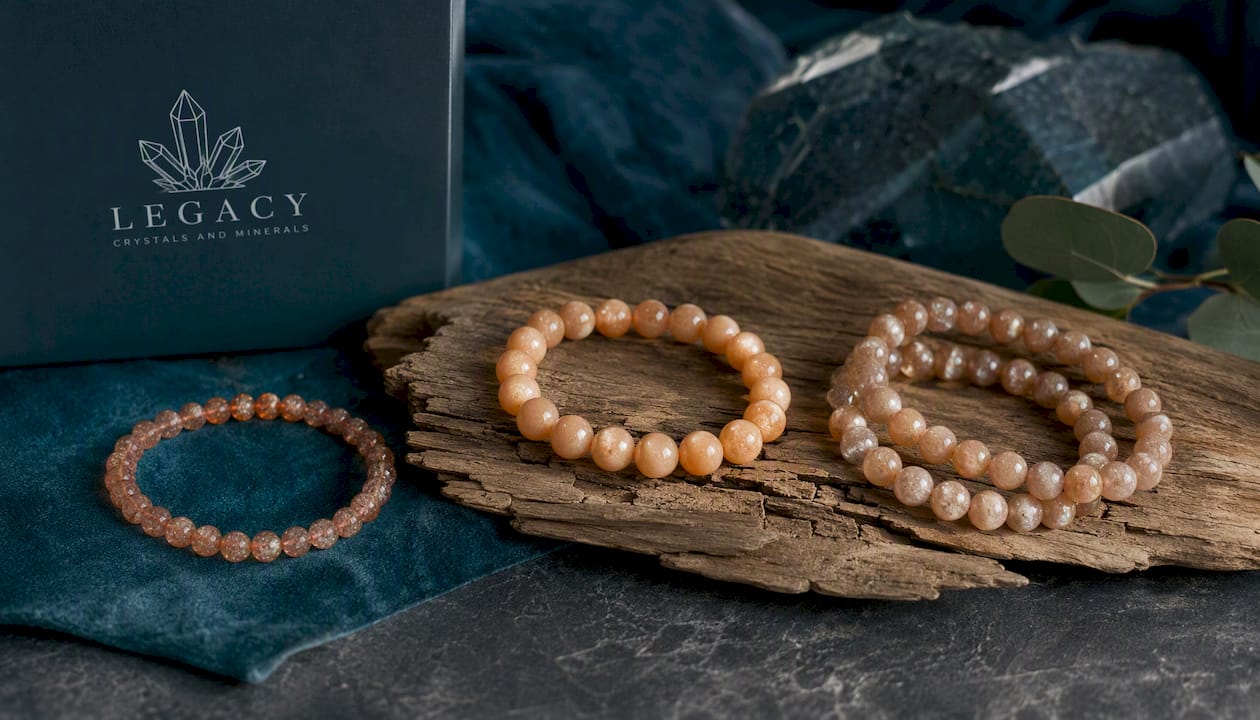
Le bracelet en pierre de soleil dorée AA de 6 mm présente des perles de feldspath aventurescent de qualité supérieure avec le genre de scintillement visible que les collectionneurs recherchent dans les pierres de soleil de plus haut grade. Pour un look plus audacieux, le bracelet en pierre de soleil dorée de 8 mm et 10 mm propose des perles plus grosses qui mettent en valeur l'éclat de la pierre au premier coup d'œil. Si vous préférez des tons plus chauds et plus profonds, le bracelet en pierre de soleil brun doré de 8 mm et 10 mm offre une teinte or-brun plus riche qui se marie bien avec une tenue quotidienne.
Même les pierres tolérantes au soleil bénéficient d'un entretien de base. Évitez de laisser un bracelet sur le tableau de bord d'une voiture chaude, car la chaleur fragilise les matériaux de montage et les sertissages, même si la pierre elle-même est intacte. Essuyez les perles après utilisation pour éliminer les huiles et la sueur, et rangez les pièces dans un tiroir ou une pochette à l'ombre plutôt que dans un plateau à bijoux ensoleillé lorsqu'elles ne sont pas portées.
Sources
- Cristaux qui pâlissent à la lumière du soleil (Explication chimique) | Crystal Almanac
- Fissuration et cicatrisation photo-induites dans les cristaux organiques (Journal of the American Chemical Society)
FAQ
Quels cristaux doivent éviter la lumière du soleil ?
L'améthyste, la kunzite, le quartz rose, la fluorine, le quartz fumé et la célestine doivent tous éviter la lumière directe du soleil, car leur couleur dépend de centres colorés photosensibles qui se dégradent sous l'exposition aux UV.
Quels cristaux sont endommagés par le soleil ?
Les mêmes pierres aux centres colorés perdent leur couleur, tandis que l'opale, la turquoise et l'ambre sont confrontées au risque distinct de fissuration et de déshydratation dû à la chaleur plutôt qu'aux UV spécifiquement.
Les cristaux d'améthyste pâlissent-ils à la lumière du soleil ?
Oui, l'améthyste pâlit de manière fiable à la lumière directe du soleil car sa couleur violette provient d'un centre coloré sensible aux UV, et les pièces d'un violet profond ou fortement irradiées ont tendance à montrer un ternissement visible en quelques semaines d'exposition constante.
Quels cristaux résistent bien à la lumière du soleil ?
Le rubis, le saphir, le diamant, le jaspe, l'agate, l'œil-de-tigre et l'obsidienne tolèrent généralement bien la lumière du soleil car leur couleur provient de chromophores stables plutôt que de centres colorés fragiles ; les bijoux en pierre de soleil de Legacy Crystals and Minerals appartiennent à cette même catégorie stable, ce qui en fait un choix pratique pour un port quotidien à l'extérieur.
Recommandé
- Pourquoi certains cristaux deviennent fluorescents sous la lumière UV – Legacy Crystals and Minerals
- Pourquoi certains cristaux deviennent fluorescents – Legacy Crystals and Minerals
- Comment repérer les faux cristaux en ligne : un guide pratique – Legacy Crystals and Minerals
- Les cristaux fenêtre expliqués aux passionnés – Legacy Crystals and Minerals


