

Buy Dioptase Without Breaking It: Meaning, Heart Work and Collector Care
Dioptase meaning centres on one idea above all others: this is a stone believed to work on the heart, dissolving old grief and opening space for compassion and forgiveness. It is also one of the more delicate specimens a collector will ever hold, prized as much for its rarity as for its emotional reputation. What follows covers how practitioners use it, what the mineral actually is, and how to buy and care for a piece without ruining it.
TL;DR:
- Dioptase’s emotional work surface buried grief and trauma, requiring short, focused sessions due to its intensity and association with deep healing.
- It is extremely fragile, with perfect cleavage and a Mohs hardness of about 5, making handling and wear, especially jewelry, a careful process.
- Quality specimens are rare because it forms in narrow oxidized copper zones and easily gets damaged during extraction, leading to high prices for undamaged, large crystals.
- Safe handling involves dry cleaning methods like smoke cleansing and moonlight recharge, avoiding water or salt to prevent cracking or deterioration.
- When buying, verify provenance, look for intact terminations, and prefer seller documentation to avoid imitations or damaged specimens.
Table of Contents
- What is dioptase? The meaning behind the heart-healing stone
- How to use dioptase for emotional healing and grief release
- Crystal pairings and safe ways to wear dioptase
- Dioptase properties: hardness, colour, and where it forms
- Storing and handling dioptase without damaging it
- Why dioptase is rare and how to buy a good specimen
- The historical roots of dioptase’s reputation
- Common myths about dioptase worth knowing
- Cleansing and recharging dioptase the safe way
- Where to find genuine, well-sourced dioptase specimens
- Sources
- FAQ
What is dioptase? The meaning behind the heart-healing stone
Ask any longtime crystal practitioner what dioptase does, and heart healing comes up almost immediately. The stone’s meaning is built around emotional release rather than gentle comfort. Practitioners describe it as a stone that surfaces buried grief, old resentment, and trauma so it can actually be processed instead of stored away for another year.
That distinction matters for how you approach it. Rose quartz and similar heart stones are generally described as soothing, ideal for steady self-love practice or calming a stressful week. Dioptase carries a different reputation in metaphysical circles: it’s associated with intensity, the kind of work that asks you to sit with something uncomfortable before you feel lighter. Some practitioners call it a “soul-level” healer, meaning the work it’s believed to support goes past surface anxiety and into patterns you’ve carried for years, sometimes decades.
That soul-level label isn’t decoration. It signals that sessions with dioptase are often described as more demanding than a quick five-minute grounding exercise with a tumbled stone in your pocket. If you’re newer to stone work, that’s worth knowing before you start.
The core meanings attributed to dioptase cluster around a few consistent themes:
- Compassion — turning attention toward both self-forgiveness and forgiveness of others.
- Grief release — helping process loss that feels stuck rather than resolved.
- Emotional honesty — surfacing feelings that have been minimized or ignored.
- Heart-chakra activation — practitioners associate its green colour with the heart centre in energy work.
- Letting go of old trauma — distinct from daily stress relief, aimed at long-held emotional weight.
Colour plays into this reputation too. Dioptase’s colour ranges from intense emerald-green to bluish-green, a saturation that’s visually distinct even among green stones. Green has carried heart associations across multiple healing traditions for centuries, and dioptase’s particular depth of colour is often cited as part of why practitioners consider it more potent than paler green stones.
It’s also worth being honest about what “meaning” means here. None of this is a scientifically tested claim about how a mineral affects your nervous system. It’s a framework, built up over decades of crystal-healing tradition, that gives people a structured way to sit with difficult emotions using a physical object as a focal point. Whether or not you buy into the metaphysics, the ritual of holding something and giving yourself permission to feel something specific has value on its own.
Pro Tip: If you’re new to dioptase, start with short sessions. Because it’s associated with surfacing difficult emotions rather than softening them, five to ten minutes is often enough for a first sitting. You can build up from there.
One more distinction worth flagging: dioptase’s fragility isn’t just a handling note tucked into a care section. Practitioners often frame it as a stone meant for deep inner healing rather than casual, everyday wear, and that framing lines up neatly with the mineral’s own physical delicacy. The meaning and the mineralogy point in the same direction: this is a stone for focused sessions, not a stone you toss in a gym bag.
How to use dioptase for emotional healing and grief release
Working with dioptase doesn’t require an elaborate ritual. A simple, repeatable structure tends to work better than an ornate one, especially if grief or old trauma is the focus.
A basic heart-healing session with dioptase can follow this order:
- Ground first. Sit somewhere quiet, hold the stone in your left hand (commonly associated with receiving energy in these traditions), and take five slow breaths before you do anything else.
- State your intention plainly. Something as simple as “I’m ready to feel this and let it move” is enough. You don’t need elaborate phrasing.
- Visualize the heart centre. Picture the stone’s deep green light expanding from your chest outward, or simply hold the piece against your sternum for a few minutes.
- Let whatever surfaces, surface. This is where dioptase’s reputation for intensity shows up. Some people cry, some feel anger they didn’t expect. That’s considered part of the process, not a sign anything went wrong.
- Close gently. Set the stone down, take three breaths, and write one sentence about what came up. Closing matters as much as the opening.
Grief work specifically benefits from pairing dioptase with something that captures the experience afterward. A short journalling habit, even five minutes right after a session, tends to help translate whatever surfaced into something you can actually work with later. If you’re also seeing a therapist or counsellor, many practitioners suggest treating stone work as a complement to that process rather than a replacement for it. It’s a ritual for reflection, not a substitute for clinical care when trauma runs deep.
For everyday, lower-intensity use, a few approaches show up consistently among practitioners:
- Carry a small palm stone in a pocket during a day you know will be emotionally taxing.
- Wear it as protected jewellery, ideally a pendant that sits close to the heart without regular impact risk.
- Pair it with breathwork, holding the stone during a short box-breathing or extended-exhale practice.
- Place it on an altar or nightstand rather than handling it constantly, if you want the association without the wear.
Pro Tip: If a session brings up something heavier than expected, don’t force yourself to keep going. Set the stone down, ground yourself with a walk or a glass of water, and come back to it another day. Dioptase work is described as cumulative, not a one-sitting fix.
Because dioptase is genuinely fragile, daily-wear jewellery is where most people run into trouble. A pendant that stays mostly still against your chest is a very different proposition from a ring that knocks against doorframes and countertops all day.
Crystal pairings and safe ways to wear dioptase
Dioptase works well within a small group of stones that share its heart-centred focus, and pairing it thoughtfully can round out a practice rather than duplicate it.
Rose quartz is the most common pairing, and the logic is straightforward: dioptase is associated with the harder work of release, while rose quartz is associated with gentler self-compassion. Using them together, some practitioners keep dioptase for active session work and rose quartz nearby for the softer landing afterward.
Kunzite pairs well for anyone working through anxiety alongside grief. Kunzite carries a lighter, calming heart association, which can balance dioptase’s more intense reputation during longer sessions.
Chrysocolla shares dioptase’s copper origin and greenish-blue palette, and practitioners often group the two for communication-focused heart work, particularly around expressing feelings that have been suppressed rather than just processing them internally.
For a simple three-stone heart grid, a common layout places dioptase at the centre, with rose quartz and kunzite positioned on either side, forming a loose triangle. Grids like this are typically left in place for a session or overnight rather than worn.
Jewellery is where fragility becomes the deciding factor. Here’s the practical breakdown:
- Pendants and brooches are the safer choices, since they sit against fabric and see minimal impact.
- Rings are discouraged, given how often hands brush against surfaces, doorframes, and countertops throughout the day.
- Bracelets need caution too, though a well-protected setting can work for occasional wear if the stone is set deep in a bezel.
- Loose palm stones avoid the wear issue entirely and work well for session-based use rather than continuous carry.
If you already wear crystal jewellery regularly, a quick primer on everyday jewellery care is worth a read before you commit a fragile piece like dioptase to daily rotation. For readers who want the heart-stone experience in a hardier format, a chrome diopside bead bracelet offers a similarly saturated green with far more resistance to daily wear.
Dioptase properties: hardness, colour, and where it forms
Dioptase is a copper-bearing cyclosilicate with the reported formula Cu6Si6O18·6H2O, though variant formulas appear across mineralogical references. The copper content is exactly what gives the stone its saturated green, distinguishing it from silicates that owe their colour to iron or chromium.
Physically, it’s a stone that rewards careful handling and punishes rough treatment. It forms prismatic, six-sided crystals typically terminated by rhombohedral faces, and its colour spans intense emerald-green through bluish-green depending on the specimen and locality.
Dioptase by the numbers: Mohs hardness about 5, specific gravity about 3.28 to 3.35, with perfect cleavage in multiple directions. For comparison, quartz sits at 7 and emerald at roughly 7.5 to 8, which explains why dioptase scratches and chips far more easily than either.
That hardness and cleavage data comes from standard mineralogical references, and it’s the single most important fact for anyone planning to wear or handle a piece regularly. Perfect cleavage means the crystal has internal planes where it will split cleanly under stress, a property so pronounced that it’s baked into the mineral’s own name.
Dioptase was named by mineralogist René Just Haüy in 1797, drawing on the Greek roots for “through” and “vision.” Haüy could see straight through the crystal’s internal cleavage planes when he examined it, and the name stuck.
A few core facts worth keeping straight when you’re evaluating a specimen:
- Chemical formula: Cu6Si6O18·6H2O (copper cyclosilicate, variants exist).
- Mohs hardness: approximately 5.
- Specific gravity: roughly 3.28 to 3.35.
- Cleavage: perfect in multiple directions, which drives its fragility.
- Crystal habit: prismatic, six-sided, typically terminated by rhombohedra.
- Colour: intense emerald to bluish-green.
Geologically, dioptase forms in the oxidized zones of copper deposits, which is a specific and relatively uncommon set of conditions. It doesn’t show up as a byproduct of ordinary rock formation the way quartz does, and that narrow formation window is a big part of why intact, well-formed specimens are hard to come by.
Storing and handling dioptase without damaging it
Dioptase’s biggest enemy isn’t sunlight or temperature. It’s moisture, and by extension, any cleaning method involving water.
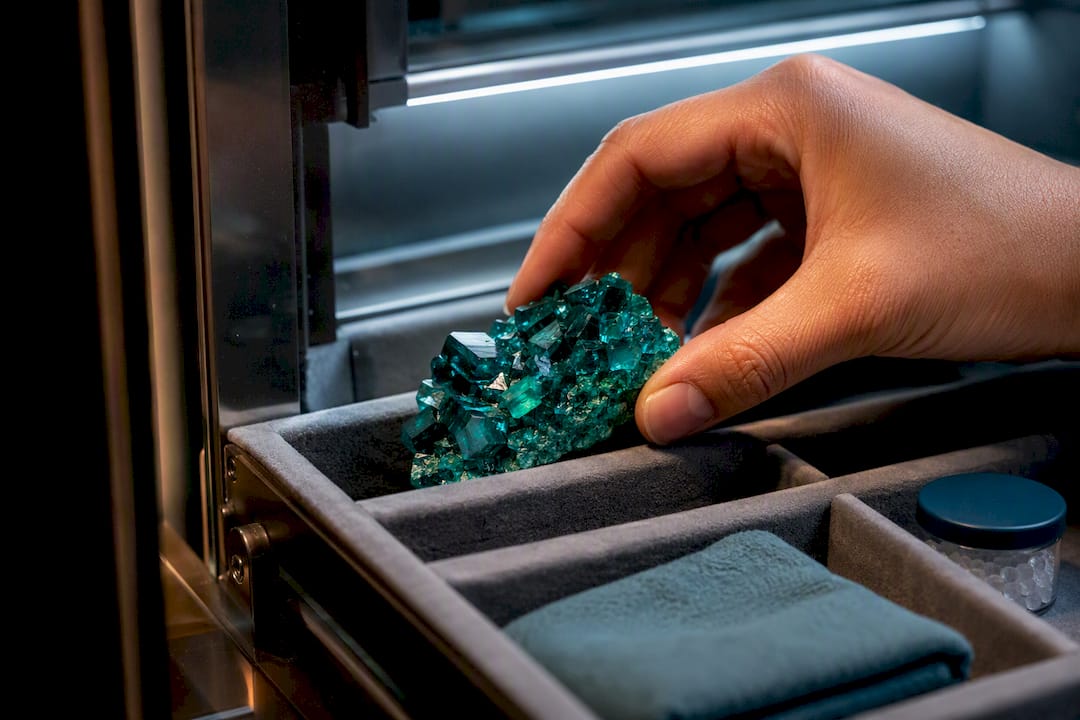
The mineral is chemically hydrated and has perfect cleavage in multiple directions, meaning water exposure and rough handling can both trigger cracking or flaking along those internal planes. Elixirs, the practice of soaking a crystal in water to prepare a drinkable infusion, are specifically discouraged with dioptase for two separate reasons: the specimen itself can degrade, and copper-bearing minerals can leach trace copper into water, which isn’t something you want to ingest.
Here’s a straightforward handling routine that keeps a specimen intact for years:
- Store it in a padded box lined with soft fabric, away from other harder stones that could scratch or chip it on contact.
- Keep humidity stable. Damp basements and steamy bathrooms are the worst display locations; a dry room with consistent temperature is ideal.
- Avoid direct sunlight for extended periods, which can affect colour vibrancy over time on some copper minerals.
- Dust with a dry, soft brush only. Skip water, cleaning sprays, and ultrasonic cleaners entirely.
- Wash your hands after handling if any moisture from your skin made contact with the specimen, particularly given the copper content.
Pro Tip: If you’re building out a home display, treat dioptase as the piece that gets the softest lining and the most protected shelf position, not the centrepiece that gets picked up and passed around. A detailed walkthrough on arranging and protecting a collection covers padded display options in more depth.
On the toxicity question specifically: dioptase isn’t considered dangerous to simply own or display. The caution is narrower than that. Because it contains copper, avoid ingesting any water that’s been in prolonged contact with it, and wash your hands after handling if the specimen got wet. Dry handling on intact, undamaged pieces carries no meaningful risk.
Why dioptase is rare and how to buy a good specimen
Fine, intact dioptase crystals are genuinely uncommon, and the reasons come down to both geology and fragility working against collectors at the same time.
Dioptase forms specifically in oxidized zones of copper deposits, a narrow geological window compared to more common minerals. Notable localities include Kazakhstan, Namibia, the Congo, Chile, and select sites in the United States, but even within those deposits, well-terminated crystals free of damage are the exception rather than the rule. The same perfect cleavage that makes the mineral fragile in your hands also makes it prone to damage during extraction and transport, long before it ever reaches a collector’s shelf.
That combination, geological scarcity plus physical delicacy, is exactly why prices climb quickly for larger, cleaner specimens. A small cluster with decent colour might be affordable, but a large, undamaged crystal with sharp terminations and strong transparency sits in an entirely different price bracket.
Historical confusion adds another wrinkle. Dioptase has been mistaken for emerald because of its similarly vivid green colour, but the two are easy to tell apart with a simple hardness test: emerald sits notably harder on the Mohs scale than dioptase, which is near 5. Anyone buying a specimen represented as either should confirm hardness or request documentation rather than relying on colour alone.
When evaluating a specimen before buying, run through this checklist:
- Ask about provenance. A documented locality (Tsumeb, Kazakhstan, Congo) adds real credibility.
- Request close-up images of the terminations. Chipped or worn points reduce both beauty and value.
- Check matrix condition. Specimens still attached to their host rock often carry more collector interest than loose crystals.
- Confirm colour saturation and transparency rather than relying on filtered photos.
- Prefer sellers who document sourcing, similar to museum-grade standards, over unverified marketplace listings.
Databases like Mindat are a useful independent check on locality claims if a seller’s description feels vague. For a broader sense of what separates a decorative piece from a genuine collector-grade find, this guide to specimen types and value breaks down the criteria in more detail.
The historical roots of dioptase’s reputation
Dioptase entered the mineralogical record formally in 1797, but its striking colour meant it had likely been noticed, and misidentified, well before that. Its resemblance to emerald caused genuine confusion among early collectors and even some traders, since a quick glance at colour alone doesn’t reveal the hardness difference that separates the two minerals.
That historical mix-up shaped how dioptase was perceived for decades. Because it was sometimes lumped in with far more valuable emerald specimens, it carried an odd reputation as either an impostor or an overlooked cousin, depending on who was doing the identifying. Modern mineralogy resolved that confusion cleanly through hardness testing and chemical analysis, but the emerald association still lingers in how some sellers describe the stone today.
Culturally, dioptase never developed the deep, continent-spanning folklore that older, more widely distributed stones like quartz or amethyst carry. Its rarity worked against it here too. A mineral that’s genuinely hard to find in quantity doesn’t accumulate centuries of regional myth the way common stones do. Instead, most of dioptase’s modern reputation comes from the last several decades of crystal-healing practice, built largely around its colour and copper composition rather than any long unbroken folk tradition.
Common myths about dioptase worth knowing
A few misconceptions follow dioptase around, and separating them from what’s actually documented helps set realistic expectations.
Myth: Dioptase is just green quartz or a variety of emerald. It isn’t either. It’s a distinct copper cyclosilicate with its own formula, hardness, and crystal structure, unrelated to quartz and only superficially resembling emerald in colour.
Myth: Because it’s a heart stone, it should feel calming like rose quartz. Practitioners generally describe the opposite experience. Dioptase’s reputation leans toward intensity and emotional surfacing rather than soothing comfort, which surprises people expecting a gentler session.
Myth: A stone this vivid must be treated or dyed. Genuine dioptase’s colour comes entirely from its copper content, not surface treatment. That said, buyers should still be cautious of dyed or composite imitations sold under the same name, which is another reason provenance matters.
Myth: Any dioptase piece is safe for daily wear like a typical gemstone. Given its Mohs hardness of about 5 and perfect cleavage, this one is more mineralogical fact than folklore correction, but it’s repeated often enough as false reassurance that it’s worth stating plainly here too.
None of these myths are malicious. They mostly come from the stone’s rarity meaning fewer people have handled a real specimen closely enough to notice the details that set it apart.
Cleansing and recharging dioptase the safe way
Standard crystal-cleansing advice runs into a problem with dioptase almost immediately: the two most popular methods, water rinsing and salt burial, both risk damaging it. Water threatens the specimen through its perfect cleavage, and salt can be abrasive against a stone this soft.
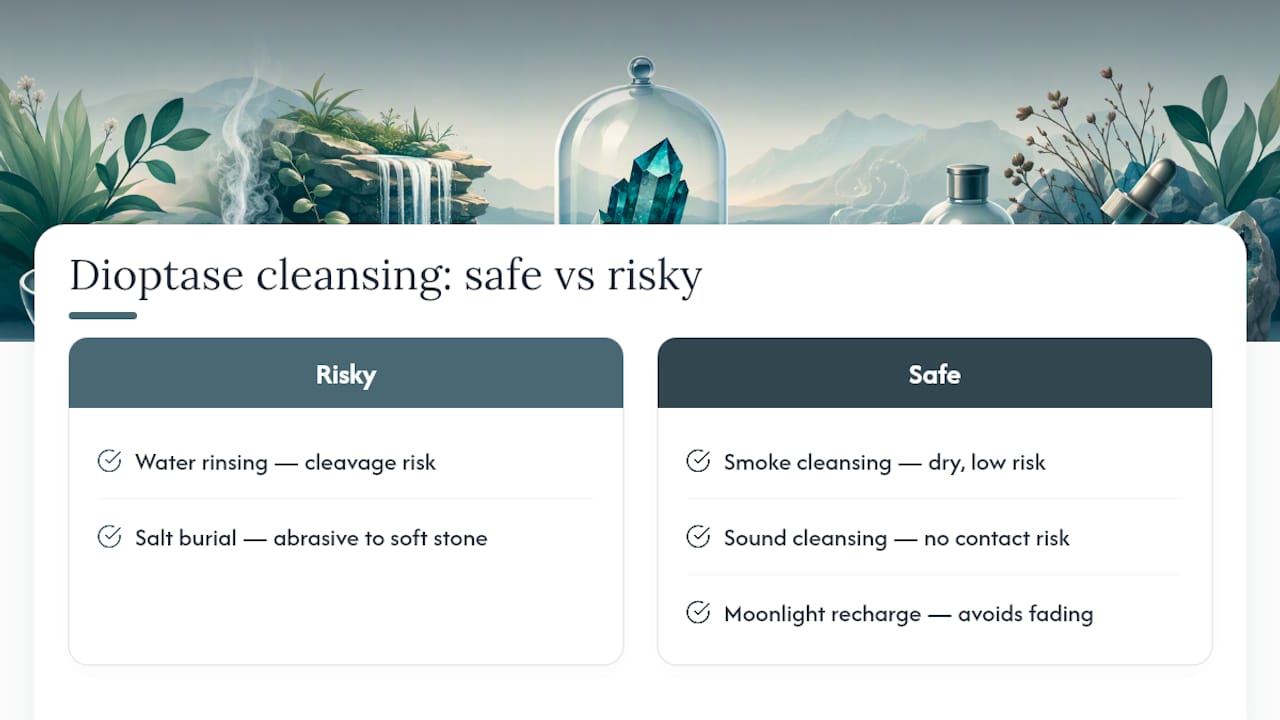
Dry methods are the safer route across the board. Smoke cleansing with sage, palo santo, or incense works without any moisture risk, and it’s the method most consistently recommended for delicate copper minerals. Simply passing the stone through the smoke for a few seconds is enough for most practitioners.
Sound cleansing is another solid option. A singing bowl or bell placed near the stone, or simply resting the specimen close to the speaker during a piece of resonant music, is considered effective without any physical contact risk at all.
For recharging, moonlight is the standard practitioner recommendation over sunlight, partly because it avoids the fading risk associated with prolonged direct light exposure. Leaving a dioptase piece on a windowsill overnight during a full moon, safely away from any chance of rain or condensation, is a low-risk way to refresh it energetically.
Whatever method you choose, dry-cleaning practices are consistently favoured for dioptase over anything involving liquid, and that guidance holds whether you’re cleansing energetically or simply dusting a display piece.
Where to find genuine, well-sourced dioptase specimens
Finding a dioptase specimen with real colour, intact terminations, and honest provenance takes more digging than picking the first green stone that shows up in a search. Some sellers source specimens with documented origins and museum-grade standards in mind, which matters most with a mineral this easy to misidentify or mishandle.
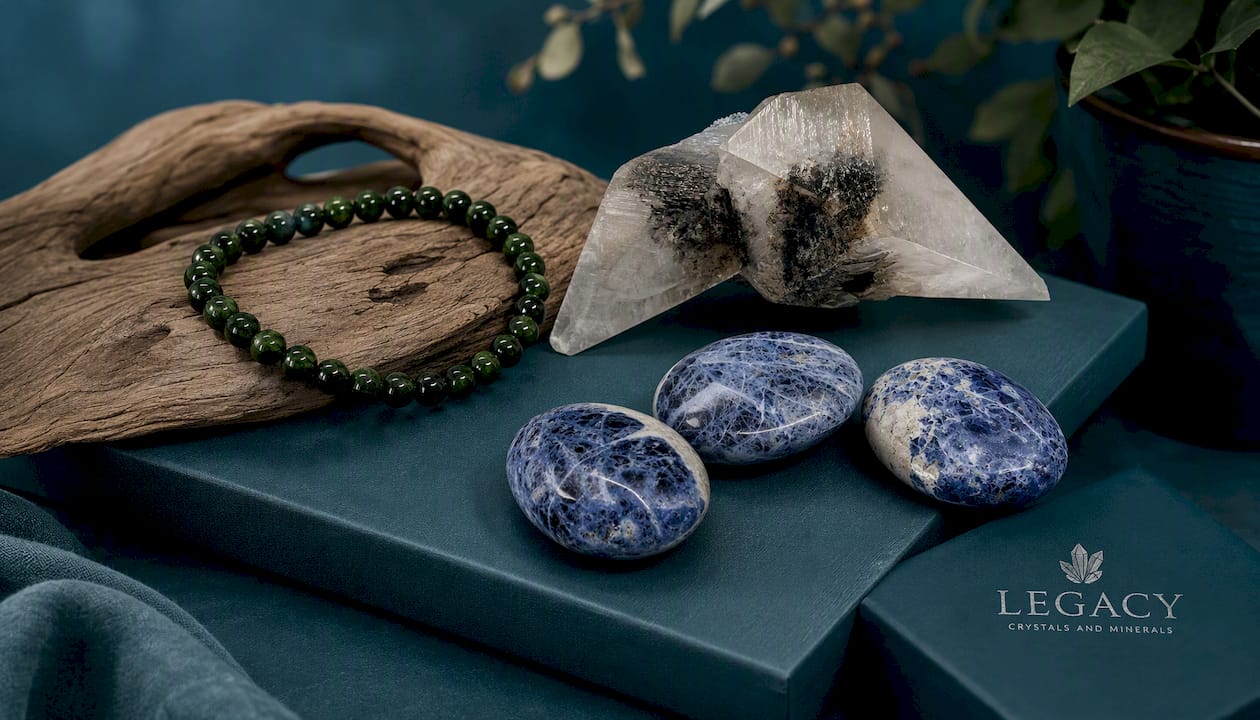
For collectors specifically drawn to dioptase’s heart-healing reputation, browsing the museum-quality minerals and crystals collection is a reasonable starting point, since specimen condition and terminations matter as much as colour saturation for a mineral this fragile. If you want a sense of what well-formed, complex mineral growth looks like beyond dioptase itself, a piece like the twin point dogtooth calcite with dendritic inclusions and sugar sphalerite shows the kind of detailed, collector-grade formation Legacy Crystals and Minerals looks for across its catalogue.
If dioptase’s fragility gives you pause but the heart-healing focus still appeals, a blue sodalite palm stone offers a sturdier alternative for daily handling and meditation work, without the handling restrictions a copper silicate demands. And for readers assembling a broader collection rather than a single specimen, the raw minerals and crystals and top shelf collector minerals collections both cover pieces suited to display and provenance-focused buyers alike.
Simon, an experienced curator with a focus on scientific provenance and specimen condition, recommends starting any dioptase purchase by asking directly about locality documentation and termination condition before price. Browse the current polished and carvings selections for complementary heart-centred pieces, or check the jewelry and bracelets collections for protected wearable formats, and reach out through the site for a specimen recommendation matched to your collection.
Sources
- Understanding dioptase | Gem-A
- Dioptase — Wikipedia
- Dioptase — Handbook of Mineralogy
- Dioptase mineral data — Webmineral
FAQ
What is the spiritual significance of dioptase?
Dioptase is widely associated with heart healing, compassion, and forgiveness in crystal-practice traditions. Practitioners describe it as a soul-level healer meant to surface grief and old trauma so it can be processed, rather than a stone for casual, everyday calm.
Why is dioptase so expensive?
Price climbs with size, colour saturation, transparency, and intact crystal terminations, since dioptase forms in a narrow geological window within oxidized copper deposits. Its own fragility means many crystals get damaged during formation or extraction, so undamaged, well-terminated specimens stay genuinely scarce.
Is dioptase toxic to humans?
Dry, intact dioptase poses no meaningful risk to simply handle or display. Because it contains copper, avoid drinking water that’s had prolonged contact with the stone, and wash your hands if the specimen gets wet during handling.
Is dioptase a rare mineral?
Yes. It only forms in specific oxidized copper-deposit conditions, and its perfect cleavage means many crystals are damaged before they ever reach a collector, making large, clean specimens genuinely uncommon compared to more widely distributed minerals like quartz.


