

Guide pour exposer vos cristaux chez vous : disposez et protégez votre collection
Exposer des cristaux à la maison est un processus artistique qui consiste à organiser votre collection de minéraux pour améliorer à la fois l'esthétique et le flux d'énergie, en combinant les principes de conception avec l'entretien des cristaux pour obtenir des résultats durables. Un guide bien planifié pour l'exposition de cristaux à la maison couvre trois piliers principaux : l'éclairage, l'espacement et l'entretien. Chaque pilier protège vos spécimens tout en maximisant leur impact visuel et spirituel. Que vous possédiez une seule pièce maîtresse ou une collection croissante de spécimens bruts, de pierres polies et de sculptures, les mêmes règles fondamentales s'appliquent. Si vous les respectez, votre exposition aura l'air intentionnelle, et non accidentelle.
De quoi avez-vous besoin avant d'exposer des cristaux à la maison ?
La préparation distingue une exposition d'aspect professionnel d'une étagère désordonnée. Avant de placer un seul cristal, évaluez les conditions d'éclairage de votre pièce à trois intervalles clés : 10h, 14h et au coucher du soleil. La lumière change tout au long de la journée, révélant quels endroits reçoivent un soleil direct intense et lesquels offrent la lumière douce et diffuse que la plupart des spécimens préfèrent. Sauter cette étape est l'erreur la plus courante commise par les propriétaires.
Ensuite, rassemblez vos outils d'exposition. Vous aurez besoin de :
- Étagères flottantes ou vitrines pour une présentation surélevée et à l'abri de la poussière
- Supports et rehausseurs pour ajouter une variation de hauteur et éviter un aspect plat et encombré
- Plateaux doublés de feutre pour protéger les bases et regrouper les petites pièces
- Une brosse douce et des chiffons en microfibre pour le nettoyage courant
- Options d'éclairage telles que des spots ou des rubans LED pour un éclairage d'accentuation
Comprendre les propriétés physiques de vos cristaux est tout aussi important. Le sélénite est soluble dans l'eau et se piquera et se dissoudra dans des environnements humides comme les salles de bain. Le quartz et le jade tolèrent beaucoup mieux l'humidité. La dureté, la stabilité chimique et la sensibilité à la lumière déterminent où un spécimen peut vivre en toute sécurité chez vous.
| Cristal | Sensibilité à la lumière | Tolérance à l'eau | Meilleure pièce |
|---|---|---|---|
| Améthyste | Élevée | Modérée | Chambre, loin des fenêtres |
| Quartz rose | Élevée | Modérée | Salon, lumière indirecte |
| Quartz clair | Faible | Bonne | Toute pièce |
| Sélénite | Faible | Très faible | Pièces sèches uniquement |
| Malachite | Modérée | Faible | Bureau, vitrine fermée |
Conseil de pro : Parcourez votre espace à chaque intervalle d'éclairage et photographiez les emplacements candidats. Vous verrez immédiatement quelles zones passent d'une douce lueur matinale à un éblouissement intense l'après-midi.
Comment agencer et espacer les cristaux pour un impact visuel maximal
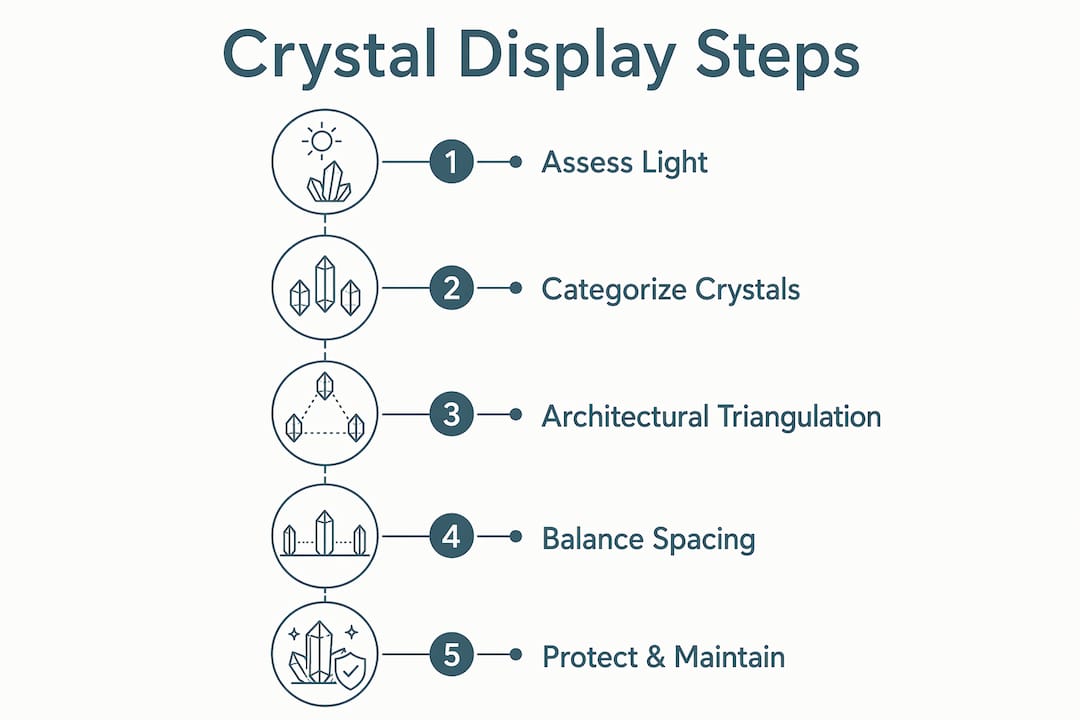
La principale différence entre une exposition professionnelle et une étagère encombrée est la hiérarchie visuelle. Classez vos cristaux en trois groupes en fonction de leur taille et de leur poids visuel : les ancrages, les ponts et les pièces de texture. Les ancrages sont des spécimens de plus de 4,5 kg qui attirent l'attention. Les ponts sont des amas de taille moyenne qui relient la composition. Les pièces de texture sont de petites pierres utilisées pour remplir des bols ou pour la superposition.
Suivez ces étapes pour créer un arrangement équilibré :
- Placez votre ancre en premier. Placez la pièce la plus grande et la plus visuellement dominante légèrement décentrée. Un placement parfaitement centré donne un aspect statique.
- Appliquez la triangulation architecturale. Positionnez deux pièces "pont" à différentes hauteurs pour former un triangle implicite avec l'ancre. Cela attire naturellement l'œil à travers l'exposition.
- Maintenez un espace négatif. Laissez au moins 5 cm d'espace au-dessus de votre cristal le plus haut et maintenez un rapport de 10 cm d'espace vide pour chaque 15 cm de largeur de cristal. Cela évite l'effet "décombres".
- Élevez avec des supports. Les arrangements plats donnent l'impression d'encombrement. Les supports créent de la profondeur et permettent à chaque spécimen de se tenir indépendamment.
- Remplissez la texture en dernier. Ajoutez de petites pierres, des amas ou des sculptures seulement après que la composition principale soit établie. Les pièces de texture doivent soutenir, et non concurrencer.
- Choisissez un arrière-plan neutre. Un papier peint chargé ou un tissu à motifs derrière une exposition rivalise avec les couleurs et les formes naturelles des cristaux. Un mur uni ou une étagère blanche fonctionne mieux.
La triangulation architecturale est le même principe que les architectes d'intérieur utilisent pour les regroupements de meubles et les murs de galeries. Cela fonctionne parce que l'œil humain recherche naturellement les compositions triangulaires comme stables et complètes.
Conseil de pro : Reculez de trois mètres de votre exposition et plissez les yeux. Si une zone semble plus lourde ou plus sombre que les autres, redistribuez une pièce de pont ou ajoutez un support à cette zone.
Quel rôle l'éclairage joue-t-il dans l'exposition de cristaux ?
L'éclairage est la variable la plus sous-estimée dans toute exposition de cristaux à domicile. La mauvaise température de couleur de l'ampoule brouille les bleus et les violets, faisant paraître l'améthyste grise et l'aigue-marine terne. Utilisez des ampoules LED à spectre complet avec une température de couleur de 3000K à 3500K. Les ampoules blanches douces standard de 2700K déforment les teintes des cristaux et sont le choix par défaut dans la plupart des foyers, ce qui explique précisément pourquoi la plupart des expositions à domicile semblent plates.
Principes d'éclairage clés à suivre :
- Observez d'abord la lumière naturelle. Une lumière matinale douce convient à la plupart des spécimens. Un soleil intense l'après-midi provoque une décoloration irréversible des pierres sensibles à la lumière.
- Évitez l'éclairage zénithal sur les pierres opaques. La lumière zénithale aplatit la texture. Utilisez plutôt un éclairage latéral ou des spots inclinés.
- Rétro-éclairage pour les spécimens translucides. Placer un petit spot LED derrière une plaque d'agate ou un mince amas de quartz révèle la structure interne et la couleur que l'éclairage frontal cache entièrement.
- Installez des gradateurs. Un gradateur vous permet de passer d'un éclairage d'exposition lumineux pendant la journée à une lueur ambiante plus douce le soir sans changer d'ampoule.
- Limitez l'exposition aux UV. Le rayonnement UV décolore les centres de couleur des minéraux sensibles en quelques semaines ou mois. L'améthyste, le quartz rose et la kunzite sont les plus vulnérables. Gardez-les loin des fenêtres orientées sud.
Les vitrines fermées résolvent entièrement le problème des UV tout en permettant une visibilité totale. Elles éliminent également l'accumulation de poussière, ce qui est un avantage secondaire qui réduit considérablement le temps de nettoyage.
Conseil de pro : Testez votre éclairage en plaçant un morceau de papier blanc à côté de votre exposition. Si le papier semble jaune ou orange, votre ampoule est trop chaude et vos cristaux perdent leur vraie couleur sous celle-ci.
Comment prendre soin et entretenir vos expositions de cristaux
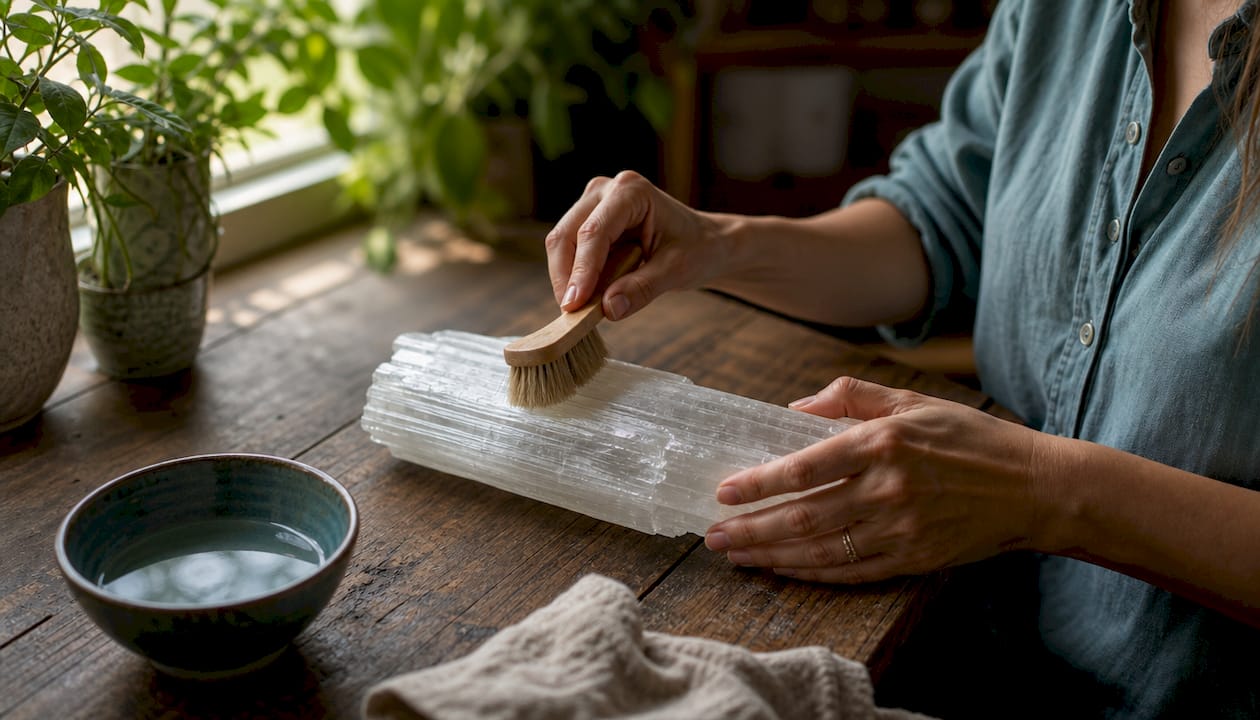
Un entretien régulier protège à la fois l'apparence et l'intégrité de votre collection. La poussière est plus dommageable que la plupart des collectionneurs ne le réalisent. La poussière contient des particules de quartz abrasives qui créent des micro-rayures sur les minéraux tendres comme la sélénite et la calcite lorsqu'ils sont essuyés avec un chiffon sec. Utilisez une brosse douce à poils naturels pour enlever la poussière de la surface avant tout contact avec un chiffon.
Suivez cette séquence d'entretien :
- Dépoussiérez chaque semaine avec une brosse douce. Travaillez de haut en bas afin que les particules délogées ne se redéposent pas sur les pièces déjà nettoyées.
- Essuyez avec un chiffon sec en microfibre. Utilisez des mouvements légers et circulaires. N'appliquez jamais de pression sur les minéraux tendres ou stratifiés.
- Évitez l'eau sur les spécimens sensibles à l'eau. La sélénite, l'halite et certaines variétés de calcite se dissolvent ou se piquent au contact de l'humidité. Pour des conseils de nettoyage détaillés, la ressource sur l'entretien des cristaux de Legacy Crystals and Minerals couvre les protocoles spécifiques aux minéraux.
- Faites pivoter les pierres sensibles à la lumière. Déplacez l'améthyste, le quartz rose et les spécimens similaires hors de toute exposition à la lumière tous les quelques mois pour éviter une décoloration cumulative.
- Rangez les pièces non exposées en toute sécurité. Les boîtes à œufs doublées de papier de soie sont une solution de rangement peu coûteuse et efficace pour les spécimens plus petits qui ne sont pas actuellement exposés.
Un stockage et une rotation appropriés ne sont pas des extras facultatifs pour les collectionneurs sérieux. C'est la différence entre une collection qui semble vibrante dans cinq ans et une qui semble délavée en un an. Traitez vos pièces non exposées avec le même soin que vos spécimens vedettes.
Pour la conservation et le stockage à long terme des spécimens, des compartiments rembourrés et des plateaux doublés de feutre évitent les dommages de contact entre les pièces pendant le stockage.
Quelles erreurs courantes devez-vous éviter lors de l'exposition de cristaux ?
La plupart des problèmes d'affichage proviennent d'un petit nombre d'erreurs répétitives. Les reconnaître tôt permet d'économiser de l'argent et de la frustration.
- Traiter tous les cristaux comme visuellement égaux. Ignorer la hiérarchie visuelle produit de l'encombrement. Sans ancrages, ponts et pièces de texture, l'œil n'a nulle part où se poser.
- Entasser sans espace négatif. Remplir chaque centimètre d'une étagère supprime l'espace de respiration qui rend les spécimens individuels lisibles. Le rapport d'espace négatif 4:6 existe pour cette raison.
- Placer des pierres sensibles à la lumière en plein soleil. La décoloration due à l'exposition aux UV est irréversible. Aucune quantité de repositionnement ne récupère une améthyste délavée.
- Utiliser des ampoules chaudes de 2700K. C'est le défaut dans la plupart des foyers et l'erreur d'éclairage la plus courante. Cela rend les violets bruns et les bleus gris.
- Sauter le nettoyage de routine. L'accumulation de poussière ternit l'éclat de la surface et, sur les minéraux tendres, provoque des micro-rayures permanentes avec le temps.
Une exposition qui évite ces cinq erreurs aura l'air nettement plus réfléchie que l'arrangement domestique moyen. L'écart entre une étagère encombrée et une exposition de qualité galerie est presque toujours une question de technique, et non de qualité des cristaux eux-mêmes.
Points clés
L'exposition de cristaux à domicile la plus efficace combine une hiérarchie visuelle, une température d'éclairage correcte et des soins spécifiques aux minéraux pour protéger les spécimens et créer un impact esthétique durable.
| Point | Détails |
|---|---|
| Évaluez l'éclairage avant de placer | Observez la lumière à 10h, 14h et au coucher du soleil pour identifier les endroits sûrs et flatteurs. |
| Utilisez la hiérarchie visuelle | Classez les pièces en ancrages, ponts et textures pour éviter l'encombrement. |
| Adaptez la température de l'ampoule | Utilisez des LED 3000K–3500K pour restituer les couleurs des cristaux avec précision. |
| Protégez les pierres sensibles à la lumière | Gardez l'améthyste et le quartz rose à l'abri du soleil direct pour éviter une décoloration irréversible. |
| Entretenez avec les bons outils | Utilisez une brosse douce avant tout contact avec un chiffon pour éviter les micro-rayures sur les minéraux tendres. |
Ce que j'ai appris de nombreuses années à observer les succès et les échecs des expositions de cristaux
Les expositions qui durent dans le temps partagent une qualité : l'intentionnalité. Chaque décision de placement a été prise pour une raison, que ce soit la direction de la lumière, le poids visuel ou la tolérance du minéral à l'humidité. Les expositions qui s'effondrent, littéralement et esthétiquement, sont celles où les pièces ont été posées sans plan et n'ont jamais été revues.
La règle d'espacement surprend la plupart des gens lorsqu'ils la rencontrent pour la première fois. Quatre pouces d'espace vide pour chaque six pouces de largeur de cristal semble être beaucoup d'espace inutilisé. En pratique, cet espace négatif est ce qui rend chaque spécimen lisible. Sans lui, même une collection de pièces véritablement rares ressemble à un tas de roches.
L'éclairage est le domaine où je vois les erreurs les plus constantes. Les collectionneurs dépensent des sommes considérables pour des spécimens de qualité et les exposent ensuite sous des ampoules de 2700K qui suppriment les couleurs mêmes qui rendent ces pièces dignes d'être possédées. Passer à une LED de 3000K à 3500K est un coût minime avec un résultat visible majeur. Si vous voulez aller plus loin, construire une collection de qualité muséale nécessite de penser à l'exposition dès l'acquisition, et non comme une réflexion après coup.
L'entretien est le domaine où la plupart des collectionneurs sous-investissent. Une exposition qui n'est pas nettoyée et tournée régulièrement se dégrade plus rapidement qu'une exposition stockée dans une boîte. La poussière est abrasive. Le soleil est implacable. Les cristaux qui conservent leur éclat après cinq ans sont ceux dont les propriétaires ont considéré l'entretien comme faisant partie de la pratique d'exposition, et non comme un élément distinct.
— Simon
Spécimens dignes d'être exposés : Legacy Crystals and Minerals
Une exposition bien planifiée mérite des spécimens bien choisis. Legacy Crystals and Minerals propose des pièces de qualité musée sélectionnées pour leur impact visuel, leur provenance et leur aptitude à l'exposition.

La fluorite de Shangbao avec quartz est un spécimen de collection réactif aux UV qui se transforme sous différentes conditions d'éclairage, ce qui en fait une pièce maîtresse naturelle pour toute exposition construite autour d'un éclairage en couches. Pour une ancre sculpturale audacieuse, le crâne de rubis dans la zoïsite de 1,1 kg est sculpté à la main et suffisamment visuellement dominant pour ancrer une composition d'étagère complète. Legacy Crystals and Minerals propose également le quartz à inclusions de haute clarté avec des caractéristiques squelettiques des montagnes Goboboseb en Namibie, un spécimen de collection de 30 mm qui récompense une observation attentive. Chaque pièce est expédiée avec des détails de provenance, afin que vous sachiez exactement ce que vous placez dans votre exposition.
FAQ
Quelle est la meilleure façon d'arranger les cristaux à la maison ?
Classez les cristaux en pièces d'ancrage, de pont et de texture en fonction de leur taille et de leur poids visuel, puis utilisez la triangulation architecturale pour les positionner. Maintenez un rapport de 10 centimètres d'espace négatif pour chaque 15 centimètres de largeur de cristal afin d'éviter l'encombrement.
Quels cristaux ne doivent pas être placés en plein soleil ?
L'améthyste, le quartz rose et la kunzite sont très sensibles à la lumière. Le rayonnement UV peut décolorer leurs centres de couleur en quelques semaines ou mois, et la décoloration est irréversible.
Quel éclairage est le meilleur pour exposer les cristaux ?
Les ampoules LED à spectre complet avec une température de couleur de 3000K à 3500K restituent les couleurs des cristaux avec la plus grande précision. Les ampoules blanches douces standard de 2700K déforment les violets et les bleus et sont l'erreur d'éclairage la plus courante dans les expositions à domicile.
Comment nettoyer les cristaux exposés sans les endommager ?
Utilisez une brosse douce à poils naturels pour enlever la poussière avant tout contact avec un chiffon, puis essuyez délicatement avec un chiffon sec en microfibre. Évitez l'eau sur les minéraux sensibles à l'eau comme la sélénite, qui se piquettera et se dissoudra au contact de l'humidité.
Puis-je exposer des cristaux dans une salle de bain ?
Seuls les minéraux chimiquement stables et durs comme le quartz tolèrent l'humidité de la salle de bain. La sélénite est soluble dans l'eau et subira des dommages permanents dans les environnements humides. Utilisez des vitrines fermées dans les pièces très humides pour une protection accrue.
Recommandé
- Construire une collection de cristaux de qualité musée : Guide d'expert – Legacy Crystals and Minerals
- Comment prendre soin et nettoyer vos cristaux – Legacy Crystals and Minerals
- Prendre soin de vos spécimens : stockage, nettoyage et exposition – Legacy Crystals and Minerals
- Comment photographier des cristaux pour les médias sociaux ou la vente – Legacy Crystals and Minerals


