

Variétés de tourmaline : espèces, couleurs et conseils d'achat
Les variétés de tourmaline se répartissent en deux systèmes qui se chevauchent : les espèces minérales et les noms commerciaux. Le côté des espèces couvre l'elbaïte, la liddicoatite, la dravite, l'uvite et le schorl, et la plupart des tourmalines de qualité gemme que vous rencontrerez dans un écrin à bijoux ou un lot de revendeur sont de l'elbaïte. Le côté des noms commerciaux est le vocabulaire que vous entendrez réellement lors d'un salon de la pierre précieuse : rubellite, indicolite, verdélite, Paraíba, watermelon, tourmaline chrome. Ces noms décrivent la couleur, pas l'espèce, et cet écart entre « ce qu'on appelle » et « ce que c'est » est important lorsque vous payez un prix conséquent pour une pierre.
Quelques noms ont un poids considérable sur le marché :
- Les Paraíba et tourmaline chrome se situent en haut de l'échelle de valeur, en raison de leur rareté et d'une saturation des couleurs que peu d'autres gemmes peuvent égaler.
- Les rubellites et indicolites peuvent également atteindre des prix élevés dans le haut de gamme, surtout pour les pierres plus grandes et pures.
- Les tourmalines watermelon et multicolores misent davantage sur la nouveauté et la qualité de la zone que sur l'intensité de la couleur pure.
Points clés
Les espèces minérales de la tourmaline déterminent sa chimie, mais ses noms commerciaux décrivent la couleur que les acheteurs recherchent réellement, et confondre les deux est l'erreur la plus courante que font les nouveaux collectionneurs.
| Point | Détails |
|---|---|
| Espèce vs nom commercial | L'elbaïte fournit presque toutes les couleurs de qualité gemme ; la rubellite, l'indicolite et la Paraíba sont des noms de couleurs, pas d'espèces. |
| La couleur provient d'oligo-éléments | Le manganèse donne le rose et le rouge, le fer et le titane donnent le vert et le bleu, le cuivre donne les tons néon de la Paraíba. |
| Paraíba et chrome en tête de la valeur | La couleur néon causée par le cuivre et le vert émeraude causé par le chrome commandent les primes les plus fortes dans le commerce. |
| Test de l'aimant comme contrôle rapide | La traînée d'un aimant en néodyme sur la tourmaline bleue riche en fer peut indiquer si une revendication "Paraíba" nécessite une vérification plus approfondie en laboratoire. |
| Options portables de Legacy Crystals and Minerals | Les bracelets en elbaïte multicolore et en tourmaline noire offrent des points d'entrée accessibles dans la tourmaline gemme véritable. |
Table des matières
- Quelles sont les principales variétés et espèces minérales de tourmaline ?
- Variétés de couleurs et les noms commerciaux que vous entendrez réellement
- Qu'est-ce qui cause les couleurs et les effets optiques de la tourmaline ?
- Comment identifier les variétés de tourmaline et vérifier la qualité des gemmes ?
- Quelles variétés de tourmaline valent le plus cher et comment bien acheter ?
- D'où vient la tourmaline et l'origine modifie-t-elle sa valeur ?
- Comment prendre soin et porter des bijoux en tourmaline ?
- Référence rapide des espèces et variétés de tourmaline
- Trouvez votre propre pièce de tourmaline avec Legacy Crystals and Minerals
- Sources
- FAQ
Quelles sont les principales variétés et espèces minérales de tourmaline ?
Le groupe des tourmalines est une famille de minéraux borosilicatés chimiquement apparentés partageant une seule structure cristalline, et les gemmologues reconnaissent cinq espèces qui importent le plus aux collectionneurs : l'elbaïte, la liddicoatite, la dravite, l'uvite et le schorl, selon l'aperçu minéralogique du GIA. Chaque espèce a une signature chimique distincte, même si plusieurs peuvent produire des couleurs qui se chevauchent.
- L'elbaïte est riche en lithium et en sodium, et elle est responsable de presque tout le spectre de couleurs de qualité gemme que l'on trouve en joaillerie, du rose vif rubellite au bleu néon Paraíba.
- La liddicoatite est riche en calcium et étroitement liée à l'elbaïte ; elle présente fréquemment un zonage multicolore spectaculaire et est prisée pour les spécimens en tranches autant que pour les pierres facettées.
- La dravite est riche en magnésium, produisant généralement des tons bruns, jaune-brun ou noirs ; la dravite de qualité gemme est occasionnellement taillée mais atteint rarement la saturation recherchée par les collectionneurs.
- L'uvite est riche en calcium et en magnésium, étroitement liée à la dravite, et se présente principalement sous forme de matériau sombre et opaque, mieux adapté aux cabochons qu'aux facettes.
- Le schorl est riche en fer et presque toujours noir ou très foncé. C'est l'espèce de tourmaline la plus abondante sur Terre, et elle fournit la tourmaline noire vendue comme bijou de protection et spécimens d'exposition plutôt que des gemmes transparentes.
L'elbaïte domine le commerce des gemmes pour une raison simple : sa chimie tolère la plus large gamme de substitutions d'oligo-éléments, ce qui est exactement ce qui produit la célèbre diversité de couleurs de la tourmaline. Les minéraux révèlent que l'elbaïte seule représente presque toutes les variétés de gemmes commerciales, tandis que la dravite, l'uvite et le schorl restent principalement sur les marchés des spécimens et des ornements. La liddicoatite occupe un terrain intermédiaire : moins dominante commercialement que l'elbaïte, mais loin d'être une note de bas de page, surtout parmi les collectionneurs qui apprécient les tranches en coupe transversale de Madagascar montrant des bandes de couleurs concentriques.
Une mise en garde mérite d'être signalée dès le début : les gemmologues ont observé que le terme « elbaïte » est parfois utilisé de manière lâche dans le commerce pour décrire toute tourmaline vibrante de qualité gemme, même lorsque l'espèce précise d'une pierre n'a pas été confirmée. L'espèce et le nom commercial ne sont pas toujours vérifiés ensemble, ce qui est l'une des raisons pour lesquelles les rapports de laboratoire sont plus importants pour la tourmaline que pour de nombreuses autres gemmes.
Variétés de couleurs et les noms commerciaux que vous entendrez réellement
Les noms commerciaux sont le raccourci que les marchands de pierres précieuses utilisent pour la couleur, et ils transcendent les frontières des espèces plus que la plupart des acheteurs ne s'y attendent. Voici le guide de terrain :
- La rubellite décrit la tourmaline rose à rouge, presque toujours de l'elbaïte, les plus belles pierres présentant une saturation semblable à celle du rubis plutôt qu'un rose pâle ou brunâtre.
- L'indicolite couvre la tourmaline bleue à bleu-vert, généralement de l'elbaïte, allant du bleu gris acier à un riche ton paon.
- La verdélite est le terme général pour la tourmaline verte, la couleur la plus courante dans la famille de l'elbaïte et généralement la plus abordable des variétés nommées.
- L'achroïte désigne la tourmaline incolore, véritablement rare car la plupart des tourmalines contiennent au moins une trace d'éléments colorants lors de leur formation.
- La Paraíba fait référence à la tourmaline bleu, vert ou violet néon colorée par le cuivre, nommée d'après l'État brésilien où elle a été découverte pour la première fois à la fin des années 1980.
- La tourmaline chrome est un vert émeraude saturé causé par le chrome ou le vanadium, historiquement provenant de Tanzanie et d'Afrique de l'Est.
- La tourmaline melon d'eau présente un cœur rose avec un bord vert, imitant la coupe transversale du fruit, et est prisée lorsque le zonage des couleurs est net plutôt que trouble. Un bracelet de tourmaline melon d'eau est l'une des façons les plus reconnaissables dont cette variété atteint le marché des bijoux.
- La tourmaline parti-colore présente deux couleurs distinctes ou plus dans un seul cristal qui ne sont pas disposées selon le motif classique du melon d'eau.
- La tourmaline Trapiche présente un motif rare en forme de rayon rayonnant du centre, causé par des irrégularités de croissance lors de la cristallisation.
- La tourmaline œil-de-chat présente une chatoyance due à des inclusions fibreuses parallèles, taillée en cabochon pour mettre en valeur l'effet.
La rubellite et l'indicolite sont presque toujours de l'elbaïte, mais la Paraíba est plus délicate. Le nom a été inventé pour l'elbaïte brésilienne contenant du cuivre, mais des tourmalines contenant du cuivre ont depuis été découvertes au Mozambique et au Nigeria, et le commerce applique désormais le terme "Paraíba" au matériau provenant des trois pays, quelle que soit la pureté de l'espèce. Il s'agit là d'un écart significatif entre le langage marketing et la réalité minéralogique, et c'est précisément pourquoi la documentation d'origine a tant de poids pour les pierres à forte valeur contenant du cuivre.
La tourmaline Paraíba et la tourmaline chrome attirent le plus l'attention du marché, et pour une bonne raison : toutes deux combinent une couleur intense et rare avec une offre mondiale limitée. Les pierres multicolores et melon d'eau intéressent les collectionneurs pour une raison différente, le zonage lui-même est l'attrait, et non la saturation brute de la couleur. Savoir si vous achetez une espèce ou un nom de couleur change la façon dont vous évaluez une pierre, et cela change les questions que vous devriez poser avant de payer un supplément.
Qu'est-ce qui cause les couleurs et les effets optiques de la tourmaline ?
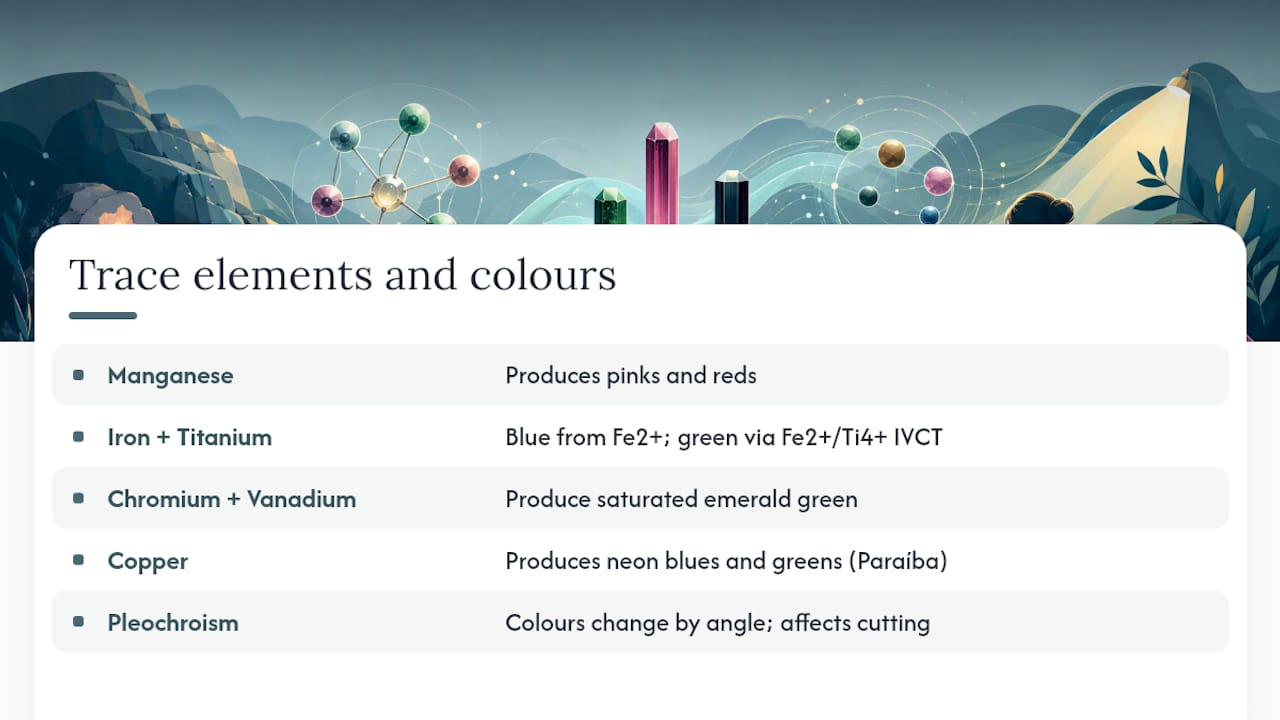
La gamme de couleurs de la tourmaline dépend des oligo-éléments présents dans son réseau cristallin, et la cartographie est assez cohérente entre les espèces. Le manganèse produit des roses et des rouges. Le fer et le titane produisent des verts et des bleus. Le chrome et le vanadium produisent le vert émeraude saturé de la tourmaline chrome. Le cuivre produit les bleus et verts néon qui définissent le matériau Paraíba.
Le mécanisme à l'origine de certaines de ces couleurs va au-delà de la simple absorption. La tourmaline bleue doit souvent sa teinte aux ions Fe2+, tandis que le vert résulte fréquemment d'une interaction entre les ions Fe2+ et Ti4+ appelée transfert de charge intervalence, ou IVCT, où les électrons sautent entre deux ions métalliques différents et absorbent des longueurs d'onde spécifiques de la lumière dans le processus. Certains roses et rouges ne proviennent pas d'un ion métallique seul, mais de centres de couleur induits par le rayonnement, des défauts structurels dans le cristal qui modifient la façon dont il absorbe la lumière.
Le pléochroïsme ajoute une autre couche. De nombreuses tourmalines présentent des couleurs ou des intensités différentes selon l'angle de vision par rapport à l'axe optique du cristal, une propriété appelée dichroïsme lorsque deux couleurs sont impliquées. Ce n'est pas un détail cosmétique. Les tailleurs doivent orienter la matière brute avec soin, car une taille mal orientée peut donner à une gemme un aspect plat, brunâtre ou délavé, même si la matière brute elle-même contenait une excellente couleur. Un tailleur habile peut extraire un bleu sarcelle vif d'une matière brute qui, autrement, semblerait d'un vert trouble.
Un raccourci mental simple : le manganèse tire sur le rose, le fer et le titane sur le vert-bleu, le chrome et le vanadium sur l'émeraude, et le cuivre sur le néon. Gardez cette association à l'esprit et la plupart des descriptions de couleurs de tourmaline dans l'inventaire d'un revendeur commenceront à avoir un sens immédiat.
Comment identifier les variétés de tourmaline et vérifier la qualité des gemmes ?
La tourmaline est connue pour sa bonne dureté, adaptée à un port quotidien, mais elle peut néanmoins être vulnérable aux éclats autour de certaines zones de clivage. L'indice de réfraction et les valeurs de biréfringence, ainsi que la densité, aident à distinguer la tourmaline des pierres d'apparence similaire et même de certaines variétés entre elles, car la chimie au niveau de l'espèce modifie légèrement ces valeurs.
- Dureté : modérée à bonne, convient aux bagues avec un soin raisonnable.
- Indice de réfraction et biréfringence : suffisamment distinctifs pour distinguer la tourmaline du verre, du spinelle synthétique et d'autres imitations courantes.
- Densité : varie modestement selon les espèces, utile pour une confirmation en laboratoire plutôt que pour un contrôle rapide sur le terrain.
- Inclusions courantes : fines tubes de croissance parallèles, plumes et inclusions occasionnelles à deux phases qui peuvent aider à confirmer l'origine naturelle.
Le magnétisme offre un raccourci vraiment utile auquel la plupart des acheteurs ne pensent jamais. La tourmaline riche en fer, y compris de nombreuses indicolites bleues, montrera une légère traînée en présence d'un puissant aimant au néodyme, tandis que le matériau de style Paraíba de couleur cuivre est essentiellement diamagnétique et ne réagira pas. Ce n'est pas un test définitif en soi, mais c'est un moyen rapide et gratuit de signaler une pierre pour un examen plus approfondi avant de s'engager à payer des frais de laboratoire.
Pour tout ce qui dépasse un prix modeste, demandez une analyse gemmologique appropriée : lecture de l'indice de réfraction, spectrométrie, et idéalement une analyse chimique capable de confirmer l'espèce et de détecter un traitement. Le traitement thermique est courant sur la tourmaline pour améliorer la couleur ou réduire les tons secondaires indésirables, et l'irradiation apparaît occasionnellement sur le matériau rose. Aucun de ces traitements n'est intrinsèquement malhonnête, mais il doit être divulgué, et il doit influencer le prix que vous êtes prêt à payer.
Conseil de pro : Transportez un petit aimant en néodyme lorsque vous achetez des pierres brutes. Une tourmaline bleue qui s'attire visiblement est plus susceptible d'être une indicolite à base de fer qu'une Paraíba à base de cuivre, ce qui peut vous épargner une conversation gênante après la vente.
Quelles variétés de tourmaline valent le plus cher et comment bien acheter ?
La couleur est le principal facteur de la valeur de la tourmaline, en particulier la teinte et la saturation, suivies par la clarté, la taille, la qualité de la taille et l'origine. La Paraíba de couleur cuivre vif et la tourmaline chrome de couleur chrome se classent systématiquement en tête des listes de prix, avec la rubellite et l'indicolite de première qualité juste derrière lorsque la couleur est saturée et uniformément répartie plutôt que tachetée.
- Vérifiez d'abord la répartition de la couleur. Une couleur uniforme et saturée sur toute la pierre l'emporte sur une pierre plus grande avec un zonage visible ou des bords délavés.
- Renseignez-vous sur l'espèce et le traitement. Un vendeur devrait être en mesure de vous dire si une « rubellite » a été confirmée comme étant de l'elbaïte et si la pierre a été chauffée ou irradiée.
- Demandez des informations sur l'origine des pierres de grande valeur. Cela est particulièrement important pour le matériau Paraíba, où les pierres brésiliennes, mozambicaines et nigérianes peuvent avoir des attentes de prix différentes malgré une apparence similaire.
- Demandez un rapport de laboratoire pour tout ce qui dépasse quelques centaines de dollars. Un rapport d'un laboratoire gemmologique indépendant documente l'espèce, le traitement et parfois l'origine.
- Comparez le prix avec les principaux facteurs de valeur connus, et non pas seulement avec l'apparence de la pierre sur une photo, car l'éclairage peut flatter une couleur faible.
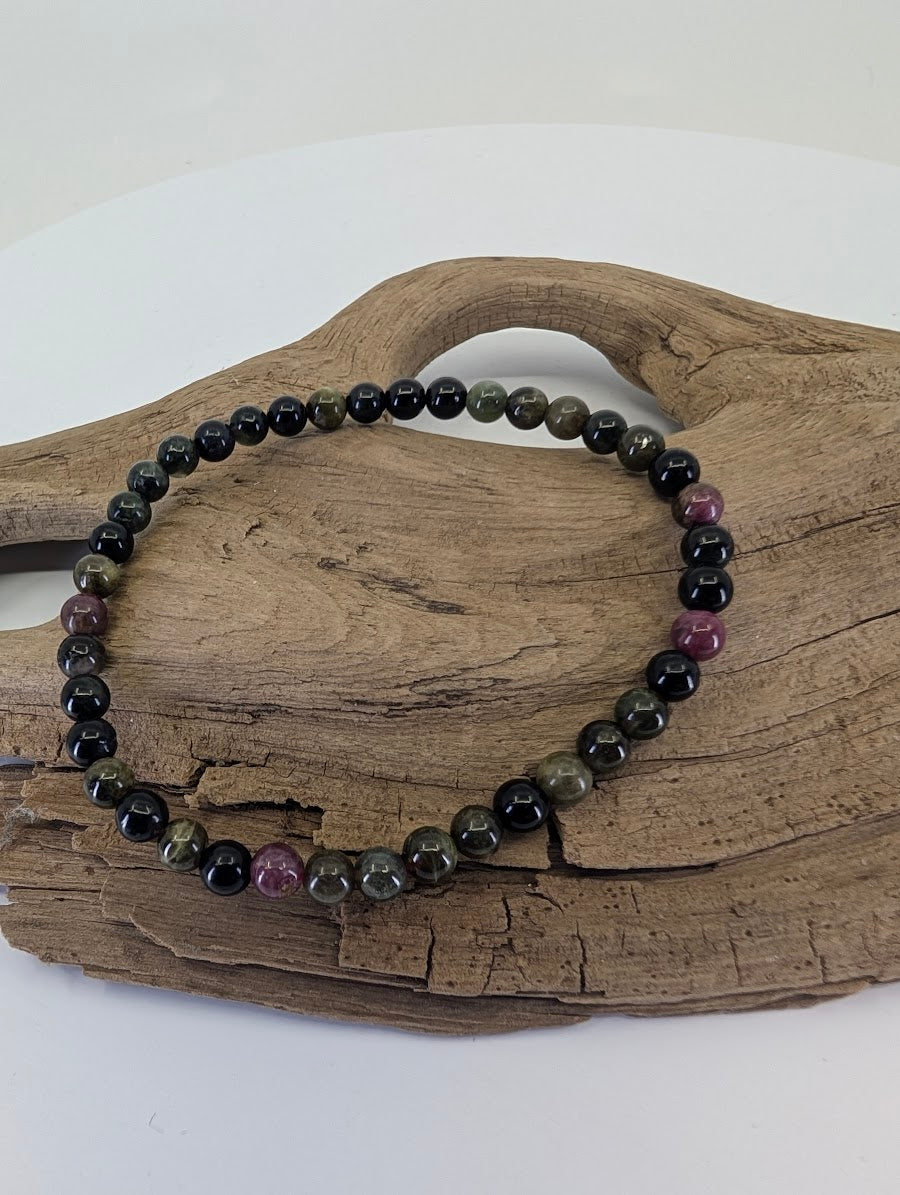
La vérification de la provenance n'est pas de la paranoïa pour les achats de Paraíba, c'est une diligence raisonnable standard, car le nom lui-même est passé d'un seul gisement brésilien à une vaste catégorie de marché. Pour les bijoux de tous les jours, comme un bracelet en elbaïte multicolore présentant plusieurs couleurs de tourmaline enfilées, la documentation est moins importante que le simple fait d'aimer la pièce et de confirmer qu'elle est naturelle, non traitée et sans verre.
Conseil de pro : Pour toute pierre commercialisée comme Paraíba ou tourmaline chrome de plus de quelques centaines de dollars, demandez un rapport de laboratoire indépendant avant de finaliser l'achat. La prime que ces variétés exigent justifie le coût supplémentaire modeste de la vérification.
D'où vient la tourmaline et l'origine modifie-t-elle sa valeur ?
Le Brésil reste la source la plus célèbre de tourmaline, en particulier le Minas Gerais pour la rubellite et la verdélite, et la région de Paraíba et Rio Grande do Norte pour le matériau néon original contenant du cuivre. Le Mozambique et le Nigeria fournissent désormais une grande partie de la tourmaline contenant du cuivre vendue sous le nom de Paraíba, un changement qui a suivi l'épuisement du gisement brésilien original. La Tanzanie et l'Afrique de l'Est sont les sources classiques du vert saturé de la tourmaline chrome. Le Nigeria produit également de fortes rubellites et indicolites. Aux États-Unis, le Maine et la Californie ont historiquement produit de belles elbaïtes roses et multicolores, bien que la production soit limitée par rapport à celle du Brésil et de l'Afrique.
L'origine affecte le prix de deux manières : la rareté et la réputation. Le gisement original de Paraíba est pratiquement épuisé, ce qui pousse la demande vers les matériaux du Mozambique et du Nigeria que les revendeurs commercialisent toujours sous le même nom, parfois avec un écart de prix reflétant la prime historique que les pierres brésiliennes continuent de commander.
Comment prendre soin et porter des bijoux en tourmaline ?
La tourmaline supporte raisonnablement bien l'usure quotidienne, avec une dureté de 7 à 7,5 sur l'échelle de Mohs, mais elle n'apprécie pas les changements brusques de température ou les méthodes de nettoyage agressives. Utilisez un savon doux, de l'eau tiède et une brosse douce pour le nettoyage régulier.
- Évitez les nettoyeurs à vapeur et à ultrasons, qui peuvent élargir les fractures internes existantes dans les pierres incluses.
- Évitez les chocs thermiques, comme faire passer une pierre chaude sous l'eau froide juste après une exposition au soleil.
- Rangez les pièces séparément pour éviter les rayures causées par des gemmes plus dures partageant la même boîte.
- Un bracelet en tourmaline noire résiste bien à l'usure quotidienne grâce à la robustesse du schorl, mais les mêmes règles de nettoyage doux s'appliquent.
Conseil de pro : Si une pierre développe un nouveau reflet interne ou une ligne après un choc, faites-la vérifier par un bijoutier avant de la porter à nouveau. Les petites fractures peuvent s'étendre avec des impacts répétés.
Espèces et variétés de tourmaline : guide rapide
| Espèce / Variété | Couleur(s) typique(s) | Cause de la couleur | Sources typiques | Notes d'utilisation en joaillerie |
|---|---|---|---|---|
| Elbaïte (rubellite) | Rose à rouge | Manganèse | Brésil, Nigeria, Mozambique | Variété de gemme nommée la plus courante ; les pierres fines et saturées atteignent des prix élevés |
| Elbaïte (indicolite) | Bleu à bleu-vert | Fer, titane (IVCT) | Brésil, Nigeria, Namibie | Le test de traînée magnétique peut aider à la distinguer des bleus contenant du cuivre |
| Elbaïte (verdelite) | Vert | Fer | Brésil, Nigeria, Tanzanie | Couleur d'elbaïte la plus abondante et abordable |
| Elbaïte (Paraíba) | Bleu néon, vert, violet | Cuivre | Brésil, Mozambique, Nigeria | Catégorie de valeur la plus élevée ; vérification de l'origine fortement conseillée |
| Elbaïte (pastèque) | Noyau rose, bord vert | Manganèse et fer zonés | Brésil, USA (Maine) | Appréciée pour son zonage de couleurs net et propre |
| Elbaïte (chrome) | Vert émeraude saturé | Chrome, vanadium | Tanzanie, Afrique de l'Est | Parmi les variétés de tourmaline les plus chères |
| Liddicoatite | Zoné multicolore | Mélange d'oligo-éléments | Madagascar | Populaire sous forme de tranches polies montrant des bandes de couleur |
| Dravite | Brun, brun-jaune | Magnésium, fer | Brésil, Kenya, Sri Lanka | Rarement de qualité gemme ; plus courante sous forme de spécimens |
| Uvite | Brun foncé, noir | Calcium, magnésium | Sri Lanka, Brésil | Principalement opaque, occasionnellement taillée en cabochons |
| Schorl | Noir | Fer | Brésil, USA, Pakistan | Courant en spécimens et en bijoux perlés |
Trouvez votre propre pièce de tourmaline avec Legacy Crystals and Minerals
Lire sur la rubellite et la Paraíba est une chose, tenir une pièce authentique et bien documentée en est une autre. Legacy Crystals and Minerals sélectionne des bijoux en tourmaline de qualité gemme et des spécimens de qualité muséale en mettant l'accent sur une authenticité que vous pouvez réellement vérifier, et non pas seulement sur un langage marketing emprunté aux variétés les plus rares.
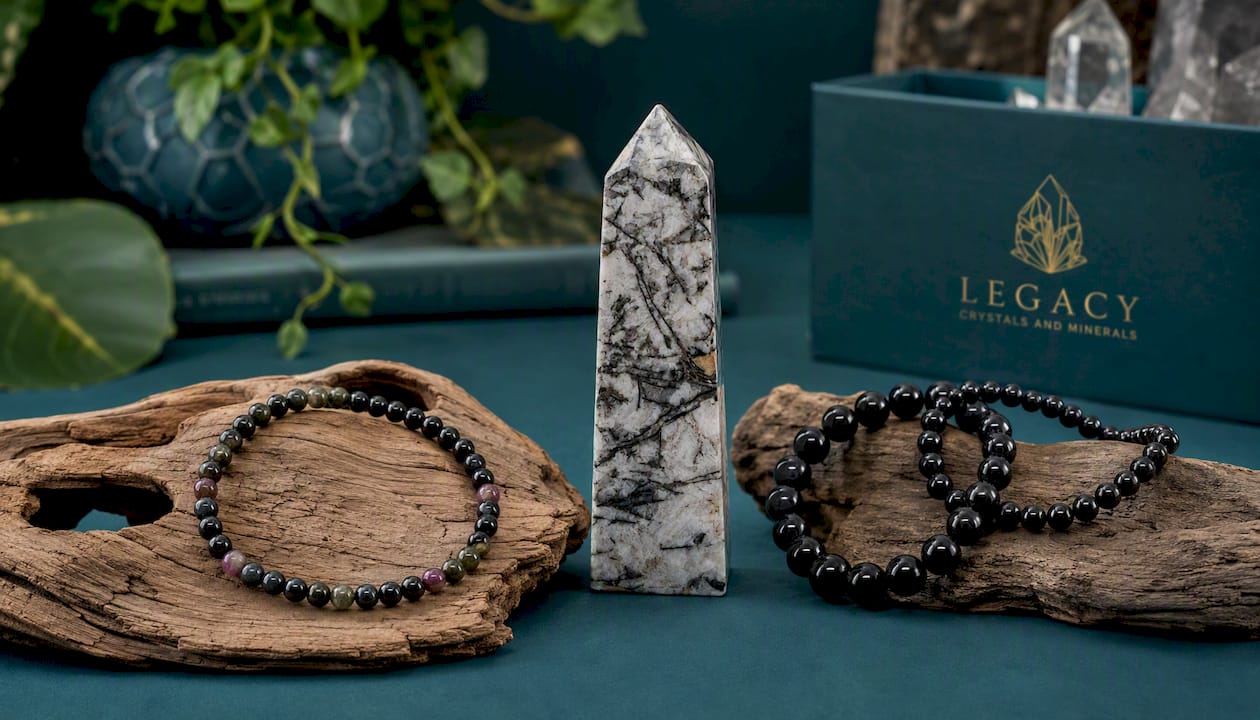
Le bracelet d'elbaïte multicolore provenant du Brésil présente plusieurs couleurs de tourmaline en une seule pièce, une façon pratique de posséder plusieurs variétés sans acheter des pierres séparées. Les collectionneurs attirés par l'aspect spécimen du passe-temps trouveront la tourmaline noire dans une tour d'albite et de quartz du Pakistan un excellent exemple de schorl dans sa matrice naturelle, le genre de pièce d'exposition qui montre l'habitus cristallin plutôt qu'une simple couleur polie. Pour un usage quotidien, le bracelet en tourmaline noire est disponible en perles de 6 mm, 8 mm et 10 mm, vous permettant d'adapter la pièce à votre poignet et à votre style.
Parcourez la sélection actuelle de tourmalines et vérifiez la disponibilité des pièces qui correspondent aux variétés couvertes dans ce guide.
Sources
Pour les lecteurs qui souhaitent approfondir la gemmologie de la tourmaline, ces sources couvrent la classification des espèces, la recherche sur l'origine de la Paraíba et les données sur les propriétés : l'aperçu de la tourmaline du GIA, l'étude sur l'origine de la Paraíba du GIA et l'entrée de Mindat sur la tourmaline pour des plages de propriétés détaillées par espèce.
- Description de la tourmaline
- Détermination de l'origine géographique de la tourmaline Paraíba (Gems & Gemology, Hiver 2019)
- Mindat
FAQ
Quelle est la couleur la plus rare de tourmaline ?
Le bleu et le vert néon causés par le cuivre de la Paraíba sont généralement considérés comme la couleur de tourmaline la plus rare et la plus précieuse, suivis de près par le vert émeraude saturé de la tourmaline chromée.
Quel type de tourmaline est le plus précieux ?
La tourmaline Paraíba atteint généralement les prix les plus élevés de la famille des tourmalines, en raison de sa couleur rare à base de cuivre et de son offre mondiale limitée, avec la tourmaline chromée de qualité supérieure et la rubellite fine juste derrière.
Quelle est la couleur de tourmaline la plus recherchée ?
Le matériau Paraíba bleu-vert néon vif attire le plus l'attention des collectionneurs et des négociants, bien que la rubellite rose saturée et la tourmaline chromée vert émeraude soient également très recherchées.
Quels sont les différents types de pierres précieuses de tourmaline ?
Les principales espèces pertinentes pour les gemmes sont l'elbaïte, la liddicoatite, la dravite, l'uvite et le schorl, l'elbaïte fournissant la plupart des variétés de couleurs nommées comme la rubellite, l'indicolite, la verdelite, la Paraíba et la tourmaline pastèque.
La tourmaline noire peut-elle être portée tous les jours ?
Oui. Le schorl, l'espèce derrière la tourmaline noire, est classé de 7 à 7,5 sur l'échelle de Mohs, ce qui le rend suffisamment durable pour un port quotidien dans les bracelets et autres bijoux avec un entretien normal.
Recommandé
- Variétés de Quartz — Du Clair au Fumé à la Fraise – Legacy Crystals and Minerals
- Opale vs opalite : tout ce que chaque acheteur doit savoir – Legacy Crystals and Minerals
- Signification de la tourmaline pastèque : le guide du chakra du cœur – Legacy Crystals and Minerals
- Tour de Quartz Feu – Quartz Hématode Poli - Brésil – Legacy Crystals and Minerals


