

Que sont les cristaux de druses : un guide complet
Les cristaux de drusite sont définis en minéralogie comme une couche de minuscules cristaux scintillants qui se développent directement sur une surface rocheuse ou à l'intérieur d'une cavité, le plus souvent composés de dioxyde de silicium sous forme de quartz. Les termes « drusite » et « druzy » (ou drusy) désignent la même formation. Tous deux décrivent une croûte continue et scintillante de pointes cristallines microscopiques plutôt qu'un seul gros cristal. Ces formations apparaissent dans les roches volcaniques, sédimentaires et métamorphiques du monde entier, et elles ont une signification à la fois en minéralogie scientifique et en lithothérapie. Legacy Crystals and Minerals propose des spécimens de drusite authentifiés qui reflètent toute la gamme du caractère naturel de ce minéral.
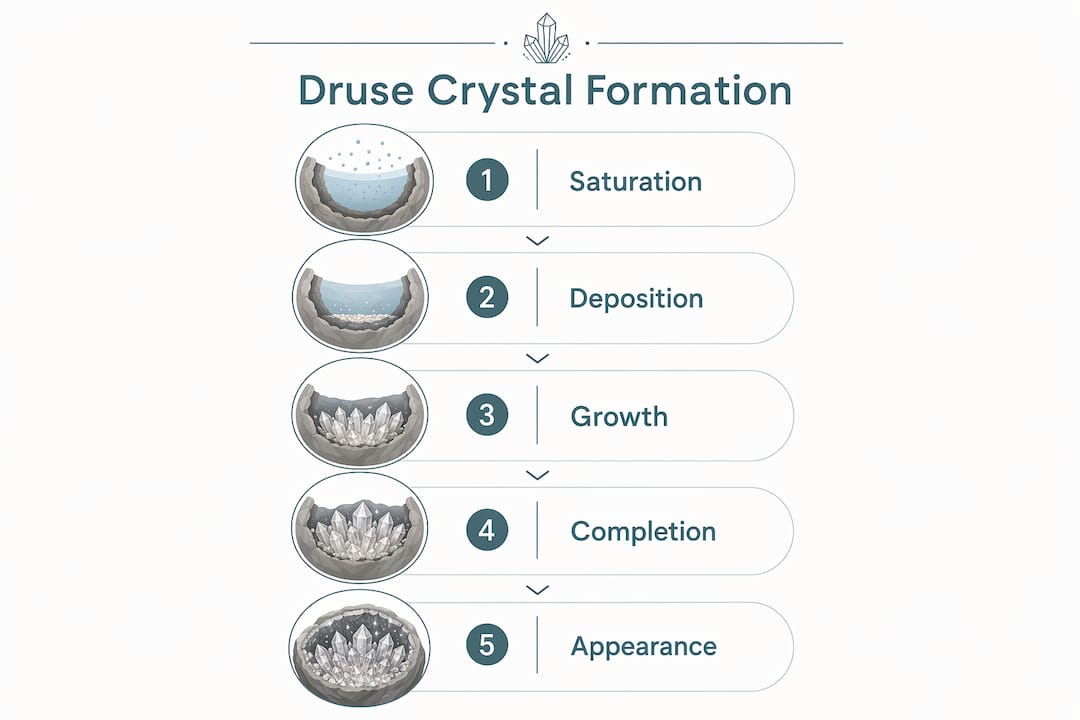
Comment les cristaux de drusite se forment-ils géologiquement ?
La drusite se forme lorsque de l'eau riche en minéraux sature une surface rocheuse ou une fracture et dépose lentement des cristaux sur des millions d'années. Le processus nécessite des conditions stables. Les fluctuations de température ou de chimie de l'eau interrompent la croissance des cristaux et produisent des revêtements irréguliers ou incomplets. La patience à l'échelle géologique est ce qui confère à la drusite son éclat uniforme caractéristique.

Les roches hôtes varient considérablement. La drusite apparaît sur le basalte volcanique, le calcaire sédimentaire et le schiste métamorphique. Le revêtement minéral se lie au substrat rocheux plutôt que de remplir un espace creux, ce qui est une distinction clé par rapport aux géodes. Le quartz, l'agate, le grenat, la calcite et la malachite forment tous des revêtements de drusite dans les bonnes conditions.
Minéraux courants et leurs caractéristiques de drusite
Le quartz est le minéral le plus courant formant des cristaux de drusite, apparaissant généralement blanc, clair ou beige. La drusite de grenat produit des revêtements rouge foncé ou orange. La drusite de calcite a tendance vers les jaunes pâles et les blancs. La drusite de malachite est distinctement verte et se forme souvent sur des roches hôtes contenant du cuivre.
La couleur est un indicateur fiable de la composition minérale, mais uniquement lorsque la pierre est non traitée. Les couleurs artificielles vives comme le bleu électrique ou le rose vif résultent de revêtements industriels tels que le dépôt de vapeur de titane. Les couleurs naturelles de la drusite sont généralement sourdes, pastel ou terreuses. L'inspection des bords et du dessous d'un spécimen révèle si la couleur n'est que superficielle ou si elle traverse uniformément la couche cristalline.
| Minéral | Couleur typique | Roche hôte courante |
|---|---|---|
| Quartz | Blanc, clair, beige | Volcanique, sédimentaire |
| Grenat | Rouge, orange | Métamorphique |
| Calcite | Jaune pâle, blanc | Calcaire sédimentaire |
| Malachite | Vert | Roche cuprifère |
| Calcédoine | Gris, bleu, rose | Cavités volcaniques |
Conseil de pro : Retournez le spécimen et examinez le dessous. La couleur naturelle de la drusite apparaît cohérente à la base des cristaux. Une teinte uniquement superficielle qui s'estompe vers le substrat rocheux est un signe de revêtement artificiel.
Comment identifier la drusite par rapport aux cristaux en grappe et aux géodes ?
La drusite, les géodes et les cavités sont trois formations distinctes que les collectionneurs confondent fréquemment. Comprendre la différence structurelle entre elles rend l'identification simple.
La drusite se forme comme un revêtement de surface sur des faces rocheuses plates ou fracturées. Elle ne nécessite pas d'intérieur creux. Une géode, en revanche, est une roche creuse, de forme plus ou moins sphérique, avec un revêtement cristallin interne. Les géodes contiennent des cristaux comme le quartz et l'améthyste poussant vers l'intérieur à partir de la paroi de la coquille, tandis que la drusite est une croûte externe ou liée à la surface de minuscules cristaux. Une cavité est similaire à une géode mais généralement plus petite et de forme irrégulière, souvent trouvée dans des formations rocheuses plus grandes. Legacy Crystals and Minerals propose un guide détaillé sur les différences entre les cavités et les géodes pour les lecteurs qui souhaitent une comparaison plus approfondie.
Liste de contrôle d'identification visuelle
Utilisez ces caractéristiques pour identifier la drusite sur le terrain ou lors d'achats en ligne :
- Revêtement de surface : La drusite se trouve sur une face rocheuse ou tapisse une dépression peu profonde. Elle n'a pas de coquille fermée autour d'elle.
- Taille des cristaux : Les cristaux de drusite sont microscopiques à très petits. Des pointes de cristaux plus grandes et distinctes suggèrent plutôt une formation en grappe.
- Couverture : Une drusite de haute qualité couvre la surface uniformément. Les lacunes ou les zones dégarnies indiquent un matériau de qualité inférieure ou des dommages.
- Consistance de la couleur : La couleur naturelle de la drusite est uniforme sur toute la couche cristalline. Une couleur inégale ou dégradée signale souvent un traitement.
- Visibilité du substrat : La roche hôte est visible sous la couche cristalline. Dans une géode, la coquille rocheuse entoure entièrement les cristaux.
| Caractéristique | Drusite | Géode | Cavité |
|---|---|---|---|
| Structure | Revêtement de surface | Sphère creuse | Petite poche creuse |
| Direction du cristal | Vers l'extérieur de la surface | Vers l'intérieur de la coquille | Vers l'intérieur des parois |
| Roche hôte visible | Oui | Extérieur uniquement | Oui |
| Taille typique | N'importe quelle | De la taille d'un poing et plus | Petite |
| Minéraux courants | Quartz, agate, grenat | Quartz, améthyste | Quartz, calcite |
Les lecteurs qui souhaitent vérifier si une pierre est naturelle ou traitée trouveront le guide sur les cristaux naturels ou synthétiques chez Legacy Crystals and Minerals une étape pratique suivante.
Quelles sont les utilisations et les propriétés curatives des cristaux de drusite ?
Les cristaux de drusite ont une signification bien établie dans la pratique métaphysique. La drusite est appréciée pour amplifier l'énergie, favoriser l'estime de soi et rayonner l'énergie vers l'extérieur à partir de ses milliers de minuscules pointes cristallines. La grande surface d'un revêtement de drusite agit comme un champ de récepteurs énergétiques, ce que les praticiens croient la rend plus réactive qu'un seul grand cristal. Un nettoyage régulier est recommandé pour maintenir cette clarté énergétique.
Le bain de lune est la méthode de nettoyage la plus utilisée pour la drusite. Placer un spécimen sous une pleine lune pendant la nuit est considéré comme sûr pour tous les types de drusite, y compris ceux qui sont sensibles à l'eau ou à la lumière du soleil. Le nettoyage régulier de la drusite maintient la clarté énergétique car les cristaux absorbent les vibrations ambiantes. Pour des conseils sur l'entretien général des cristaux, Legacy Crystals and Minerals propose un article complet sur l'entretien de vos cristaux.
Collectionner et porter de la drusite
La drusite est populaire en bijouterie car son éclat rivalise avec les pierres précieuses taillées à une fraction du coût. Cependant, la drusite nécessite une manipulation délicate en raison de ses fines pointes cristallines, qui sont fragiles et sujettes aux dommages par abrasion. Les bagues et les bracelets sertis de drusite subissent plus d'usure que les pendentifs ou les boucles d'oreilles. Les collectionneurs et les porteurs doivent stocker les pièces de drusite séparément des pierres plus dures pour éviter les dommages de surface.
Considérations clés pour les collectionneurs :
- Couverture cristalline : Une couverture cristalline uniforme sans lacunes est le principal indicateur de qualité. Les zones dégarnies réduisent le grade et la valeur.
- Taille des cristaux : Les cristaux plus petits et plus serrés sont préférés aux agrégats plus grands et incohérents.
- Authenticité de la couleur : La couleur naturelle est plus souhaitable pour les collectionneurs sérieux que les spécimens traités.
- Fragilité : Évitez l'abrasion et stockez séparément des pierres plus dures comme la topaze ou le corindon.
- Type de sertissage : Les sertissages clos protègent mieux les bords de la drusite que les sertissages à griffes dans les applications de bijouterie.
Conseil de pro : Lorsque vous rangez des bijoux en drusite, enveloppez chaque pièce individuellement dans un tissu doux. Même un contact avec d'autres cristaux peut ébrécher les pointes délicates de la surface au fil du temps.
Où trouve-t-on les cristaux de drusite dans le monde ?
Les spécimens de drusite de haute qualité proviennent du Brésil, d'Australie, des États-Unis (en particulier du Nouveau-Mexique), du Congo et de Russie. Chaque région produit des types de minéraux et des gammes de couleurs distincts liés à la géologie locale. Le Brésil est la principale source mondiale de quartz et d'agate drusy, produisant des spécimens dans la plus large gamme de tailles et de qualités.
La drusite de grenat du Congo est prisée pour sa couleur rouge profond et sa texture cristalline fine. Le Nouveau-Mexique produit des spécimens remarquables de calcite et de quartz drusy à partir de ses formations sédimentaires. La drusite australienne tend vers des variétés à base de calcédoine avec des tons gris et bleus subtils. Les spécimens russes présentent souvent des combinaisons minérales inhabituelles que l'on ne trouve pas couramment ailleurs.
| Type de minéral | Origine principale | Couleur typique |
|---|---|---|
| Quartz druzy | Brésil | Blanc, clair, beige |
| Agate druzy | Brésil, Australie | Gris, bleu, strié |
| Grenat druzy | Congo | Rouge foncé, orange |
| Calcite druzy | États-Unis (Nouveau-Mexique) | Jaune pâle, blanc |
| Calcédoine druzy | Australie | Gris, bleu pâle |
La rareté et la valeur de la drusite dépendent de trois facteurs : l'origine géographique, la composition minérale et l'exhaustivité de la couverture cristalline. Une grappe d'améthyste brésilienne avec une couverture druzy complète commande un prix plus élevé qu'un spécimen comparable avec des lacunes visibles. Les spécimens traités avec des revêtements artificiels se vendent à des prix inférieurs sur le marché des collectionneurs, bien qu'ils restent populaires dans les bijoux de mode.
Points clés
Les cristaux de drusite sont un revêtement de surface de minuscules cristaux minéraux, le plus souvent du quartz, formés par un dépôt lent de minéraux sur les faces rocheuses et identifiés par une couverture uniforme, une couleur naturelle sourde et une taille de cristal microscopique.
| Point | Détails |
|---|---|
| Définition de la drusite | Une couche de minuscules cristaux sur une surface rocheuse ou une cavité, et non une formation creuse. |
| Couleur naturelle vs traitée | La drusite naturelle est sourde ou pastel ; les couleurs vives comme le bleu électrique indiquent un revêtement artificiel. |
| Drusite vs géode | La drusite recouvre une surface vers l'extérieur ; les géodes sont creuses avec des cristaux orientés vers l'intérieur. |
| Indicateurs de qualité | Une couverture cristalline uniforme et des cristaux petits et serrés signalent des spécimens de haute qualité. |
| Manipulation et entretien | Rangez la drusite séparément des pierres plus dures et évitez l'abrasion pour protéger les pointes de cristal fragiles. |
Spécimens de drusite authentiques chez Legacy Crystals and Minerals
Legacy Crystals and Minerals s'approvisionne et classe les spécimens de drusite pour les collectionneurs et les passionnés de cristaux qui souhaitent des formations vérifiées et naturelles. La grappe de cristaux d'améthyste brésilienne est un exemple remarquable de formation drusy de haute qualité, avec une couverture cristalline complète et une couleur naturelle partout. Chaque pièce reflète la patience géologique qui rend les formations de drusite véritablement rares.

Pour des options à porter, le bracelet de drusite d'agate avec cavité en agate naturelle mate de 14 mm offre une qualité de grade AA dans un format adapté à un usage quotidien. Le cœur de sphalérite druzy combine un intérêt minéralogique avec une esthétique distinctive que les collectionneurs et les praticiens métaphysiques apprécient. Tous les produits chez Legacy Crystals and Minerals sont sélectionnés pour leur authenticité, leur formation naturelle et la qualité de leur couverture cristalline.
FAQ
Quelle est la définition du cristal de drusite en minéralogie ?
La drusite est définie comme une couche de cristaux fins et scintillants qui se développent sur une surface rocheuse ou à l'intérieur d'une cavité, généralement composée de quartz ou de minéraux apparentés. Le terme « druzy » (ou drusy) est utilisé de manière interchangeable dans les contextes de la bijouterie et de la collection.
Comment identifier les cristaux de drusite ?
Recherchez un revêtement uniforme de cristaux microscopiques sur une surface rocheuse, avec une couleur naturelle sourde et sans intérieur creux. Une couleur vive ou dégradée près des bords suggère un traitement artificiel plutôt qu'une formation naturelle.
Quelles sont les propriétés curatives des cristaux de drusite ?
La drusite est utilisée en pratique métaphysique pour amplifier l'énergie et promouvoir l'estime de soi, sa grande surface de minuscules pointes cristallines étant censée rayonner l'énergie vers l'extérieur. Un nettoyage régulier, comme le bain de lune, est recommandé pour maintenir ses propriétés énergétiques.
Quelle est la différence entre la drusite et une géode ?
La drusite est un revêtement de surface de minuscules cristaux sur une face rocheuse, tandis qu'une géode est une roche creuse avec des cristaux poussant vers l'intérieur depuis la paroi intérieure. La drusite ne nécessite pas de cavité fermée pour se former.
Où trouver des cristaux de drusite de haute qualité ?
Le Brésil, l'Australie, les États-Unis (Nouveau-Mexique) et le Congo sont les principales sources mondiales de spécimens de drusite de qualité. Le Brésil produit la plus grande variété, y compris le quartz et l'agate druzy dans plusieurs gammes de couleurs.
Recommandé
- Qu'est-ce que la morphologie cristalline : un guide scientifique complet – Legacy Crystals and Minerals
- Cristaux de protection expliqués : un guide complet pour débutants – Legacy Crystals and Minerals
- La croissance des cristaux expliquée — De la molécule au chef-d'œuvre – Legacy Crystals and Minerals
- Constituer une collection de cristaux de qualité musée : Guide d'expert – Legacy Crystals and Minerals


