

Cristaux squelettiques expliqués : science, identification et conseils d'achat
Les cristaux squelettiques sont des monocristaux polyédriques incomplets dont les arêtes et les coins croissent plus rapidement que les centres de leurs faces, laissant des cavités internes, des dépressions creuses ou des faces en gradins plutôt qu'un noyau solide. Les variétés de quartz, en particulier le quartz élesial, sont les exemples les plus collectionnés, et ils se situent à l'intersection de la science minéralogique et de la pratique métaphysique. Legacy Crystals and Minerals, Mindat, et la recherche évaluée par des pairs dans la revue Science traitent tous ces spécimens comme scientifiquement distincts, et pas seulement esthétiquement inhabituels.
Table des matières
- Comment se forment les cristaux squelettiques
- À quoi ressemblent les cristaux squelettiques et comment les identifier
- Quels minéraux présentent des habitudes squelettiques et où ils se trouvent
- Comment le commerce métaphysique utilise le quartz squelettique et élesial
- Conseils aux collectionneurs et acheteurs de spécimens squelettiques
- Points clés à retenir
- Sources utiles
- Spécimens squelettiques de qualité musée chez Legacy Crystals and Minerals
- FAQ
Comment se forment les cristaux squelettiques
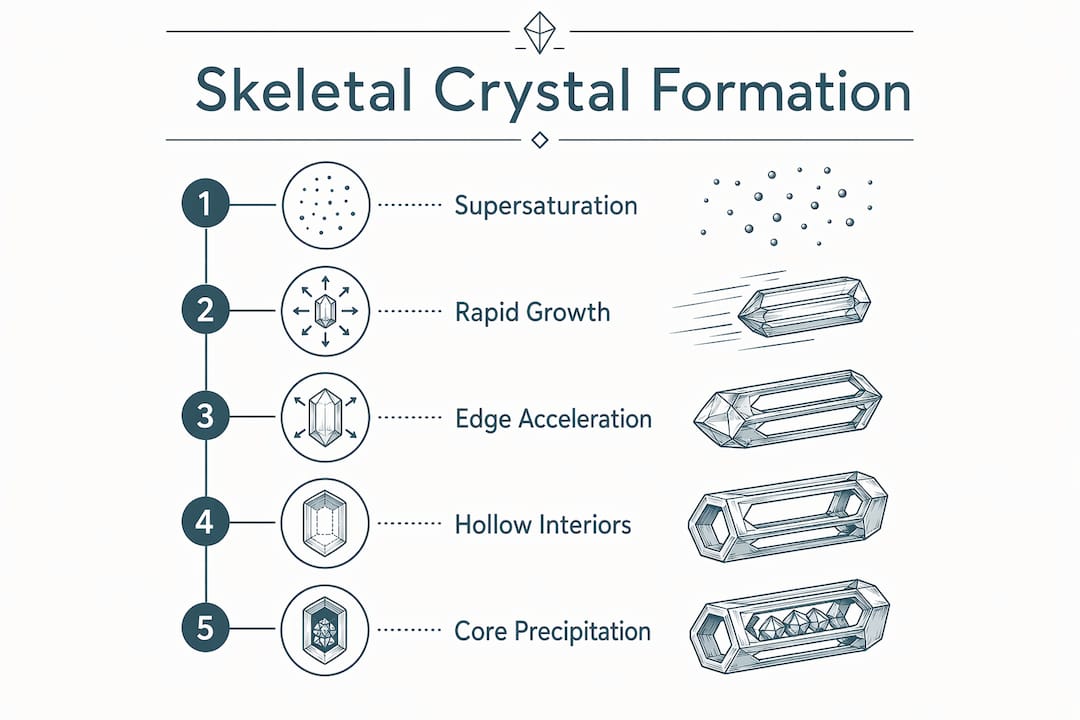
Le mécanisme est simple : une forte sursaturation pousse les atomes vers les arêtes et les coins plus rapidement que la diffusion ne peut les apporter aux centres des faces. Le résultat est un cristal qui construit son cadre extérieur avant son intérieur, produisant la structure en entonnoir ou creuse qui définit l'habitude squelettique.
Conditions qui favorisent la croissance squelettique :
- Forte sursaturation — la solution ou la masse fondue est loin de l'équilibre
- Refroidissement rapide ou évaporation — accélère le taux de croissance au-delà des limites de diffusion
- Concentration d'impuretés — certains ions bloquent les sites centraux des faces, redirigeant la croissance vers les arêtes
- Effets du substrat — la nucléation sur une surface peut biaiser la géométrie de croissance
Les exemples naturels et synthétiques partagent la même cinétique. La synthèse en laboratoire de microvaisseaux monocristallins squelettiques chiraux dans des conditions contrôlées confirme que la croissance synchrone, uniaxiale et par étapes reproduit toutes la structure creuse observée dans les spécimens naturels. La physique est la même, que le cristal ait grandi dans une source chaude kényane ou dans une fiole de laboratoire.
Les formes squelettiques sont souvent transitoires. Lorsque les conditions se stabilisent, la précipitation ultérieure remplit les noyaux creux, transformant un spécimen squelettique en quelque chose qui semble solide. Reconnaître si un noyau a été rempli est essentiel pour l'évaluation de la provenance.
Astuce : La pétrographie en lame mince ou la microscopie en lumière polarisée peuvent révéler si le cœur d'un spécimen est un espace vide original ou un remplissage secondaire. Demandez à un vendeur des notes de laboratoire avant d'acheter une pièce squelettique de grande valeur.
À quoi ressemblent les cristaux squelettiques et comment les identifier
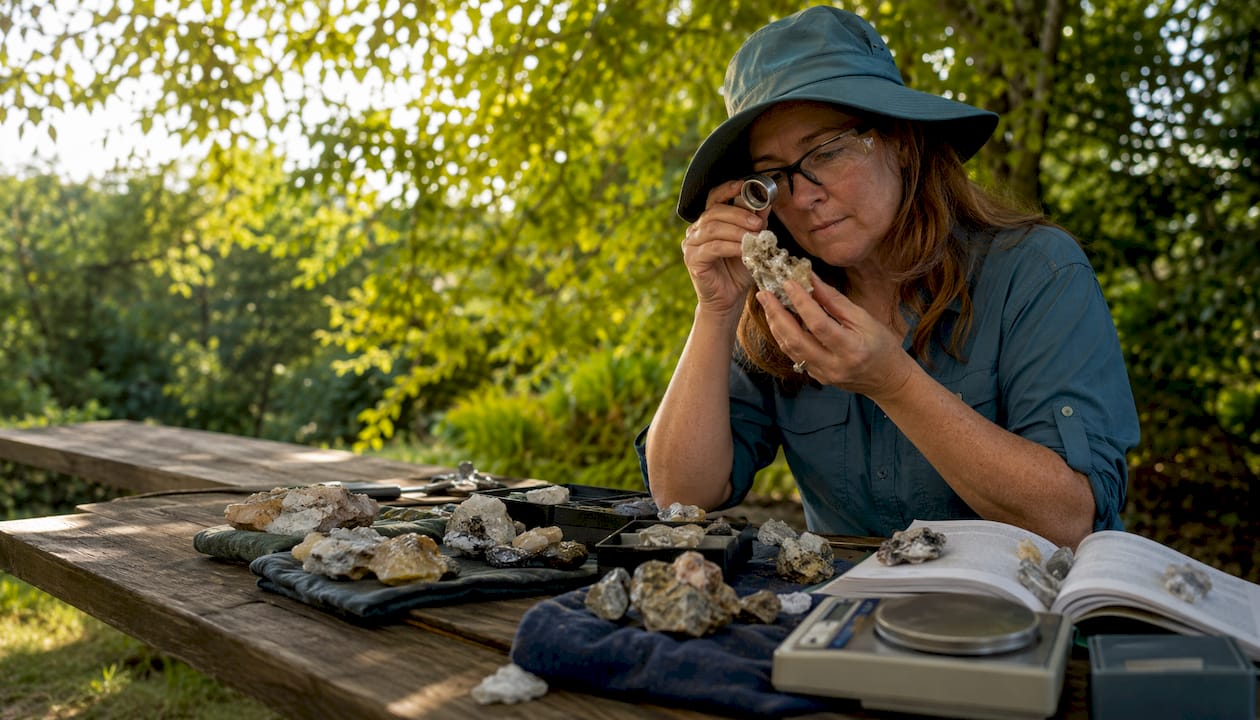
Les caractéristiques diagnostiques sont constantes : faces en gradins, intérieurs creux, arêtes vives bien développées et textures de paroi tamisées ou subcristallines. Dans les variétés de quartz et élesiales en particulier, vous verrez des textures de surface stratifiées, « en armure », et des terminaisons en gradins qui enregistrent des impulsions de croissance successives.
Formes squelettiques vs en entonnoir vs dendritiques
Ces trois termes décrivent des morphologies liées mais distinctes :
- Squelettique — monocristal polyédrique avec des faces creuses et des arêtes développées ; le contour général du cristal est toujours reconnaissable
- En entonnoir — une dépression en gradins, en escalier sur chaque face ; le halite (sel de table) est l'exemple classique
- Dendritique — croissance ramifiée, arborescente qui a entièrement perdu le contour polyédrique
Le quartz élesial se situe le plus près de l'extrémité squelettique de ce spectre. Le terme commercial « élesial » est parfois appliqué de manière lâche à tout quartz présentant des textures de surface inhabituelles, de sorte que les gros plans photographiques et les données de provenance sont importants.
Pour l'identification, une lumière rasante à faible angle sur la face du cristal met en évidence les dépressions en gradins. Une loupe 10x est suffisante pour la plupart des spécimens ; un microscope numérique USB (40x–200x) révèle les textures des parois et tout remplissage secondaire.
Avertissement : Interpréter à tort la croissance squelettique comme une simple zonation est une erreur documentée en pétrologie. Les modèles de croissance inversée peuvent produire une zonation qui semble normale à première vue, mais qui va dans la direction opposée à ce que les modèles standard prévoient. Ne vous fiez jamais uniquement à la zonation visuelle pour dater ou classer un spécimen.
Quels minéraux présentent des habitudes squelettiques et où ils se trouvent
La morphologie squelettique n'est pas exclusive au quartz. Plusieurs minéraux la produisent dans les bonnes conditions cinétiques.
Minéraux squelettiques courants :
- Quartz (quartz élesial/squelettique) — terminaisons en gradins, textures de surface stratifiées ; variété la plus collectionnée
- Calcite — calcite squelettique et trona documentés dans les dépôts de sources chaudes au Kenya et en Nouvelle-Zélande
- Halite — cubes en entonnoir classiques ; la face en gradins est la caractéristique distinctive
- Trona — environnements évaporitiques ; cristaux prismatiques creux
- Olivine et pyroxène — habitudes squelettiques dans les roches volcaniques trempées et les basaltes sous-marins, entraînés par une sursaturation constitutionnelle
Milieux géologiques associés à la croissance squelettique :
- Sources chaudes et cheminées hydrothermales
- Roches volcaniques refroidies rapidement (trempées)
- Veines hydrothermales avec une chimie des fluides fluctuante
- Bassins évaporitiques (lacs salés, sabkhas)
Pour les collectionneurs canadiens, les spécimens de quartz squelettique ne sont pas couramment extraits à l'échelle commerciale au niveau national. La plupart des quartz élesiaux et squelettiques sur le marché canadien proviennent du Brésil, de Madagascar, de Namibie ou des Alpes suisses. Demandez toujours aux vendeurs des données de localité spécifiques. Un spécimen listé uniquement comme « Brésil » sans plus de détails est plus difficile à vérifier qu'un spécimen avec une mine ou une région nommée.
Comment le commerce métaphysique utilise le quartz squelettique et élesial
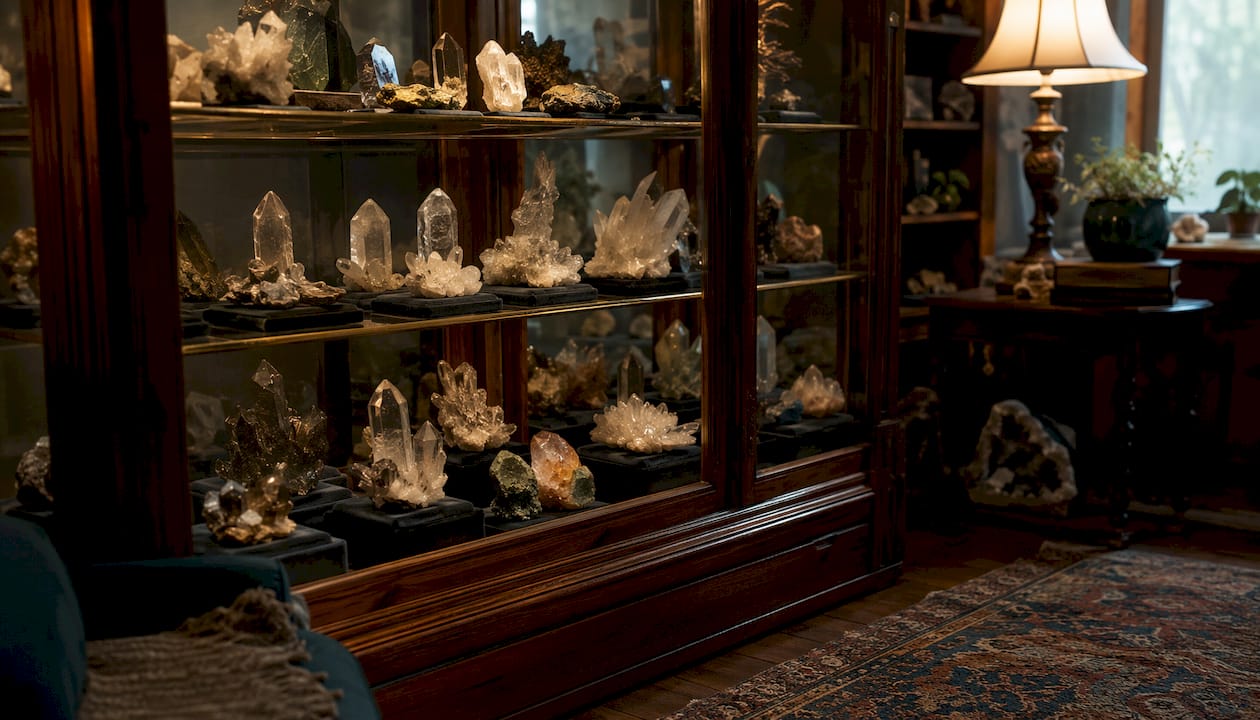
La communauté métaphysique interprète la surface stratifiée et étagée du quartz squelettique comme un enregistrement visible de la croissance, et interprète cette texture symboliquement. Le glossaire de Mindat note que « squelettique » et « élesial » sont utilisés de manière interchangeable dans les contextes commerciaux, bien qu'ils proviennent de différentes traditions descriptives.
Allégations métaphysiques courantes associées au quartz squelettique/élesial :
- La croissance stratifiée comme symbole d'évolution spirituelle ou de sagesse accumulée
- L'intérieur creux comme un conteneur pour l'intention ou l'énergie
- La texture de surface « en armure » interprétée comme un symbolisme protecteur
- Connexion aux cadres de croissance spirituelle dans la pratique de la guérison énergétique
Avertissement : Ce sont des interprétations basées sur des croyances, et non des propriétés scientifiques. La texture étagée est un enregistrement de croissance cinétique produit par la sursaturation, et non un phénomène énergétique. La minéralogie et la pratique métaphysique décrivent le même objet à partir de cadres différents.
Astuce : Si l'utilisation métaphysique est votre principale raison d'acheter, demandez toujours les données de localité et une photo agrandie. Une texture squelettique authentique est vérifiable ; une pointe de quartz lisse réétiquetée « élesial » ne l'est pas.
Conseils aux collectionneurs et acheteurs de spécimens squelettiques
Commencez par la localité. Un spécimen avec une mine, une région et un pays nommés est plus facile à authentifier et conserve généralement mieux sa valeur qu'un spécimen avec une provenance vague.
Liste de vérification pour l'achat
- Demandez la localité spécifique (pays, région, nom de la mine si disponible)
- Demandez des photos agrandies montrant les faces en gradins et les zones creuses
- Demandez si le cœur est un vide ouvert ou un remplissage secondaire
- Vérifiez la présence d'adhésifs, de stabilisateurs ou de revêtements de surface
- Vérifiez la politique de retour du vendeur et si l'assurance d'expédition est incluse
Questions à poser à un vendeur
- Quelle est la localité exacte de ce spécimen ?
- A-t-il été traité, stabilisé ou réparé ?
- Existe-t-il des notes de laboratoire ou de microscope disponibles ?
- Quelle est votre politique de retour si le spécimen arrive endommagé ?
- La pièce est-elle assurée pendant le transport ?
Pour l'entretien : les spécimens squelettiques avec des noyaux creux ouverts sont fragiles. Conservez-les emballés individuellement dans du papier de soie sans acide, à l'abri de la lumière directe du soleil et des températures extrêmes. Pour le nettoyage, une brosse douce et de l'eau distillée suffisent pour la plupart des quartz ; évitez les nettoyeurs à ultrasons sur les spécimens creux. Des conseils complets sur l'entretien des cristaux sont disponibles pour référence.
Note sur l'expédition au Canada : Déclarez les spécimens minéraux avec précision sur les formulaires douaniers. Assurez les pièces squelettiques creuses séparément ; les hivers canadiens entraînent des variations de température pendant le transport qui peuvent stresser les spécimens fragiles. Demandez des packs chauffants ou des boîtes doublées de mousse aux vendeurs qui expédient entre novembre et mars.
Legacy Crystals and Minerals propose des spécimens squelettiques et élesiaux de qualité musée avec documentation de localité. Leur quartz squelettique de haute clarté des montagnes Goboboseb, en Namibie, est un bon point de référence pour ce à quoi devraient ressembler la documentation de provenance et la qualité photographique. Pour les collectionneurs intéressés par les formes minérales sculptées, la gamme de minéraux sculptés en forme de pierre tombale en cristal montre à quoi ressemble une sculpture de qualité musée sur du matériau minéral naturel. Utilisez le guide des faux cristaux avant d'acheter auprès d'un vendeur inconnu.
Points clés à retenir
Les cristaux squelettiques se définissent par leur morphologie creuse et étagée, produite par une croissance rapide sous forte sursaturation, et les variétés de quartz (quartz élesial) sont les exemples les plus collectionnés à des fins scientifiques et métaphysiques.
| Point | Détails |
|---|---|
| Définition scientifique | Les cristaux squelettiques sont des monocristaux polyédriques creux avec des arêtes développées et des noyaux solides absents. |
| Cause de la formation | Une forte sursaturation et une croissance rapide, limitée par la diffusion, construisent les parois extérieures avant les intérieurs. |
| Marqueurs d'identification clés | Les faces étagées, les intérieurs creux, les arêtes vives et les textures de paroi tamisées distinguent les formes squelettiques. |
| La provenance d'abord | Demandez toujours des données de localité spécifiques, des photos agrandies et des informations sur l'état de remplissage avant d'acheter. |
| Legacy Crystals and Minerals | Propose des spécimens squelettiques et élesiaux de qualité musée avec documentation de localité pour les collectionneurs et les praticiens. |
Sources utiles
Références primaires utilisées dans cet article :
- Glossaire Mindat — cristal squelettique — définition minéralogique standard et notes terminologiques commerciales
- Science — assemblage synchrone de microvaisseaux monocristallins squelettiques chiraux — synthèse en laboratoire confirmant la cinétique de croissance squelettique
- OSTI — calcite squelettique et trona, sources chaudes du Kenya et de Nouvelle-Zélande — documentation de terrain de la calcite et du trona squelettiques ; avertissements de mauvaise identification
- DOI — cristaux squelettiques de calcite et de trona (SEPM) — comportement de remplissage du cœur, modèles de croissance inverse et implications pour la provenance
- Alex Strekeisen — cristaux squelettiques dans les roches ignées — sursaturation constitutionnelle et habitudes dendritiques dans les environnements volcaniques
- Crystallography Reviews — transition des formes isométriques aux formes squelettiques — transitions de forme contrôlées par la diffusion et modélisation énergétique
- ResearchGate — structures cristallines dans le corps humain — cristaux biologiques (calcite, phosphate de calcium) distincts des spécimens minéraux
Spécimens squelettiques de qualité musée chez Legacy Crystals and Minerals
Les collectionneurs qui souhaitent des quartz squelettiques et élesiaux avec des données de localité vérifiées et une documentation photographique ont une option directe. Legacy Crystals and Minerals sélectionne des spécimens de qualité musée, du quartz squelettique brut et des pièces minérales sculptées, chacun choisi pour son authenticité et sa qualité esthétique.
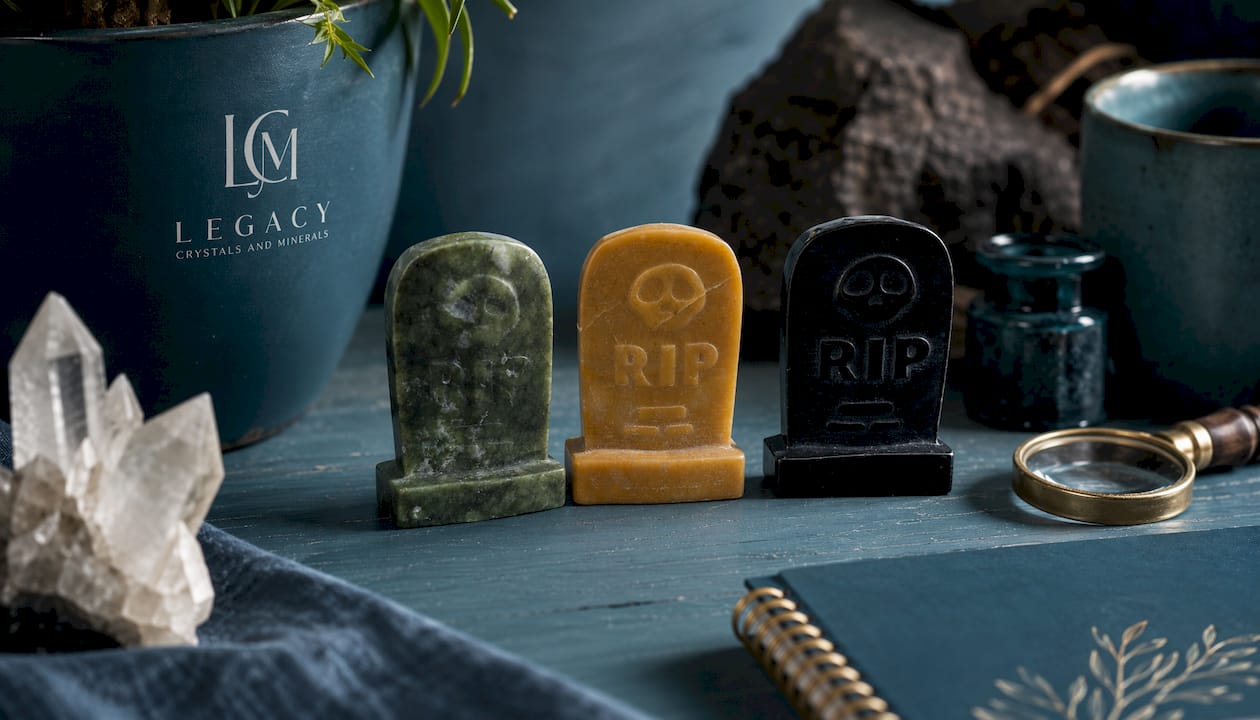
Le catalogue comprend du quartz squelettique provenant de localités documentées, des formes minérales sculptées telles que la gamme de minéraux sculptés en forme de pierre tombale en cristal, et des ressources éducatives pour les collectionneurs de tous niveaux. Les spécimens sont expédiés partout au Canada dans des emballages adaptés aux pièces creuses fragiles. Parcourez la collection complète chez Legacy Crystals and Minerals pour trouver un spécimen avec la provenance et les détails visuels recommandés dans cet article.
FAQ
Qu'est-ce qu'un cristal squelettique ?
Un cristal squelettique est un monocristal polyédrique incomplet avec des intérieurs creux et des dépressions de face en gradins, formé lorsque les arêtes et les coins croissent plus rapidement que les centres des faces sous forte sursaturation. Le quartz élesial est l'exemple le plus largement collectionné.
Qui devrait éviter de porter des cristaux ?
Certains vendeurs spirituels déconseillent de porter des cristaux lors de funérailles ou de périodes de deuil aigu, considérant cela comme une pratique commerciale plutôt qu'une règle scientifique. Il n'y a aucune base minéralogique à cette restriction ; elle reflète des conseils basés sur des croyances spécifiques à certaines traditions métaphysiques.
Où trouve-t-on des cristaux dans le corps humain ?
Le corps humain contient de véritables structures cristallines, notamment de la calcite dans l'oreille interne (otolithes) et du phosphate de calcium dans les os. Ces cristaux biologiques sont distincts des spécimens minéraux et sans rapport avec les affirmations métaphysiques sur l'énergie des cristaux.
Qu'est-ce qui provoque la formation de cristaux dans le corps humain ?
Les cristaux biologiques se forment par biominéralisation contrôlée, où les cellules déposent des ions minéraux dans des matrices structurées. Ce processus est régulé par des protéines et des signaux biochimiques, et n'a aucun lien avec la sursaturation géologique qui produit les spécimens minéraux squelettiques.
Recommandé
- Pourquoi les cristaux se fissurent ou se clivent : la science expliquée – Legacy Crystals and Minerals
- Pourquoi les cristaux prennent différentes formes : un guide scientifique – Legacy Crystals and Minerals
- Spécimens de cristaux : guide du collectionneur sur les types et la valeur – Legacy Crystals and Minerals
- Comment identifier les cristaux naturels et synthétiques – Legacy Crystals and Minerals


