

Crystals on a Plane: Canadian Carry-On and Checked Bag Rules
Yes, you can fly with crystals in Canada. Raw minerals, tumbled stones, carvings and crystal jewellery are not on the lists of banned items, and most travellers carry them without trouble. What decides how smooth screening goes is the shape of the piece, how much of it you carry, and how you pack it. Pieces with a cutting edge, and large quantities of loose stones or powder, are the cases that need a plan. Our crystal travel guide covers durable stones to bring. This article covers the airport side.
TL;DR
- Crystals, raw minerals and polished stones are generally allowed in carry-on and checked bags. The final call always belongs to the screening officer on the day.
- Sharp-edged pieces, such as knapped obsidian blades or arrowheads, belong in checked baggage. Morning stars are banned from both bags.
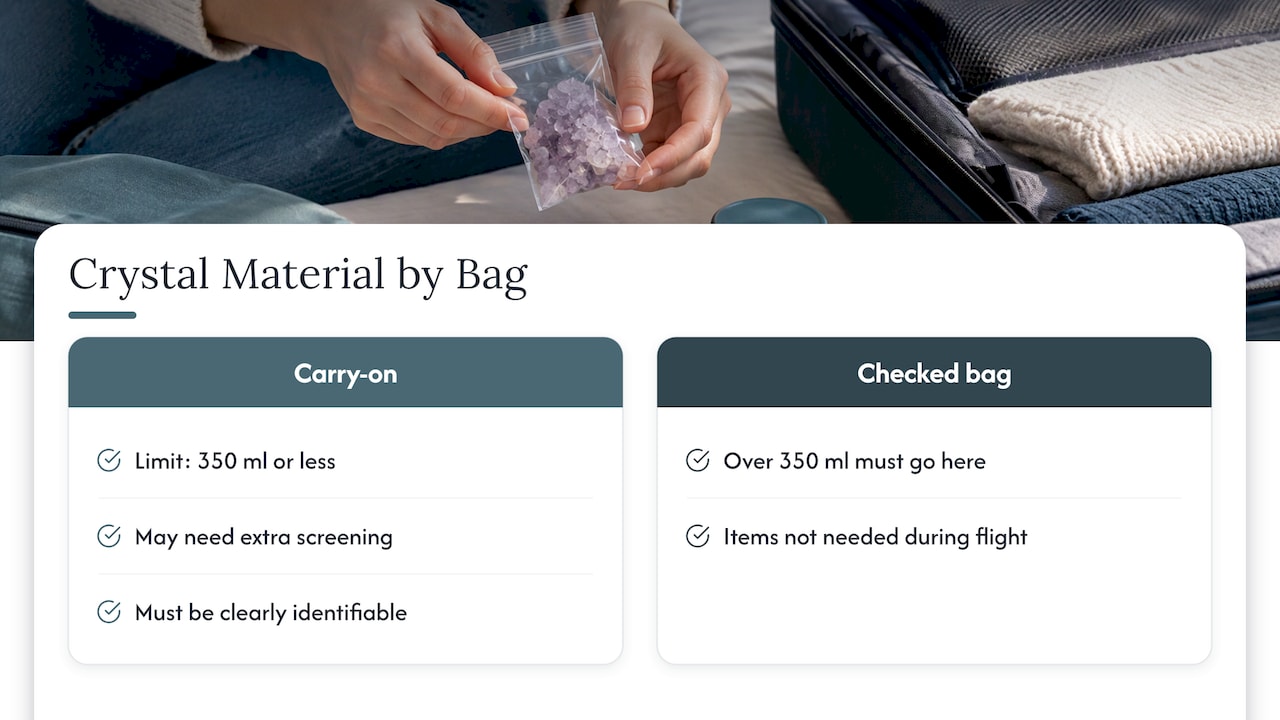
- Loose granular or powdered material is limited to 350 ml in carry-on. Whole stones are not powder, but crushed stone, sand and crystal chips can be.
- Tell the officer before screening if an item has a handling protocol or cannot go through X-ray. You can ask for a private search area.
- Children should not handle specimens without supervision, because some minerals are toxic.
Table of Contents
- What Canadian rules say about crystals
- Carry-on or checked bag: how to decide
- Powders, chips and granular material
- Shapes and materials that draw attention
- How to pack crystals for screening
- Crystals that are sacred or spiritual items
- What has changed at Canadian checkpoints
- Flying to or from another country
- Carrying crystals with children
- Choosing pieces that travel well
- Find travel-ready pieces
- FAQ
- Sources
What Canadian rules say about crystals
In Canada, security screening at airports is run by CATSA, the Canadian Air Transport Security Authority. Its What can I bring tool tells you whether an item is permitted, restricted or prohibited in carry-on and checked bags. Crystals are not singled out as a category, so the rules that apply to them are the general ones.
Transport Canada’s list of items you can’t bring on a plane is where crystal travellers should look. Three entries matter:
- Sharp objects that could cause serious injury.
- 350 ml or more of inorganic powder or granular material.
- Dangerous goods.
A smooth tumbled stone is none of these. A wand with a fine point, a knapped blade or a bag of crushed stone can be.
One point from a travel-gear guide is worth knowing: crystals, healing stones, raw minerals and polished gemstones are allowed in both carry-on and checked luggage, and an opened bag does not by itself make them confiscable. That matches the general Canadian rules above. Officers still decide at the checkpoint, so pack for easy inspection.
Carry-on or checked bag: how to decide
Use a simple test. Ask what the piece is worth to you, how fragile it is and whether it has an edge.
| Item | Where it usually goes | Why |
|---|---|---|
| Tumbled stones, palm stones | Carry-on | Smooth, compact and easy to read on X-ray |
| Crystal jewellery, bracelets | Carry-on or worn | Small, valuable and easy to lose in a checked bag |
| Polished spheres and carvings | Carry-on, wrapped | Dense and fragile, so you want to keep them with you |
| Raw clusters and specimens | Carry-on if small, padded checked bag if large | Points and fragile terminations break easily |
| Large geodes and heavy pieces | Checked bag | Dense mass can prompt a second look and add weight |
| Knapped obsidian, arrowheads, blades | Checked bag | An intentional cutting edge works as a blade |
| Crushed stone, sand, loose chips | Small amounts in carry-on, large amounts checked | Powder and granular rules apply |
The general principle comes from CATSA’s own advice on sacred and spiritual items: it does not recommend packing delicate or fragile items in checked baggage. A fine specimen with delicate points is safer in your hands than in a baggage handler’s.
Weight and airline limits
Minerals are heavy. A few pieces can push a carry-on past an airline’s weight limit even if security has no concern. Check your airline’s carry-on allowance before you leave and weigh the bag with the stones in it. Heavier pieces go in checked luggage, where you can pad them well.
Powders, chips and granular material
This is the rule collectors miss. Whole crystals are solid objects. Crushed crystal, sand, tumbling grit and chip stones can count as granular material.
CATSA’s page on powder and granular material says that in carry-on these are limited to a total of 350 ml or less, roughly the size of a soda can. They may need additional screening. Items you do not need during the flight should go in checked baggage. The page notes exemptions for several categories, including sacred or spiritual items.
Air Canada’s restricted items page adds a practical point. Powders over 350 ml must go in checked baggage, and a powder in carry-on will not be allowed into the cabin if security officials cannot clearly identify it. If you carry a small jar of chips or sand, keep it in a clear container and keep it small.
Shapes and materials that draw attention
Most crystals pass without comment. These are the ones that sometimes do not.
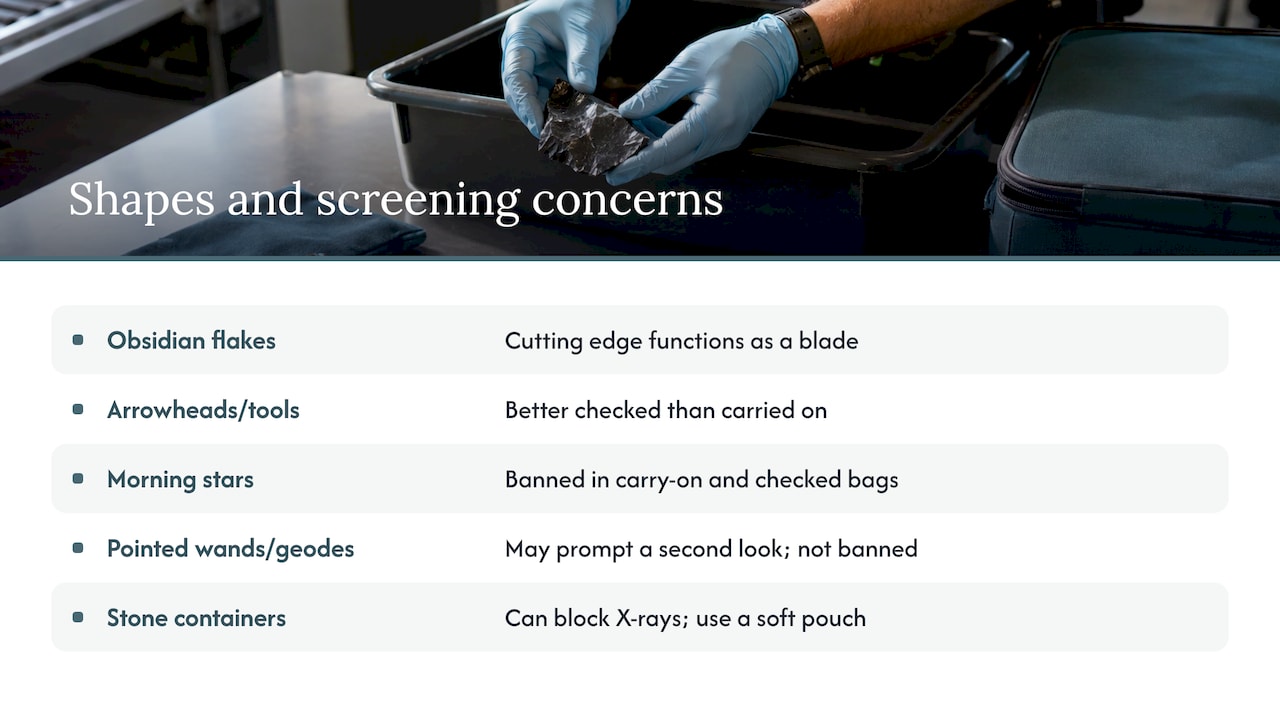
Sharp-edged obsidian and knapped tools. A raw obsidian flake with an intentional cutting edge functions as a blade. The same goes for arrowheads and knapped tools, which are better checked than carried on. Natural obsidian, such as a rounded or polished piece, is a different matter, but when in doubt, check it.
Pointed wands and large geodes. Dense minerals show as bright, solid shapes on X-ray. A heavy geode or a long pointed wand can prompt a second look. That is a short inspection, not a ban.
Morning stars. These spiked ball-shaped objects are banned in carry-on and checked baggage, because they are illegal under the Criminal Code of Canada. CATSA states that presenting one at a checkpoint requires police notification and could lead to charges. Spiky crystal balls are not morning stars, but anything shaped like a spiked mace head, even a carved one, is better left at home.
Dense stone containers. Thick stone boxes and bowls can prevent a clear X-ray image. Fibre, cloth or wooden containers are less likely to cause trouble, as Canadian guidance on carrying dense containers notes in the context of urns. Pack your stones in a soft pouch or a padded case, not a stone bowl.
How to pack crystals for screening
CATSA’s security screening process is the same for everyone: boarding pass, items in bins, X-ray of the bins and carry-on, then a body scanner or walk-through metal detector. Officers sometimes need to screen particular items separately. Your aim is to make that quick.
- Keep stones where you can reach them. Pack them near the top of your carry-on or in an outer pocket, not under your laptop and clothes.
- Wrap each piece. Use soft cloth or bubble wrap. Wrapping protects points and stops stones knocking together, and it makes unwrapping for inspection simple.
- Use a small padded pouch or case. A group of dense stones in a bag produces an image that is hard to read. If you carry many stones, take them out and put them in a separate bin so the officer sees them clearly.
- Separate jewellery from loose stones. Bracelets and pendants can be worn through the scanner or placed in a bin, depending on what the officer asks.
- Photograph and list valuable pieces. A short list of what you carry, with photos, helps if a piece is damaged or goes missing.
- Leave extra time. A second look takes a few minutes. Arrive early if you carry a large collection.
For packing the rest of your bag, a compact kit helps. Ideas for packable travel accessories can free up room for padded crystal cases.
If you are shipping instead of flying
A large or valuable collection may be better sent ahead than carried. Our guide to shipping mineral specimens covers how collectors pack and ship pieces so they arrive intact.
Crystals that are sacred or spiritual items
If you use crystals in a spiritual practice, CATSA has specific guidance. Its page on sacred and spiritual items says officers treat such items with the utmost respect and screen them without holding or touching them.
Tell the officer before screening starts if the item:
- cannot be touched
- has a handling protocol
- cannot go through X-ray
- must be worn
You can also ask for a private search area. Powder and granular materials are listed among common sacred or spiritual items on that page. Saying this up front, calmly and before your bags enter the X-ray, is the single most useful habit for practitioners who carry stones for ritual use.
What has changed at Canadian checkpoints
Screening is getting faster at some airports. CATSA’s 2025 annual report says 21 CT X-ray units were installed at pre-board screening checkpoints across six airports in 2024/25. CT stands for computed tomography, a 3D scan that gives officers a clearer view inside a bag. CATSA says this technology is meant to improve detection and reduce the need to remove large electronics and permitted liquids, subject to Transport Canada approval, in its 2024 annual report.
Vancouver International was the first Canadian airport to adopt this equipment, in September 2024. According to YVR’s news page, the plan is to extend it to every checkpoint in 2026. Not every airport has it, and rules at a lane can differ from the next. Follow the signs and the officer’s instructions, and check CATSA’s site for your airport before you travel.
For crystals, a clearer image can mean fewer second looks. It does not change what is allowed. The same rules on blades and powders apply.
Flying to or from another country
Everything above is Canadian. If your trip crosses a border, the rules of the departure airport, the arrival country’s customs and the airline apply as well. Some countries restrict bringing in minerals, soil or items made from protected materials. Check the customs page of the country you are flying to before you pack.
Carrying crystals with children
If you travel with children, or buy stones for them, treat mineral specimens as something to supervise, not as toys.
The Canadian Conservation Institute’s guideline for natural history collections notes that some mineral specimens, such as those containing arsenic or thallium, may be toxic and need specialist identification and special handling. It also flags radioactivity in minerals, rocks and fossils as an often-overlooked issue.
Practical rules for families:
- Supervise any handling of raw specimens, and keep them out of mouths.
- Wash hands after handling raw stones, and do not eat or drink while handling them.
- Do not grind, crush or polish stones. Dust is the main route by which some minerals cause harm.
- Choose smooth, solid tumbled stones in a sealed pouch, rather than loose chips or fragile points, for a child’s travel pouch.
- If you are unsure what a specimen is, ask the seller for its mineral name and locality before it goes near a child.
If a child swallows a stone or you suspect poisoning, contact your local poison control centre or emergency services right away.
Choosing pieces that travel well
Travel is easier when the stone suits it. Compact, durable pieces survive bags, bins and baggage trays. Our beginner list of durable crystal picks is a good place to start, and the crystals not to mix guide explains storage rules for softer stones that scratch or get scratched.
Wearable pieces are the simplest option. A bracelet or pendant stays on your body through the scanner and cannot be crushed in a bag. If you want a stone you can carry in a pocket, polished and tumbled pieces have no points to chip.
Find travel-ready pieces
We sell raw specimens, polished stones, carvings, jewellery and bracelets, plus museum quality and collector pieces. For travel, our polished stones and bracelets are the formats that fit a carry-on pouch or a wrist.
If you are building a collection of larger specimens, browse our museum quality minerals and crystals or the jewellery collection.
FAQ
Can you bring crystals on a plane in Canada?
Yes. Crystals, raw minerals and polished stones are generally allowed in carry-on and checked bags. Items with a cutting edge, and powder or granular material over 350 ml, are restricted. The officer at the checkpoint makes the final decision.
Do crystals set off airport scanners?
Small, smooth stones usually pass without comment. Dense minerals show as bright solid shapes on X-ray, so a large geode, a heavy wand or a cluster of many stones can prompt a second look. Put loose stones in a separate bin to make that look short.
Can I carry crystals in my checked bag?
Yes, but pad them well. CATSA does not recommend packing delicate or fragile items in checked baggage, so keep valuable and fragile pieces in your carry-on and put heavy, sturdy or edged pieces in the checked bag.
What if my crystals are part of a spiritual practice?
Tell the screening officer before screening starts if an item cannot be touched, has a handling protocol, cannot go through X-ray or must be worn. CATSA says officers screen such items without holding or touching them, and you can request a private search area.
Are crystals safe for kids to carry on a trip?
Only with supervision. Some mineral specimens can be toxic, and dust is a risk, so keep raw pieces out of mouths, wash hands after handling and choose smooth tumbled stones for a child’s pouch.
Sources
- What can I bring through airport security, CATSA
- What you can’t bring on a plane, Transport Canada
- Powder and granular material, CATSA
- Travelling with sacred and spiritual items, CATSA
- Security screening, CATSA
- Morning stars, CATSA
- Restricted and prohibited items, Air Canada
- Can you bring crystals on a plane? Rules for every type
- Traveling with cremated remains, FSAC
- CATSA 2025 Annual Report
- CATSA Annual Report 2024
- Security screening equipment upgrade, YVR
- Caring for natural history collections, Canadian Conservation Institute


